
The moving keys are the easy part to notice. What makes a reproducing piano interesting is the possibility that a hesitation before a melody, a gently released chord or a carefully judged crescendo might survive after the pianist has left the room.
A modern player piano can capture and reproduce detailed aspects of a performance, but it does not preserve the entire original sound or the player’s physical experience. Systems such as Steinway Spirio and Yamaha Disklavier use performance information to make an acoustic instrument play again. The distinction between preserving sound and preserving the instructions that produce it explains both the attraction and the limits.
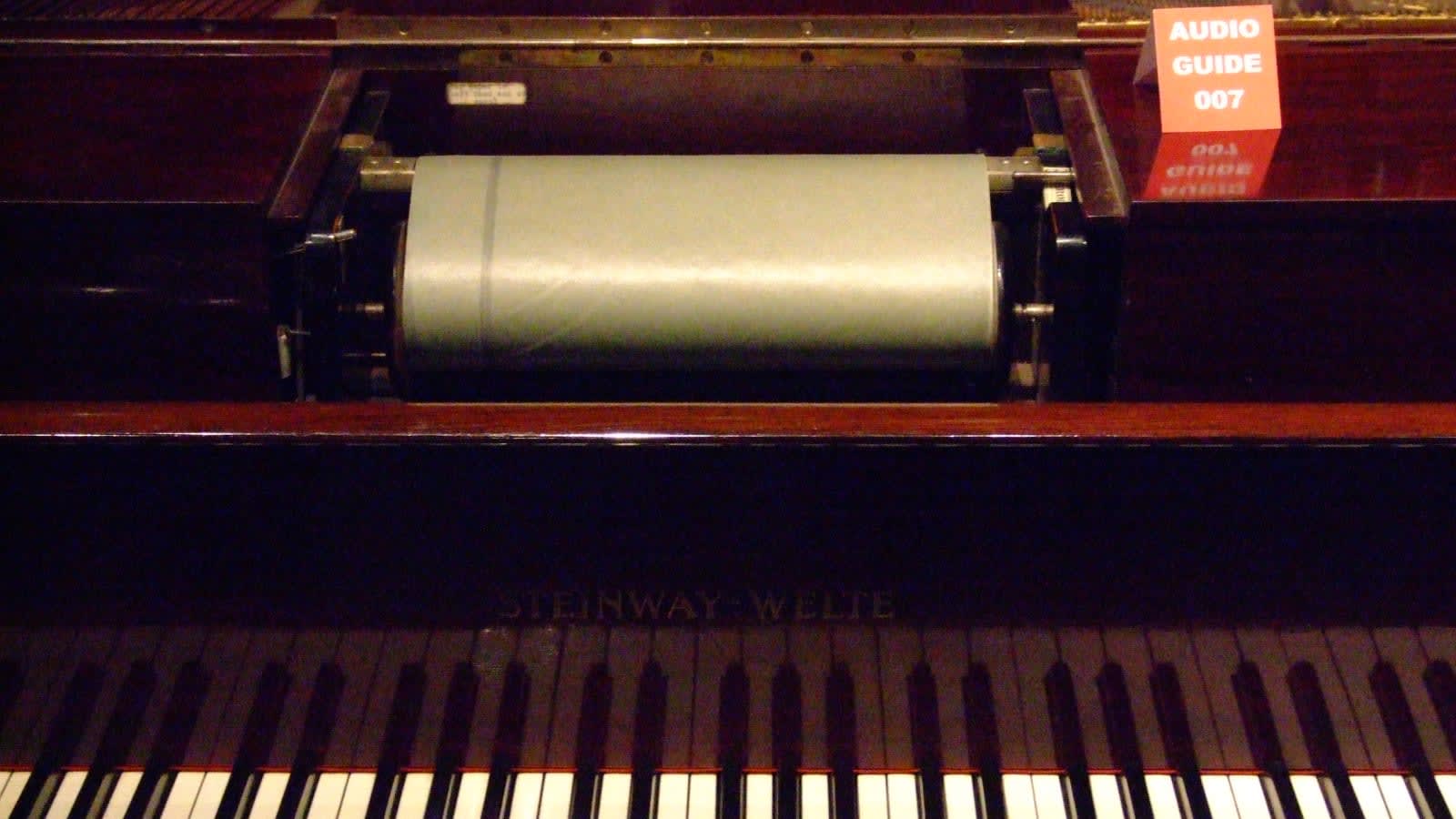
Featured photograph: a historical Steinway-Welte at the Musical Museum, Brentford, by Les Chatfield / Wikimedia Commons, CC BY 2.0; cropped. This is a roll-playing instrument, not a modern Spirio.
An audio recording and a performance file preserve different things
A microphone recording captures sound arriving at the microphone. The piano’s tone, the room’s reverberation, the recording position and any noises that reach it become part of that recording. Listening later also involves your headphones or speakers, and, with speakers, the room in which you play it.
A performance file takes a different route. It can describe which notes begin and end, their timing, aspects of their dynamics and the use of pedals. It needs something to turn those instructions into sound. That might be a software instrument, an electronic keyboard or the mechanism inside a reproducing acoustic piano.
Capture the sound
- MicrophonesHear the original piano in its room.
- Audio recordingStores the captured sound.
- Speakers or headphonesPlay that recording through a new listening setup.
Capture performance information
- SensorsMeasure selected key, hammer and pedal behaviour.
- Performance dataStores events and control information.
- Reproducing pianoMoves a real mechanism and makes fresh acoustic sound.
MIDI is a familiar example of performance information. As Acoustica’s MIDI explanation makes clear, the messages contain instructions rather than recorded audio. That does not mean every player-piano system uses the same ordinary MIDI format or preserves the same detail. Proprietary formats can carry information intended for a particular recording and playback system.
This distinction also explains why a recording of your playing and turning MIDI into readable notation are different jobs. Timing data may preserve a slight anticipation that notation software needs to interpret. A microphone may capture a beautiful resonance that a note list cannot describe.
How a modern player piano records more than the notes
Consider a melody played over a quiet accompaniment. The right pitches and rhythm are only the beginning. The melody needs a different dynamic level from the chords underneath; the notes need their own beginnings and releases; the pedal may be partly lifted rather than simply switched on or off. Those details give a recording system much more to do than identify which keys moved.
Steinway describes Spirio’s system in terms of hammer velocity and proportional pedalling. It specifies up to 1,020 dynamic levels, measurements at up to 800 samples per second, and up to 256 pedal positions. These are the manufacturer’s stated figures for performance capture and reproduction, not independent measurements of how identical two performances sound.
The distinction matters because resolution and accuracy answer different questions. A system can represent many possible values without every reproduced value being exact. Equally, a larger number on a specification sheet does not tell you whether the musical difference is audible. These figures are not directly comparable with the sample rate of an audio recording: they describe different things being sampled.
Also distinguish Spirio playback from Spirio | r recording. The Spirio | r specification adds capturing and editing your own performances. A piano that can play a supplied library is not automatically equipped to record its owner.
The receiving instrument has work to do too. In the Disklavier ENSPIRE PRO specifications, Yamaha lists optical sensing of key position and velocity, key release, hammer behaviour and pedals, alongside a servo-controlled drive system with feedback. Its AccuPlay description explains that playback is monitored and adjusted. The engineering problem includes making a physical mechanism respond, not merely storing a detailed file.
What these measurements preserve is selected evidence of the pianist’s actions. They do not describe how a fingertip felt against the key, how the wrist moved or how the player adjusted to the instrument. A camera can add some of that visible context. “Touch” is a useful musical word, but it should not make us confuse a captured result with a complete record of a body playing.
Historical entries in a modern library can take another route. Steinway says it uses proprietary audio translation software for performances by artists such as Glenn Gould and Sergei Rachmaninoff. These are reconstructions from earlier material, rather than sensor recordings made when those pianists played. Knowing that origin is part of understanding what the system is reproducing.
Paper rolls were already asking the same question
The paper roll in an old piano is easy to mistake for a primitive sound recording. Its holes contain control information. As the roll moves past the reading mechanism, those openings help determine what the piano does. The strings and soundboard supply the sound at playback.
There was no single kind of roll. The University of Illinois Music and Performing Arts Library’s exhibition distinguishes arranged rolls, hand-played rolls and reproducing rolls. Arranged rolls could be prepared from music rather than captured from a pianist. A person operating a player piano could shape tempo and expression with its controls. Hand-played rolls incorporated information from a performance, while reproducing systems added coded expression controls.
The exhibition shows how Duo-Art rolls used extra perforations at their edges for expression. A pianist’s name on a box therefore deserves a follow-up question: what kind of roll is it, and what information does this particular system reproduce?
The Pianola Institute’s account of the Duo-Art recording process adds a crucial detail. Its recording machine did not capture the pianist’s dynamics automatically. A musical producer supplied dynamic information, and editing helped shape the finished roll. The surviving object can embody collaboration between pianist, producer and mechanism.
That does not make it worthless evidence. It changes the kind of evidence it is. A roll can tell us a great deal about an interpretation while still requiring us to ask which details were captured, supplied, corrected or changed for reproduction. The same questions are useful when a digital performance has passed through an editor.
A 1918 interpretation, heard through a 2004 playback
One particularly revealing example is the Pianola Institute’s presentation of Rosita Renard playing Schumann’s Traumeswirren, Op. 12 No. 7. The Institute dates the roll recording to about 1918 in New York. It identifies the later playback as a Steinway Duo-Art grand in London in December 2004.
Rosita Renard: Schumann, Traumeswirren
Hear the recording at the Pianola Institute
The dates describe two events. Renard’s interpretation reached the roll in the early twentieth century. The sound in this audio file was made much later, when another piano played it back. We are hearing an audio recording of a reproduction, not a microphone transported to Renard’s original session.
Try listening for phrasing: where the line seems to press ahead, where a gesture settles, and how larger shapes emerge from the passagework. Then separate those observations from judgments about the piano’s particular brightness or the space around it. The example invites both kinds of listening, but they do not tell us the same thing about the original performance.
Why the instrument and room still matter
Imagine one performance file played on two well-prepared acoustic pianos in different rooms. Even if each mechanism reproduces the intended timing and hammer behaviour closely, the instruments still have their own strings, hammers, soundboards and resonances. One room may prolong the sound; another may make attacks seem more exposed.
This follows from the physical task: the file is causing a new acoustic event. The discussion of what a technician changes when voicing a piano explains why hammer condition belongs in any account of tone. And concert pianists’ instrument choices show how much musical importance performers place on the piano and its setting.
Pedalling makes the distinction especially clear. A stored pedal movement is useful performance information. But the resulting blend also depends on how that piano resonates in that room. If the original pianist were there, they might choose a different amount of pedal after hearing it. A faithful replay of a captured gesture cannot also make every new interpretive decision the absent pianist might have made.
There is another complication when the demonstration reaches us online. A video of a player piano has been recorded through microphones and replayed through our own equipment. We can watch the keys move and hear that recording, but we are not experiencing the instrument directly in its room. A compelling video is an introduction, not a substitute for every kind of comparison.
This is also why digitised rolls need clear labels. Stanford describes its preservation process as scanning rolls, converting their information to MIDI, and generating audio that emulates an acoustic player piano. That route makes fragile historical material accessible. It does not create a previously undiscovered microphone recording of the original session.
What would a convincing demonstration show?
We would ask for a short, identifiable performance and a clear account of what happens to it. Musical examples are more informative than a spectacular flourish followed by a claim that the machine captures everything.
- Know the source. Is this a performance captured on the instrument, an edited library file, a historical roll conversion or an audio-derived reconstruction? Those are different starting points.
- Keep the comparison fair. For a live record-and-replay demonstration, ask to hear the same piano from the same listening position. Note whether the playback level has been changed. If comparing recordings, keep microphone position and gain consistent too.
- Choose something revealing. A quiet melody above chords, repeated notes at different strengths, an intentionally spread chord and a passage with changing pedal give you specific events to follow. Ask whether the relationships between notes survive, rather than simply whether the result sounds impressive.
- Ask what was edited. Corrections can make a recording more useful, but they change what it represents. Preserve the original take if the purpose is to examine exactly what the pianist played.
Editing is not a theoretical concern. Steinway lists changes to note velocity, start and end times, notes themselves and pedal data among Spirio | r’s capabilities. It also distinguishes its proprietary performance export, MIDI and an MP3 export described as sampled audio. A shareable sound file may therefore be rendered from performance data rather than recorded by a microphone in the room.
None of this is a reason to demand an impossible, context-free copy. It is a way to decide what you value. For studying an interpretation, timing and balance may be the main interest. For remembering a particular recital’s sound, an audio recording has information a performance file does not. Keeping both can preserve more of the event than asking either format to do every job.
Explore a roll without owning a player piano
Stanford’s Pianolatron lets you explore digitised piano rolls with a moving visualisation and generated piano sound. Its Play and Perform controls make the relationship between data and interpretation unusually tangible: the basic mode includes playback and tempo controls, while Perform offers adjustments such as dynamics, accents and pedalling.
Use a laptop or desktop if possible. Stanford recommends Firefox or a Chrome-family browser, notes limited phone functionality and warns that the initial sound-sample download can take time. Its usage guide explains the controls and loading behaviour.
Begin with an unchanged playback and note the roll’s performer and type. Then change the tempo or an expression control and notice what remains recognisable about the musical shape. It is a useful way to encounter the promise of a player piano: a performance can leave behind something that another instrument can enact, while the resulting sound still belongs to the place and moment in which we hear it.


