
A piano can be beautifully in tune and still make a quiet melody surprisingly hard to play. Perhaps one note bites, the next seems woolly, and the sound turns aggressive before the phrase has reached its climax. Those are reasons to discuss the instrument’s tone with a technician, but they do not all point to the same repair.
Voicing adjusts the character and consistency of an acoustic piano’s sound, chiefly through its felt-covered hammers. Tuning sets pitch; regulation adjusts the mechanism that turns a finger movement into a hammer strike. A useful service visit begins by finding out how these jobs interact on your particular piano.
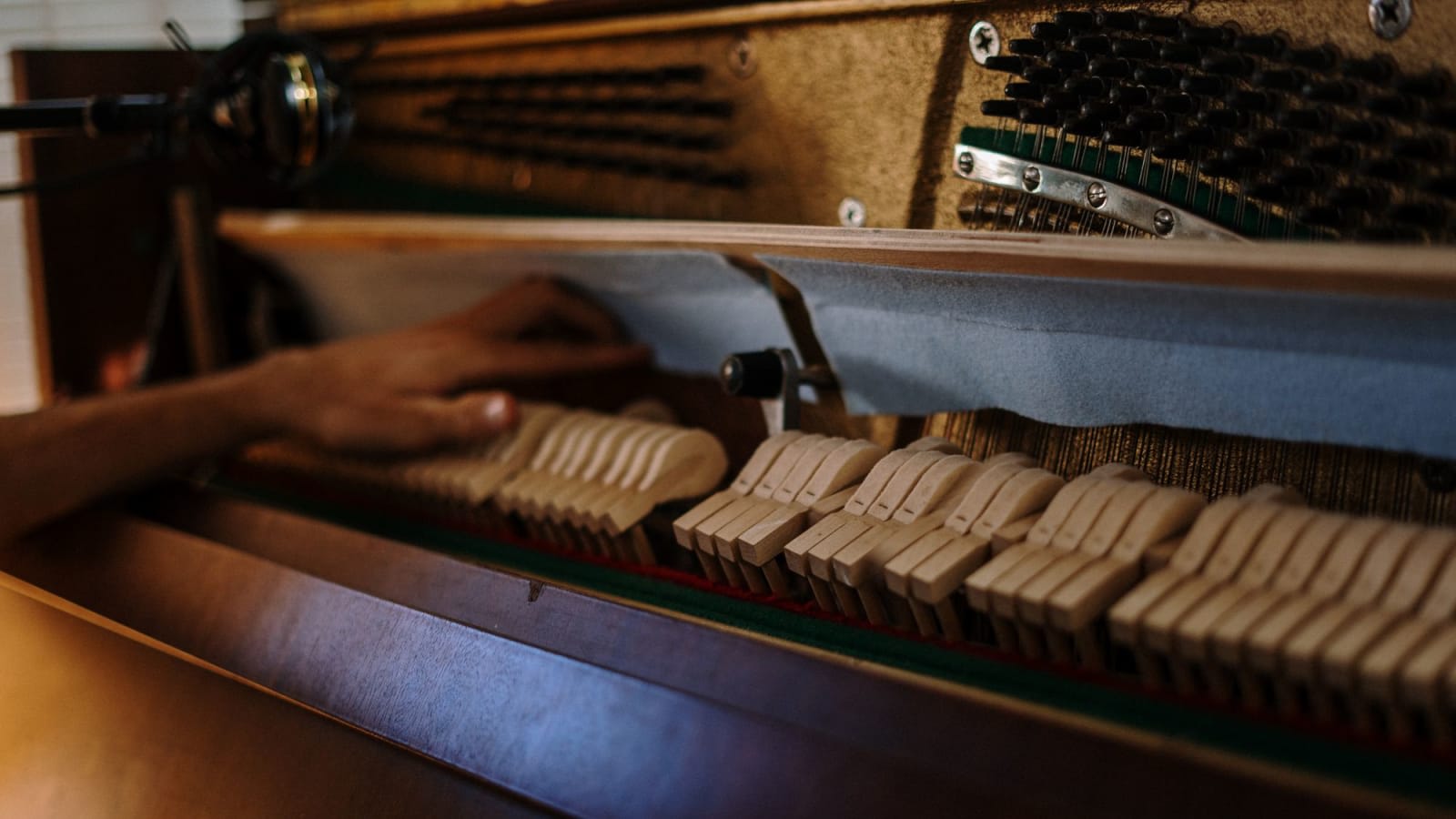
Featured photograph: cottonbro studio / Pexels. The image shows an upright piano being tuned, with its action exposed.
Voicing, tuning and regulation: three different jobs
The word voicing can cause confusion before the technician even arrives. A teacher may use it to mean bringing out a melody above an accompaniment. That is the playing skill covered in balancing voices with your fingers. Technical voicing changes the instrument you are playing.
Swipe the table sideways to compare all three columns.
| Service | Main adjustment | The musical question |
|---|---|---|
| Tuning | String tension and the relationships between pitches. | Do the notes and harmonies sound in tune? |
| Regulation | The coordinated movement of keys, action, dampers and pedals. | Can you control attacks, repetition and release reliably? |
| Voicing | Hammer condition and tonal response, including consistency between notes. | Can you obtain the colour and contrast the music needs? |
Steinway’s service guide distinguishes these three areas. Its regulation examples include key travel, hammer distance and repetition, while its voicing description centres on the felt and the resulting tone. This explains why booking “a tuning” does not necessarily book all the work you have in mind.
For example, a note that keeps disappearing in a soft passage raises a different question from a note that always sounds conspicuously metallic. Tell the technician both what you hear and what happens under the finger. Avoid deciding in advance that every unpleasant sound needs a softer hammer.
What actually changes in the hammer?
The white felt on a piano hammer is a working material, not just padding. Its shape and resilience affect how it meets the strings. Voicing involves assessing that material and the quality of contact, then listening to the result across the keyboard.
There is a physical reason that a piano’s colour changes as you play more strongly. Acoustics researchers Anders Askenfelt and Erik Jansson explain that hammer felt behaves more stiffly at higher impact speeds. Contact with the string becomes shorter, increasing the contribution of higher-frequency partials, the components above the fundamental pitch. A stronger note therefore changes character as well as loudness. That is why judging a hammer’s sound at only one volume misses something essential.
Yamaha’s account of the final manufacturing adjustments describes changes to hammer-felt hardness and resilience, shaping the surface, and ensuring that a hammer meets the strings of a multi-string note evenly. It also describes using specialist tools to increase flexibility. Where and how much to work the felt are skilled decisions, not a general recipe for making a piano warmer.
That distinction matters if you picture voicing as turning down a treble control. The technician is working on many individual hammer-and-string relationships. One note may need attention while its neighbours already work well. A whole register may need a different approach from an isolated conspicuous note.
Nor is this the extra strip of material heard in a felt-piano recording. A practice mute puts a separate layer between hammers and strings. Voicing works on the piano’s normal tonal response. Asking for the intimate, muted sound of a recording and asking for a less abrasive acoustic piano are different requests.
Watch the work behind the sound
Steinway’s short Stations of the Steinway film shows the factory voicing stage. Notice the alternation between playing the instrument and working on its exposed action. The decisions are checked at the keyboard: the small tool is only part of the work.
Watch the film on Steinway’s website if the player is unavailable.
This is a look at factory preparation, not a controlled before-and-after test of a home piano. It cannot tell you how much a particular instrument can change. It does make the listening-and-adjusting relationship visible, which a photograph of a voicing tool alone would miss.
When “too soft” turns out to be a question about touch
In Rosalie Burrell’s profile of concert technician Joel Bernache, he describes a recurring situation: a pianist reports that the instrument is “too soft.” He listens to the complaint, then tries the piano himself. He also considers stiffness, heaviness and friction in the action. Difficulty getting a response can be experienced as insufficient sound.
“I usually don’t say anything right away, I just listen.”
Bernache explains that a solution may combine regulation and voicing. The profile does not present a single named repair with a measured result; its value is the technician’s explanation of how he investigates a musical complaint.
For an owner, that suggests a much better opening than specifying a treatment: play the troublesome phrase. “The melody disappears unless I hit these notes harder than I want to” gives someone a musical problem to investigate. “Soften all the hammers” has already chosen the answer.
Why a piano can sound too bright
Brightness is not automatically a fault. A clear attack can help a melody carry, and a stronger sound may be exactly what a climax needs. The more useful question is when the brightness arrives. Does it appear only when you ask for a forceful sound, or is the same edge present in a quiet phrase?
The Piano Technicians Guild’s care guidance points to compacted, worn hammers, but also to the room and the lid: reflective surfaces and an open lid can make a piano seem brighter and louder. It recommends evaluating tone after tuning and checking the instrument’s condition. Sometimes tuning provides the improvement the owner wanted.
Before the appointment, notice whether the problem is one note, one register or the whole instrument. Ask someone to play while you listen from your usual seat elsewhere in the room. If you normally practise with a particular lid position, tell the technician. Comparing different positions is useful only when you can handle the lid safely and as its maker intends.
Keep a record of recent changes. Did the sound become troubling after a move, a room refurbishment or the start of the heating season? These details do not diagnose the piano, but they prevent a conversation about hammers from overlooking its surroundings. The Guild explains how climate affects the piano’s materials, pitch and response; our piano humidity guide covers that separate maintenance question.
A phone recording can help you point to the passage or note. Treat it as a reminder, not a verdict on the instrument’s tone: moving the phone changes what it captures. For a before-and-after reference, keep the room, lid position, phone position and passage as consistent as possible, and make the final decision at the piano.
Listen in three passes, using music you already know
You do not need a concert programme to explain what you want. Choose a short phrase you can play comfortably, preferably one with a melody and accompaniment, and a few neighbouring notes around the troublesome area. The following comparison is a way to organise your observations, not a test that identifies a repair.
Play the phrase softly, initially without pedal so you can hear each attack.
Notice notes that fail to speak, jump forward or have a markedly different colour. Try a conspicuous note with another finger or in another short pattern. Record what repeats rather than judging a single attempt.
Play at an easy singing volume, then add the pedalling you normally use.
Can the melody stay clear above the accompaniment? Does the tone connect across the phrase, or does one note sound as though it belongs to another instrument? This is a useful place to show the technician what you like as well as what you dislike.
Play a comfortable forte passage. There is no need to force the keys or choose music beyond your technique.
Listen for the energy you want to retain. If you hope to reduce a hard edge, explain which stronger sounds still matter to you. A successful change should leave room for the music to grow.
Then compare your notes. “Too bright” may become “the upper melody has an edge even when I play quietly, but I like the bass and the stronger middle register.” That is a more selective brief. Equally, “I cannot control repeated soft notes” gives the technician a reason to examine response before assuming a tonal treatment is needed.
Use ordinary words. Glassy, dull, thin and round become useful when you attach them to an audible example. You do not have to agree on the perfect adjective if you can agree on the sound.
What to ask before agreeing to the work
We would start with a specific aim and something worth preserving. For example, an owner could send this before booking:
“The piano was tuned recently. Several upper notes sound sharp-edged in quiet melodies, but I like the strength of its louder sound. Could you assess the action and tone, hear the passage I mean, and explain which changes are realistic? Please separate any necessary preparation from the voicing work in your estimate.”
That is an example message, not a diagnosis. Add the piano’s make, model if known, recent service history and any move or room change. Tell the technician that you want time to play during the visit; a hurried handover may leave neither of you enough opportunity to compare the result.
The Guild suggests asking for a demonstration on one or two notes. Where the technician considers that appropriate, it lets you discuss a concrete change before agreeing to a broader tonal direction. Ask to hear those notes beside their neighbours and in the actual phrase, rather than choosing a sound from an isolated strike.
Ask what the estimate includes: tuning, action adjustments, hammer preparation, tonal balancing, replacement parts if needed, and any follow-up visit. These are possible elements of an assessment, not a list that every piano requires. An isolated correction and substantial work on a worn instrument are different jobs; a price without a defined scope tells you little.
Leave needling, filing, chemical treatments and action removal to a qualified piano technician. The owner’s useful contribution is listening, describing and agreeing on the goal. Ask about the technician’s experience with voicing your type of piano and how they involve the player in the decisions.
What voicing cannot promise
A realistic aim respects the instrument’s design and condition. The Guild notes that heavily worn components may need substantial repair, and that tonal differences around the transition between wound and plain strings can reflect design compromises that voicing cannot remove. A piano is not infinitely adjustable.
Nor should every note acquire an identical character. An even melodic line still travels through distinct registers. For the player, a useful result is that an unwanted bump no longer interrupts the phrase and that differences in colour feel musically usable.
After the work, return to the same quiet, moderate and strong passages. Check whether the original complaint has improved, whether you still like the qualities you wanted to preserve, and whether a new unevenness catches your ear. Play with your usual pedal as well as without it. A demonstration scale is helpful; your own music gives the change a purpose.
Agree on follow-up and future checks with the technician. Service needs vary with use, location and the instrument, so voicing need not become an automatic addition to every tuning. Keep a short description of what was done and what you liked about the result.
The most useful request may turn out to be quite modest: keep the piano’s liveliness, make those few notes belong to the phrase, and let a quiet melody stay quiet.


