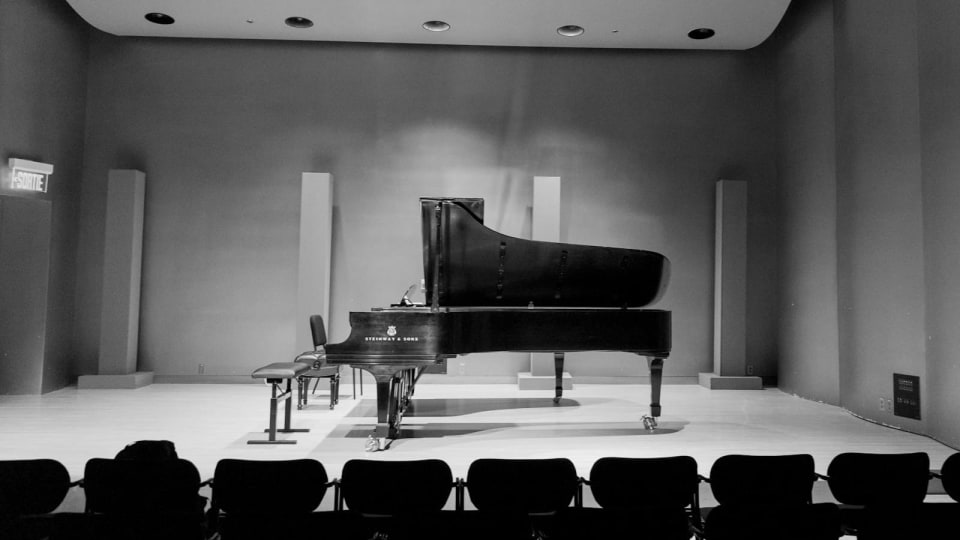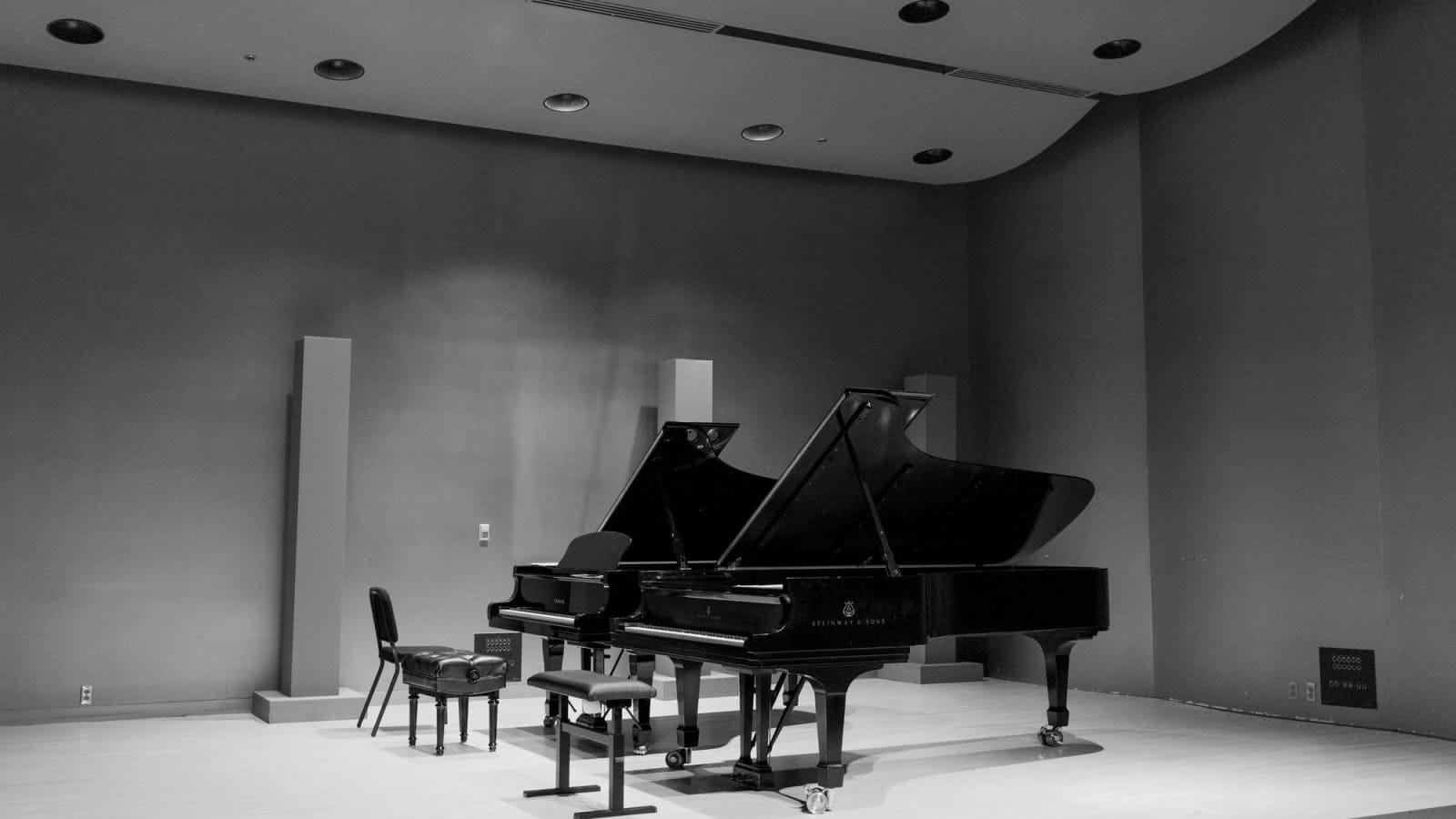
Two grand pianos can look almost identical from your seat in the hall and feel very different under a pianist’s hands. When a venue offers a choice, the player is looking for an instrument that responds to their touch, gives them the colours the music needs and carries those colours into the room. A few quiet notes can matter as much as a thunderous climax.
Featured photo: two grand pianos in a Montreal hall, by Julia Barrantes / Pexels.
Alice Sara Ott starts with the quiet end of the piano
In Southbank Centre’s 2023 selection film, Alice Sara Ott works with concert technician Peter Salisbury at the Royal Festival Hall. Her interest lies especially in what an instrument can offer at its softest. She also describes wanting a sound that continues to develop after the note begins, comparing that lingering complexity to the aftertaste of wine.
“The piano selection is always a big moment for me, because every instrument is just so different”
That preference gives a selection session a musical purpose. A pianist needs to be able to begin a delicate phrase with confidence and shape the notes that follow. Maximum volume tells us little about how freely an instrument allows that.
For Angela Hewitt, touch opens up the colour
Angela Hewitt made the connection between fingers and sound explicit in a 2019 interview with Opera PLUS. Asked about her Fazioli F278, she praised its response to small changes in touch, its tonal variety and the clarity of its bass. She valued being able to move between power and delicacy while retaining the character of the sound.
Her answer also contained a practical complication: the forthcoming Prague concert would be on a Steinway. A strong preference does not mean that every engagement provides the preferred instrument. Preparation includes finding out what the piano available that evening will let the player do.
Think of a melody over a quiet accompaniment. The pianist needs the melody to speak while keeping the notes underneath restrained. Our guide to bringing out a melody explores the playing skill; Hewitt’s account shows why the instrument’s response matters to that skill.
Why two pianos of the same model can differ
A model name identifies a design, but each piano also has its own history of playing and preparation. Even Steinway’s factory selection-room account emphasises differences between individual instruments. Its Model B and Model D pianos receive tuning, regulation and voicing before buyers try them.
Those three jobs affect different parts of the experience. The Piano Technicians Guild explains the distinction:
Tuning adjusts the strings’ pitches and their relationship to one another.
Regulation adjusts the mechanism. The action transfers movement from the keys to the hammers; its condition and adjustment affect how evenly and reliably the piano responds.
Voicing changes the tone, including work on the hammers. It can alter brightness and tonal balance without changing which pitches the instrument plays.
Wear and humidity can affect the mechanism as well as the sound. So a piano can be in tune yet feel uneven, or respond smoothly while offering a tone a particular player dislikes. When a pianist and technician discuss the selection, they need to establish which of those things the player is reacting to.
The audience hears from a different place
A piano also has to work beyond the keyboard. In her account of selecting concert instruments, technician Sally Phillips stresses projection and sustain, alongside the pianist’s experience of the action. A sound that pleases the player at close range still needs to reach listeners farther away.
Concert organiser Tracy Lees described a very direct way of checking this in her 2019 account of the International Piano Series: pianists sometimes asked her to play chords while they listened from the back of the hall. They could then judge the instrument from somewhere other than the bench.
This helps explain why the selection continues as a conversation with the technician. Phillips recommends making the final fine voicing in the hall where the piano will be used. She also notes that some problems with feel can be adjusted within limits. The pianist needs to distinguish a correctable uneven note from an instrument whose overall sound does not suit the performance.
The programme can change the choice
Lees also reported that repertoire influenced the decision, sometimes enough for a pianist to want a different instrument for each half of a recital. Her example paired a brighter sound with Haydn and a warmer one with Chopin. That is an illustration of an artist’s possible preference, not a rule assigning composers to particular pianos.
The useful question is what the actual music asks of the instrument. A light, detached accompaniment needs clarity between notes. A slow melody needs room to linger. Dense chords need an audible top line without every inner note becoming equally prominent. Trying those passages tells a pianist more about the evening ahead than playing only the easiest or most impressive part of the programme.
Some artists in Lees’s account chose in advance; others decided during their practice session, with the instruments on stage and the technician present. The time to adjust and become familiar with the chosen piano is part of preparing for the performance itself.
András Schiff brought his own answer
There is another way to approach the choice: bring a particular instrument. In its account of András Schiff’s 2023/24 residency, the Elbphilharmonie described his use of his own mahogany Bösendorfer, rather than a Steinway from the hall’s collection. The residency covered five concerts, including solo, orchestral and chamber music.
That is a different arrangement from selecting among the venue’s pianos for each appearance. It also makes the importance of the individual instrument tangible: the choice can be a specific piano that a musician brings into several kinds of musical partnership.
At your next recital, listen to a quiet phrase, the way a melody emerges from accompanying notes, and what happens to the sound as a long note fades. Those moments give you something concrete to follow in the performance. They are also the kinds of musical possibilities a pianist needs to find before the audience arrives.