“Passed” can sit beside three pages of jury comments that seem to ask for different kinds of playing. The student leaves knowing the result but wondering which voice to follow in tomorrow's practice. A useful post-jury lesson turns those comments into a few musical decisions, while keeping the panel's original evaluations and formal result intact.
The case below follows one fictional piano student from the panel sheets to the following teaching cycle. It includes agreement, conflicting advice and a review that leaves some work unfinished. The people, comments, music and rehearsal observations are invented to show the decisions; they are not a customer success story.
Keep the decision and the teaching conversation distinct
First establish what the jury actually decided and how the institution communicates it. At Carnegie Mellon, panel members write individual evaluations; the studio area or teacher determines how jury evaluations and grades affect the studio grade. Students receive copies of jury sheets, and teachers can request them. At the University of North Texas, results reach instructors after an area's juries, and students review comments and grades with their instructor. Some divisions keep comments anonymous.
Those are examples of different local arrangements. Before circulating comments, check who should receive them and whether names belong on the student copy. Keep the original sheets available. A staff summary can explain the next work, but it should not quietly replace an examiner's words or manufacture a new average grade.
At Alder Music Academy, Ari Vale passes an Autumn Jury on 5 November. Ari plays Duo Study in E minor by Alex Arden with clarinettist Morgan Lee. The composer and work are also invented for this example. Tess Rowan, Ari's teacher, has the original evaluations and the authorised school recording. The passage labels C and D below belong to that fictional movement.
The school records the official result, Passed, in its normal assessment record. In our Practis institution workspace, an administrator can also enter a short event outcome note. The real interface below uses fictional records to show that additional summary.
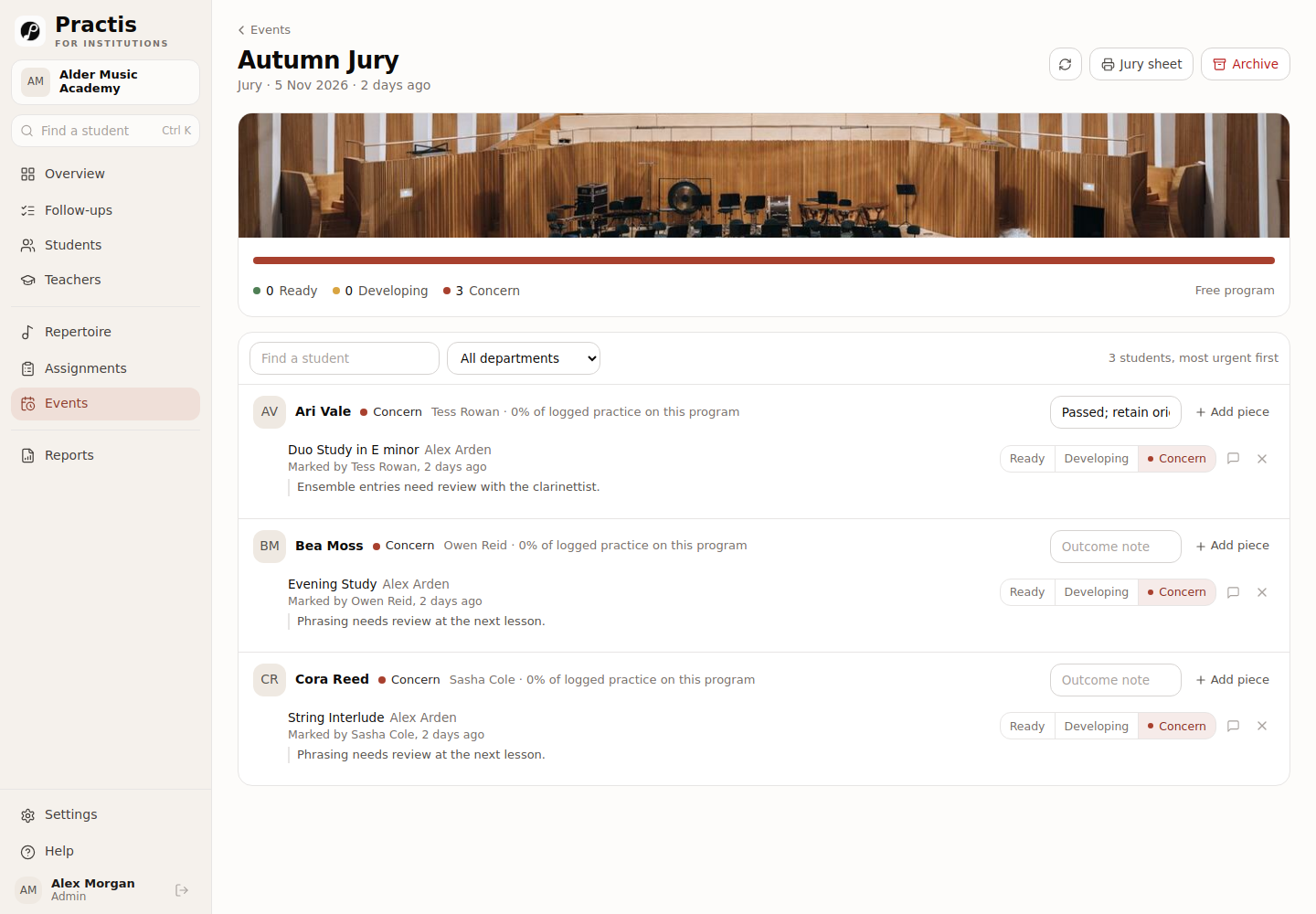
The complete saved note is: “Passed; retain original panel sheets. Review ensemble entries next lesson.” Its opening is visible in the narrow field. The piece still has a Concern verdict about an ensemble cue. An assessed result and a teaching concern can coexist; changing a piece's preparation status should not rewrite what the jury decided.
Practis's outcome note is optional and limited to 120 characters. Administrators enter it; teachers and department heads cannot edit that field. It is not an official gradebook, a place for three complete evaluations, or an automatic import of juror forms. Keep the authoritative sheets and any formal conditions in the school's established assessment record.
Read the three responses together
Ari initially hears one contradiction: one person wants less force, another wants more commitment. Tess starts by locating the comments in the score, then checks which observations are shared and which decisions remain open.
| Sheet | Comment |
|---|---|
| A | “The long phrases have a convincing direction. At C, the piano's arrival covers the clarinet; give it more space. I would take a longer breath before D. The final exchange needs a more secure shared pulse.” |
| B | “Good character and clear phrase shapes. Commit to the piano entry at C: it sounds hesitant. Keep moving into D rather than adding time. Coordinate the final exchange more reliably.” |
| C | “The broad shape is persuasive. Balance and ensemble at C need attention. Review the final exchange with the clarinettist. Inner voices in the piano interlude could have more definition, and the closing sound could be more varied.” |
There is useful agreement. All three responses recognise Ari's sense of phrase, and all identify ensemble work. That tells Tess what to preserve as well as what to address. Giving Ari five unrelated corrections without acknowledging the musical strength would make the next lesson unnecessarily difficult to interpret.
There are also two different disagreements. At C, “less” and “more” may concern different features of one entry: balance and the clarity of the arrival. Before D, the advice really does propose different amounts of time. Treating both situations as a general instruction to “find a compromise” would leave Ari without a musical choice.
Use the passage to decide what to try
Tess and Ari listen to C with the score open, including the preceding phrase. The recording suggests that the piano enters late and then arrives with a heavy bass. That gives them a testable interpretation: a more definite shared entry could still use less weight in the bass. It would address the two comments without asking Ari to play everything both louder and softer.
Morgan adds the missing rehearsal context. Ari has been waiting to hear the clarinet's new note before committing to the piano entry. Morgan, meanwhile, has been waiting for Ari's movement. The pair agree who gives the preparation and where both parts meet. They rehearse into the entry from the previous phrase, rather than repeatedly starting on the troublesome chord.
The recording does not settle every question about balance. Microphone position can favour one instrument, and Tess was not sitting in every panel member's chair. She treats the recording as one source, then listens to the pair in the room. If there is no permitted recording, the teacher can still compare the score, the written comments and a new performance; they should not claim to reconstruct the original event exactly.
The breath before D needs a different discussion. Ari explains that the extra time was deliberate, but Morgan was unsure when the phrase would resume. Tess asks them to try both interpretations and make each coordinated. She chooses a continuous approach for the next rehearsal because it lets Ari sustain the intended line while giving Morgan a predictable arrival.
That is Tess's teaching decision for this stage. It does not prove that panel A was wrong or that a longer breath can never work. The original disagreement stays visible. If a comment is an explicit assessment condition rather than interpretive advice, the responsible faculty member should clarify the requirement through the institution's process before the student is asked to choose.
Give Ari a plan that fits the next lesson
The immediate priority is the ensemble exchange, because it affects continuity and appears across the panel's responses. Tess keeps the inner-voice and colour suggestions for later work. They remain in the original sheets and longer teaching note; they do not all become urgent assignments for the same week.
Here is the short message Ari takes away from the meeting:
Your jury result is Passed. The panel heard a clear sense of phrase. Keep that direction while we make the duo entries more dependable.
For 11 November: rehearse with Morgan from the phrase before C through the final exchange. Agree the preparation for C. Keep the bass light enough for the clarinet to remain clear, and continue into D without the additional pause for this rehearsal.
Bring to the lesson: the marked score and one complete take of that passage, including the lead-in. Tell us where either player still has to guess. Tess will hear it with both of you present.
The piano interlude's inner voices come next. We are not changing the jury result or treating every comment as a new condition of passing.
Responsibilities need to be agreed as part of the conversation. Ari and Morgan arrange their rehearsal and confirm that both can attend the review. Tess owns the musical decisions and the next listening check. The administrator preserves the result and makes any required record available. A department head can help resolve conflicting requirements, but an appearance on a staff list does not mean that person has agreed to hear the student.
Practis can hold an owner and a next step for an existing generated follow-up. In the screen below, Ari has already marked “Duo entries and phrasing” as stuck. The item is In review and names Tess as owner, but the Next step field is empty.
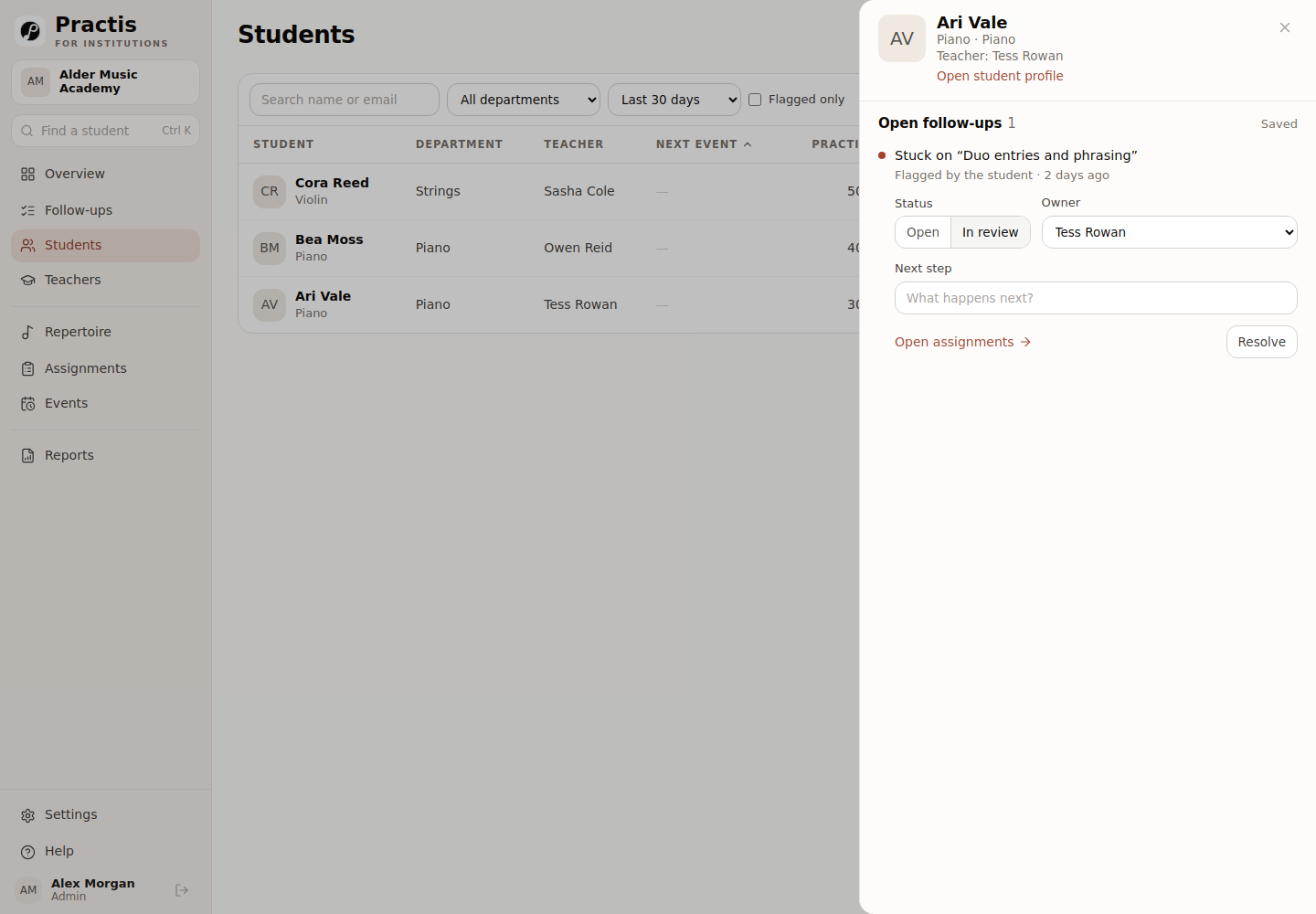
The fuller plan above has not been entered in that screenshot. A suitable short next step would be: “Tess to hear C through the final exchange with Ari and Morgan on 11 November; check the shared cue and discuss what still needs guessing.” The score markings and longer explanation belong in the teaching record.
This distinction matters when using the software. The stuck assignment generated this item; entering Passed on the jury did not create it. Practis does not offer a blank follow-up form for every sentence on a panel sheet. Where no matching item exists, agree the action in the school's ordinary lesson or staff record. Our student follow-up guide explains the existing item types and how ownership works.
At the review, record what was actually heard
At the 11 November review, Ari and Morgan coordinate C in both the short passage and the complete movement. Tess can hear the clarinet through the piano's arrival. The final exchange still separates, however, when Ari looks down to turn a page during the complete movement. The selected task has helped part of the problem; the complete ensemble passage is not yet dependable.
Tess records both observations. “Entries improved” alone would overstate the result and leave the next teacher to guess which entry had been checked. “Still an ensemble problem” would erase the useful change. Her next note says that C is coordinated in the passage and the complete movement, while the final exchange needs another rehearsal with the actual page turn.
For 18 November, they keep that performance condition in the rehearsal instead of removing the page turn to make a successful take easier. Tess hears the passage in context again. In this imagined review, the cue works once but is missed on the repeat; she leaves the action In review and agrees another short check. The programme's overall readiness still needs a separate judgement.
Resolving a Practis follow-up would record the end of that staff action. It would not change the assignment, the piece's verdict or the formal jury result. A generated prompt can also disappear when its underlying information changes, without creating a resolved-history entry. Keep a dated teaching observation where the next teacher will find it, particularly if it needs to outlast the prompt.
What should survive into the next teaching cycle
The next teacher needs the original result and evaluations, the meaning of the later teaching decisions, and the remaining work. In Ari's case, that means Passed on 5 November; the original disagreement about D; Tess's agreed interpretation for the November rehearsals; evidence that C was coordinated on 11 November; and the final exchange still needing review on 18 November. None of those facts replaces another.
Keep the music identifiable too. A note about C is useless if the next colleague receives a different movement or an edition with different rehearsal marks. Put the work, movement, edition and collaborator beside the observation. Our repertoire record examples show how to preserve that identity across terms. For decisions made before a performance, the recital hearing guide deals with the separate question of whether a programme is ready to proceed.
Practis's student report can include the recorded event outcome under Programs & juries. Lesson recap text is excluded by default and can be included deliberately. Review the report before sharing it: the short outcome is not the full panel evaluation, and an internal teaching discussion is not automatically the right message for every recipient.
Ari's next teaching cycle begins with a clear result, a musical strength worth keeping and one ensemble problem whose next check is already understood. The value of the record is that another faculty member can join that work without asking the student to reconstruct the entire jury conversation.
Arrange a Practis institution walkthrough with one completed jury and the teaching work that follows it. Look at who records the outcome, who can act on the concern and what the next teacher will be able to understand.
Featured photograph: Yan Krukau / Pexels. General teaching photograph, unrelated to the fictional jury case.