A recital programme can have every title entered, a pianist booked and a date in the calendar, while one movement still cannot get through a rehearsal. It can also be musically secure while a missing approval holds up the hearing.
Review the programme in three parts: whether it meets the course requirements, what the teacher has actually heard, and what decision the hearing committee still needs to make. Keeping those questions separate gives the student something useful to prepare and the faculty a recommendation they can explain.
Featured photograph: Joanjo Puertos / Pexels. General performance photograph; the musicians are unrelated to the fictional review below.
Start with the hearing your institution actually requires
The hearing date determines how much time remains to change the programme, rehearse with collaborators or respond to a concern. It is easy to borrow another school's checklist and discover too late that its timetable is completely different.
| Published example | Hearing timing | What is expected at that point |
|---|---|---|
| Austin Peay State University | A successful hearing at least two weeks before the recital. | A complete programme draft. The committee includes the primary instructor and at least two additional faculty. Programme corrections may follow a successful hearing. |
| North Dakota State University | At least four weeks before the recital. | The teacher-approved final programme and any required notes or translations. The collaborative pianist and other collaborators perform at the hearing unless excused by the applied instructor. |
| University of Alaska Anchorage | At least six weeks before the recital. | All recital repertoire, including encores, is performed. Complete programme text and notes are due; any special staging plans also need approval. |
Published pages checked 7 November 2026. On a phone, swipe sideways to read the table.
These examples establish how much procedures can differ. Confirm the current course handbook and departmental instructions before fixing dates. NDSU's page still contains a Fall 2025 deadline elsewhere, so its general guidance should not be mistaken for a confirmed timetable for the current academic year.
Ask what the hearing is authorised to decide: permission to present the recital, permission with specified corrections, postponement, or another outcome defined locally. Check who communicates that decision and where it is recorded. At Austin Peay, an unsuccessful hearing means releasing the selected recital date and consulting the applied instructor about another attempt. That consequence needs to be understood before the room is full of examiners.
One complete programme, three different reasons to pause
Consider Mira, an advanced clarinet student preparing a recital with pianist Daniel and teacher Elena. This is a fictional programme review: the people, local requirements, dates, timings and observations are invented to demonstrate the decisions. It is not a customer result or a proposed programme for any of the universities above.
Their school requires 40–50 minutes of music, complete works, contrasting nineteenth- and twentieth-century repertoire, and a hearing with the pianist four weeks before the recital. The planned recital is 18 December; the hearing is 20 November. Elena reviews the programme on 9 November, while there is still time to act.
| Complete work | Entry and timing | What Elena can currently say |
|---|---|---|
| Brahms: Clarinet Sonata in F minor, Op. 120 No. 1 | Approved repertoire choice. 21:40. | She has heard it with Daniel. Phrases and ensemble hold together through the complete work; remaining detail can be addressed in the normal preparation. Ready. |
| Schumann: Fantasiestücke, Op. 73 | The proposal says only “Fantasy Piece”; all three pieces are intended. 11:10. | The title needs correcting and the complete choice needs approval. Elena has not yet heard the full set with Daniel. No current verdict. |
| Poulenc: Sonata for Clarinet and Piano | Approved repertoire choice. 13:00. | They have rehearsed the complete sonata, but the finale loses its shared pulse and stops. Mira needs Elena's cue to restart. Concern. |
Illustrative music timings total 45:50. These are invented figures for the case, not measured performances or recommended durations. Replace them with the student's actual complete performances, including the intended repeats.
The programme meets the fictional duration range on those figures, and its composers meet the broad period requirement. Elena still needs to confirm the exact works and the school's interpretation of contrast. Three entries in a database cannot decide whether a programme fulfils a degree requirement.
The Schumann problem initially contains two separate tasks. Mira can correct the entry to identify all three pieces; Elena can approve that repertoire choice. Neither action tells her how the complete set sounds with Daniel. She arranges to hear it on 13 November rather than assigning a favourable verdict to clear the remaining blank.
The Poulenc requires a different response. Elena has heard enough to identify an obstacle to performing. Its accurate title and approved status do not remove that obstacle. Asking the office to “finish the programme” would send the problem to someone who cannot make the musical judgement.
Read the board's reasons, not just its colour
Our Practis institution workspace brings the event requirements, programme entries and teacher verdicts into one board. The real screen below shows a Winter Jury with fictional example accounts. It illustrates the controls and the relationship between a student's summary and the individual pieces; it is separate from Mira's recital case.
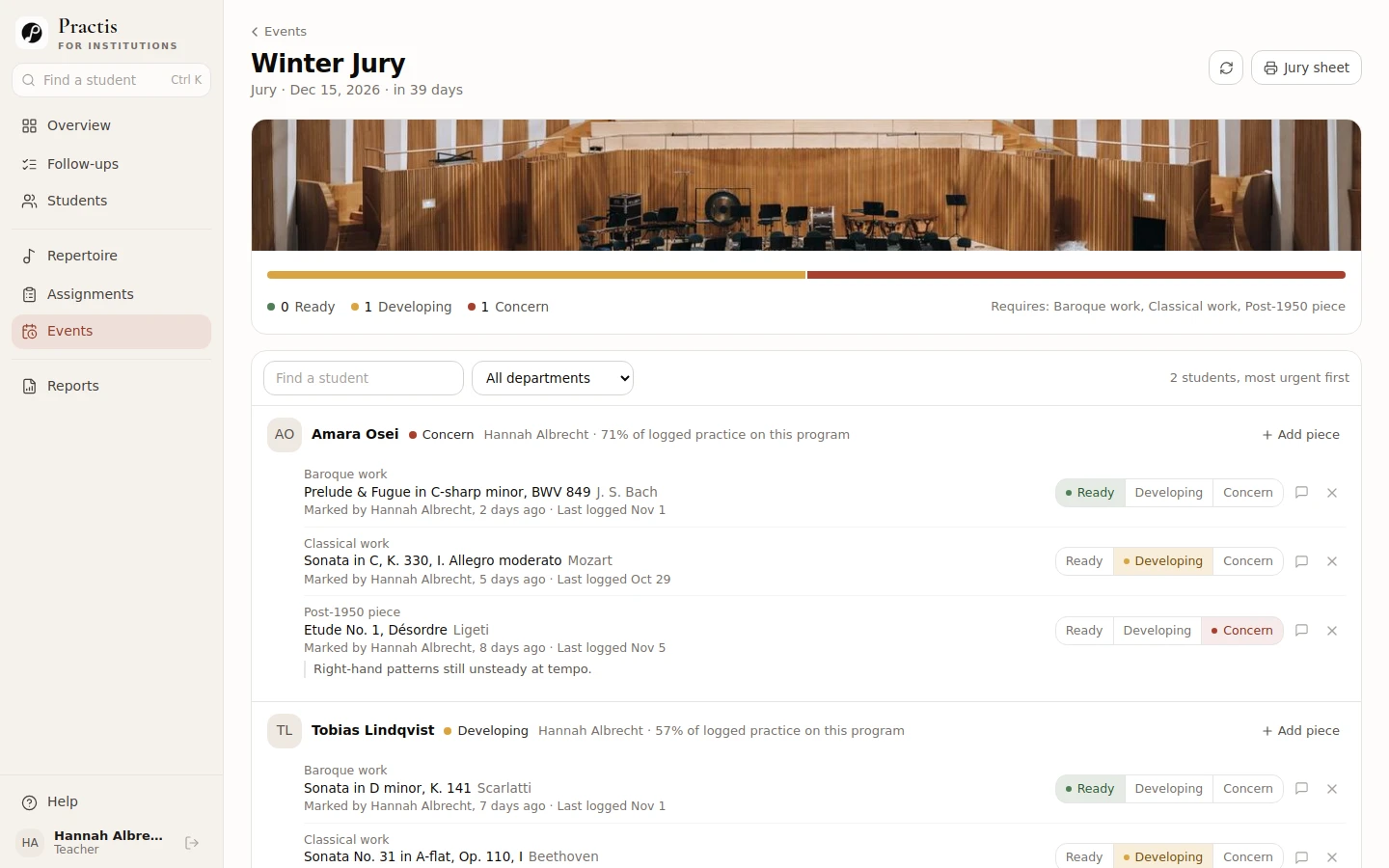
- The requirements line describes this event.
- Here it names a Baroque work, a Classical work and a post-1950 piece. Those are the configured requirements for the pictured jury, not default rules for every recital. A filled slot means a piece has been assigned to it; faculty still check the choice against their syllabus.
- The piece verdict carries the musical judgement.
- Amara's Bach is Ready, her Mozart Developing and her Ligeti Concern. The named teacher and date sit beside each assessment. The Ligeti note explains the concern: “Right-hand patterns still unsteady at tempo.” Another faculty member can see what needs discussing rather than guess from a red mark.
- The student's summary draws attention to the outstanding problem.
- Amara's overall label is Concern even though another piece is Ready. Her 71% figure is the share of her logged practice spent on this programme. It is not a 71% readiness score and cannot cancel the teacher's concern.
A summary can also signal an administrative gap. Near an event, an unfilled requirement or an unapproved programme entry can make the student show Concern. Open the entries to establish whether the issue is an unfinished approval, missing music or an actual teacher verdict. The same label can require a different next conversation.
Not reviewed also needs interpretation. It can mean that no programme has been entered, or that an existing piece has no teacher verdict. Ready at student level requires the configured requirements to be filled, the entries approved and every piece marked Ready. Developing covers preparation that has not yet reached that point, provided a more urgent concern or missing review does not take precedence.
Approval and assessment are separate controls. A student's proposed piece is approved as a repertoire choice before the normal verdict controls appear. Teachers can then choose Ready, Developing or Concern and add a short explanation. Recorded practice and run-through hints provide context; they do not listen to the playing or determine its quality. A missing log is not proof of missing practice.
Keep an unresolved musical concern visible
At their review, Mira says she can play the Poulenc finale's difficult passages separately. She loses her place when a rapid exchange with the piano goes wrong and has been restarting from the beginning. Daniel says he can follow her planned pacing but cannot reliably tell where she will rejoin after a breakdown.
That exchange gives Elena a more useful problem than “the finale needs work.” The pair need a shared way to continue after the interruption, and Elena needs to hear whether that continuity survives a complete performance. Simply adding more isolated repetitions would leave the ensemble question unanswered.
Elena's verdict note: Finale stopped twice in rehearsal with pianist. Re-entry needed teacher cue. Hear complete sonata together on 16 November, checking shared pulse and recovery.
The note is short enough for the board's 200-character field. Fuller rehearsal instructions belong in the teaching record. Elena and Daniel agree rehearsal starting points with Mira and arrange time together before that review. Their task is to make the music continue convincingly, including when something imperfect happens.
On 13 November, Elena hears the complete Schumann set with Daniel. The example's result is positive: the pair sustain the line across the three pieces and manage the transitions together. The corrected entry is approved, and Elena records Ready. That resolves the missing review without implying that the Poulenc has improved.
At the 16 November Poulenc review, the first two movements hold together. The finale improves until a missed exchange causes another stop; Mira still waits for a cue. Elena keeps Concern. She explains this to Mira before the hearing, including the possibility that the recital may need to move. An encouraging lesson can acknowledge the improvement while preserving the decision that remains unresolved.
They consider replacing the work, but the alternative has not been rehearsed with Daniel and would need fresh programme approval. Changing the title on the list would hide the immediate concern while introducing unheard music. Elena instead brings the current programme and an explicit recommendation to the committee: hear the sonata as prepared, and do not confirm the recital date unless the required continuity is demonstrated.
What the committee should receive
The staff record before the hearing now has an intelligible shape: the programme is complete and approved; two works have current Ready verdicts; the third has a specific Concern with a dated account of what remained difficult. Daniel's attendance is confirmed. The programme text has been checked against the scores. The school can distinguish a complete submission from a favourable performance decision.
Use a short final check before sending that record:
- Identify the exact music. Include works and movements, complete or selected sets, agreed repeats or cuts, collaborators and the student's actual timings. Check notes, translations and other documents against the local requirements.
- Identify what has been heard. Give the reviewing teacher and date, and say whether the pianist or other performers were present. An isolated passage heard last month does not describe today's complete programme.
- State the outstanding decision. Describe the remaining musical issue and the recommendation. If a condition or another hearing is possible, use the institution's authorised procedure and name who will confirm the result.
In this fictional hearing, the committee hears the same interruption and postpones the recital under the school's assumed procedure. Elena explains the musical reason to Mira; the office handles the date change and the school records the formal outcome in its normal hearing record. They agree a new review after further rehearsals with Daniel. The case ends with a clear decision, even though the musical preparation continues.
Practis can keep the current programme and teacher assessments visible during that work. Its optional event outcome note is not an official grade record, and a Ready label does not replace committee approval. For the separate task of assigning and checking the next staff action, our student follow-up guide follows three teaching cases through ownership and closure.
Once a recital is approved, the recital running-order template deals with performance order and changeovers. A student preparing the next hearing can use performance-style run-throughs to rehearse the full task their teacher needs to hear.
To see how this looks across your own faculty, arrange a Practis institution walkthrough around the next performance cycle. Bring its requirements and one programme with an unresolved question; the useful test is whether the right staff can see what remains to be decided.