A student's name comes up at a staff meeting. Their teacher knows about the problem; the office has seen an email; someone suggests an extra rehearsal. A week later, everyone remembers the conversation and nobody is certain what happened next.
A useful music-school follow-up gives one person responsibility for the next action and sets a point at which they will check the result with the student. The record needs to show that result, including when the first attempt did not help. Three fictional cases below show how this can work, alongside the follow-up controls in our own Practis institution workspace.
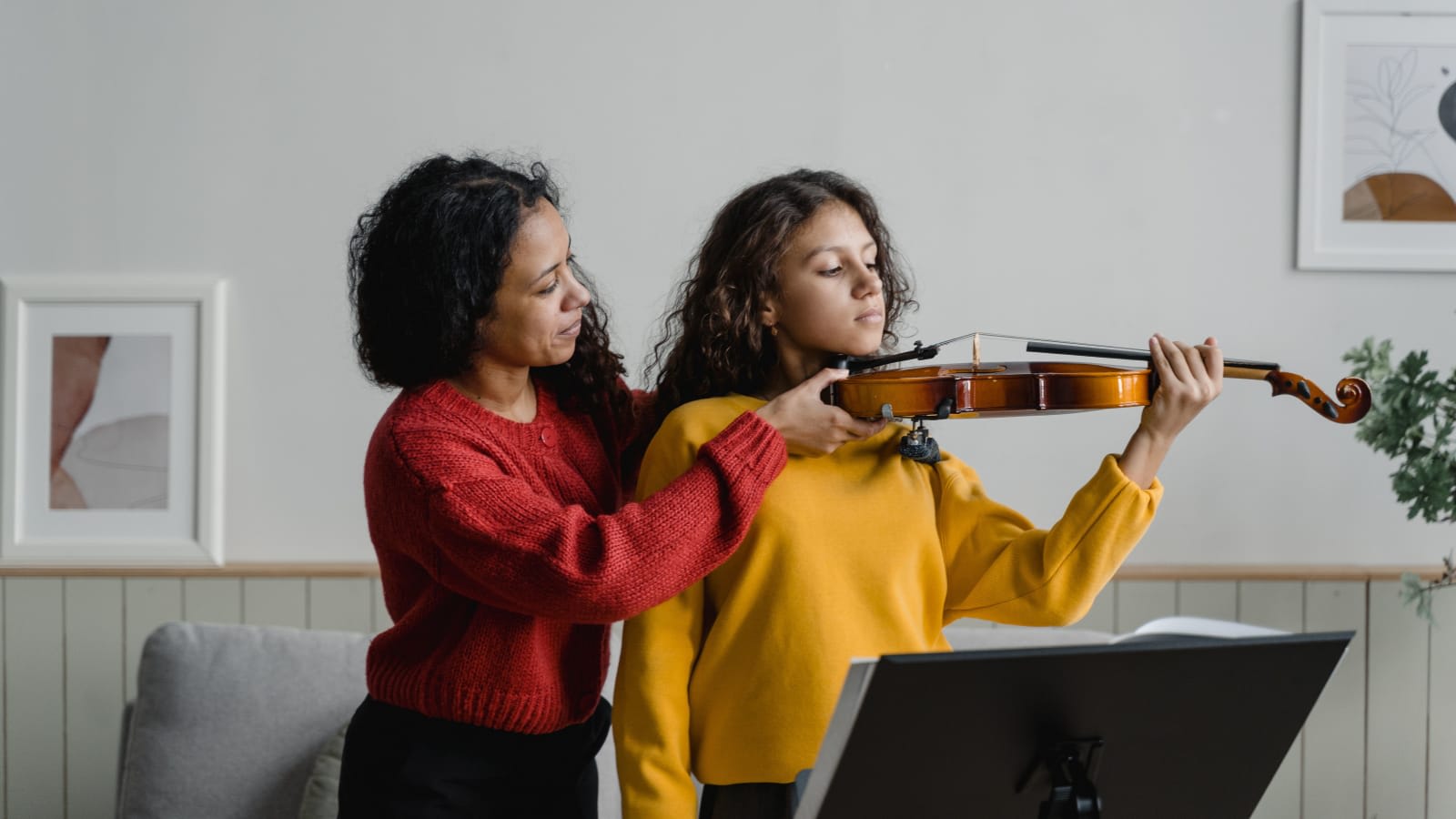
Featured photograph: Tima Miroshnichenko / Pexels. A general lesson photograph; the people pictured are unrelated to the fictional cases.
Leah has marked an assignment “stuck”
Leah, a violin student, has marked her bowing assignment as stuck. Her teacher, Rosa, sees the follow-up before their Tuesday lesson. The assignment says to keep the bow moving through a four-bar phrase, but Leah has understood this as an instruction to play the whole phrase in one bow.
That explanation changes the lesson. Rosa demonstrates the intended bow changes and asks Leah to show where she will change direction. They agree a shorter task that Leah can explain and begin herself. Sending the original instruction again would have left the misunderstanding intact.
Rosa is the named owner because she can clarify the musical instruction and hear the result. An administrator could arrange an appointment, but should not be expected to judge Leah's bowing. Rosa puts the follow-up In review while the revised task is being tried.
Student's account, 3 November: Leah thought the phrase had to fit into one bow and ran out before the last bar.
Owner: Rosa, Leah's rostered violin teacher.
Next step: Practise bars 1–2 with the marked bow changes. Rosa will listen on 10 November and ask Leah to explain the task before playing.
Review, 10 November: Leah describes the bow changes correctly and plays the two bars with them. The original misunderstanding has been addressed; the longer phrase still needs work.
Resolution note: Task clarified and demonstrated back on 10 November. Leah can begin the agreed two-bar practice independently. Continue the phrase in ordinary lessons.
Rosa records the outcome and resolves the follow-up while it is still present, then updates the underlying assignment separately. Resolving the follow-up does not mark an assignment completed.
The small check matters: can Leah explain and begin the intended task? “We spoke about it” would record a conversation without telling the next teacher whether anything had changed. It also avoids turning a solvable misunderstanding into a permanent description of the student.
Music Mark’s A Common Approach places discussion with the learner at the centre of formative assessment: teacher and student review progress and decide the next work together. Its recording guidance favours brief, clear observations focused on selected skills. That is a useful standard here. The follow-up holds the unfinished action; the lesson note carries the fuller teaching detail.
Where the action lives in Practis
Practis brings certain existing teaching signals into its follow-up list. They include an assignment marked stuck, a teacher's Concern verdict on an upcoming event programme, and an approaching event with no programme entered. These are reasons to look more closely. A gap in logged practice, for example, tells you that no practice was recorded there; it does not establish that the student did no practice.
The panel works with those generated items. It does not provide a blank form for creating any kind of student support case. If a conversation raises a separate concern that has no corresponding item, keep the action in the school's appropriate record instead.
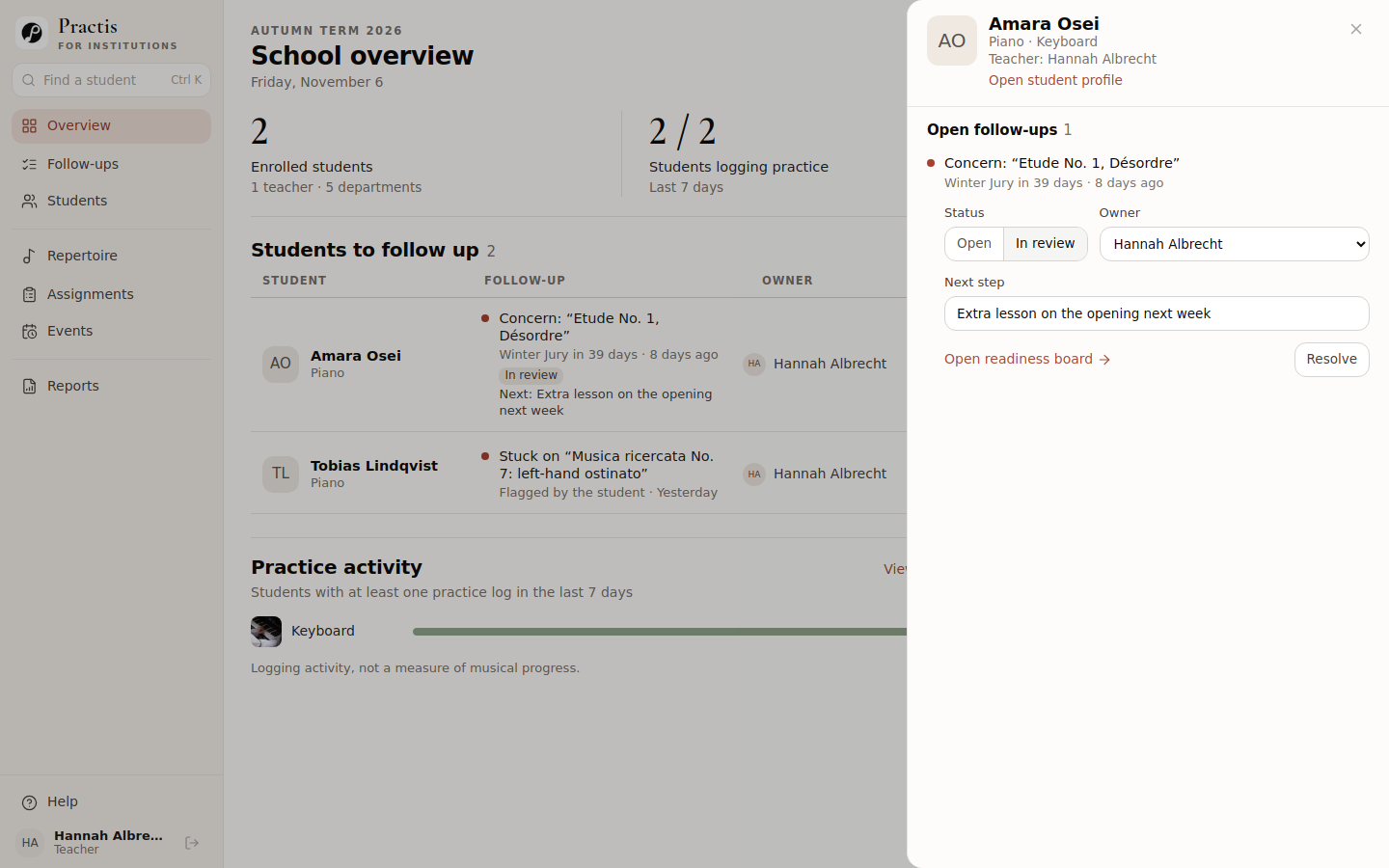
In the screen, the concern about Amara's programme piece has an owner and a next step, “Extra lesson on the opening next week.” That is a useful start. To make the plan easier to review, the teacher could specify which opening passage to hear and the actual lesson date. A screenshot cannot tell us whether that lesson happened or helped.
- Choose an owner who can act. The selector offers the student's rostered teachers and institution administrators. A teacher normally already appears as the owner. Confirm that the person knows what they are taking on; a name in a field does not confirm a conversation. Department heads have read-only access, so they coordinate action with an authorised teacher or administrator.
- Write the next action and review date together. The Next step field holds a short sentence. There is no separate review-date control in this panel. Include the date in the sentence and use the school's normal calendar for any appointment or reminder.
- Use In review while the action is underway. Changing the owner or status saves that change. For Next step, finish editing and leave the field or press Enter. The person doing the work still needs to arrange the lesson, speak to the student or contact a colleague through the usual school channel.
- Resolve an item after checking its outcome. Resolve opens an optional “What happened?” field before Mark resolved. A short outcome note makes the decision intelligible later. Resolved history shows who resolved it, when and the note, if one was entered.
The status belongs to this particular follow-up. It does not certify that every piece is ready, that a student needs no further support, or that every associated assignment is finished.
Nico's music is agreed, but the programme is empty
Nico's trumpet recital is approaching, and the school sees “No program submitted.” His teacher, Owen, has already agreed two pieces with him on paper. Nico thought those choices had been passed to the office. The office has no entries for his event programme.
The first conversation establishes that Nico is preparing music. The missing information is the programme itself. Owen confirms the exact titles and movements; Priya, an institution administrator, owns the job of getting the agreed choices into the event record and checking them back with Nico.
Observation, 4 November: No pieces entered for Nico's 14 November recital, although he and Owen have agreed the music on paper.
Student's account: Nico expected the agreed choices to be forwarded. He can identify both scores and the movements he is preparing.
Owner and next step: Priya will obtain Owen's confirmed list, enter the pieces and check the displayed programme with Nico by 6 November.
Review, 6 November: The entries match the confirmed list, and Nico recognises the correct movements. Owen will assess their readiness separately.
Outcome: The missing-programme prompt disappears once the pieces are entered. Priya records the completed check in the school's ordinary administrative record.
This case closes differently from Leah's. Correcting the underlying information can make a prompt disappear without adding a resolved-history note. Once that prompt is gone, there is no remaining active item to resolve. If the school needs a record of who checked the programme, it should keep that in its normal record rather than assume the disappearance created one.
Entering music also leaves a separate question: has a teacher assessed it? A complete list of titles is useful to the office, but says little about how the recital currently sounds. Likewise, a programme awaiting approval is not the same as an empty programme. The “no pieces entered” prompt refers to the latter.
Priya does not need to chase Nico for more practice or write a judgement about his organisation. Her task is to finish a specific exchange of information. Owen retains the musical decision.
Samira practises the entrance, but still misses it in rehearsal
Samira, a clarinet student, can play the opening of her piece alone but misses the entrance after the piano introduction. Her teacher, Inez, records a Concern verdict for the event programme piece. Inez owns the resulting follow-up and initially asks Samira to practise the opening slowly, beginning from her own first note.
At the next rehearsal, the entrance is still uncertain. It would be easy to leave “practise opening” in the record for another week. Instead, Inez asks Samira to describe what she is listening for before she comes in.
Samira explains that she has been rehearsing her part successfully, but does not recognise where she is in the piano introduction. The first action did not recreate the problem. They need to rehearse hearing and joining the preceding music, with the pianist, as well as playing the clarinet notes.
Inez keeps the follow-up open while they try that change. Her reviews show both the unsuccessful first attempt and the later improvement.
| Review | What happened | Inez's next decision |
|---|---|---|
| 2 November | Samira plays her opening alone. Her entrance after the introduction remains uncertain. | Keep In review. Ask Samira what she hears before entering, and arrange a rehearsal with the pianist. |
| 5 November | Together they identify an audible cue in the piano part and practise starting from the preceding music. Samira can explain the cue. | Keep In review until a later attempt shows whether she can use it without a teacher's prompt. |
| 9 November | Samira joins from the introduction on two starts without Inez counting her in. The later section still needs ensemble work. | Record the result and resolve the entrance follow-up. Update the piece's readiness separately to Developing. |
On a phone, swipe sideways to read all three columns.
Inez arranges the pianist's involvement through the school's usual rehearsal process. The follow-up owner stays Inez; the pianist does not need to become an app owner to contribute. Her revised Next step could read: “Rehearse the cue with pianist on 5 November; Inez checks entrance from the introduction without counting in on 9 November.”
The resolution note is equally specific: “9 November: joined from the piano introduction twice without a count-in. Entrance concern addressed; later ensemble section remains in progress.” Inez saves that outcome on the still-present concern, then changes the readiness verdict. Marking a follow-up resolved does not change that verdict for her.
Two successful starts give Inez a reason to close this entrance concern. Another student or piece may need a different check. If a later rehearsal brings the problem back, it deserves attention again; a new Concern verdict can bring the item back into the open list.
The important change in the middle of this case is the explanation. Samira's account reveals why more of the first task would have missed the difficulty. A 2024 qualitative study of dropout in Slovenian music schools similarly found intertwined accounts involving repertoire choice, relationships, perceived competence, resources and competing commitments. It drew on five focus groups with former students, parents, teachers and principals. The study offers reasons to ask beyond practice totals; it did not test a follow-up system, predict individual departures or establish that software improves retention.
Make the staff review about the unfinished decision
A staff review is useful when it changes what will happen next. For each open item, the owner should be able to say what they learned from the student, what they have done and when the result will be checked. If the review date has passed, establish whether the action happened before interpreting the student's response.
If the named teacher is absent, agree cover with someone who has the relevant access and teaching responsibility. If the action depends on a colleague, name who will contact that colleague. “Waiting for the pianist” leaves an ambiguity; “Inez to confirm Thursday's rehearsal with the pianist by Tuesday” gives someone a job they can finish.
Keep the discussion proportionate. Leah's two-bar assignment does not need the whole faculty involved. Nico's missing entries need an accurate programme. Samira's entrance needs a musical review. A report for a family can later draw on these checked observations; the three end-of-term report examples show how to turn such details into readable accounts of progress.
Ordinary follow-up notes should contain the information needed for teaching and coordination. A sensitive disclosure belongs in the school's designated safeguarding or support process, with its appropriate access and records. The ISM’s code for its members requires confidentiality subject to its safeguarding responsibilities, and asks teachers to stay within their professional competence when advising families. A routine next-step field is not the place to assemble that wider confidential history.
When responsibility changes permanently, use a proper teacher handover as well. Reassigning one follow-up is only one part of passing on current teaching and access responsibilities.
A short record for the next review
A small studio can use an approved document or paper record for the same purpose. The editable sheet below separates the first observation from the student's explanation, and leaves room for a second review when the initial plan has not helped. Keep one authoritative record in the school's chosen place rather than maintaining competing copies.
Download the editable student follow-up record (DOCX)
The blank sheet includes an owner, next action, review dates and a final outcome. It is a separate document for your school's records; it does not import into Practis.
Copy the blank record as text
Student reference / instrument / date: ______
What was observed, and where? ______
What does the student say is happening? ______
Named owner / any colleague to contact: ______
Agreed next action / who will do it / by when: ______
Review date / what the owner will check with the student: ______
Review result / keep open, change the plan or close: ______
Further action and review, if needed: ______
Final outcome / checked by / date / where recorded: ______
For a school coordinating these concerns across teaching and administration, see Practis for institutions and bring one ordinary follow-up to the walkthrough: who would own it, what they would do next, and what would count as having dealt with it.