An end-of-term music report should help a student recognise something they can now do, understand what still needs attention and see a worthwhile reason to continue. A list of pieces and practice hours supplies part of that story; the teacher has to explain the musical change. The three complete reports below show how that can work for a beginner pianist, an advanced singer and an adult returning to guitar.
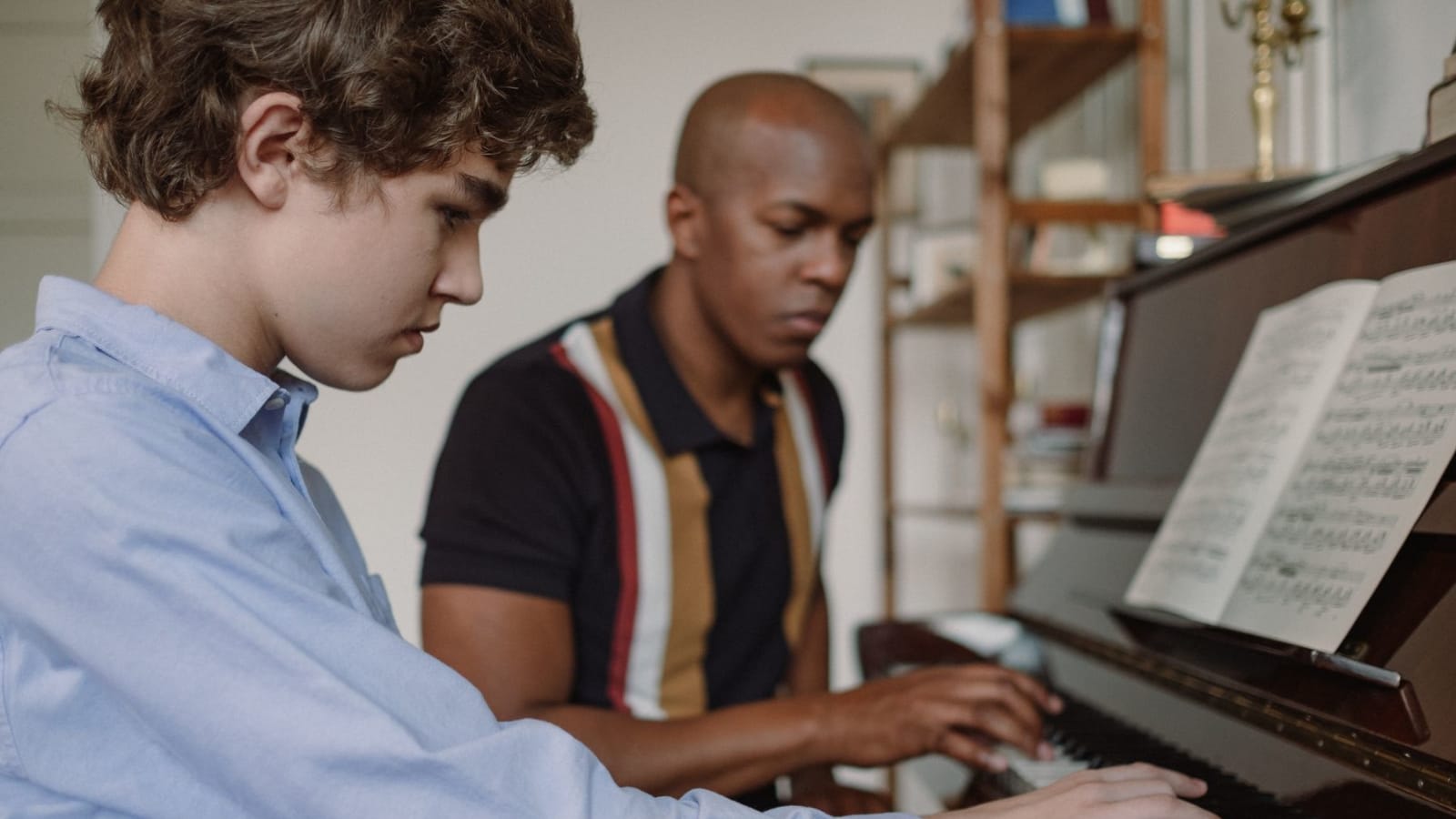
Featured image: cottonbro studio / Pexels.
Start with something the student can hear
“Good progress” leaves the reader guessing. Perhaps the student can keep playing when a note goes wrong, bring out a melody without a reminder, enter after a piano interlude or explain why they chose a particular sound. Name that change and the situation in which it happened. Then be equally precise about what is still unsettled.
Before: “Ellis has worked hard, completed several pieces and improved their rhythm.”
After: “In the final duet, Ellis kept the tune moving after a wrong note and rejoined at the next phrase. Earlier in the term they would stop and begin again. Keeping the same pulse while the left hand changes position still needs work.”
The revised version gives a starting point, an observation and a remaining task. It also avoids pretending that finishing a piece proves every part of it is secure. The useful detail may already be in your lesson notes, a dated recording or the student's own account. Choose the evidence that supports the point you want to make, rather than attaching everything you have.
Music Mark’s reporting guidance recommends clear language, progress against individual learning aims and room for the learner's response. It also recognises that musical qualities cannot always be expressed adequately through marks. A report can therefore describe an important change even when there is no examination result or completed level to announce.
All three reports below are fictional. The students, lessons and performances were created to demonstrate the writing. Adapt the structure and level of detail; replace every observation with something you can support about the student you teach.
A beginner pianist: keeping the music moving
Example report · Ellis
Beginner piano · Autumn term · Written for Ellis and their parent or carer
Ellis began the term finding familiar tunes by ear and looking to the teacher for help with each new line of notation. They can now read the short melodies we have studied, find their starting notes and explain when the tune moves up, down or stays on the same note. In the final lesson, Ellis started a familiar piece from the middle after finding the place in the score. This was a useful step towards playing with less prompting.
The clearest change has been in keeping a tune going. In our duet on Mary Had a Little Lamb, Ellis continued after a wrong note and found the next phrase while the accompaniment carried on. Earlier in the term, an error usually meant stopping and returning to the beginning. Ellis also chose a quieter ending and was able to hear the difference when we played it back.
Keeping the pulse steady while the left hand changes position is still developing. Ellis can manage the movement on its own, but pauses sometimes return when both hands are involved. Next term we will work on that change within a short phrase, then hear whether the phrase keeps moving in the duet. The teacher will model the task before it goes home.
Ellis would like to learn another tune they recognise. We will choose one together and use it to practise reading ahead. At home, a helpful contribution is to listen to the agreed phrase and ask Ellis which attempt felt easiest to continue. A complete performance can remain something to enjoy, without every wrong note becoming a new instruction.
This report identifies growing independence and a musical decision as well as note reading. Its unfinished goal is audible: the phrase still pauses at a particular kind of movement. A family can understand the next step without being asked to teach hand coordination.
An advanced singer: progress within demanding repertoire
Example report · Leila
Advanced singing · Autumn term · Written for Leila and the teaching team
Leila's main aim this term was to make the meaning of the text shape her performance, while becoming more independent in rehearsals with a pianist. In Schumann's Widmung, she began with the notes and German text substantially learned, but often needed a reminder to direct a phrase towards its important word. She now explains her interpretation before singing and can make a deliberate difference between a direct statement and a more reflective passage.
In the final studio rehearsal, those choices remained audible through a complete performance. Leila also discussed the opening pace and agreed a shared ending with the pianist, rather than waiting for the teacher to make those decisions. Her preparation now includes marking the piano's contributions and identifying the sounds she will listen for before an entry. This is a meaningful development in ensemble responsibility.
Consistency is the next priority. At the faster pace tried in rehearsal, some word endings became less clear, and an unsettled entry led Leila to watch the teacher for confirmation. The performance shows a stronger interpretation, but it does not yet establish that the same result will hold in an unfamiliar room or with a different pianist.
Next term, the teacher and pianist will review the entry and the clarity of the text within complete phrases. A later run-through will test whether Leila can communicate her interpretation and recover from a missed cue without stopping. Leila has asked to keep an English-language song alongside the German repertoire so that she can compare how naturally she communicates in each. Her next programme will reflect that choice as well as the course requirements.
The report credits interpretive and collaborative work, then names what would make that progress dependable. Leila has a clear reason to revisit the same song: she is learning to carry her interpretation through a complete performance with less prompting.
A returning adult guitarist: reporting against a chosen goal
Example report · Daniel
Returning adult guitar · Autumn term · Written directly to Daniel
You returned to lessons wanting to accompany songs comfortably enough to play with other people. You remembered several chord shapes, but moving between them often interrupted the strumming. Our work this term has concentrated on keeping a simple accompaniment going, using The Water Is Wide in the arrangement we chose together.
In the final lesson, you maintained the accompaniment through a complete verse while the teacher sang. When one chord did not sound clearly, you kept the pulse and joined the next change. You also gave an opening count and agreed the ending before we began. Those are practical steps towards the kind of shared playing you wanted, even though the chord changes are not yet consistently clean.
The change into the less familiar chord remains the main interruption when you sing as well as play. You can make it more easily when the guitar part is simplified. Next term we will keep that simpler version long enough to practise the coordination, then decide together whether a fuller strumming pattern helps the song. There is no need to add difficulty solely to make the arrangement look more advanced.
Your written practice record is incomplete, so it cannot give a reliable total for the term. You have described returning to the same song between lessons, and the playing heard in lessons gives us a better basis for discussing what has changed. We will use a short note about the troublesome change when that is useful, without treating an empty entry as evidence that you did not play.
Your next goal is to accompany a complete song for someone you choose. At the start of next term we will hear the current version again, agree which section needs attention and leave room for a new song you would enjoy. An examination is not part of the goal you have set.
This version speaks to the adult learner and uses their purpose as the point of comparison. It distinguishes an incomplete practice record from the playing actually heard. The teacher still gives a clear assessment; enjoyment does not require vague praise or an artificially easy standard.
For a returning learner, agreeing what progress means is part of the work. The adult practice-goals guide develops that conversation beyond the report itself.
When progress is uneven, say what remains uncertain
A term may contain patient work without a convincing complete performance. A student may understand the problem in a lesson but struggle to solve it independently. Those distinctions belong in the report. Writing “no progress” erases what changed; writing “excellent progress” can conceal the exact help the student still needs.
Too broad: “Needs to practise more to reach the required standard.”
More useful: “The opening is more secure when played on its own, but the same hesitation returns in a complete performance. Next term we will practise entering that passage from the preceding phrase and review it again in a full run.”
That sentence makes a limited claim and changes the teaching plan. It does not infer effort, motivation or ability from an unfinished piece. If the teacher has not heard the work recently, say so: “The last complete performance heard in a lesson was before the break; the current ending still needs review.” A report need not manufacture certainty to sound professional.
Keep three sorts of information recognisable. “The log contains practice entries” describes a record. “The student says the slow version feels easier” describes their experience. “The melody remained audible above the accompaniment in the lesson” describes a teacher's observation. Combining them can be useful; silently turning the first two into the third is misleading.
The same applies to percentages. A piece marked partly complete in an app may help someone organise their work. It does not mean the student has acquired that percentage of the musical skills required, or earned the equivalent examination mark. Use a musical description when the report is making a musical judgement.
Use the printable record as the starting material
Practis is our platform. Its institution workspace brings a student's lesson entries, programme pieces, repertoire and logged practice into a printable student report. That helps a teacher review the records behind the prose. The finished paragraphs above are still written by a person; the report screen does not compose them or provide a narrative editor.
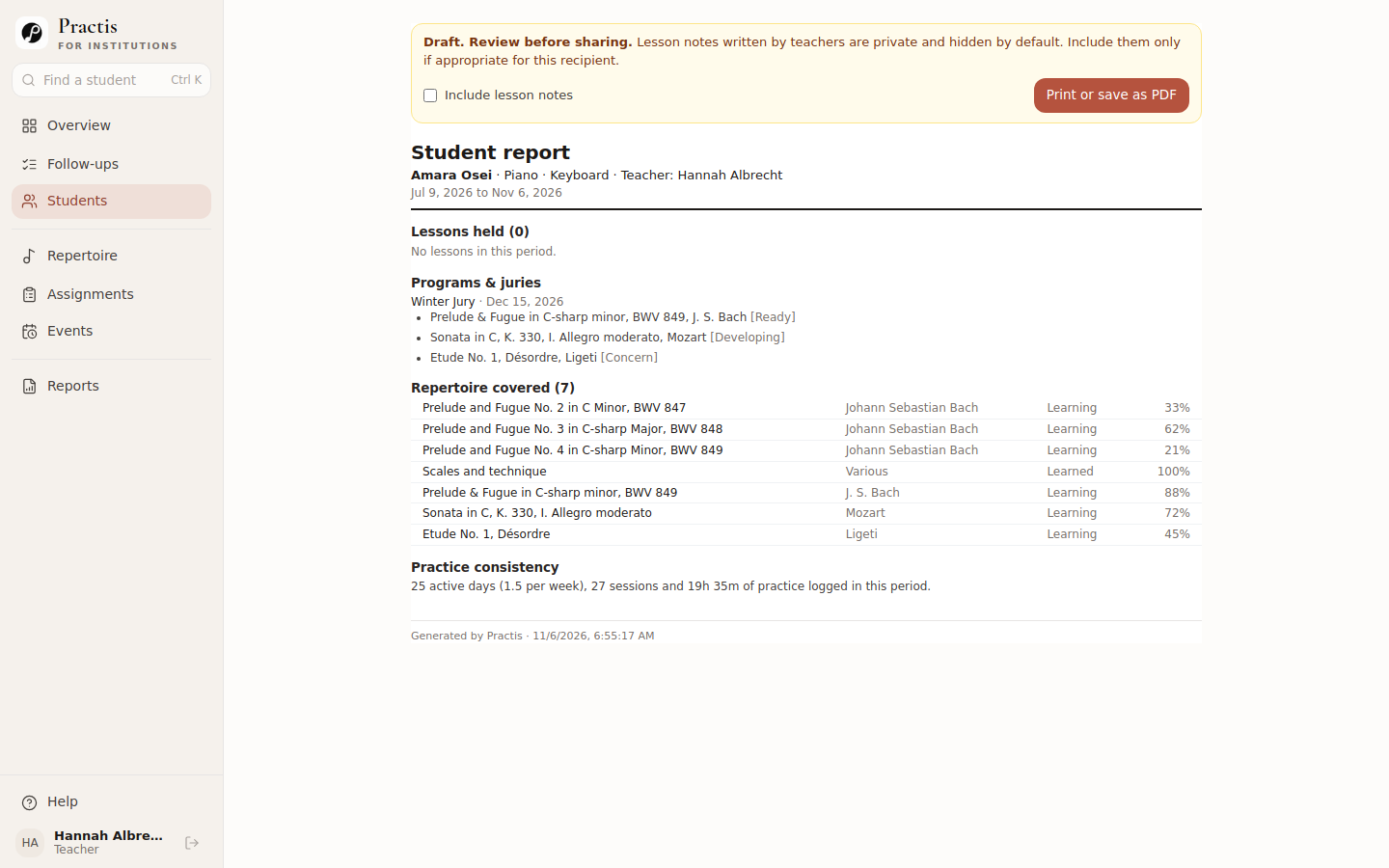
Start from Reports, set the dates you want to review and open Student report beside the student's name. Check the date range at the top. The shortcut on the individual student's page opens a report too, but its initial range is the previous 120 days, which may not match your term.
The selected dates apply to lesson entries and practice totals. Programme and repertoire sections can also contain work outside that period, so read their dates and titles before describing them as this term's achievements. In the screen shown here, a forthcoming jury appears above the repertoire record. Its preparation status describes work towards an event, not a result already awarded. Our jury-software comparison explains that distinction in more detail.
Also check what the underlying records mean. The section headed “Lessons held” lists recorded lesson entries; confirm attendance against your school's record before reporting it as attendance. The example screen has no lesson entries in its selected period. That does not establish that the student received no teaching. Practice totals likewise describe what was logged, not everything the student necessarily played.
Lesson notes are hidden by default. The report has an Include lesson notes checkbox and asks staff to review the draft before sharing. Selecting it can add a teacher's strengths, challenges, breakthroughs and next-focus notes. Read those notes for this particular recipient before including them; a private reminder may need to be rewritten as a considered report sentence elsewhere.
Print or save as PDF opens the browser's print process. Review the saved document, then use your institution's agreed method of sharing it. This screen does not automatically email parents. If you want to send a narrative report with a supporting record, prepare the narrative in your usual document tool and decide whether the full printout is useful to its reader.
To see how the student records and printable reports could work across your school, ask for an institutional walkthrough. Bring one report you already use and an example of the information staff currently have to collect for it.
Make the final page belong to this student
A shared school format can make reports easier to read while leaving teachers room to describe different kinds of music-making. Use a short identification line for the student, teacher and reporting period, then write connected paragraphs around the agreed aim, the change you have heard, the part still developing and the next step. Include relevant attendance or results where your school requires them, using the confirmed record.
Download the editable music student report template (DOCX). It includes a blank writing page and all three fictional examples. Adapt it in your usual word processor, remove the prompts and keep only the information that belongs in the final report.
The ISM’s guidance for private teachers asks its members to offer parents of child pupils progress communication at least once a term, through a written report, discussion or both. For adult pupils it describes progress communication as part of tuition. That is a useful reminder to choose the reader and purpose, rather than sending every learner the same parent-facing form.
- Read the evidence against the wording. Could you point to the lesson, performance, recording or student comment behind each important claim? Check that a future goal has not accidentally become a completed achievement.
- Read it from the recipient's position. Explain unfamiliar terms, remove unnecessary personal detail and make sure the proposed next step is understandable. An adult learner should be addressed as the learner.
- Leave room for a response. Invite the student to identify a change they recognise and something they would like to work on. Record a different view accurately instead of forcing agreement with the report.
- Check the version you will send. Confirm the name, dates, attachments and recipient. Keep the final report with its issue date so the next term's review has a clear point of comparison.
A useful final sentence can be quite small: “At the first lesson next term, we will play the duet again and listen for whether the phrase continues through the hand change.” It gives the student and teacher somewhere concrete to begin.