A repertoire entry that says “Beethoven, Pathétique, learned” leaves the next teacher with several questions. Was it the slow movement or the whole sonata? Did the student perform it, submit it for assessment, or simply reach the last page in lessons? A useful school record keeps those answers available when the people and plans around the student change.
Keep a clear identity for the music, a dated history of what happened to it, and a separate statement of its current use. That gives a department something it can use for next term’s programme without reconstructing the previous year from emails. The three completed records below show how this works for piano, violin and voice; there is also an editable template to keep.
What needs to survive a change of term
A student may study a piece without performing it. A public performance may never receive a formal assessment. A successfully assessed movement may then sit untouched for a year. All three facts belong in the history, even when the current status changes.
For each work or movement, these four questions prevent a surprising amount of ambiguity:
| Question | Useful entry | What it leaves open |
|---|---|---|
| What was studied? | Exact movement or extract, teacher and dates; identify incomplete coverage. | Whether it was ready for an audience. |
| What was performed? | Date, event and actual music performed, with a programme reference where available. | Whether it received an assessed result. |
| What was assessed? | Date, scope and a reference to the school’s official result or feedback. | Whether it remains ready today. |
| What is active now? | Current project, working version and date of the latest relevant teacher check. | Whether it is approved for a particular future event. |
The musical identity needs more than a short title. Record the composer, catalogue number, movement and extent studied. Add the edition and arrangement where those affect the work, and the sung language and selected key for voice. “Complete” should refer to the named scope: a complete Sarabanda is still one movement of a partita.
A single record can accumulate several dated entries. When a student starts another movement, give that movement its own linked entry or a clearly separate section. Changing “II” to “I” in an old row would quietly attach the earlier concert and assessment to the wrong music.
Three completed repertoire records
These are fictional school records. The music and identified editions are real; the students, teachers, dates, performances and confirmations are invented to show the decisions a record should support. The detail is deliberately different in each case.
A blank record and all three examples. Use it in your school’s approved document system; it is a separate document, not a Practis import or an official university form.
Piano: one movement, with its own history
Clara’s slow movement has both a concert history and an assessment history. Neither entry says she has studied the entire Pathétique. Her new work on the first movement can develop alongside that history without changing what the summer record means.
- Student / teacher
- Clara Patel, piano / Ellie Morrison
- Work and scope
- Ludwig van Beethoven: Sonata No. 8 in C minor, Op. 13, Pathétique. This record covers movement II, Adagio cantabile, complete. Movements I and III are outside this record.
- Score used
- G. Henle Verlag, HN 1348; editors Norbert Gertsch and Murray Perahia; fingering by Perahia. Student’s printed copy, with lesson markings.
- Study and current use
- Studied January–June 2026. Inactive since the summer assessment. Movement I began in September and has a separate linked entry.
- Performance history
- 18 June 2026: complete movement II at the school’s summer concert, from memory. Programme retained in the school record.
- Assessment history
- 25 June 2026: complete movement II heard at the end-of-term assessment. Panel feedback is filed separately; the result does not cover the whole sonata.
- Teacher confirmation
- Ellie Morrison, 2 July 2026: scope and the June performance/assessment entries checked against the programme and assessment record.
- Next programme decision
- For a future complete-sonata proposal, check the separate histories of I and III and arrange a new hearing. June’s entry establishes what happened to II only.
The edition entry identifies Henle’s HN 1348 edition. That is useful if the next teacher needs to distinguish the printed fingering from Clara’s lesson annotations. An edition name also makes a later discussion of editorial markings much more precise than “the blue book.”
Violin: keep the performed version identifiable
Jonah returns to a movement he played earlier in the year. The question now concerns his revised bowing and current playing. A dated note about the working copy lets the teacher understand the change without erasing the earlier performance.
- Student / teacher
- Jonah Reed, violin / Tomas Varga
- Work and scope
- Johann Sebastian Bach: Partita No. 2 in D minor, BWV 1004, Sarabanda, complete. Solo violin; other movements are not included.
- Score used
- G. Henle Verlag, HN 356, edited by Klaus Rönnau. The marked part has Wolfgang Schneiderhan’s fingering and bowing. Current working copy also has Varga’s bowing changes dated 5 November 2026.
- Study and current use
- Studied September–December 2025. Returned to active study on 2 November 2026 for a proposed January studio recital.
- Performance history
- 12 February 2026: complete Sarabanda at a lunchtime recital, using the earlier working copy. The programme and that copy are identified in the school record.
- Assessment history
- No graded assessment recorded for this movement. February’s public performance remains a performance entry.
- Teacher confirmation
- Tomas Varga, 5 November 2026: movement and working-copy revision checked. A complete run of the revised version has not yet been heard.
- Next programme decision
- Hear the complete movement with the revised bowing on 19 November before deciding on January’s programme. Do not carry February’s readiness judgment forward automatically.
Henle’s HN 356 collection includes marked and unmarked parts. Recording which part the student uses, plus the date of substantial teaching changes, makes the reference usable. There is no need to copy every pencil mark into the repertoire record; the record should help someone find the relevant score.
Voice: preserve the key change
A song title can stay the same while the rehearsal copies change. Mina’s record keeps the earlier key in the history and makes the current one clear to her pianist. It also avoids turning a lesson into a public performance or treating a planned hearing as a completed assessment.
- Student / teacher
- Mina Shah, voice / Elena Park
- Work and scope
- Franz Schubert: An die Musik, D 547, Op. 88 No. 4. Text by Franz von Schober; sung in German. Complete song with piano.
- Score used
- Musicnotes Edition, MN0133304, piano/vocal arrangement. Current selected key: B-flat major. Singer and pianist have matching B-flat copies; the previous C-major copy is marked superseded.
- Study and current use
- Active study since 28 September 2026, initially in C major. Changed to B-flat major on 5 November after a lesson with the teacher and pianist.
- Performance history
- No public performance yet. The 5 November lesson is not entered as a concert.
- Assessment history
- No formal assessment yet. A complete-song hearing is planned for 26 November in B-flat major.
- Teacher confirmation
- Elena Park, 5 November 2026: language, complete-song scope and current key confirmed with singer and pianist. This is not approval for a future assessed programme.
- Next programme decision
- Keep B-flat major on the rehearsal and hearing copies. Check the receiving course’s repertoire and edition requirements before submitting the song for assessment.
The identified Musicnotes arrangement offers both C-major and B-flat-major options alongside its original published key of D major. Those choices explain the example; they are not a recommendation for every singer or course. Schubert-digital identifies the work and its text author. Before an assessed submission, the teacher still needs to establish that the chosen edition or arrangement fits that course.
A new key does not give the song a new history. If an institution restricts repeated repertoire, the earlier appearance of the same work remains relevant. Keep the change within the record and check the local rule rather than treating a transposition as a fresh piece.
Why the history matters to real schools
Schools ask for repertoire information in different forms. The underlying history becomes useful because it can answer more than one of those requests without forcing each department to adopt the same form.
San José State University’s currently linked 2026–27 undergraduate music handbook illustrates two uses. Its junior qualifying examination guidance asks most areas for a repertoire sheet covering method or technique books, solo repertoire studied and repertoire performed publicly. Its voice appendix asks for a collegiate repertoire list organized by language, with titles, composers and an indication of performance. See printed pages 29 and 59; students should check their area’s requirements.
At the University of Toronto, the classical undergraduate jury guidance describes a list prepared by the teacher in consultation with the student and submitted by the teacher; subsequent changes come from that teacher. It also says repertoire from earlier juries should not be performed again. That makes the distinction between an ordinary concert and a previous jury consequential.
The University of North Texas’s voice jury instructions require the list to reflect music assigned and prepared during that semester, with accurate titles and teacher approval and signature. They also direct students to the current forms in CANVAS. A lifelong history can help prepare that semester list, but it does not replace the required form.
These are examples of local policy, not a common rulebook. None of the three fictional records is a submission to those universities. The useful lesson for a school designing its own record is to preserve enough detail to make the correct selection later: a semester’s study, previous jury appearances, songs in a particular language, or complete movements available for consideration.
Where day-to-day repertoire tracking fits
The long-term record and the current teaching view have different jobs. A teacher preparing tomorrow’s lesson needs to see the pieces in progress and recent practice. Someone planning next year’s assessment may need a performance from two terms ago and the precise movement it covered.
In Practis, our institution workspace brings a student’s repertoire and programme preparation into the same profile. The repertoire view below shows named pieces, their stored learning status and progress. The Mozart title includes the movement, which keeps this particular entry’s scope visible.
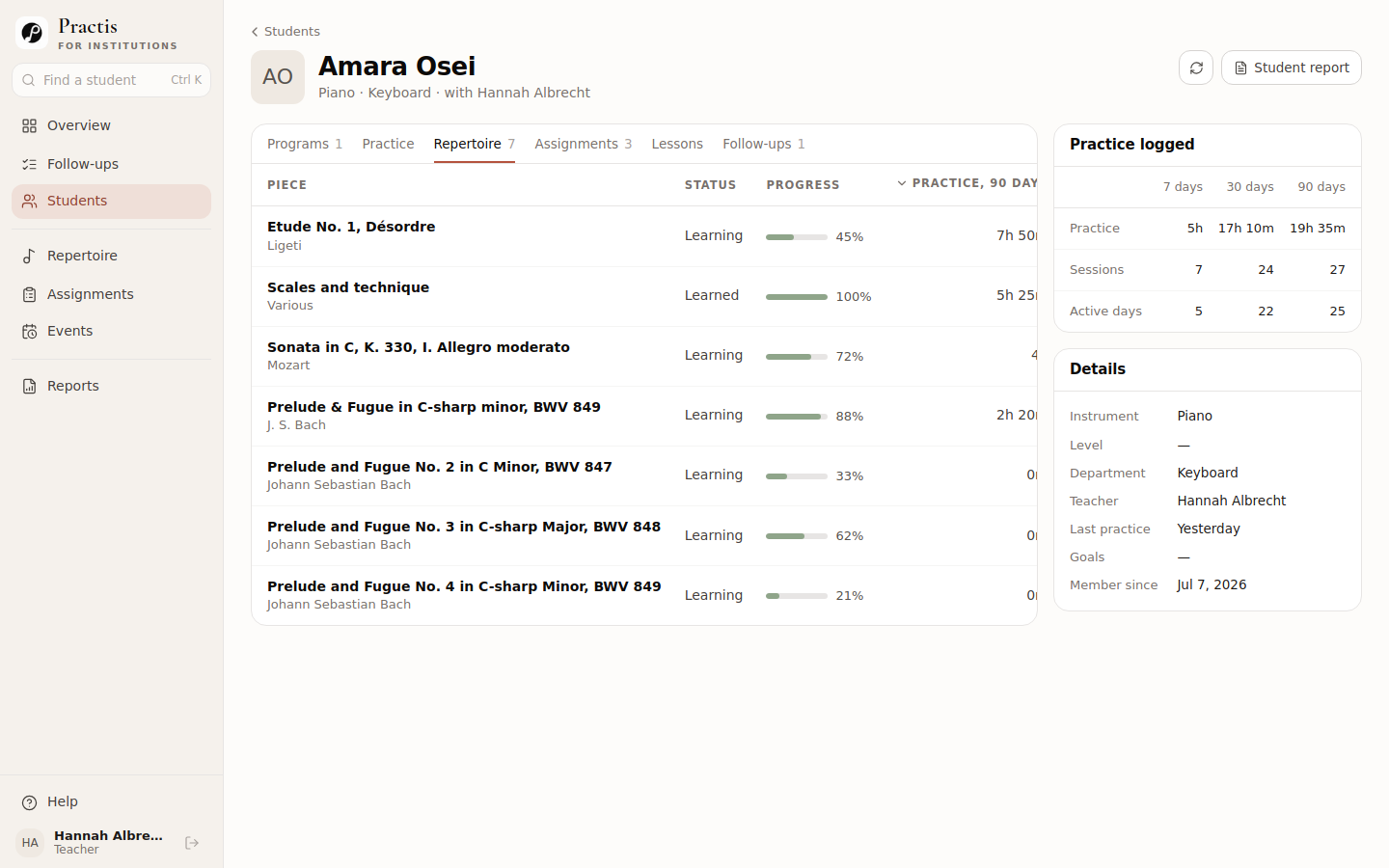
The broader view also includes logged practice, with deadlines and last-practice information where available. Those details help with current teaching, but they do not establish what happened at an earlier recital. A progress percentage can be updated by the student; it should not be read as a panel mark or proof that every movement has been learned.
The programme view adds a different piece of context: the teacher’s readiness judgment for music attached to a particular event. Here, Bach, Mozart and Ligeti have different verdicts within the same winter-jury programme. That distinction can guide the next rehearsal even while all three works remain in the student’s repertoire.
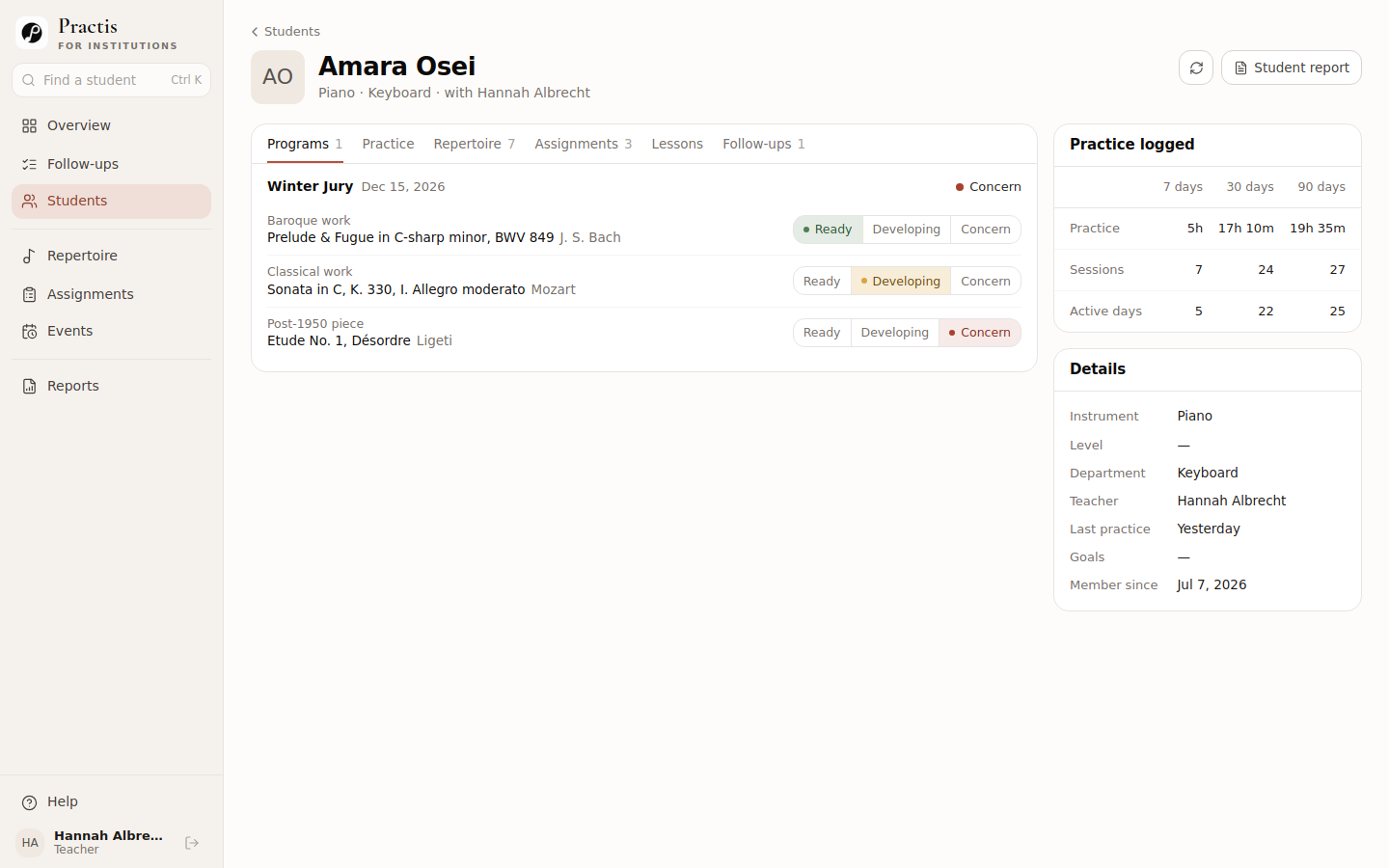
Keep the extra academic detail in the separate record. The edition, selected key, language, dated performance history and teacher confirmation in our template are not native columns in these Practis views. Nor is a readiness verdict a university’s signed repertoire certification. There is no automatic import or synchronization with the download: the school needs an agreed place for the richer history and a person responsible for keeping it current.
If your school already has an academic record but needs clearer shared context for current pieces and upcoming programmes, see Practis for institutions. The two views above show the part it can play.
Make the next term easier to plan
Start with the repertoire that will influence the next programme or assessment. Ask the student to identify the score and fill obvious gaps, then have the teacher check the musical scope and relevant history. If an older entry rests only on the student’s recollection, mark it “student-reported; not yet confirmed.” A blank or uncertain date is more useful than invented precision.
After a concert or assessment, add the event once, with the exact music involved and a reference to the existing programme or result. Avoid maintaining a second, competing set of official marks. When study pauses, change the current-use line while leaving the earlier entries intact. A teacher taking over can use the record alongside a short student handover, which covers the immediate teaching priorities.
At the next planning meeting, Clara’s record directs attention to the other sonata movements; Jonah’s calls for a fresh hearing of the revised bowing; Mina’s makes the selected key clear before the pianist prepares. Those are three different next steps, drawn from records that still explain what happened last term.
Featured photo: Caleb Oquendo / Pexels. General rehearsal photograph. Product screenshots: Practis, with fictional student records.