One hand can carry a melody, answer it with another voice and keep a dance moving underneath. Choosing a whole programme from this repertoire means finding four pieces with different things to say, as well as checking their place on the exam lists.
Here are two complete left-hand programmes for ABRSM Performance Grades 7 and 8 using the 2027–28 repertoire: exact scores, reasons for the combinations and professional performances to explore. The selections fit the published repertoire rules; your own playing time and the demands of each score still determine whether a programme suits you.
The rules these programmes satisfy
The 2027–28 Piano Performance Grades syllabus applies from 1 January 2027. A programme has four pieces, covering Lists A, B and C, with no more than two by one composer. The respective programme limits are 20 and 25 minutes, including transitions. The own-choice minimum is two minutes at Grade 7 or three at Grade 8, even for listed pieces. An exception applies if meeting that minimum would exceed the programme limit. Both proposals below use the left hand throughout; the upper staff is not a separate right-hand part.
The tables follow our suggested playing order. “Own choice” identifies a piece’s role, so it need not be last. For the separate decision about keeping an older syllabus, see our 2027–28 syllabus overlap guide.
Grade 7: a singing line, then a change of step
This programme moves from Saint-Saëns’s clear arpeggiated writing to a more layered Godowsky waltz, then pairs Foote’s expansive Romanze with his compact Polka. The final two works share a composer but differ in metre, phrase length and articulation. Their quiet endings also offer an alternative to closing with a loud flourish.
| Suggested order | Programme role | Recording reference |
|---|---|---|
| 1. Saint-Saëns: Prélude, Op. 135 No. 1 | A22 | Piers Lane 2:11 |
| 2. Godowsky: Waltz-Poem No. 5, A-flat major | B19 | Konstantin Scherbakov 3:24 |
| 3. Foote: Romanze, Op. 37 No. 3 | Own choice Also listed as B18 | Kirsten Johnson 4:07 |
| 4. Foote: Polka, Op. 37 No. 2 | C17 | Kirsten Johnson 1:36 |
These named recordings total 11:18 of music, before transitions. Their timings come from Lane’s Hyperion booklet, Scherbakov’s Marco Polo release and Johnson’s Delos booklet. They give a sense of scale, not a target tempo for your performance.
The Prélude establishes how you sustain a phrase. At the opening, a rising arpeggio arrives at a longer upper note while shorter notes continue below. In his notes on the six studies, Piers Lane draws attention to the interplay of arpeggiated harmony and held melodic fragments. On the page, the challenge is already visible: the hand must move on while the listener continues to hear that upper note as part of a line.
Try tracing that line through the first phrase before adding the intervening notes. When the complete texture returns, listen for whether the destination note still has direction, or whether the moving notes take over. Later, Saint-Saëns writes sans presser during the flowing semiquavers, and the final page settles into Tranquillo and softer dynamics. Choose a starting pace that leaves room for those changes.
Godowsky’s fifth Waltz-Poem makes the layers denser. Use the original left-hand version in A-flat major. Its opening four-note figure leads into long melody notes above shorter inner notes and bass movement. The two staves organise those voices; one hand plays them all.
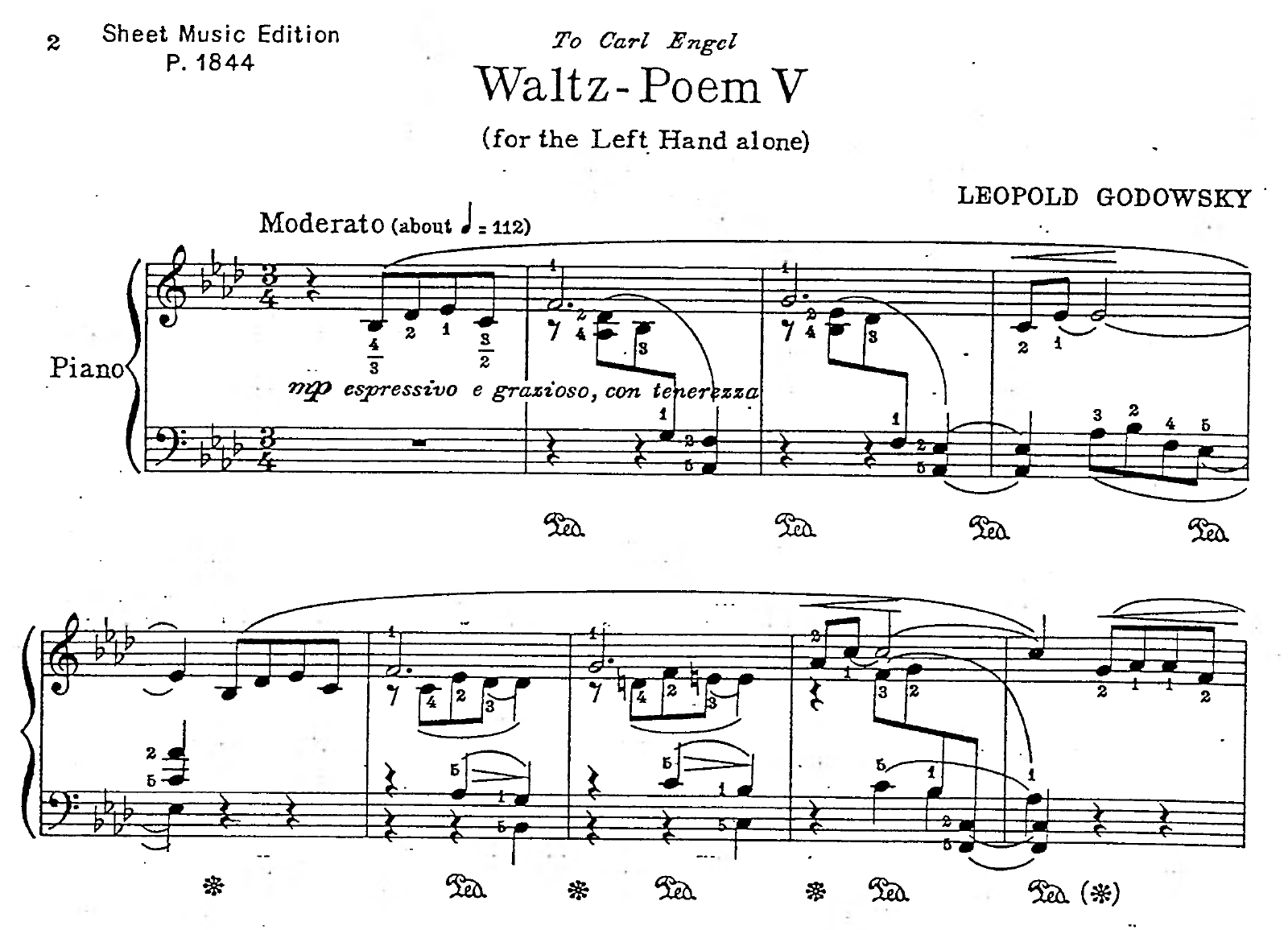
In the bar after that opening figure, the dotted minim in the upper voice spans the bar while the inner notes continue moving. That is a useful place to test balance: can you follow the long note through the accompaniment? The waltz also needs a sense of three beats even when the inner writing gets busy. Practising the bass movement and the melodic outline separately can make their different jobs clearer before you put the full texture back together.
The piece continues for six music pages in this edition, with chromatic passages, changes of colour and a quieter closing section. Try something from the middle and the ending before deciding it is manageable from the opening alone. Its closing più sostenuto, soft dynamics and una corda ask for control after the more active writing.
Foote’s Romanze broadens the phrase. The four-beat opening combines a dotted melodic gesture, rolled chords and longer notes. Running semiquavers then lead towards substantial fortissimo passages, so this is not simply a slow resting place between harder pieces. Test the return from that fuller texture into the expressive line, as well as the soft final page with its tied harmony and fermata.
The Polka changes the programme’s gait. Its two-beat movement sets detached chord attacks beside slurred connecting figures. Giving every note the same short articulation would lose that contrast, particularly in the softer expressive writing. The ending becomes pianissimo, with short gestures and rests. Let those rests complete the dance; the programme can finish quietly and still feel finished.
Grade 8: counterpoint, colour and a quiet conclusion
Here Saint-Saëns opens with two interacting voices, Godowsky supplies a flowing waltz, and Bridge creates a much broader dynamic landscape. The Bourrée brings back a clear dance pulse before its surprisingly gentle close. This order makes the contrast between Bridge’s final resonance and the Bourrée’s opening particularly worth rehearsing.
| Suggested order | Programme role | Recording reference |
|---|---|---|
| 1. Saint-Saëns: Alla fuga, Op. 135 No. 2 | A19 | Piers Lane 2:02 |
| 2. Godowsky: Waltz-Poem No. 2, B-flat major | B17 | Konstantin Scherbakov 3:12 |
| 3. Bridge: At Dawn, H. 134 No. 1 | C18 | Ashley Wass 4:15 |
| 4. Saint-Saëns: Bourrée, Op. 135 No. 4 | Own choice Also listed as A20 | Piers Lane 3:39 |
The reference performances total 13:08 of music. Lane’s and Scherbakov’s releases are linked above; the Bridge timing comes from Ashley Wass’s Naxos recording. The video below is a different performance, by Chenyin Li.
Alla fuga asks you to distinguish voices within one hand. The first entry begins in the lower register; the upper voice subsequently enters while the lower line continues. Follow each separately on the page, including the rests and articulation. Then consider which entry needs to draw the listener’s attention when both are present. Playing every moving note with equal emphasis would make their conversation harder to follow.
Lane points to the final page’s stretto, where entries overlap more closely. That gives the ending a different intensity from the opening. The score also passes through a contrasting middle section before returning to its original key signature. Use those changes to organise the piece in your mind, rather than relying only on a chain of remembered finger movements.
Godowsky’s second Waltz-Poem needs its own character. This is the B-flat major original for left hand, marked Allegretto grazioso. Sustained melody and moving accompaniment again share the hand, but the more sustained middle section changes the pace of the musical thought. First and second endings appear early in the score: decide your repeat plan while learning the form. The return to B-flat and the quiet close should feel like a return from somewhere, rather than simply more waltz bars.
At Dawn is more than a soft interlude. Bridge begins with an exposed melodic gesture and very quiet upper decoration. Later, longer melody notes sit above broken accompaniment; near the end comes a broad fortissimo climax, with a fermata, before the music returns to softness. A performance needs space for that whole arc.
In Chenyin Li’s performance, published by Pianist, follow the melody as the hand moves away into other registers. With the score beside you, locate the loud climax on the final page and the later pianississimo writing. Those landmarks give you something specific to listen for.
The Bourrée changes the texture again. Its opening has a quick two-beat dance impulse, but the middle moves into a quiet G major passage. A recurring low G supports changing notes above: a pedal point. That term describes the repeated pitch, not an instruction to keep the sustain pedal depressed.
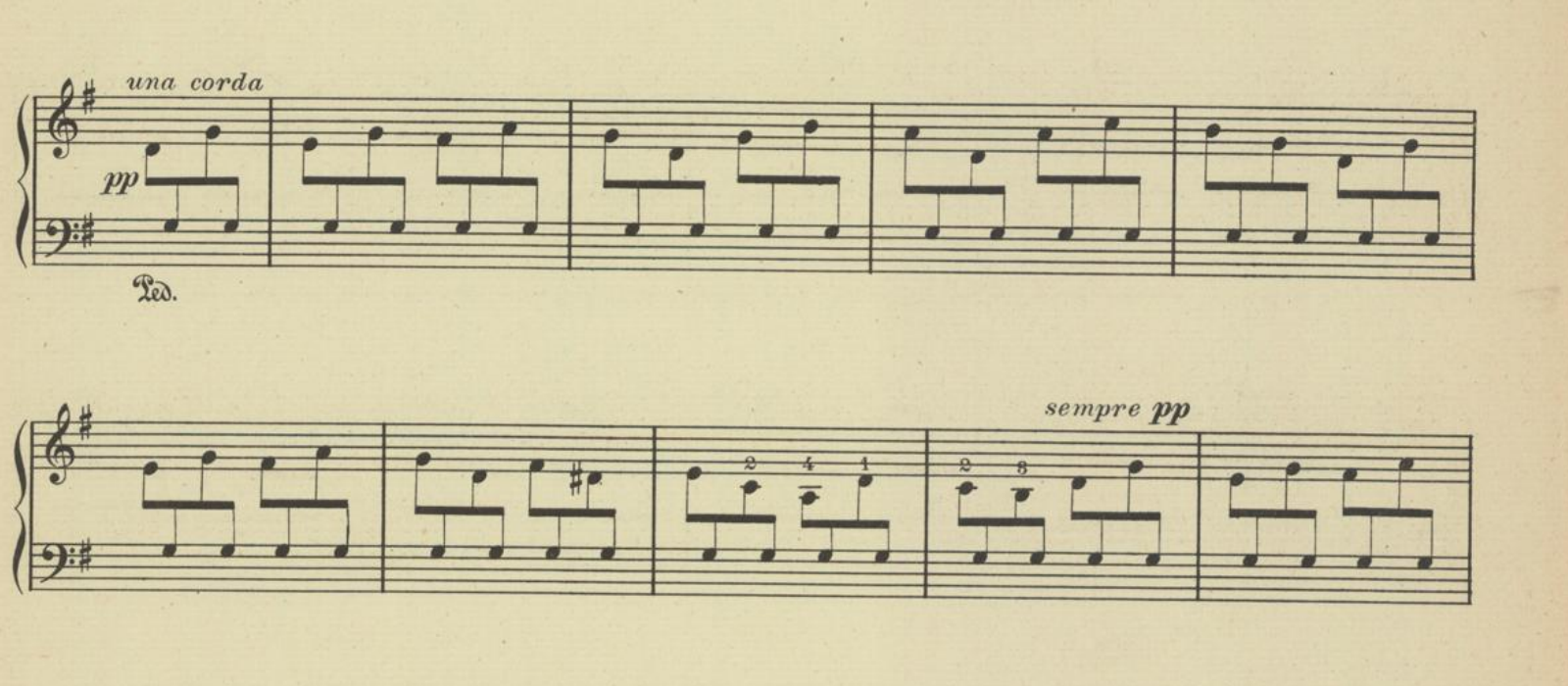
Listen for how the upper line changes while G keeps returning below it. The quiet dynamic and una corda marking make this a different colour from the opening, even though the hand remains active. Near the end, Saint-Saëns again moves into a one-sharp key signature and asks for pianissimo through the finish. If you place it last, rehearse that quiet ending as the conclusion of the whole programme.
Find the right versions before learning them
These are original works, for which the syllabus permits alternative editions. The links below identify the complete copies used for our discussion. For Godowsky especially, check the hand and key: another arrangement with a similar title may contain different music.
- Saint-Saëns, Prélude and Alla fuga: the 8notes public score viewer shows them on displayed pages 1–4 and 5–8 respectively. Reading the pages online is public; its PDF download requires Premium. We use the displayed edition, rather than identifying it as a particular historical printing.
- Godowsky, Waltz-Poems Nos. 2 and 5: choose the original left-hand scores in the IMSLP collection. The Carl Fischer copies bear copyright 1930: No. 2 in B-flat has plate 25398-4; No. 5 in A-flat has plate 25401-6. These have four and six music pages respectively.
- Foote, Polka and Romanze: the Arthur P. Schmidt scan of Op. 37 bears copyright 1897. In its twelve-page PDF, the Polka occupies pages 6–7 and the Romanze pages 8–11, with plates 4127 and 4128. The last PDF page is an advertisement.
- Bridge, At Dawn: the University of Toronto scan is the Winthrop Rogers edition, copyright 1919, plate M.49. The movement’s printed pages 1–3 appear as PDF pages 9–11.
- Saint-Saëns, Bourrée: the Basel scan is Durand, copyright 1912, plate 8457. Its seven music pages are PDF pages 4–10. This download contains only the Bourrée; use the separate viewer above for the Prélude and Alla fuga.
Keep the complete score in view when choosing a piece. The two excerpts here explain particular textures; they do not show everything that must be prepared. Compare the opening, the busiest passage, a return and the ending with your teacher before committing to all four works.
Time your own programme, including the gaps
The recordings show that these combinations have room within the overall limits, but they cannot establish your exam duration. Their tempos, pauses and repeat choices may differ from yours. The Grade 8 own-choice Bourrée deserves particular attention: Lane’s 3:39 is only 39 seconds above the required minimum.
Ordinary repeats are generally optional in this Performance syllabus unless specifically required. The Godowsky No. 2 and Bourrée scores contain repeat signs. Choose a musically convincing plan with your teacher, then time that plan; do not assume a recording takes the same repeats.
Record a complete run in the intended order, noting each piece’s actual duration and the gaps between pieces. Include the time needed to settle, change the score and prepare the next opening. If an own-choice piece comes out too short, reconsider the selection or a suitable repeat plan. Extra silence does not make the piece longer, and an artificially slow tempo may damage its character.
Rehearse each join as music: the last phrase, the release, the pause and the next beginning. In Grade 7, that includes moving from the Romanze’s sustained final harmony into the Polka’s lighter attack. In Grade 8, allow Bridge’s last resonance to finish before establishing the Bourrée’s pulse. Our post on preparing for a continuous performance develops this part of the preparation.
Make the musical layers audible
In Pianist’s interviews about left-hand repertoire, Nicholas McCarthy emphasises the pedal’s role in connecting the sound, while Ivan Ilić draws attention to awareness of register and attentive bass listening. Those observations are useful across both programmes. A printed note may need to remain perceptually present after the hand has travelled elsewhere, while a new bass note can change the harmony underneath it.
For a short practice passage, choose one listening question. In Godowsky, follow the sustained melody through the inner movement. In Alla fuga, follow the lower voice while the upper voice enters. In the Bourrée’s middle, listen to what changes above the recurring G. Record the passage, listen back with the score and decide which layer disappeared or became too prominent.
Then return to the complete phrase. An isolated chord can sound balanced while the next movement of the hand interrupts the line. The programme is ready to take forward when those local decisions remain audible through each whole piece and from one piece to the next. Before recording the exam, consult ABRSM’s current Performance Grades specification and syllabus updates for entry and submission requirements.
Score excerpts: Godowsky, Carl Fischer 1930, via IMSLP; Saint-Saëns, Durand 1912, Universitätsbibliothek Basel, kk XVIII 1005:7, via e-rara. Sources and rights are linked beside each excerpt. Featured photo: Steve A Johnson / Pexels.