A paradiddle can feel settled on a practice pad and fall apart as soon as the first note moves to a tom. The sticking is familiar; the distance, sound and place in the groove have changed. To make rudiments useful on the kit, practise those changes directly, then include the beat after the fill.
Start with a pattern you can play slowly and evenly. You need sticks, a pad or snare, a metronome and a kit for the application stage. A phone recording is useful for hearing what happens at the transitions; the existing lessons below provide the technique demonstrations.
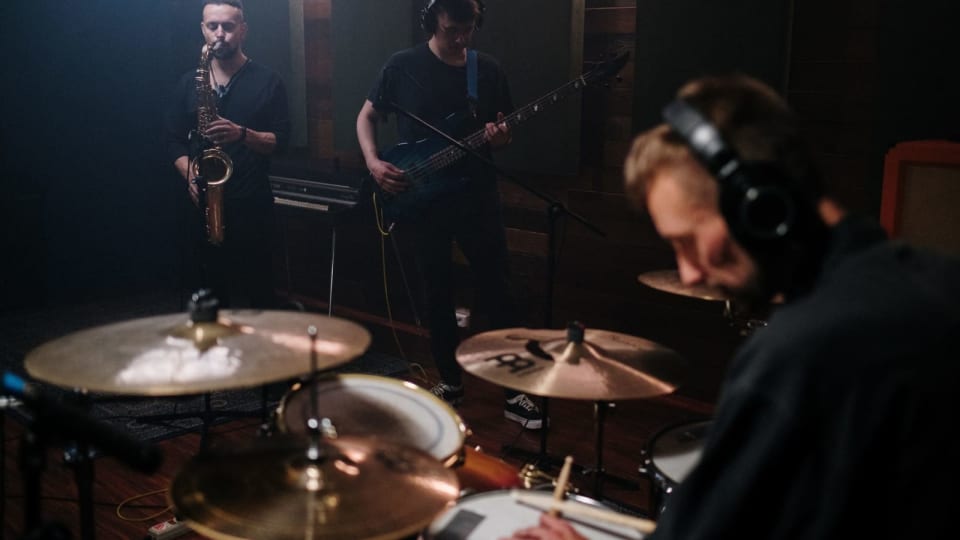
Photograph: Big Bag Films / Pexels.
Three patterns with different jobs
The Percussive Arts Society’s 40 International Drum Rudiments provide the larger reference. For this practice task, three familiar patterns are enough to explore alternating hands, repeated strokes and a change of leading hand. Here, R means right hand and L means left hand.
- Single strokes: R L R L
- Each hand takes the next note. Listen for even spacing and an intentional sound from both hands. Drumeo’s single-stroke lesson develops that consistency before moving the pattern around the kit.
- Double strokes: R R L L
- Each hand plays twice. The second stroke needs its place in the rhythm; it should not disappear or arrive early. The double-stroke lesson makes even spacing a central concern, including when rebound helps produce the second note.
- Single paradiddles: R L R R L R L L
- Alternating strokes lead into a double, and the next group starts with the other hand. The paradiddle lesson explains that combination. It becomes especially useful when the leading note has a different accent or sound.
Rob “Beatdown” Brown demonstrates these foundations in the lesson below. Use it to check the movements behind the letters. There is no requirement to learn all forty rudiments before trying a small musical application.
Keep the subdivision clear when the surface changes
A tempo number is incomplete without the notes you are playing against it. At a quarter-note click of 80 BPM, sixteenth notes mean four strokes per click. Eighth notes mean two. Write down the subdivision so that next week’s “80” refers to the same task.
Begin on one surface with an even stream of notes. Then move a small, predictable part of the pattern to another surface. For single strokes, that might mean a short group on the snare followed by the same group on a nearby tom. Keep the counting continuous while the sound changes.
Double strokes deserve their own check on the new drum. A pad and a tom need not respond alike, so listen to both notes of each pair instead of assuming the second will appear as it did on the pad. If the rhythm becomes uneven, simplify the movement and lower the tempo until you can hear what needs attention.
Changing the sticking, tempo, accents and orchestration all at once makes the result difficult to understand. Keep three of those settled while you explore the fourth. A slow pattern that reaches the intended surface on time is a useful stage in its own right.
Turn a paradiddle into a two-beat fill
Here is a small original practice example in 4/4. Play two beats of a comfortable groove, then use R L R R L R L L as sixteenth notes on beats 3 and 4. The eight strokes occupy exactly two quarter-note beats.
First play all eight notes on the snare. Once the rhythm is settled, move the first note of each four-note group to a tom you can reach comfortably. Give those two notes a clear accent and keep the other six lighter on the snare. The right hand leads the group on beat 3; the left leads the group on beat 4.
Beat 3
| 3 | e | & | a |
|---|---|---|---|
| R | L | R | R |
| Tom accent | Snare | Snare | Snare |
Beat 4
| 4 | e | & | a |
|---|---|---|---|
| L | R | L | L |
| Tom accent | Snare | Snare | Snare |
The final two left-hand notes leave the right hand available for the next bar. Return to your ordinary groove on beat 1. You can add a crash later if it serves the phrase, but landing the next beat is the first task.
For more ways to distribute the same sticking, Drumeo’s drum-set application lesson provides existing demonstrations. Compare the movement and sound choices with your small version, rather than trying to acquire every variation in one sitting.
Practise the way back into the groove
A fill can sound fluent in isolation and still make the next bar late. That boundary is part of the musical phrase. Drumeo’s introductory drum-set guide includes alternating a basic beat with a fill; use the same idea to give this rudiment a place to arrive from and return to.
A four-bar practice loop
Bars 1–3: your comfortable groove.
Bar 4: keep the groove for beats 1–2, then play the two-beat fill on 3–4.
Next bar 1: return to the groove without a pause or an extra note.
Count the bars as well as the subdivision. If you get lost, spend another pass on the groove alone while saying where the fill would begin. Then put the short pattern back. A smaller fill that fits the phrase gives you more musical control than a longer one whose ending is uncertain.
Once this is comfortable with a click, try it with a suitable drumless track or in a piece whose phrasing you know. Listen to what the music needs. The exercise gives you an option; it does not require you to fill every fourth bar in an actual song.
What to listen for beyond the top speed
Record a few loops, including the return to the beat. Keep the microphone position similar when you compare attempts, and make sure you can hear the drum pattern clearly enough to judge it. Pick one question for each playback:
- Are the notes evenly placed? Listen particularly to the second stroke of each double and the hand change after it.
- Do the accents sound deliberate? The tom notes should stand out because you chose them, rather than because reaching for a different surface made everything louder.
- Does the fill keep its allotted time? Follow beats 3 and 4 through to the next beat 1. Extra notes or a pause at the boundary need attention before another tempo increase.
- Does the groove remain recognisable afterward? A fill is connected to the surrounding music. Check whether the following bar keeps the feel you established before it.
If the pad version is even but the tom version rushes, the next task is moving between those surfaces. If both are even but beat 1 is late, work on the exit from the fill. This is more precise than recording only that the pattern “needs work.” Our post on hearing progress in improvisation uses a similar approach to reviewing one musical intention across different takes.
A useful diary note might read: “Single paradiddle, sixteenths at 72, accents on the tom at beats 3 and 4. Snare version even; left-hand tom entry still early. Repeat at the same tempo with only that move.” This is an illustrative note, not a reported test result.
You can keep a task like this as your own repertoire entry in Practis, with practice-session notes describing the sticking, surfaces and next change. It does not need a published score. If choosing the click or rhythm tool is the unresolved part, our rhythm-training app comparison separates the different jobs those tools can do.
Keep a version that works at a comfortable tempo. On another day, see whether you can place it in the same phrase again, then try one new sound or accent. That gives the rudiment a musical use you can return to, alongside whatever speed you eventually develop.