An exam report can identify uneven pulse, an obscured melody or a phrase that needs more direction without telling you what to practise on Monday. The useful next step is to find a passage where the comment makes sense, decide what you want to hear and choose a small task that tests that change.
The example below follows three invented comments into two short musical demonstrations and a four-week plan. The plan leaves room for a teacher to interpret an unclear remark and for the next recording to change your priorities.
Read the comment alongside the music
Start with the complete report, including what went well. A confident opening or a clear sense of character is something to preserve while working on a different weakness. Reading only the least flattering sentence can turn the next month into a repair exercise that loses the strengths of the performance.
ABRSM’s public Performance Grades criteria consider pitch, time, tone, shape and performance, with separate criteria for the programme as a whole. Those headings help locate a concern, but they do not diagnose its cause. A comment about time could involve rushing, hesitation, an unsuitable pace or a rhythmic detail; the score and the actual performance help distinguish them.
This report excerpt is entirely invented. It is neither an actual candidate’s result nor an official exam-board form. The two short compositions introduced later are our illustrations, not pieces claimed to have been played in an exam.
Piece A: The opening line communicated clearly. The pulse was less settled in the later passage with quavers, and the next arrival felt uncertain.
Piece B: The accompaniment sometimes obscured the upper melody.
Piece C: Longer phrases needed more direction.
For Piece A, the first question is where the pace changed and whether the score called for that change. For Piece B, identify the melody and the accompaniment in the passage concerned. For Piece C, ask the teacher which phrase they would choose to explore first and what musical destination they hear. The last comment is too broad to turn immediately into a prescription to play louder.
If you have the exam recording, use the version that was assessed and note a useful timestamp. If there is no recording, the report and a fresh lesson performance can still guide the discussion. A new take may reveal a current issue, but it cannot prove exactly what happened in the exam.
Give an uneven pulse a specific listening test
Our first miniature, Walking the Square, is four bars in G major, in 4/4 at crotchet = 96. The melody mixes crotchets with two pairs of quavers; the bass uses minims. This makes it possible to examine the pulse while the surface rhythm changes.
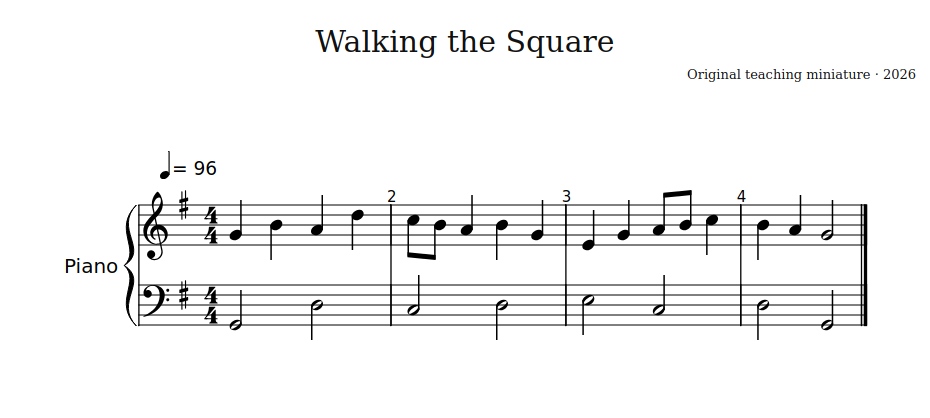
Original score: Walking the Square. Swipe to read the notes. Download printable score (PDF) or full-size image.
Unstable pulse
Steady pulse
Follow the beats through the quavers, then listen to the next arrival. Both files have the same total length. That means the final duration alone cannot show whether the intervening beats were steady: some intervals can shorten while others lengthen.
In your own piece, choose a passage that starts before the suspected change and continues past it. Count or tap the underlying beat while following the actual rhythm, then play at a pace where you can keep that relationship clear. Include the approach and the next arrival when you record the attempt. Repeating only the quickest notes would leave their effect on the surrounding phrase untested.
The aim here is a steady pulse in a miniature designed for that purpose. Expressive timing in other music needs a different judgement. Ask the teacher whether a local change is intended and convincing before treating every departure from a click as an error.
A useful note might be: “Check whether the beat stays consistent through the quaver pair and into the next bar. Record the approach and the following bar together.” That gives the next attempt something audible to answer. “Improve rhythm” leaves the task much less clear.
Work on the relationship between melody and accompaniment
The second miniature, A Line over Water, has four bars in D minor, in 3/4 at crotchet = 90. A sustained upper melody sits over moving quavers in the left hand. The comparison keeps the notes, timing, sound and melody level the same while reducing the accompaniment in one version.
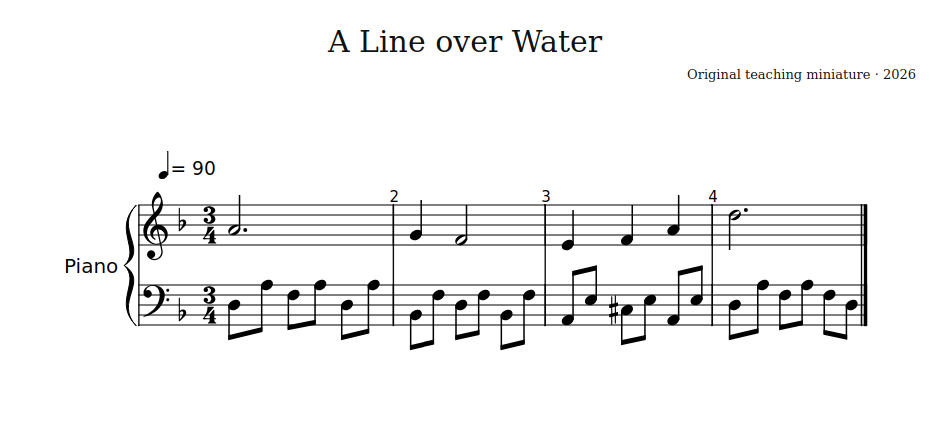
Original score: A Line over Water. Swipe to read the notes. Download printable score (PDF) or full-size image.
Accompaniment prominent
Accompaniment reduced
Follow the upper melody through its longer notes. Compare how readily you can keep track of that line while the accompaniment moves. The intended listening question concerns the relationship between the parts; making the complete recording louder would change a different variable.
For the passage in your own repertoire, play the melodic line separately and decide where it goes. Then restore the accompaniment and listen for whether that direction remains clear. A recording can help you compare the result with your intention. Keep the microphone position and recording settings as consistent as possible so an equipment change does not confuse the comparison.
The synthetic example changes accompaniment level only. Real piano balance also involves the instrument, register, articulation, pedal and how the line develops through time. A teacher can help decide which of those matters in the actual passage. Do not assume the same numerical level difference would suit every piece or piano.
A practical note might read: “Keep the upper melody audible through its long notes while the left-hand quavers continue. Compare one complete phrase with the previous take.” It names the relationship you want to hear without prescribing a universal dynamic for either hand.
Leave ambiguous phrasing comments open long enough to understand them
“More direction” can describe several different problems. The phrase might lose momentum before an arrival, peak too early, end abruptly or sound like separate notes without a longer connection. Choosing a crescendo immediately may address none of those.
Bring one phrase to the lesson with two questions: where is its destination, and what in the score helps make that destination audible? Try the teacher’s suggestion in context and compare it with your starting version. A useful explanation should help you recognise the change when you listen again, rather than merely attach another adjective to the phrase.
In our invented report, Piece C stays as a question for the teacher while Pieces A and B supply clearer initial tasks. You can act on useful feedback without pretending every sentence has already been solved.
A four-week plan with decisions at each review
This schedule proposes four review points. It does not assume improvement happens on a fixed weekly timetable. If a task is unclear or the intended change has not appeared, use the next review to adjust the task before adding more work.
| Review point | Work and evidence to bring back |
|---|---|
| Week 1: understand and locate | Read the full report with the teacher. Choose one passage for the pulse comment and one for balance. Make a starting recording, identify an existing strength and leave the phrasing question open until it has a musical explanation. |
| Week 2: change one thing | Work on the selected pulse passage and the melody/accompaniment relationship. Make short comparisons under similar recording conditions. Describe what can actually be heard, including attempts where the intended change is absent. |
| Week 3: restore the context | Play into and out of each passage. Check whether the change survives the surrounding phrase and a return to the intended pace. If it disappears, shorten the task again and discuss what changed when the context was restored. |
| Week 4: review and transfer | Compare a fuller performance with the starting evidence. Decide with the teacher whether to continue, reduce the task to occasional maintenance or try the same musical skill in a new piece. Keep unresolved questions visible. |
Adapt the four-week plan (CSV) and use the blank practice-task sheet (CSV) to keep the comment, passage, listening question and next decision together.
Save a short record of each decision: piece and passage, the comment being explored, the listening question, the relevant take and what you will do next. A teacher should be able to understand why the task is still in the plan. Practice time alone cannot answer whether the pulse or balance changed.
In Practis, our practice diary, a manual practice entry lets you select the piece and add a note alongside the session. Use that note for the passage, listening question and next task. A paper diary can hold the same information; the useful part is being able to return to the decision when you next practise.
For example, “The quavers stayed steady at the slower pace; the next attempt will include the previous phrase” is a possible review note, not a result we measured. “Still unsettled at the same place; bring both takes to the lesson” is equally useful when it is what the recording supports.
Use the next recording to choose the next task
After an exam, there is no requirement to remain indefinitely with every old piece. A teacher may choose a new work that develops the same skill, retain one passage for occasional comparison or recommend a different priority after hearing you again.
Keep the report as context, but let current musical evidence inform the next decision. Once the selected task has a clear purpose, the next week of practice can begin with a passage and a listening question rather than an attempt to correct an entire result at once.
Featured photograph: Pavel Danilyuk / Pexels.