If your woodwind exam is moving into 2027, check the music before replacing the books. ABRSM’s from-2022 repertoire overlap ends on 31 December 2026, but some familiar pieces remain on the newer lists. A programme may need one replacement rather than a fresh start.
For flute, clarinet, saxophone, recorder, oboe and bassoon, the syllabus to use in 2027 is called “from 2026”. It began on 1 January 2026 and is valid until further notice. There is no separate 2027 woodwind book cycle to wait for. ABRSM sets out the dates on its syllabus and overlap page.
Which date counts for your exam?
The deadline has a different practical meaning for the two exam formats. A booking, a finished piece and a video sitting on your phone are three different stages of preparation.
Practical Grade: you can use the from-2022 pieces in an exam taken by 31 December 2026. Tell the examiner that you are using that syllabus, or put it on the programme form.
Performance Grade: you must upload the recording using the from-2022 set pieces on or before 31 December 2026. Recording it in December and uploading it in January does not meet the overlap deadline. Enter “from 2022 syllabus” on the online programme form.
In either format, the three set pieces must belong to the same syllabus. The Performance Grade’s fourth, own-choice piece is outside the overlap arrangement. Those are ABRSM’s published woodwind overlap rules; plan any upload comfortably ahead of the final day.
If the exam is already booked within the overlap and the whole programme is ready, there may be no musical reason to change it. If you are still learning a substantial part of the music, or cannot arrange the accompaniment and submission in time, compare the current lists now. Rushing an exam solely to preserve an old selection can cost more useful preparation time than replacing one piece.
The pieces change; the two exam formats keep their different jobs
ABRSM’s instrument guidance distinguishes a three-piece Practical Grade from a four-piece Performance Grade. The repertoire lists are shared, but preparation for the complete exam is different.
| Part of preparation | Practical Grade | Performance Grade |
|---|---|---|
| Programme | One piece from each of Lists A, B and C. | A piece from each list, plus a fourth piece chosen under the own-choice rules. |
| Other assessed work | Scales and arpeggios, sight-reading and aural tests. | No separate supporting tests; the sustained performance is central. |
| Accompaniment | Live accompaniment for music that requires it. | Live or recorded accompaniment is permitted under the exam guidance. |
The from-2026 change leaves Practical Grade scales and arpeggios, sight-reading and aural requirements unchanged. Keep that work in the week while you change repertoire. ABRSM confirms this on its woodwind page.
For accompanied pieces in a Practical Grade, arrange your own accompanist; the examiner does not take that role. ABRSM explains this in its exam regulations. A backing track cannot replace the pianist in this format, as the Practical syllabus, page 12 confirms. Send a replacement’s piano part as soon as you choose it, so the first joint rehearsal does not become a first reading for both players.
Check the piece, movement and arrangement
Start with the exact instrument and grade in the new PDF. Saxophone has separate E-flat and B-flat lists; recorder has separate descant and treble lists. A familiar title elsewhere in the document does not establish that it is available for your exam.
Compare each of your three choices with its current entry. Match the composer, movement or extract, and arranger. Then note the current list letter and number, any repeat instruction, and the accompaniment. Searching the title is useful, but read the surrounding entry before deciding to keep it.
Use the specified arrangement or transcription; other pieces allow a choice of edition. Check the edition rules before replacing a book.
It helps to make the decision beside the music itself: “still listed, keep”; “different arrangement, compare copies”; or “missing at this grade, choose a replacement.” That is enough to reveal the size of the change before anyone orders a whole new set of books.
A Grade 3 flute programme that keeps two pieces
Imagine a flautist preparing Bach’s Menuet, A Whole New World and He’s a Pirate for a Practical Grade 3. The intended exam moves to February 2027. Here is one way to revise those choices, assuming the player and teacher still want to keep the first two.
The original selections appear on page 37 of the from-2022 Woodwind Performance syllabus. The new choices below are on page 54 of the from-2026 Practical syllabus. This is an illustrative programme decision, with the same repertoire lists applying to both qualifications.
| Current piece | Position in the two syllabuses | Decision for 2027 |
|---|---|---|
| J. S. Bach: Menuet, sixth movement of the Suite in B minor, BWV 1067 | A4 in 2022; A4 from 2026. | Keep it. The first repeat is required in both entries. |
| Alan Menken: A Whole New World, arranged by Peter Lawrance | B7 in 2022; B7 from 2026. | Keep this arrangement, including the specified repeat. |
| He’s a Pirate, arranged by Alan Bullard | C3 in 2022; absent from the from-2026 Grade 3 lists. | Replace the List C slot with Monty Norman’s The James Bond Theme, arranged by Nikki Iles: C3 from 2026. |
The revised three-piece selection is therefore Bach A4, Menken B7 and Norman C3, all under the from-2026 syllabus. Keeping Bach and Menken is not mixing syllabuses: each remains a current choice in its own right. The two film themes happen to share the label C3 in different editions of the syllabus; that number alone does not identify the music.
What stays on the music stand?
One listed option is the Peters edition of Bach’s Suite No. 2, BWV 1067. Its publisher identifies the flute-and-piano edition as EP4921. Check the flute and accompaniment copies together, particularly the repeat. A family already using a suitable edition has no reason to buy the same movement again simply because the exam year changed.
Menken’s arrangement is in Winner Scores All for Flute, published by Brass Wind. Its piano accompaniment is a separate publication. The publisher’s flute catalogue lists the flute book as 0324 and the accompaniment as 0324PA. Keep both available for rehearsal; a recording included with another package would not replace the pianist in the Practical exam.
The replacement is in Flute Exam Pieces from 2026, ABRSM Grade 3, ISBN 9781786016553. ABRSM’s book includes the flute part and piano accompaniment. It contains nine selected pieces, so buying it does not mean that every available Grade 3 choice is inside. Our retained Bach and Menken selections come from their separate publications.
To hear this particular arrangement, use the ABRSM Sounds recording by Claire Wickes and Iain Farrington. Follow your flute part as you listen, noticing where you would need to count through an accompaniment passage or prepare an entry. The recording can help you get to know the piece; choose a practice tempo that allows you to read it accurately.
Why make only this change?
The example preserves two pieces the player already knows and leaves one clear learning project. That is useful when the player likes the existing programme and the teacher is satisfied with its musical range. It is not a recommendation to keep a piece that has become uncomfortable, uninteresting or poorly suited to the player.
Try enough of the replacement to discover its demands before committing to it. Read a later passage as well as the opening, check the complete flute range, and look at where the accompaniment supplies an entry. Familiarity with the film theme may help recognition, but the printed arrangement determines the actual notes, rhythm and length. Do not transfer articulation or timing from a remembered soundtrack without checking the score.
Could the old film piece become your fourth piece?
For a Performance Grade, possibly. He’s a Pirate could be considered as the own-choice piece while Bach, Menken and Norman fill the current A, B and C slots. Its removal from a set list does not by itself make it unsuitable for own choice.
That would produce four pieces, but it still needs a complete programme check. Under the from-2026 Performance syllabus, an own-choice piece must be broadly at the grade’s standard or above and have a fully notated score. At Grade 3, its minimum duration is 35 seconds, subject to the syllabus’s maximum-time exception. The whole programme has an eight-minute maximum, measured from first note to last and including the transitions.
Time your actual performance with the chosen repeats and accompaniment. We have not assigned a duration to this proposed combination. A player’s comfortable tempo and pauses between pieces can change whether a programme fits. Also read the wider programming rules, including limits on unaccompanied pieces, duets and repeated composers, before finalising an own-choice selection.
Two film pieces may be a satisfying end to this particular programme, or they may leave the player wanting another mood. Try the running order aloud with the instrument and accompaniment. Does each piece get a settled beginning? Can the final piece retain its character when the player is already tired? Our post on rehearsing a complete Performance Grade recording develops those practical transitions.
Prepare the replacement without losing the pieces you kept
A syllabus change can pull attention towards the new piece until the retained music starts to feel unfamiliar. Give the two jobs different amounts of time. The replacement needs regular learning sessions; the retained pieces need shorter returns that reveal what still needs attention.
The following four-week cycle assumes the player already knows Bach and Menken and is beginning the Norman arrangement. It is a way to organise the change, not a promise that four weeks is enough to become exam-ready. Repeat a stage when the music needs it.
First week: find the actual learning problem
Read through the replacement in manageable sections. Mark uncertain rhythms, finger changes, breaths and entries after rests. Choose one short passage for focused work, then include its approach and continuation so the passage does not become playable only from a special starting point.
Return to one retained piece on alternate days. Play a substantial section without restarting at every slip, then make one specific correction. Check the required repeats now, while there is time to change a habit.
Second week: bring in the accompaniment
Work through the new piece with the pianist or, for a Performance Grade, the accompaniment you intend to use. Agree how the first entry happens and identify places where listening to the accompaniment helps you arrive together. A successful solo run may still leave an entrance after a rest uncertain.
Spend part of the rehearsal on the retained music too. A new accompanist needs to know the old pieces, and a familiar accompanist needs your current choices about breath, pace and endings. Note one thing to prepare before the next joint session.
Third week: play the chosen programme
Make a complete private run in the intended order. For Performance Grades, include the fourth piece and time the transitions. For Practical Grades, include a separate run through the supporting tests during the week so the new repertoire does not consume the whole preparation.
Listen back for a small number of questions: an entry that repeatedly arrives late, a breath that breaks the phrase, or an ending that loses its shape. The purpose is to find what happens over the whole performance. Do not treat the first full run as a verdict on whether the change was a mistake.
Fourth week: repair what the run revealed
Choose the two problems that most interrupt the performance and work on them in context. If an entrance failed, practise the rest and the cue before it. If a later passage became unreliable, start far enough back to include the conditions that led to it.
Then make another complete run on a different day. If the same interruption remains, allow another cycle before setting a final date. For a digital exam, leave time after the musical work for a framing test, a satisfactory continuous take, checking the file and completing the upload.
Keep a useful record of the change
The old piece can remain part of the player’s repertoire even when it leaves the exam programme. Keep its existing notes and recordings, and describe its next role: a possible own-choice piece, a concert item or something to revisit after the exam. Our post on keeping learned repertoire available offers a longer-term approach.
In our practice app, Practis, the repertoire view brings pieces together with their latest practice notes. The real screen below uses illustrative piano records, but it shows the useful relationship: a piece stays visible beside a concrete reminder for its next session. A notebook can carry the same information.
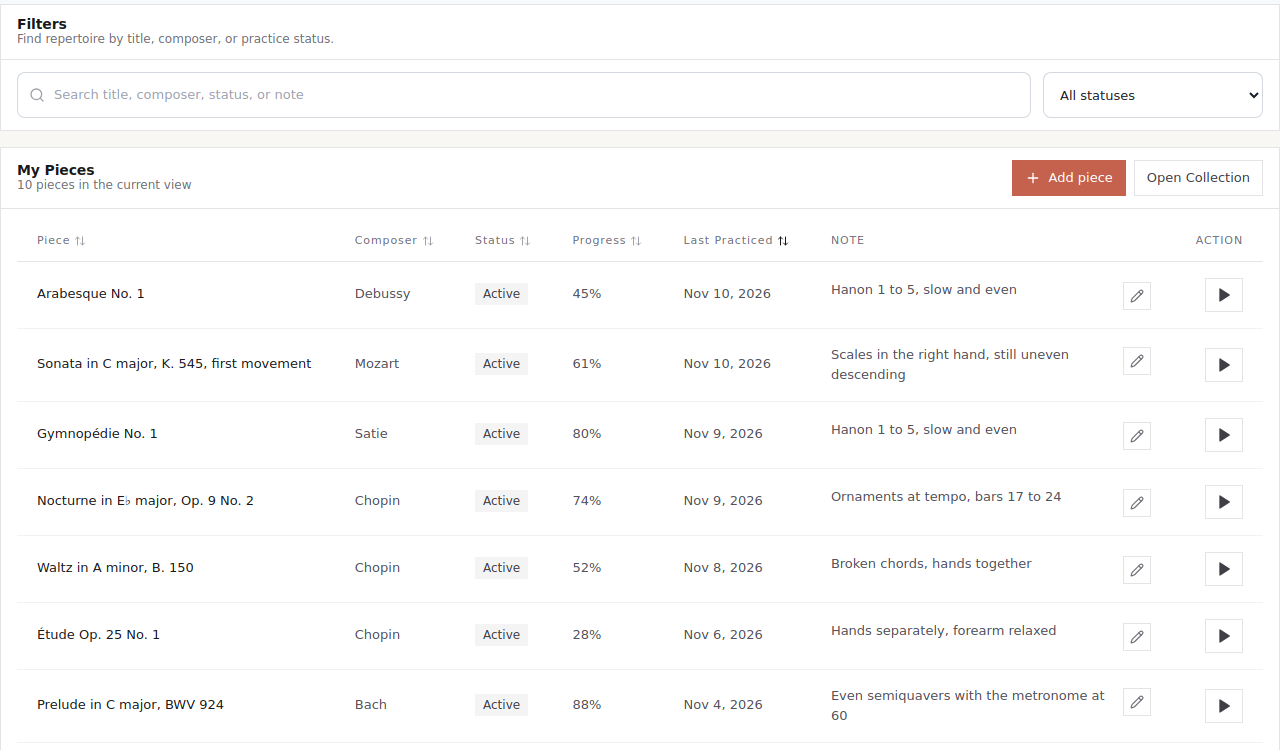
For our flute example, a useful next-session note would be: “Bach retained for 2027: include the first repeat; rehearse the return with the pianist.” For the new piece, it might be: “James Bond Theme: count the rest before the uncertain entry, then play through the following phrase.”
Keep the programme’s administrative details in one stable place as well: exact editions, current list references, exam format and intended date. A latest-session note will change as practice moves on. If a school needs that information to survive a change of teacher or term, the student repertoire record examples show what to preserve.
Before you confirm the date
Bring the proposed programme and the actual scores to the next lesson. Agree which syllabus the three set pieces belong to, check the current ABRSM corrections and clarifications, and make sure the accompaniment is available for every piece that requires it. For a Performance Grade, check the fourth piece and the timed programme as a whole.
If the exam will be in 2027, finish that conversation with a complete from-2026 selection and a first rehearsal date. The work already done on the retained pieces remains useful; the replacement can then receive the time it actually needs.
Featured photo: Jean-Paul Wright / Pexels. The flute and printed score illustrate the subject; the score pictured is not the Grade 3 example programme. Product screenshot: Practis. Syllabus dates and programme references checked 16 November 2026.