For occasional quiet violin practice, a correctly sized rubber practice mute is an inexpensive place to start. A heavier metal-core model is worth considering when reducing the sound is the main priority. A small orchestral mute serves a different musical purpose: do not buy one expecting it to solve late-night apartment practice.
Our three choices below cover those different jobs. We compared published designs, fit guidance and acoustic research; we have not tested these mutes on our own instruments. The decision also depends on your room, your bridge and how quiet the people around you need you to be.
What a mute changes at the bridge
A violin’s strings transfer their vibration through the bridge to the body, which radiates sound into the room. Adding a mute changes that transfer. The UNSW explanation of violin acoustics describes how added bridge mass reduces transmitted power, particularly at higher frequencies. That helps explain why muting changes the colour as well as the level: it is not simply the same sound turned down.
A light performance mute belongs to the sound of the music. When a score says con sordino, the player adds a mute; senza sordino asks for it to come off. A compact model that can move quickly into and out of position is useful here. A bulky practice mute is chosen chiefly to make private work quieter, so its stronger alteration of the sound can be an acceptable compromise.
“Rubber versus metal” is a useful starting question, but the label alone does not settle the choice. A little rubber performance mute and a substantial rubber practice mute have different designs. A black, rubber-coated mute may conceal a metal core. Compare the intended use, overall construction and fit rather than assuming that all black mutes behave alike.

A 2025 study of eleven mute designs found greater attenuation in its heavy practice group, but adding more mass did not produce proportionately more quieting. Its measurements used two violins and structured glissandi; the work did not evaluate playability. This supports the broad distinction between performance and heavy practice designs. It does not tell us which of the shop listings below will be quietest on your violin, or whether a neighbour will hear you.
Three buying options for different jobs
The prices below are for individual mutes from US listings checked on 16 November 2026, before tax and delivery. At this price level, shipping can change which seller offers the better purchase. A local violin shop also has an advantage that a cheaper online listing cannot supply: someone can check the fit on your instrument.
| Mute | Useful for | Size to check | Listed price |
|---|---|---|---|
| Ultra rubber practice mute | An inexpensive first quiet-practice purchase | 4/4; separate 3/4–1/2 and 1/4–1/8 options | $4.99 at Concord |
| Artino PM-01 | A heavier metal-core practice design | Violin/viola model; check your bridge fit | $18.65 at Violin Shop Tampa |
| D’Addario Spector, black 9493 | Quick changes in music requiring a mute | 4/4 violin only | $10.99 from D’Addario |
Ultra: a sensible low-cost first purchase
The Ultra is a substantial rubber practice mute, sold in different sizes rather than as one universal fitting. Choose the size for your violin: the smallest listed version has three prongs, while the larger versions have five. Concord describes it as dense rubber intended for practice.
This is our starting suggestion for someone who wants quieter daytime repetition without spending much. Its low price makes it reasonable to find out whether a practice mute meets the household’s needs before considering a more expensive design. The purchase still needs a fit check, and rubber should not be treated as a promise that the instrument cannot be damaged.
It is also a sensible point at which to stop shopping if the result is adequate. There is no benefit in buying a heavier model merely to own the most substantial-looking mute. The useful question is whether you can hear enough to practise and the people nearby are comfortable with the remaining sound.
Artino PM-01: metal inside a rubber coating
Otto Musica’s Artino specification identifies a solid metal core covered in rubber. That makes the PM-01 a different proposition from an all-rubber mute, despite their similar dark appearance. We would consider this design when stronger attenuation is the priority, while treating its actual result as something to establish on the instrument.
Buy the violin/viola PM-01, not the PM-02 cello version. A label covering two instruments does not guarantee that it will seat equally well on every bridge, and the maker’s main listing does not establish a fit for every fractional violin. If you play a smaller instrument, ask the seller for the appropriate size or another model.
The coating separates the metal core from direct contact, but the object is still heavy. Handle it over a stable, well-supported instrument and put it somewhere secure when removed. Paying more for the coated construction does not remove the need to fit it gently.
Spector: choose it for the musical mute changes
D’Addario’s Spector sits between the A and D strings and slides up over the bridge to engage. It can slide back and remain on the instrument when the muted passage ends. That arrangement makes sense when an orchestral or chamber part requires changes during the piece. The maker specifies 4/4 violin only.
D’Addario also describes quieter practice among its uses. Nevertheless, its compact, sliding design is not the same purchase as a heavy practice mute. If the immediate problem is a sleeping household, we would start with one of the purpose-built practice choices above. If the problem is reaching the next con sordino entry in time, the Spector is the relevant option.
A secure fit does not mean forcing it down
The bridge is part of the instrument’s setup, not a handle for fitting accessories. Check the mute’s size and instructions before putting it on. Align it carefully with the bridge and strings, and use gentle pressure. Stop if the bridge visibly moves, the mute sits insecurely or something seems obstructed; a teacher or violin repairer can assess the fit.
There is no universal rule that a practice mute must sit completely flush. K.C. Strings’ guidance for the Artino specifically warns against forcing it and explains that it may not sit all the way down on a thicker bridge. That is much more useful than trying to match the appearance of a photograph by pushing harder. Do not alter the bridge or the mute to make an uncertain fit work.

Once fitted, try a few gentle notes and check for rattling, slipping or an unexpected new buzz. Do not assume every unwanted noise is an inevitable feature of muted playing. Remove a bulky practice mute before packing the instrument and store it securely so that it cannot move around the case. A small sliding performance mute has its own storage arrangement; follow that model’s instructions.
For a new player, this is a good accessory to take to a lesson. The teacher can check the installation and hear what has changed. It belongs alongside the basic setup decisions in our guide to starting violin as an adult, rather than becoming another problem to solve by applying more force.
Keep one musical comparison in your practice
Quiet practice is useful for learning a sequence, coordinating a string crossing or making a rhythm dependable. It gives you less information about the full projecting sound of the instrument. Keep some unmuted playing in the week, at an agreed time, so that the mute does not become your only reference for tone and phrasing.
Here is a short original comparison to try. Play in first position, in D major and 4/4, at a comfortable pace such as crotchet = 60. Each pitch below is one crotchet except the final D, which lasts two beats. Start on the open D string; the A is the open A above it, and the B sits above that. Use a separate bow for each note initially.
Bar 1 D · F♯ · A · F♯
Bar 2 E · G · B · A
Bar 3 F♯ · A · G · E
Bar 4 F♯ · E · D (two beats)
First play it unmuted during your normal playing hours. Listen for the move to the A string in bar 1 and the higher B in bar 2: does either arrival disrupt the pulse? Fit the practice mute and repeat the phrase with the same bowing and tempo. Work on the timing of those crossings, rather than pressing harder to recover the missing loudness.
Then, when the room permits, remove the mute and play once more. Keep any improved coordination, but listen afresh to the balance between the strings and to the shape of the final three notes. That last check matters: a well-timed phrase can still need a different bow distribution to sound settled and complete.
A brief recording can help compare the timing, provided you label the takes “muted” and “unmuted.” Do not use a phone’s changing recording level as a decibel test. Our guide to organising practice recordings helps keep comparable passages together. In a notebook or a Practis session note, “crossing to B now on time; recheck unmuted phrase ending” says more than “quiet practice, 20 minutes.”
Find out what the room allows
A practice mute changes the sound produced by the violin. It does not change the sound insulation of a door, wall or floor. “Quieter beside the player” and “inaudible in the next room” are different outcomes, so no material label or shop description can guarantee that a particular apartment is suitable for late-night playing.
Arrange a short daytime trial with someone who can listen from the place that matters. Play the sort of passage you actually need to practise, with the door and room arranged as they normally will be. Establish which hours and duration are acceptable. A listener’s report from that location is more relevant to this decision than a promotional demonstration recorded beside the instrument.
Use the result to divide your work. Quieter sessions can cover notes, rhythm and coordination; full-tone playing can occupy the agreed daytime window. If even the muted sound is too much, that period is better used for score study or silent fingering away from the bow. A practice routine that fits the household will be easier to sustain than repeatedly testing its patience with a new accessory.
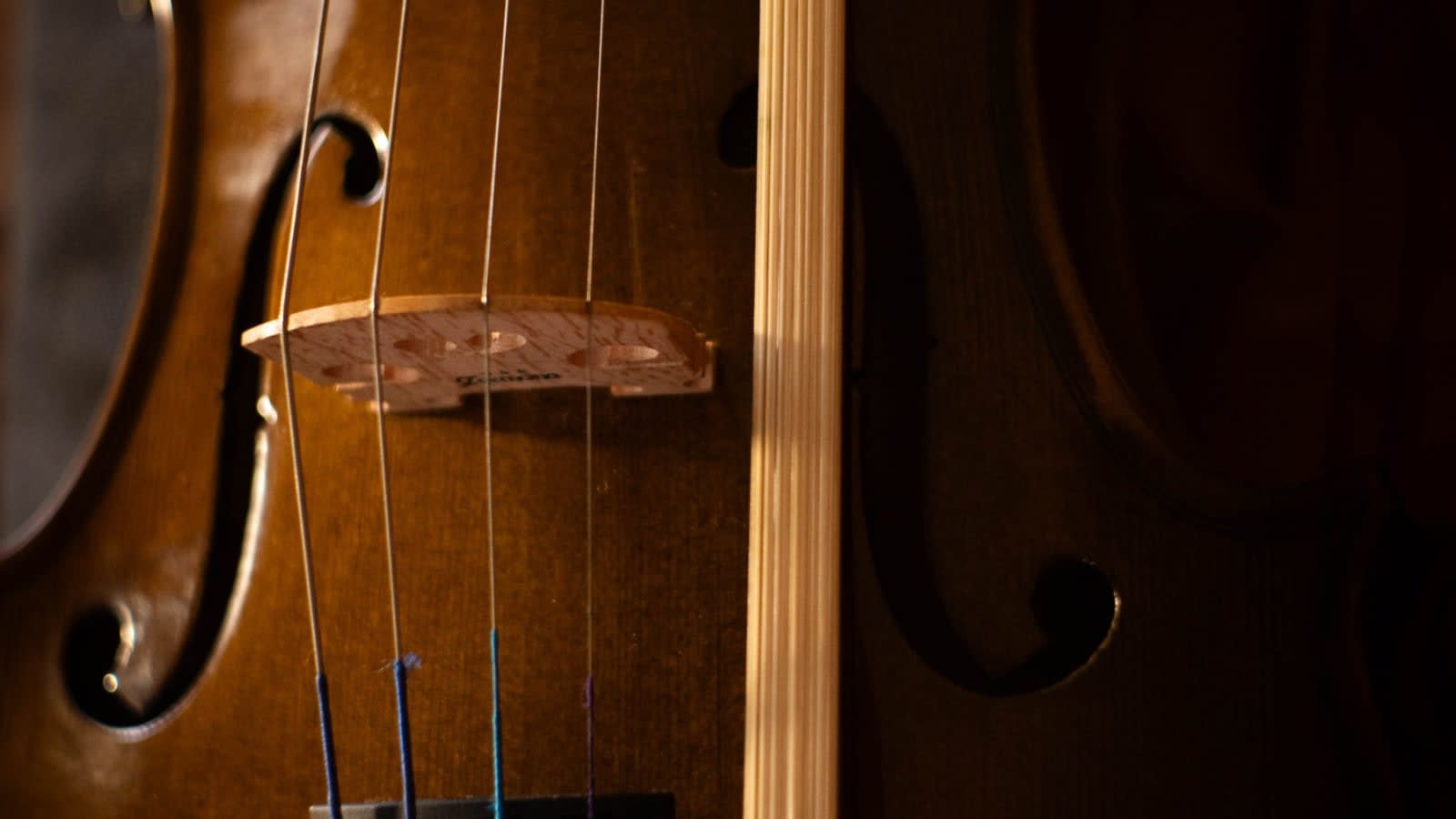
Featured photograph: luian C / Pexels. The hero shows the bridge and strings without a mute.