Photo: cottonbro studio / Pexels.
For four bars, Satie’s Gymnopédie No. 1 gives us only a low bass note followed by a chord. When the melody arrives, it enters on the second beat, above a pattern that already feels familiar. Keeping those two layers distinct is the first step towards playing the piece well.
The notes are approachable for a pianist who can read both staves, move between bass notes and chords, and use the sustain pedal. The useful work is quite specific: make the left-hand journey without a lurch in the rhythm, let the melody continue through its held notes, and notice how the final return changes. These three passages give you somewhere to begin.
How difficult is Gymnopédie No. 1?
Henle rates No. 1 at level 2, in its “easy” category. That is the publisher’s own scale, not an ABRSM or Trinity grade. There are no rapid runs to master, and much of the accompaniment repeats, so the original can be a rewarding choice fairly early in your playing.
It does ask more than keeping both hands in one position. The left hand travels from a low bass note to a chord near middle C; later, the right hand has fuller chords and the harmony introduces accidentals outside the opening key signature. Look through the whole score before deciding that the first line represents every demand.
You will need an acoustic piano or a touch-sensitive digital piano with a sustain pedal. Being able to make one hand quieter than the other will help more here than playing fast scales. If moving the left hand makes you stop on every bar, learn that movement separately before combining the opening with the melody.
A free complete piano score from Mutopia is available as a PDF. It saves space with a repeat and two endings, while some editions write the return out in full. The opening bar numbers below match both layouts. Our excerpts simplify the presentation and omit expression marks; keep the markings in your complete score.
The opening: one bass note, then one chord
Count three beats in each bar. The bass arrives on one; the chord arrives on two and continues through three. There is no fresh chord on the third beat. Adding one changes the accompaniment into a much busier waltz pattern.
On a phone, swipe across the notation or open the full-size image.
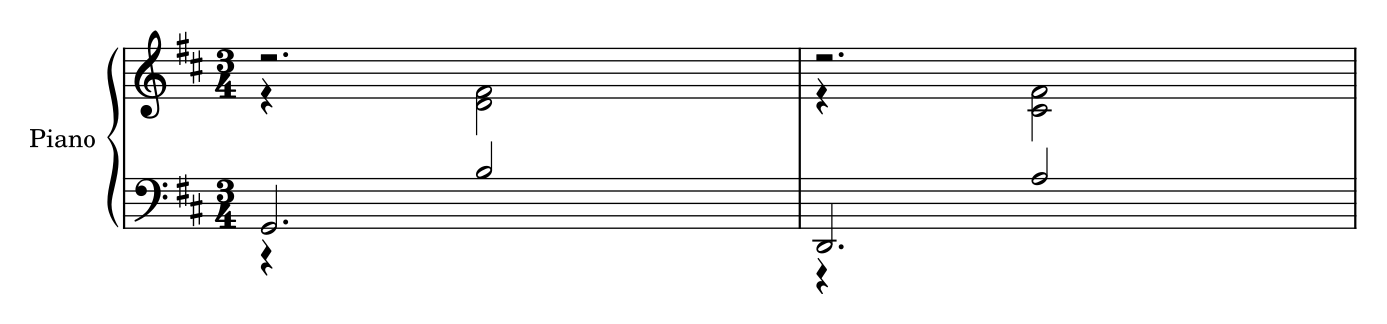
In the first bar, the bass G supports B–D–F♯; in the second, bass D supports A–C♯–F♯. Together these make G-major-seventh and D-major-seventh harmonies. If those names are unfamiliar, our piano chord-symbol lesson shows how a seventh changes a plain triad. Here, the same upper F♯ belongs to both chords while the notes underneath move.
The engraving spreads the accompaniment across both staves. That does not mean the upper notes must belong to the right hand: Henle’s editorial commentary explains this characteristic notation and the left hand’s role. Learn the complete chord shape as one destination. You move to it after the bass; you do not stretch your hand across the whole distance at once.
Try the journey before adding the sound. Play the first bass G, release your hand and place it silently on B–D–F♯. Pause there. Repeat until you can find the shape without searching for each note, then play the bass on one and the chord on two. Do the same with D and its chord.
Now alternate the two bars, counting all three beats aloud. Listen for an extra gap before the chord or a rushed return to the next bass. Choose a pace at which both journeys fit comfortably.
Without pedal, releasing the bass to move will leave a gap in its sound. That is useful while finding the notes, but the finished texture needs the bass resonance to continue underneath the chord. As a starting point, change the sustain pedal just after each new bass sounds: lift enough to clear the previous harmony, then lower it again to catch the new one. Adjust the depth to your instrument and room. Our pedalling exercises explain how to hear whether the change is clean.
Bars 5–12: follow the melody past the moving notes
The right hand rests on the first beat of bar 5. Its F♯ enters on beat two, with the left-hand chord, then rises to A. Give that entrance enough presence to be heard without making the accompaniment louder at the same moment.
Over the next few bars, the melody comes down through shorter notes to a dotted-half-note A in bar 8. It then settles on F♯ in bar 9, tied across four bars. The line has not finished merely because the right hand has stopped moving.
On a phone, swipe across the notation or open the full-size image.
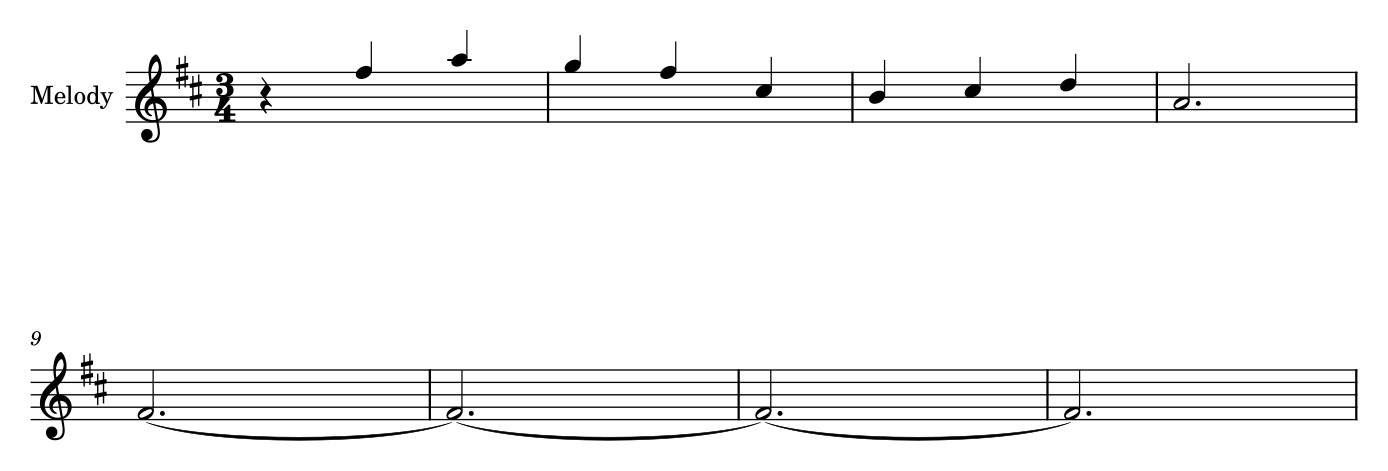
That long F♯ creates a practical detail worth spotting. The accompaniment also includes the same F♯ key at the top of its chords. Keep the sustained note with the right hand and let the left hand supply the other chord notes here, so an accompanying finger does not accidentally strike the tied melody again.
A piano note naturally fades after the hammer strikes. Trying to compensate by making each new left-hand chord louder will bury the melody sooner. Keep the accompaniment quiet enough that you can still follow the held note and the changing bass beneath it. At a comfortable tempo, the four bars should retain their three-beat movement even as the sound decays.
Give the phrase a voice. Play only the melody from bar 5 through bar 12. Hum along if that helps you carry the long F♯ through the four bars, and keep counting underneath it. Then play just the left hand while humming the melody above it.
Put the hands together and make a short recording. On playback, follow only the tune. If the beat-two chords repeatedly pull your attention away, reduce them and try again. The aim is an audible line at an ordinary listening volume, without forcing the right hand.
Keep the score’s swells and changes of dynamic in this experiment. Satie’s Lent et douloureux, meaning slow and sorrowful, is not an instruction to make every note equally soft. For more work on separating the layers, see how to practise voicing.
The return: familiar music, a different ending
Much of the opening music comes back. It is tempting to treat the return as an exact repeat, but its closing passage changes. The chord at the end of the first half is D major; the final chord of the piece is D minor. The crucial note is F♯ becoming F natural.
On a phone, swipe across the notation or open the full-size image.
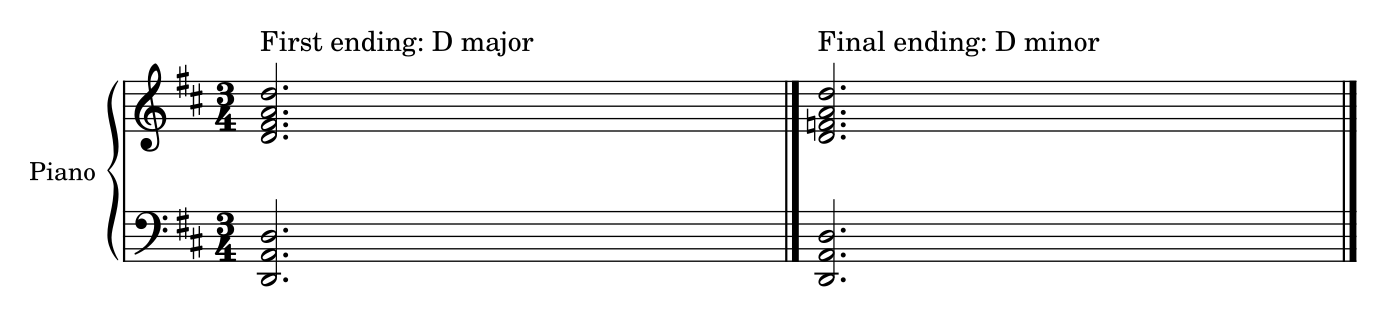
This is a change in the notes themselves, so it remains audible without a dramatic slowdown or a large change of volume. The final passage also has other altered notes before that chord. Read it afresh instead of allowing the familiar opening to carry your hands onto the first ending by habit.
Compare the two arrivals. Play a simple D–F♯–A chord, then D–F–A, over the same D bass. You can use a comfortable close position rather than the full octave chords in the score. Keep the rhythm and volume similar so you can attend to the changed third.
Then play the last few bars of each ending from your complete score. Notice where the versions begin to differ, and practise starting just before that point. Finally, continue through the first ending into the returning accompaniment, so that arrival does not become an unintended stop.
Follow the whole piece
Pascal Rogé performs the piece in this video from Steinway & Sons, filmed at Steinway Hall in New York. Follow the opening bass-and-chord pattern, the melody’s entry and long held note, then the return and its changed ending. You can attend to one of those features on each play without trying to analyse everything at once.
For your next session, take the first twelve bars. Keep the bass changes regular, let the melody enter on its second beat, and carry its held F♯ to the end of the phrase. Once those layers are clear, you have something musical to build on through the rest of the piece.