Cmaj7 means C, E, G and B; C7 changes that B to B♭. A few letters can tell you which harmony to play, but they leave you choices about where to put the notes and how to move them. We’ll start with four simple chords, add sevenths, then change a bass note to see what a slash chord actually asks of your hands.
Featured photo: Yan Krukau / Pexels. The notation and sound examples below are our own.
Start with the letter and the chord’s quality
The letter names the root. A plain C means a C-major chord: C, E and G. Add a lowercase m and it becomes C minor: C, E♭ and G. The change happens in the middle note, called the third. A flat or sharp immediately after the root belongs to its name, so B♭ means a B-flat-major chord.
You can arrange those notes in different octaves. C–E–G and E–G–C contain the same three note names. The lead-sheet explanation from Puget Sound calls this choosing a voicing. At the piano, the hands can share the notes: there is no requirement to squeeze the entire chord into the left hand.
For the examples here, you need to find note names on a keyboard and count four steady beats. Middle C is labelled C4; C3 is the C an octave below it. The PDFs and listening examples are free, and you can use any piano or keyboard.
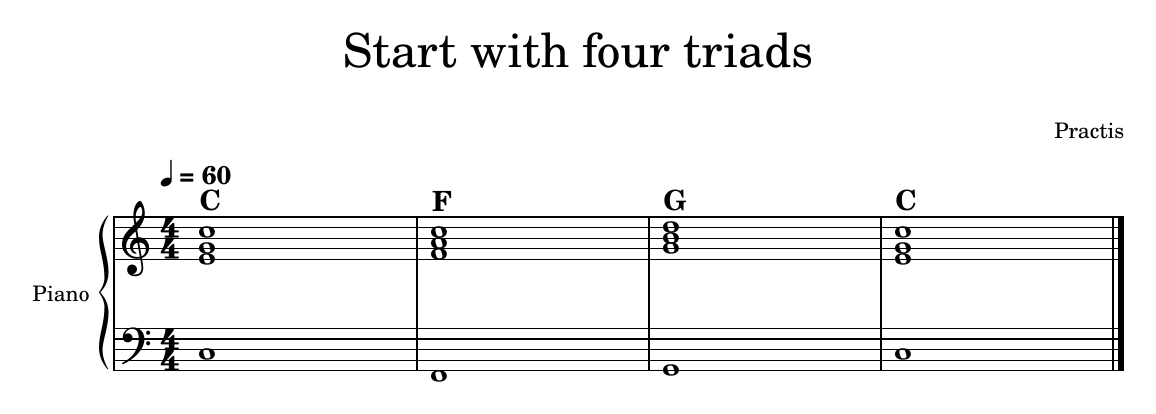
Put C, F, G and C under your fingers
Play one bass note in the left hand and the three written notes in the right. Hold each chord for four beats, then move together to the next one. Start without pedal so the changes remain clear. The recording uses a slow 60 beats per minute; a pause between chords is fine while you find the notes.
On a phone, swipe across the score or open the full-size image.
Enlarge score · Open one-page PDF · Listen to the synthesized example
That first shape is useful because the right hand sits near the next chord. The C symbol would also allow C–E–G in the right hand, but this particular arrangement makes a different choice. Once you can move through all four bars, say the chord names as you play rather than naming every individual key.
What changes between Cmaj7, C7 and Cm7?
A seventh chord adds another note to a triad. Count upward from C, including C as one, and the seventh letter is B. The symbol tells you which kind of B belongs in the chord. Major, dominant and minor sevenths are different chord qualities, even though their names share the word “seventh.”
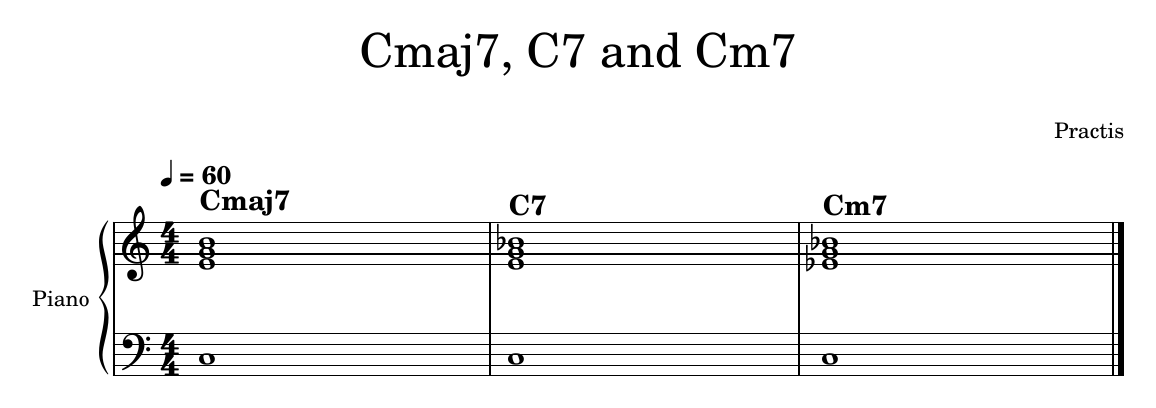
Cmaj7: C–E–G–B
C7: C–E–G–B♭
Cm7: C–E♭–G–B♭
Keep C in the left hand. In the right, play E–G–B, then lower only the B to B♭. To turn that C7 into Cm7, lower E to E♭ as well. The score makes both changes visible; the three short sounds let you compare them without changing the bass or the timing.
On a phone, swipe across the score or open the full-size image.
Enlarge score · Open one-page PDF · Listen to the synthesized example
A bare 7 means a minor seventh above the root. That is why C7 uses B♭ even in a piece whose key signature has no flats. Read the chord symbol on its own terms; do not replace its notes with whichever notes happen to belong to the surrounding key. “Major” in Cmaj7 identifies the major seventh, while the lowercase m in Cm7 changes the triad to minor.
A slash tells you which note goes at the bottom
C/E means a C-major chord with E as the lowest sounding note. Read it aloud as “C over E.” The C remains the root. The E is the bass, and it does not ask for an E-major chord in the left hand. This distinction between root and bass is the basis of chord inversions.
Try the first C chord from our exercise, with C3 in the left hand and E4–G4–C5 in the right. Now keep the right hand still and replace C3 with E3. You have changed C to C/E. Moving only the right-hand notes around while leaving C at the bottom would not make that change.
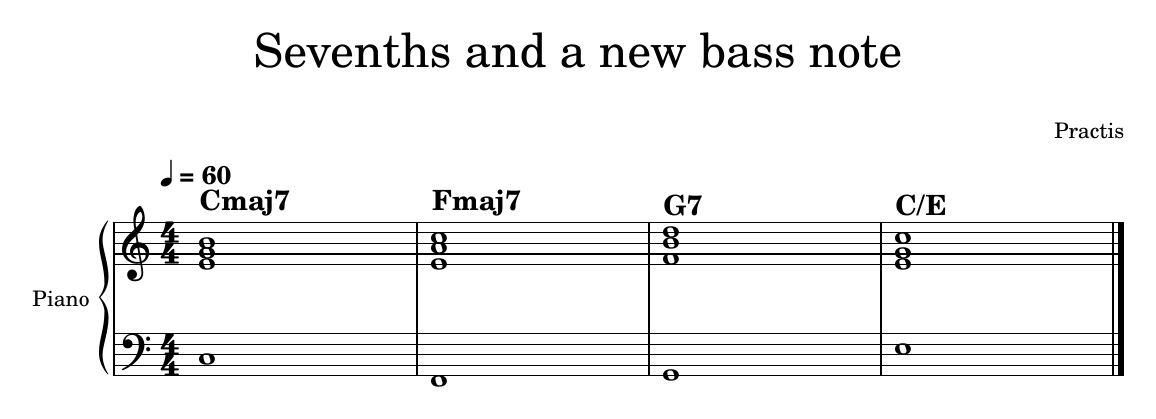
Here is the four-bar progression with sevenths added to the first three chords and C/E at the end. The right hand always has three notes; the left supplies the fourth note of each seventh chord.
On a phone, swipe across the score or open the full-size image.
Enlarge score · Open one-page PDF · Listen to the synthesized example
If reading the staff slows you down, these are the same voicings written as note names, from low to high within each hand:
| Symbol | Left hand | Right hand |
|---|---|---|
| Cmaj7 | C3 | E4, G4, B4 |
| Fmaj7 | F2 | E4, A4, C5 |
| G7 | G2 | F4, B4, D5 |
| C/E | E3 | E4, G4, C5 |
The largest right-hand span here is a sixth. If a shape feels cramped, try a different comfortable distribution between the hands while preserving the chord’s notes and its specified bass. A slash bass can also be outside the chord: C/D means the C-major notes above a D bass. In that case it is not simply an inversion of the C triad.
Recognise the other spellings you’ll meet
Publishers do not all use the same shorthand. Cmin and C− can mean Cm; Cma7 and CΔ7 can mean Cmaj7. Look at a chart’s legend when a mark is unfamiliar. Berklee’s guide to lead sheets describes this variation, including the common plus sign for an augmented chord.
These additional symbols make specific changes. The note spellings show them on C, so you can try each one before learning it in other keys.
| Symbol | Notes | Meaning |
|---|---|---|
| Cdim or C° | C, E♭, G♭ | Diminished triad |
| Caug or C+ | C, E, G♯ | Augmented triad |
| Csus4 | C, F, G | Fourth replaces third |
| Csus2 | C, D, G | Second replaces third |
| Cadd9 | C, E, G, D | Add D; no seventh implied |
| C9 | C, E, G, B♭, D | Dominant seventh plus ninth |
For sus, replace the third rather than keeping it and adding a neighbouring note. For add9, keep the third and add D. The Open Music Theory chord-symbol chapter explains both conventions. A plain “sus” usually means sus4.
Two easily confused symbols are Cm7♭5, also written Cø7, and Cdim7, also written C°7. The first contains C–E♭–G♭–B♭; the second lowers that last note again to B double flat, which is played on the same key as A. They are not interchangeable. You can leave these less familiar shapes for later while you become fluent with the progression above.
Give the same chords a different rhythm
Once the notes are secure, keep the same four chord symbols and change only the pattern. Play the left-hand bass on beat one, then the right-hand chord on beats two and four. Count all four beats aloud, including the quiet third beat. The harmony has stayed the same while the accompaniment has changed.
This is one reason a lead sheet feels different from a written piano arrangement: you help decide the texture. If you are playing with a singer, leave room for the tune rather than treating every chord change as a fill. The accompaniment post develops that musical job.
Keep the examples on your music stand.
Download all three exercises (ZIP: PDFs, MusicXML, MuseScore files and MIDI). You may print, adapt and share these original examples. The sound links use synthesized tones, not a recorded pianist.
For the next pass, cover the written notes and use only the chord names. If one change makes you stop, isolate that pair of chords and find both shapes before adding a steady pulse again.