On many grand pianos, the middle pedal holds a few chosen notes while the rest of the music stays clear. On many uprights, it makes the whole instrument quieter. A digital piano can do either, or give that pedal another job altogether.
The first function is called sostenuto; the second is usually called a practice pedal or muffler. The shape and position of the pedal will not reliably tell you which one you have. A short playing check is more useful.
Try two notes before deciding
You need only the piano. On a digital, select a normal acoustic-piano sound first and turn off any song playback. Leave the right pedal completely released. Use notes in the lower and middle keyboard, since the highest acoustic-piano notes may have no dampers.
- Play the C an octave below middle C and keep that key held down.
- Press the middle pedal, then release your finger from C. Keep the pedal down.
- Play and release the G above middle C.
- Listen for whether C continues while G stops. Then release the pedal.
If C keeps ringing but the later G stops when your finger lifts, the pedal may be working as sostenuto. To distinguish it from bass sustain, repeat with two neighbouring low notes: hold C before pressing the pedal, then play and release D afterwards. True sostenuto keeps the selected C; bass sustain can also keep the later D because it sustains a whole bass range.
If the pedal instead makes newly played notes noticeably quieter and more muffled, you probably have a practice pedal. If nothing obvious happens, check the model’s manual before assuming it is broken. A digital assignment, a silent-play system or an acoustic mechanism needing attention can each change the result. Do not force a pedal or open the action to investigate.
Sostenuto keeps the notes you choose
Inside an acoustic piano, felt dampers stop strings from vibrating when you release the keys. The right-hand sustain pedal raises the dampers together. A sostenuto mechanism instead catches the dampers that are already raised when you press it, allowing those notes to continue after your fingers leave the keys. Steinway’s explanation of the pedals and dampers describes the distinction.
This is why the order matters: play and hold the notes, press sostenuto, then let go of the keys. Pressing the pedal before playing does not select the notes you play afterwards. The diagram shows what happens after the C and the later G in the exercise have both been released:
Middle pedal: sostenuto
Only C was selected.
Right pedal: sustain
Later notes sustain too.
For a small musical example, catch the low C with sostenuto and play E–G–E–C above middle C as four short, detached notes. The bass can continue underneath while your right hand leaves space between its notes. Try the same idea with the right pedal and the upper notes will linger together. That contrast is useful whenever a long bass note needs to outlast the fingers available to hold it.
A practice muffler cannot produce this effect. If your instrument has no sostenuto and a score depends on it, discuss the passage with your teacher rather than automatically holding the right pedal through everything.
On an upright, it may be the quiet-practice pedal
A practice pedal lowers a strip of felt between the hammers and strings. The hammers strike through that extra layer, reducing the sound and changing its colour. Yamaha’s grand-versus-upright guide shows how this differs from the left soft pedal, which moves an upright’s hammers closer to the strings.
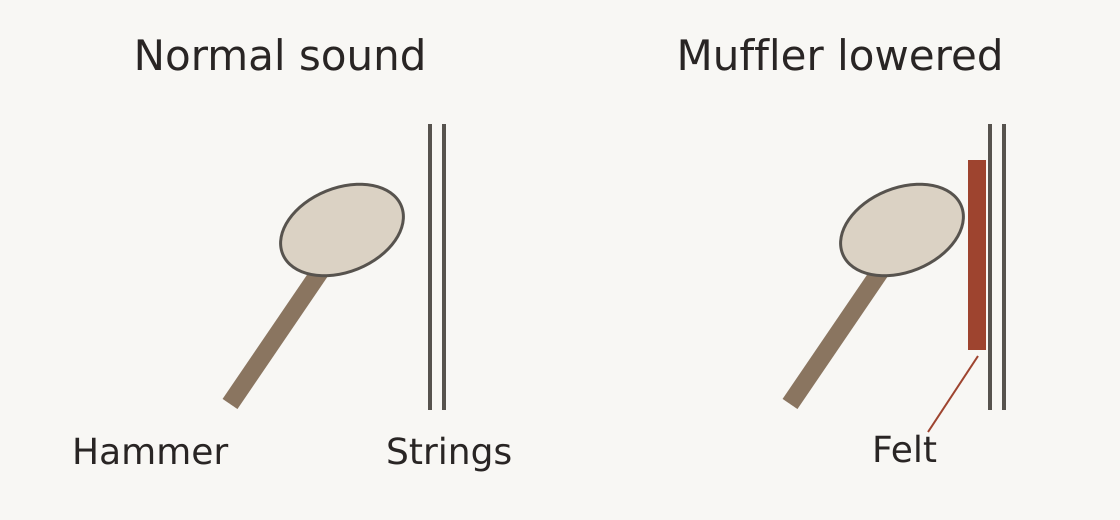
The quieter sound can help with practice at home, but the piano remains audible. It is also a different sound from the one you will use without the muffler, so leave some practice time for listening to your normal tone and balance. A dedicated headphone system is a separate feature; our post on silent acoustic and digital pianos explains that choice. On some silent-system models, the middle pedal engages silent mode instead, so follow that instrument’s instructions.
Upright does not automatically mean muffler. Yamaha’s pedal guide names the YUS5 as an upright with true sostenuto. Other instruments use bass sustain, which lifts only the bass dampers. These exceptions are the reason to try the notes and look up the exact model.
On a digital piano, check the sound and pedal setting
A digital piano can change the middle pedal’s function without changing anything you can see under the keyboard. The Roland LX-9 is a useful example: its default setting gives you sostenuto with most tones, but a simulated muffler when you select an upright-piano tone. A sudden change after choosing a new sound can therefore be normal.
In the LX-9 manual (PDF), pages 7 and 25, the setting is called Center Pedal. Choosing Sostenuto makes that function stay in place; other assignments include Play/Stop and adding a second tone during Dual Play. The manual gives the menu controls. This example comes from Roland’s documentation, not a hands-on LX-9 test.
Other models have fixed functions, and a separate three-pedal unit must be compatible with the keyboard. If you are adding pedals rather than identifying the ones already fitted, check the connections in our digital-piano pedal buying guide. For an unfamiliar piano you are about to play, the two-note check and its own manual are the quickest place to start.
Featured photo: Arjun01 / Wikimedia Commons, released into the public domain; cropped to fit. Diagram by Practis.