
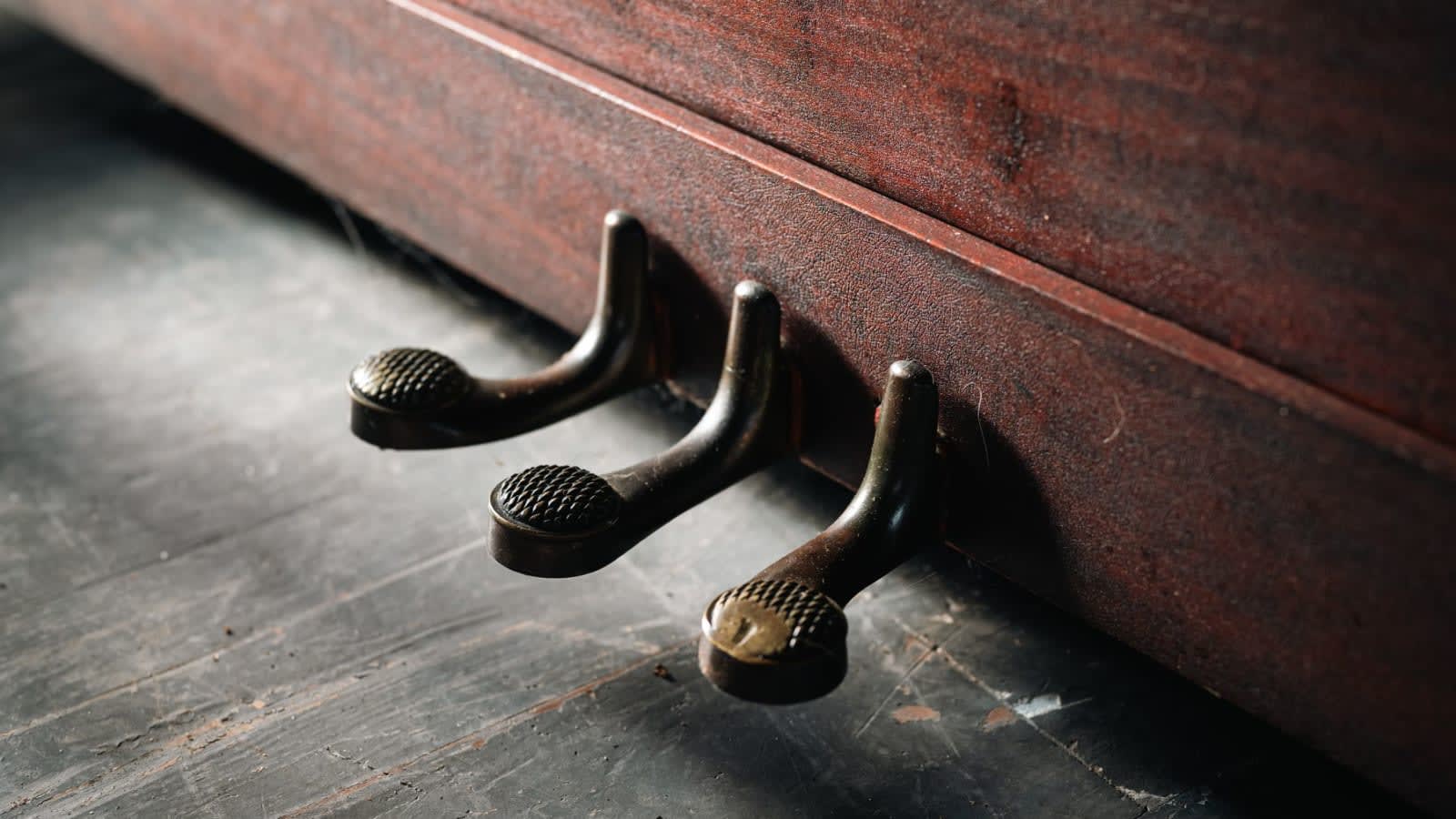
A heavier pedal and a half-damper pedal are not the same upgrade. A $25 piano-shaped switch can stop the plastic footswitch from skating across the floor, yet still send only two states: off and on. A continuous pedal can send intermediate positions, but only when the digital piano has the right input and knows how to interpret them.
That makes the best sustain pedal a compatibility decision before it is a product ranking. For a conventional on/off sustain jack, start with the M-Audio SP-2 or On-Stage KSP100. For half-pedalling, buy the exact pedal family named by the piano manual. The Roland DP-10, Yamaha FC3A, and Korg DS-1H are strong choices inside their supported systems, while the Roland RPU-3 and Casio SP-34 solve two very different three-pedal jobs.
What problem are you actually trying to solve?
Many entry-level portable pianos include a compact square footswitch. It is cheap to ship and enough to hold a chord, but its light case can move when the player's heel is anchored and the toes press forward. Replacing it with a longer metal lever and a broader rubber base changes the physical experience even when the electrical signal remains binary.
Sliding, feel, reversed operation, and missing half-pedalling are four separate faults. The first two are mechanical. Reversed operation is usually a polarity mismatch on a switch input. Missing half-pedalling is a signal-chain problem: the pedal and piano must both support a continuous range, and they must agree on the connector and electrical behavior.
A three-pedal unit adds another question. Some units use three separate quarter-inch plugs, some use one proprietary connector, and some mount to a brand-specific furniture stand. Three metal pedals in a row do not prove that a particular piano can read or physically accept the unit.
Why does a quarter-inch plug prove so little?
The familiar quarter-inch shape is only the outside of the connection. Basic sustain switches commonly use a TS plug, with tip and sleeve contacts, while continuous half-damper pedals commonly use TRS, adding a ring contact. The shape can look almost identical from across the room. Wiring, resistance behavior, polarity, and the piano's firmware still have to match.
A polarity switch is useful on a simple switch pedal because keyboard makers have used different open and closed conventions. It can correct the classic symptom where notes sustain with the pedal released and stop when it is pressed. It cannot add the extra conductor of a TRS connection, turn a switch into a continuous sensor, or teach an on/off input to read intermediate positions.
The full chain has four gates. Product pages often advertise only the first, which is why a pedal can look right and plug in cleanly yet fail at the last step.
One failed gate changes the result. The pedal may work only as a switch, operate backwards, fail calibration, or do nothing.
Start with the exact model number on the piano, including its suffix. Search the manual for damper, sustain, half pedal, and the accessory model. Our post on digital-piano buying mistakes explains why the same discipline also matters for stands and three-pedal bars. If the manual names only a basic footswitch, do not assume a continuous pedal will add a feature the instrument never promised.
“Universal polarity can fix a backwards switch. It cannot create a continuous pedal input.”
Which exact models are worth considering?
The shortlist below covers seven distinct jobs rather than seven interchangeable winners. Practis did not bench-test these models side by side. Specifications come from current manufacturer pages and manuals, while the prices are non-Amazon US snapshots checked on August 24, 2026. Amazon buttons do not state or imply a current Amazon price or stock level.
| Model | Actual job | Signal and connection | Compatibility rule | US snapshot |
|---|---|---|---|---|
| M-Audio SP-2 | Budget weighted switch | On/off, TS polarity switch | Conventional quarter-inch switch input | $25.00 |
| On-Stage KSP100 | Alternative weighted switch | On/off, TS polarity switch | Conventional quarter-inch switch input | $23.95 |
| Roland DP-10 | Anti-slide single pedal | Continuous or switch mode fixed polarity | Half-damper only on an explicitly supported host | $64.99 |
| Yamaha FC3A | Yamaha half-damper | Continuous, TRS no polarity switch | Buy only when the Yamaha manual lists it | $43.95 sale |
| Korg DS-1H | Korg half-damper | Continuous fixed negative polarity | Supported Korg host; calibration may be required | $59.00 sale |
| Roland RPU-3 | Freestanding triple unit | Three separate quarter-inch leads | Host needs three suitable continuous pedal inputs | $189.99 |
| Casio SP-34 | Casio slab triple unit | Proprietary connector | Only named Privia PX-S and CDP-S models | $139.99 |
Affiliate notice: Some links are paid links. As an Amazon Associate, we earn from qualifying purchases.
When is a weighted on/off switch the right upgrade?
The M-Audio SP-2 is the sensible default when the manual calls for a conventional quarter-inch switch pedal. M-Audio specifies a six-foot lead, a polarity selector, a chromed lever, and a rubber-coated shell. Its support documentation is unusually clear that the intended input is a dedicated quarter-inch TS sustain jack, not an audio output and not a device that requires TRS. At the August 24 B&H snapshot it cost $25.
The SP-2 solves the two complaints most owners have about the included square switch: the foot meets a long piano-style lever, and a larger rubber base has more floor contact. It does not sense a continuum of travel. Calling it piano-style describes the body and lever, not half-pedal capability.
The On-Stage KSP100 is the close alternative, not a higher technical tier. On-Stage publishes the same six-foot cable length, a quarter-inch TS connector, a polarity switch, a full-size lever, and a removable nonslip cover. B&H listed it at $23.95 on August 24. Choose between these two by return policy, local availability, and which base grips the actual floor, not by an imagined difference in sustain expression.
Either switch is a meaningful first upgrade for a beginner setup if the current pedal moves or feels vague. The broader home piano setup under $600 puts that small purchase in context: a stable stand, correctly sized bench, foot support, and pedal placement work as one physical system. A better lever cannot compensate for a keyboard rocking above it.
Which pedals actually give you half-pedalling?
Half-pedalling means the instrument responds to intermediate pedal positions instead of treating the travel as one simple threshold. On an acoustic piano, partial damper lift changes how quickly and how fully strings are released. Digital implementations approximate that behavior in different ways, so a continuous control signal is necessary but does not promise that every sound engine will react like the same acoustic piano.
The Roland DP-10 is the most versatile physical design here. Its side selector offers Continuous mode for a supported half-damper input and Switch mode for instruments that need ordinary on/off operation. Roland also gives it a 2.2-meter cable and a rubber heel plate that rotates out to make the footprint roughly 402 millimeters long. That plate addresses sliding directly, but the pedal has fixed polarity rather than the reversal switch found on the SP-2 and KSP100. Roland's own manual says to use Switch mode when the connected instrument does not support half-damper operation.
The Yamaha FC3A is the clean choice when the exact Yamaha manual names it. Yamaha specifies a six-foot cable, quarter-inch TRS plug, and continuous output, in contrast with the binary FC4A and FC5. It was $43.95 at Sweetwater on August 24, below Yamaha's $54.99 direct price. There is no polarity switch and no good reason to treat it as universal. Some Yamaha manuals also specify connection and startup behavior, so follow the model's instructions rather than copying a power-on ritual from another keyboard.
The Korg DS-1H fills the same role in supported Korg systems. Korg lists half-damper capability, fixed negative polarity, a 740-gram body, and a metal lever. The $59 Sweetwater sale snapshot places it between the FC3A and DP-10. Several compatible Korg manuals include a half-damper calibration routine; that is evidence that the pedal and host form a measured system, not evidence that the DS-1H will calibrate correctly on an unrelated keyboard.
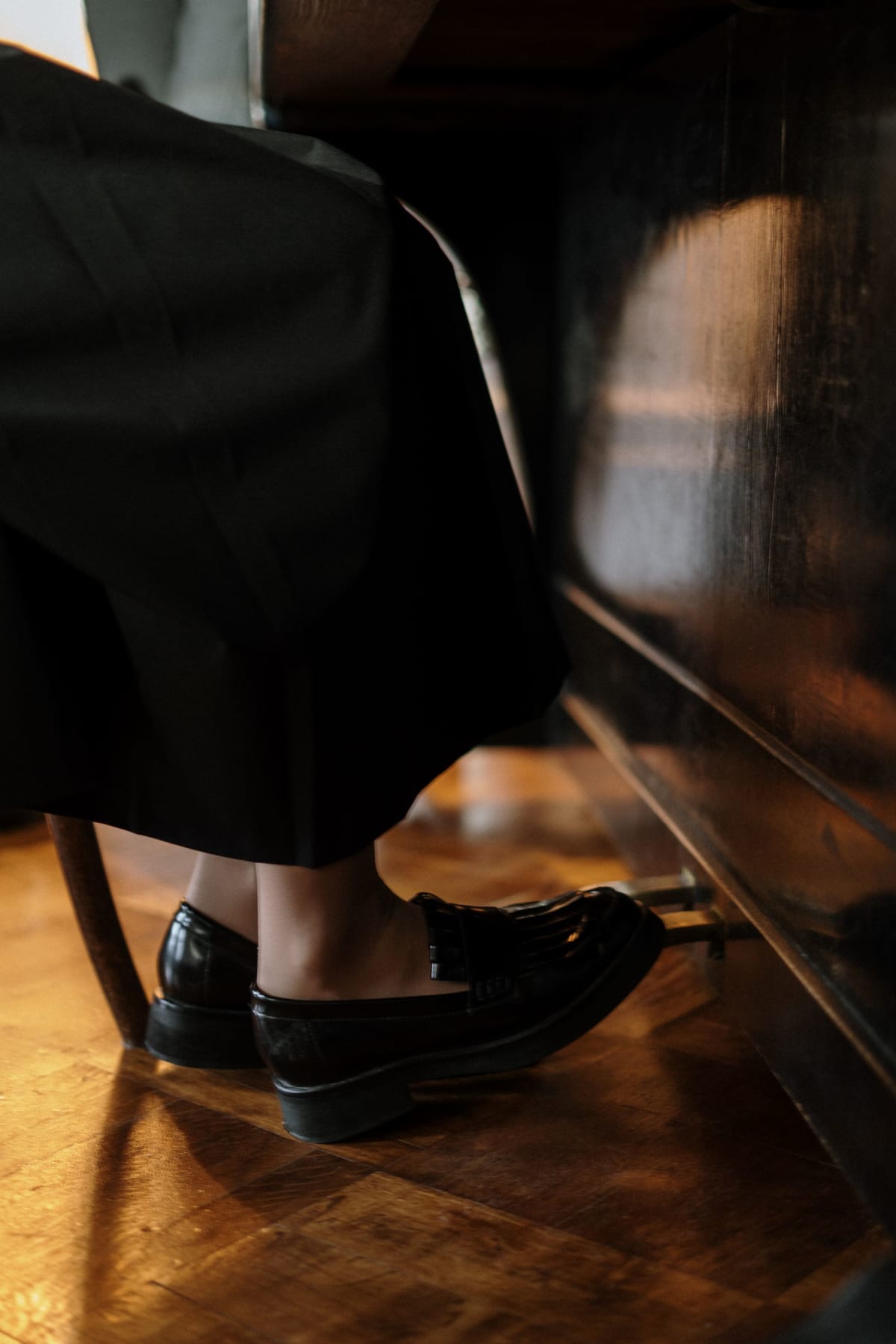
Once the matched hardware works, expression still has to be practised. Our guide to deliberate pedalling practice covers clean changes, partial lifts, flutter, and listening exercises. Transfer between acoustic and digital instruments also depends on the action and sound engine, so do not judge the entire setup by the pedal alone.
“Half-pedalling is a relationship between pedal and piano, not a feature contained in one metal lever.”
When does a three-pedal unit earn the floor space?
A full unit adds sostenuto and soft controls beside the damper pedal, which matters for repertoire that actually uses them and for players preparing on an acoustic-style layout. It can also reduce floor movement because the three pedals share a wide, heavy base. The price is more cable management, more compatibility checks, and a larger object under a portable stand.
The Roland RPU-3 is for stage pianos with three suitable pedal jacks. It has three separate quarter-inch outputs, 2.2-meter leads, and a published weight of 2.5 kilograms. Roland's manual requires three inputs that support continuous detection and warns against connecting the unit to expression-pedal-only jacks. It is not a way to push three functions through one sustain socket. Roland also confirms that the RPU-3 is not compatible with the FP-30 or FP-30X, whose single pedal connector uses the matching KPD-70 furniture unit instead.
The Casio SP-34 takes the opposite approach. Its single proprietary connector serves named Casio models, including a defined group of Privia PX-S and CDP-S instruments. On supported models it provides damper, soft, and sostenuto functions plus half-damper response. B&H listed it at $139.99 on August 24. That neat single-cable design is convenient when the model matches and useless when the socket does not.
Buy three pedals when the music, teaching work, or stage setup uses three pedals. Do not buy the format merely because it resembles a grand piano. For many beginners, one stable damper pedal and a better bench produce more daily value than two extra controls that the current repertoire never touches.
How do you make the final match?
Use the manual as the first shopping page. Write down the exact piano model, the connector label beside its pedal jack, the accessories the manual names, and whether half-damper or continuous response is explicitly supported. Then compare floor grip, lever length, cable reach, and return terms among the compatible choices. This order prevents a beautifully made incompatible pedal from winning on appearance.
Do not hold the pedal down during startup unless the exact manual instructs you to. Some pianos detect switch state or polarity while powering on, while others use a settings menu or fixed behavior. If operation remains wrong after following the manual, stop swapping random adapters and contact the piano maker with the model and pedal numbers.
Once the pedal stays put and behaves predictably, leave the hardware alone and listen to the release of every harmony. A repeatable physical setup makes that focused work easier, and a Practis plan can keep the exercises, recordings, and next-session notes attached to the goal rather than scattered around the room.
The purchase decision can now be short. Choose the SP-2 or KSP100 for a better binary switch, the DP-10 for its excellent heel-plate design when the host matches, the FC3A for a supported Yamaha, the DS-1H for a supported Korg, the RPU-3 for three appropriate stage-piano inputs, or the SP-34 for one of Casio's named models. If the current piano cannot accept the response you need, our beginner digital-piano guide compares instruments by use rather than promising that an accessory can rewrite the input hardware. The right upgrade disappears underfoot: it stays where you put it, sends exactly what the piano expects, and lets you hear the harmony instead of thinking about hardware.


