A duet gives a simple piano part a different life. A melody that feels rather bare alone can sit above a moving bass, changing chords and another person’s phrasing. You also get to make the music with someone, which is a good enough reason to begin.
For an uneven pair, start with Diabelli’s Op. 149 No. 1: the upper part is much easier than the lower one. His No. 6 adds a livelier rhythm. If both of you already read comfortably and move around the keyboard, try the first of Schubert’s Four Ländler, D. 814. All three have free scores linked below.
First, share the keyboard
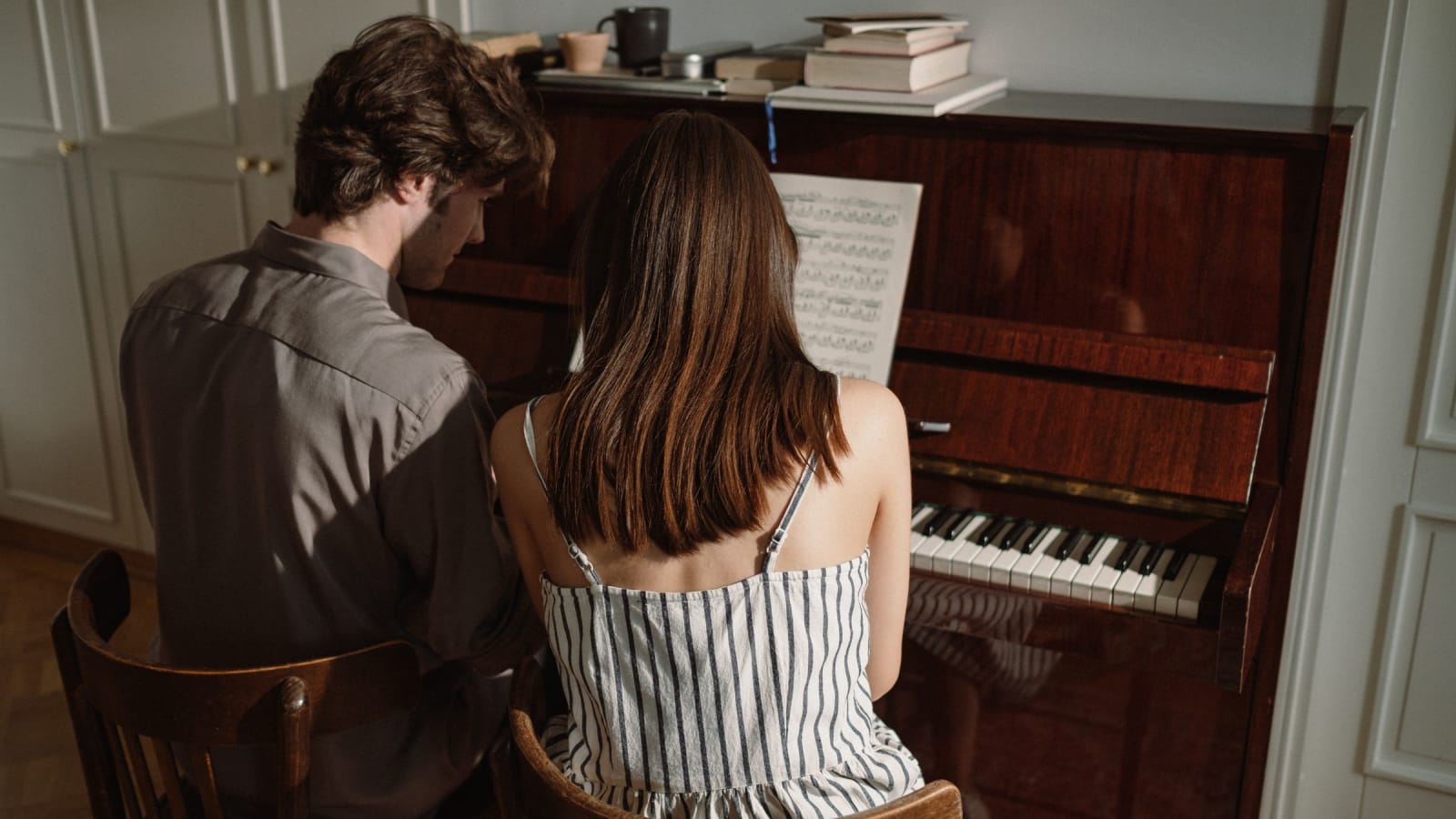
The primo player sits on the right and takes the higher part; secondo sits on the left and takes the lower part. Each player uses both hands. Check the clefs before starting: duet music can put both primo staves in treble clef and both secondo staves in bass clef.
Sit far enough apart to move your elbows comfortably, then try the notes nearest the middle of the keyboard together. A broad bench can work, but two stable piano stools or benches let you set your own height and distance. Pianist Rhonda Rizzo recommends practising in your actual duet seat, too: a part feels different when you have learned it from the centre and then move sideways.
Use an ordinary piano sound and the keyboard’s normal pitch layout. A digital piano’s “Duet,” “Twin Piano” or “Four Hands” mode may give each person a separate copy of the same range. For example, Kawai’s KDP90 manual (page 15) describes that octave remapping. These scores use the normal shared keyboard instead.
Diabelli Op. 149 No. 1: when one player is newer
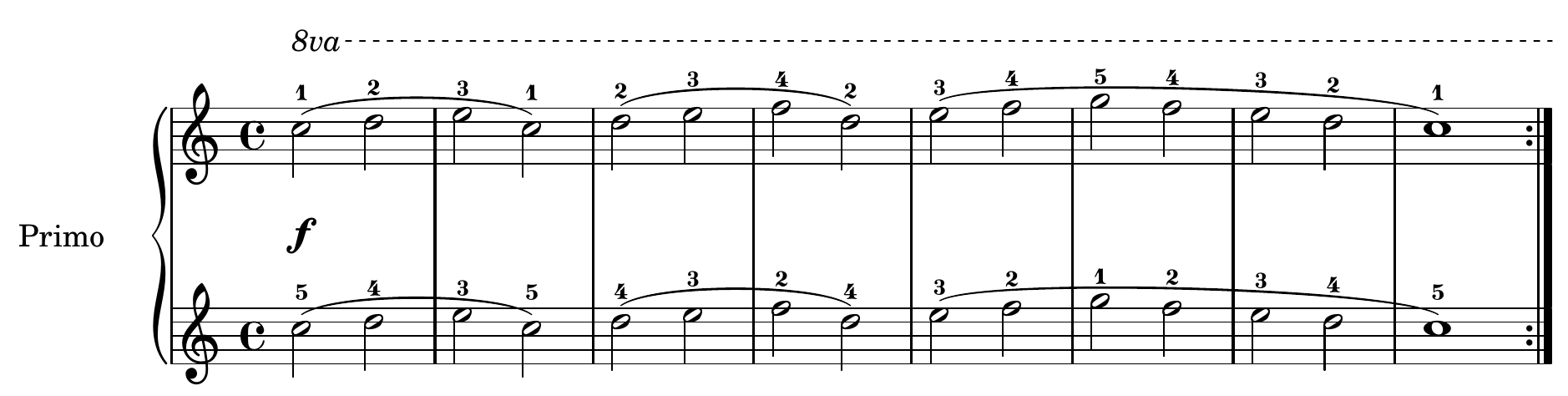
This Andante is a particularly inviting way for a beginner to join a more experienced friend. The primo melody moves through just C, D, E, F and G, with the hands playing the same tune an octave apart. Half notes and whole notes leave time to hear the accompaniment changing underneath. Aim for a connected, singing line.
The primo player needs to keep both hands together, hold the longer notes for their full value and follow the repeat signs. Both staves use treble clef, and the right hand has an octave-up instruction. Set the starting notes carefully before the first count-in; playing an octave too low puts the music in the wrong space.
The secondo player has a more substantial job: a walking quarter-note bass under changing right-hand chords, with accidentals and some movement beyond a fixed hand position. Give this part to the person who can keep that pulse comfortable while listening to the melody. It is too much to assume that two people in their first few lessons can simply take a part each.
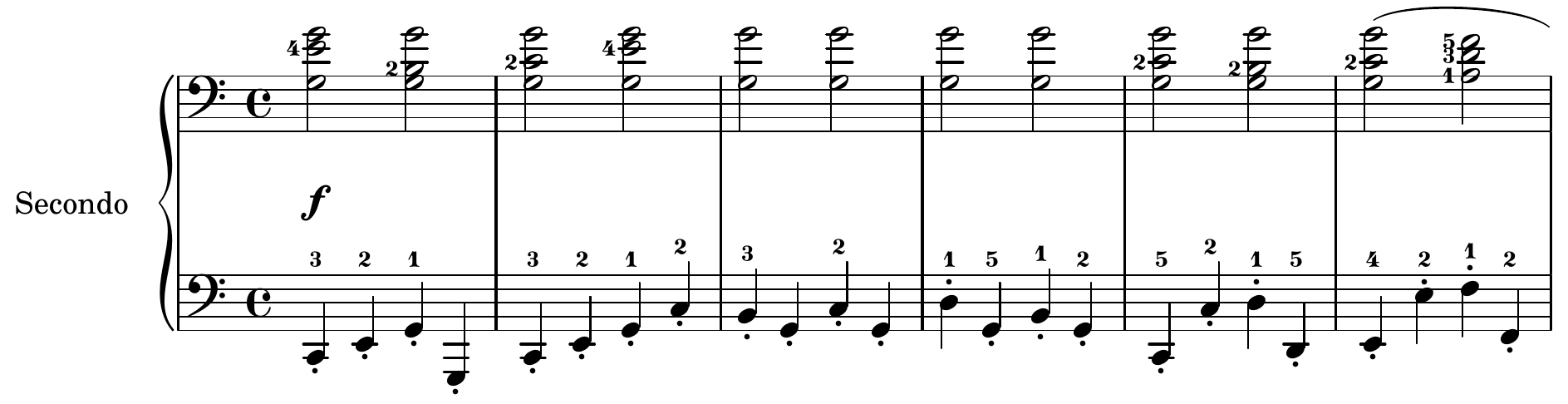
Try the opening four bars together at a relaxed pace. The primo has two long notes in each bar while the secondo’s bass supplies four steady beats. If the upper player loses their place, that bass can help them hear where the next note belongs. Keep it light enough that the melody remains easy to follow.
Download Diabelli Op. 149 No. 1 from Mutopia (free PDF, both parts; engraved by Alberto Simões). Print the two pages separately and place them side by side on the stand.
Diabelli Op. 149 No. 6: a livelier next piece
No. 6 has a springier character: short repeated notes, little slurred pairs and a three-beat accompaniment. It is a useful next choice when the same pair wants more rhythmic variety. The word Allegro is a destination; choose a starting speed at which the small notes and rests still fit.
The primo still doubles a compact melody in both hands, but now has eighth notes, dotted rhythms and small grace notes. There are black notes to negotiate as well. The Trio changes the key signature to three flats and includes F-sharps, so the white-key opening does not describe the whole piece.
For secondo, the main pattern is a bass note on beat one followed by chords on beats two and three. The left hand also plays octaves, and the harmonies change shape. This remains the more demanding part. Let the bass and chords release where they are marked short; heavy pedal would blur much of the music’s bounce.
Before combining the parts, agree how the repeats work and where Da capo al fine sends you after the Trio: back to the opening, ending at Fine. The brief rest at the end of a phrase still belongs to the shared count. Finishing a note early is not a cue for the other player to start the next bar.
Download Diabelli Op. 149 No. 6 from Mutopia (free PDF, Allegro and Trio, both parts; engraved by Alberto Simões). For an easier first read, work on the Allegro before adding the Trio.
Schubert D. 814 No. 1: for two confident readers
The first Ländler is a small dance in E-flat major, with a lilting three-beat pulse and phrases that rise, soften and answer one another. Its compact length makes it approachable, but it asks for more fluent reading than Diabelli’s first primo part. Choose it when both players can already manage changing positions and accidentals without stopping at every note.
Primo carries the melody, often doubled between the hands. Some bars contain a continuous stream of eighth notes; later, the right hand moves higher while the left stays below. The challenge is to keep the tune graceful through those changes, with its slurs and dynamic shading intact.
Secondo begins with chords, then has a moving bass beneath longer right-hand notes. Read ahead for the clef change and the altered notes in the second half. The accompaniment has its own phrasing: it needs to breathe with the melody instead of becoming three equally heavy beats in every bar.
Start with the first eight bars. Play them once with primo leading the phrase, then repeat while that player listens especially to the bass. Adjust the balance until both of you can follow the tune and the harmonic movement. When you add the second half, agree where you will make room at the ending rather than each slowing independently.
The University of Rochester’s free Schubert PDF contains the four dances on printed pages 32–33 (PDF pages 34–35). Secondo is on the left page, primo on the right; No. 1 begins at the top of each. The library’s catalogue record identifies this historical Peters edition.
Marta Poggesi and Emanuele Proietti play the complete set on their Piano4Hands channel. The first dance is the one selected here; the remaining dances offer a sense of where you might go next.
A first rehearsal that gets you playing
Learn enough of your own part to recognise its shape, then meet over a short passage. Four or eight bars are plenty. Choose one person to give a full bar’s count-in and agree a pace that suits the harder part. Play to the end of that passage before discussing what happened, unless either person needs to stop.
If you lose each other: stop together, name the bar and count in again. Repeatedly chasing a partner who is a beat ahead makes it hard to hear the original problem.
If the tune disappears: try the melody with only the other player’s bass. Add the inner notes back more quietly, then decide which part needs to be heard most.
Begin without pedal so you can hear the joins and releases. When you add it, give one player responsibility for it. Secondo is the usual practical choice, because that player is nearer the pedals and has much of the harmony, as Henle’s discussion of duet pedalling explains. The pedal affects your partner’s notes too, so its changes need to suit both parts.
Mark one place where either of you can restart after a slip, and try that entrance together. Our post on preparing your own part for ensemble playing develops that idea. Finish by playing the passage through once more, including its final release. You will have rehearsed a small piece of music together, with a clear place to begin next time.
Featured photo: cottonbro studio / Pexels. The Diabelli downloads are licensed under CC BY-SA 3.0; the linked Schubert edition is in the public domain.