An otherwise lovely piece can become a frustrating choice when its accompaniment keeps asking for an octave you cannot comfortably reach. There is plenty of piano music that leaves those stretches out. These four short works by Schumann and Burgmüller offer singing lines, quick exchanges and a little drama, without octave chords in either hand.
Start with Schumann’s Melody if left-hand chords are the main obstacle. Its accompaniment moves one note at a time. The Wild Rider suits someone who enjoys a brisk, rhythmic piece and can play short chords spanning a sixth. The two Burgmüller pieces reach a seventh in the left hand, so they belong on a different shortlist.
What needs to fit under your hand?
A sixth means the distance from, for example, C to A; a seventh from G to the F above it. Those names describe the outer notes. The notes inside a chord, the black keys involved and how long you hold it all affect how the shape feels.
A melody travelling an octave does not necessarily require an octave stretch: the notes arrive in sequence. A held melody note with another voice moving underneath it can require a spread even when the page looks sparse. The passages below include both kinds of detail.
We checked the complete scores linked here, including their endings. They are the original pieces, rather than simplified arrangements. This is a repertoire selection, not a test of how far you should be able to reach. If playing hurts, stop; BAPAM’s advice for musicians is clear on that. For persistent symptoms, seek advice from a qualified health professional.
Schumann: Melody, op. 68 no. 1
This is the lyrical choice. The right hand begins with a simple descending tune while the left supplies a continuous, gently moving accompaniment. Later, the melody reaches higher and becomes more expressive before settling back into familiar material. There is enough shape in those twenty bars to make a satisfying little performance.
The left hand plays single notes throughout. That makes Melody a useful alternative to pieces built from repeated block chords, although the accompaniment still needs to move smoothly between positions. Keeping it quiet enough for the tune to remain clear is a substantial part of the music.
Check bar 8, then its return in bar 16. The right hand holds F while an inner voice begins on the A below it: a sixth. Those notes belong together even though they are not all struck at the same moment. Elsewhere there are smaller right-hand intervals, including the B–F in bar 11. The piece avoids octaves, but it is not entirely a one-note-at-a-time right-hand part.
Schumann: The Wild Rider, op. 68 no. 8
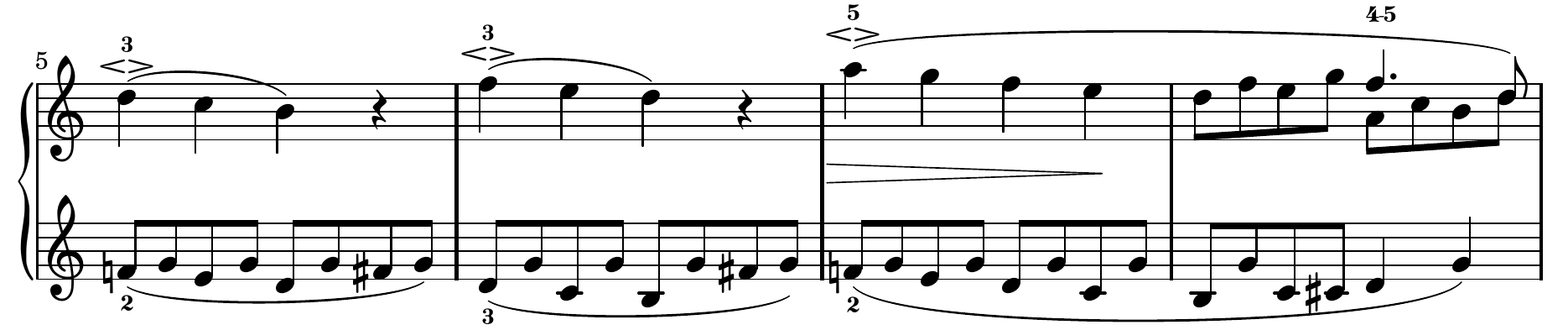
The Wild Rider gives you a different kind of pleasure: a compact gallop in 6/8, with clipped accompaniment and a tune that keeps springing away. In the middle section, the left hand takes over the melody and the right supplies the chords. That exchange makes the return of the opening especially clear.
The widest written chord in either hand spans a sixth. In the opening, look at the left-hand A–D–F shape in bar 2; in the middle section, try the right-hand C–F–A at bar 9. These are useful places to judge the fit before learning the whole piece.
The challenge is the repeated movement between melody notes and short chords. The rests and detached markings are part of its character; turning everything into a long, connected sound loses the gallop. Choose this for its rhythmic energy if those chord shapes already feel comfortable. A smaller maximum span does not make it the easiest piece here.
Burgmüller: La Candeur, op. 100 no. 1
Burgmüller’s op. 100 has a particular connection to this subject: as Henle’s editor explains, its original title explicitly mentions composing and fingering for small hands. The pieces still need checking individually. The first is a good example of why.
La Candeur, often translated as Innocence or Sincerity, begins with flowing right-hand figures above sustained harmony. Its little changes of emphasis and its quiet ending reward careful phrasing. It is a lovely choice for someone who wants to make a short study sound like a complete piece.
The left hand needs sevenths. Bar 7 holds D–F sharp–C for a whole bar; bar 15 has two G–F half-note intervals. These are more demanding than the compact opening chord suggests. The later C–F–A flat chords are also worth trying, since a black key changes the shape.
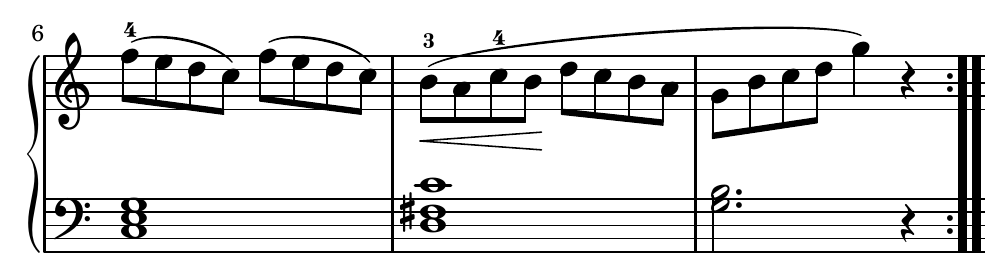
If a seventh is comfortable but octaves are not, this can fit well. If holding those sevenths already feels like a stretch, choose another piece from the selection. The flowing surface should not disguise the sustained work underneath it.
Burgmüller: Arabesque, op. 100 no. 2
Arabesque is for the player who wants something quick and theatrical. Its short rising figures climb through the keyboard, then the hands exchange jobs: the left takes the quick notes while the right sings a longer line. The final descent and emphatic chord give this small piece a proper ending.
Most of the left-hand chords are compact, but bars 8 and 9 repeat G–B–F, spanning a seventh. Compare that with the held sevenths in La Candeur: here the task is to return to the shape repeatedly. The last right-hand interval, C–A, is a sixth. There is no surprise octave chord waiting at the end.
The fast figures change position, so their full range is not a shape to hold open under the hand. Even with comfortable chords, coordinating those shifts and making the short phrases sound light takes work. For help separating reach from the other demands of a new piece, our post on choosing your next repertoire takes a broader view.
Before committing, check the ending
A comfortable first page can be misleading. Bach’s First Invention in C major, for instance, spends almost its entire length with one line per hand, but the linked edition’s final bar contains a left-hand octave with an arpeggio marking. That is why it is outside this particular octave-free selection.
If a piece you love has one awkward passage, take the exact score to your teacher. A different fingering or a redistribution between the hands needs to preserve the voices and suit your movement; it is more useful to solve that specific passage than to change notes from a general rule. Our post on choosing fingerings explains what to consider.
For now, open the piece whose character appeals to you and try the passage named above at an unhurried pace. Check it in context, with the preceding and following bars. That will tell you more about whether the piece belongs on your stand than its reputation as “easy” ever could.
Featured photo: Yuliia Tretynychenko / Pexels. Illustrative piano-playing photograph.