An audition book has to survive a simple request: “What else have you brought?” Every title in it should lead to music you can sing and pages a pianist can use. Start with a small selection you are preparing properly, then add a song when it offers something the others do not.
The useful unit is a complete song with a known key and edition, plus any cuts made for particular auditions. We will use Art Is Calling for Me from Victor Herbert’s The Enchantress to show those decisions on an actual score. The marked pages illustrate how to communicate an entrance and ending; they are not a tested audition recommendation for a particular singer.
Featured photograph: JIUN-JE LIN / Pexels.
Read the request before cutting the music
A book is a reusable selection of music. An audition asks for a particular use of it. Put the current request at the front of your preparation: style or period, length, accompaniment and whether you are preparing a live audition or a recording.
Two published university examples, checked in November 2026, show why a single ready-made cut cannot answer every call:
- Indiana University of Pennsylvania asks for two contrasting 32-bar vocal selections, one written before 1970, and provides a pianist for in-person auditions.
- The University of Oklahoma’s prescreen instructions specify song files of 60–90 seconds, with one song before 1970 and one after. A bar count alone does not establish that a file meets that duration.
These are examples of different requests, not a complete application checklist. Save the instructions for your own audition and prepare that version of the song. If an organiser’s wording leaves it unclear whether a piano introduction counts, resolve that before choosing the boundaries.
Choose songs that give you different things to do
For a competition, check its separate rules too. The NATS repertoire requirements, for example, are a different job from assembling a general audition book.
Consider the contrast a listener would hear. Two songs can have different tempos and still let you play essentially the same scene. Ask what the character wants, whom they are addressing and whether the words are persuading, confessing, challenging or celebrating. Those questions give you more to work with than calling one selection “the ballad” and another “the funny one.” Your teacher can help assess which choices your current singing can support.
NYFA’s audition-book guidance makes a useful practical point: keep the material current, easy to find and clearly marked. It also suggests stylistic variety. Treat categories as prompts for useful contrasts, rather than a quota that forces an unprepared song into the book.
Keep a short index that answers what you can offer now. Include the title and show, key, exact edition, location of the full song, available cuts and the next preparation task. Different cuts of one song can share a row; different keys need unmistakable labels.
For the historical example below, the entry would look like this:
- Song and source
- Art Is Calling for Me, from The Enchantress; Victor Herbert; Witmark vocal score, 1911.
- Key and full song
- E-flat major; No. 12, printed pages 125–130.
- Illustrated cut
- Two piano-only bars, then 16 sung bars; second lyric line; stop before the Ensemble.
- Duration
- Not measured. Time the actual version if the audition sets a limit in seconds.
You can make the same index in a notebook or spreadsheet. A note such as “short cut prepared; longer version still needs an ending” is more useful than treating every PDF in a folder as ready to offer. Keep songs you are still learning separate from the book you take into the room.
Keep the full song behind the cut
A cut may begin halfway through a musical thought or after the words have already established the situation. Learn what precedes it. Decide what the character is trying to achieve when you start, and where that intention changes within the excerpt. Writing a short, specific intention beside the title can be more useful in rehearsal than an abstract mood such as “confident.”
The example uses No. 12 in the 1911 Witmark vocal score of The Enchantress, with music by Victor Herbert. Its key is E-flat major and its meter is 2/4. The complete number has a verse, a refrain and an ensemble continuation. It therefore offers considerably more context than the final stretch of solo singing used below.
Keep the complete six-page number alongside the cut. This historical theatre score includes other voices after the solo passage; it is not an instruction to sing the ensemble material alone. It also should not be silently substituted for a modern anthology arrangement. If your teacher chooses another edition or key, prepare the cut from that exact music and check its boundaries again.
For the full number, preparation means understanding the larger text and musical sequence, including the move into the ensemble. For a short audition request, you must establish an intention immediately, enter from an agreed piano lead-in and finish at a precise place. The song remains the same; the amount of context the room receives changes.
What “16 bars” means in this example
Imagine an audition requesting 16 sung bars, with a short piano introduction allowed. That is our illustrative request, not a universal audition convention. A real notice may count the introduction within its allowance, ask for seconds instead, or specify a different length. Follow that wording and ask the organiser if the distinction is unclear.
The marking example takes the final 16 bars of the solo refrain, using the second printed line of words. The pianist starts two bars earlier. There is no internal jump or transposition: the piano continues through the printed passage. The original held vocal notes in those first two bars are crossed out, making them piano only.
The numbers on the marked copy are editorial, counted from the first complete bar of the number. They are not numbers printed in the original edition:
- Piano start: bar 61, beat one. Play bars 61–62 while the singer remains silent.
- Voice entry: bar 63, beat one, on the second lyric line, “I long to hear them shouting.” Keep that lyric line throughout.
- Finish: continue through bar 78 and stop before the section headed Ensemble. The pianist plays the whole final bar.
That makes 16 sung bars and 18 played bars. It gives us no measured duration. Tempo, delivery and any agreed flexibility affect the elapsed time; count the bars on the score and time the actual music separately.
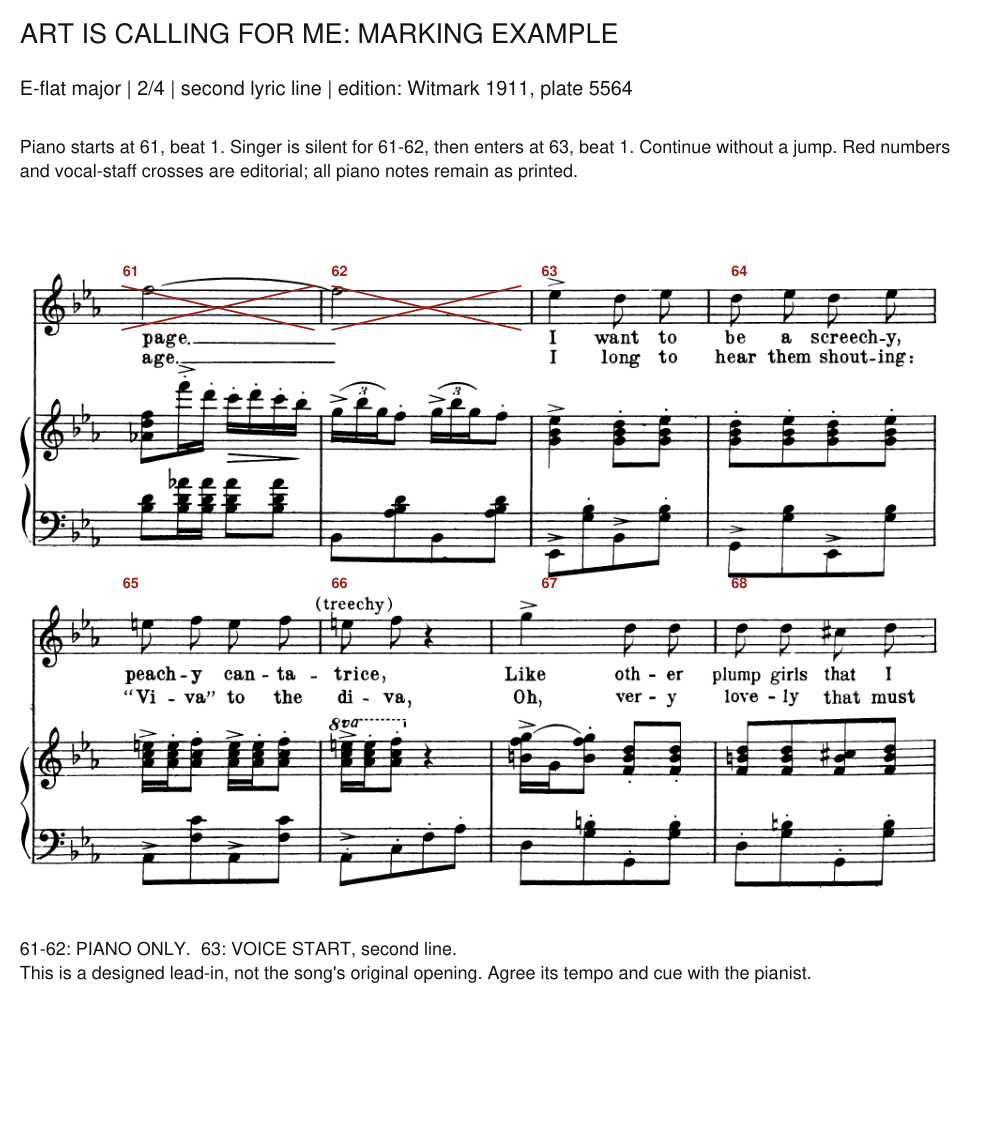
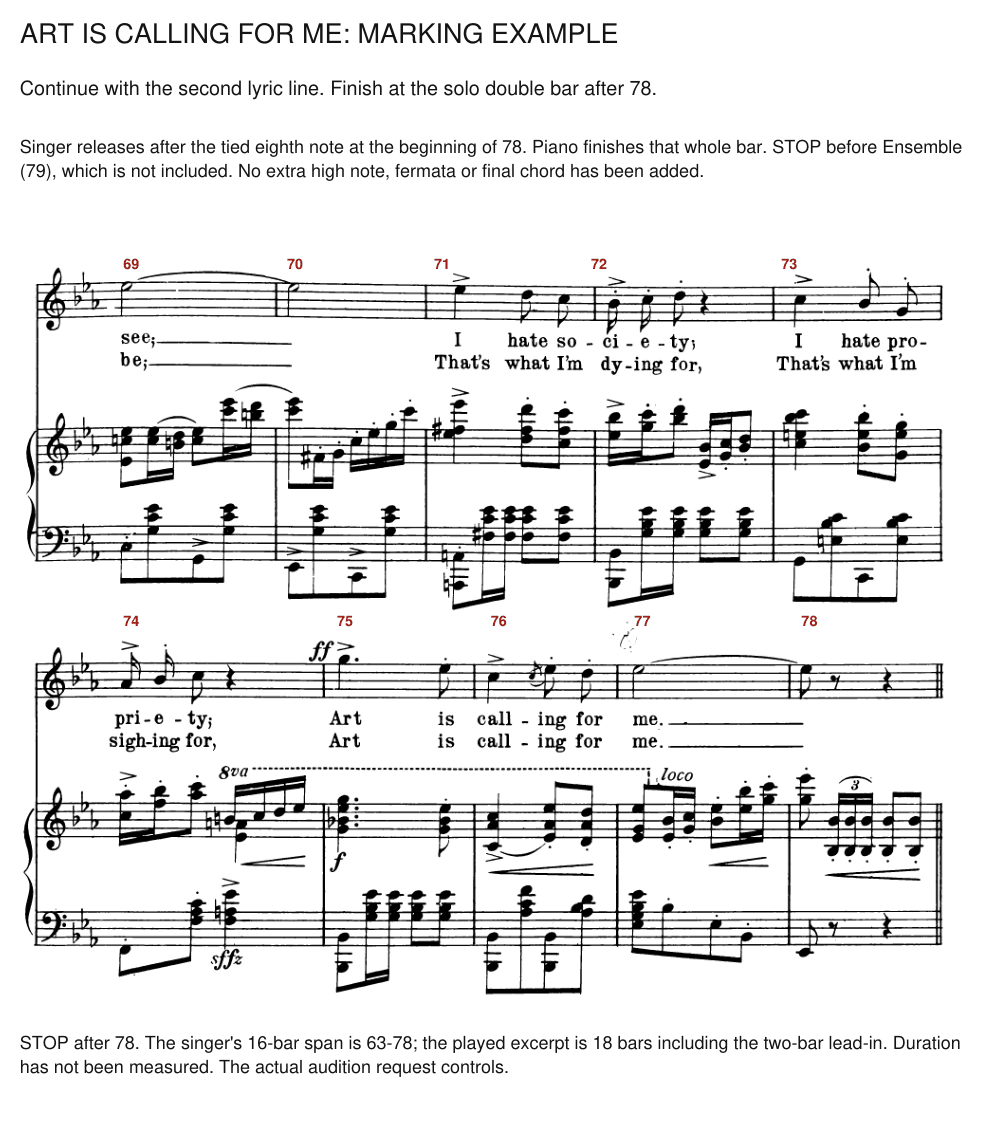
The voice and piano do not simply stop on the same attack. In the final phrase, the singer’s last note continues from bar 77 into the first eighth note of bar 78; the voice then rests while the piano completes the bar. Preserve that distinction when rehearsing the finish.
Make the handoff brief enough to use
The pianist needs the exact music in the agreed key, a clear starting point, the singer’s entry, the route through the cut and its ending. IUP’s guidance also asks for a binder or folder with as few page turns as possible, along with the song, composer, key and source book. Put those decisions on the pages before arriving. Use legible marks that leave the notes visible, and arrange the two pages so the pianist can read them without a surprise turn. Try the actual paper or screen at the piano.
A short written example of the handoff makes the markings easier to understand:
“This is Art Is Calling for Me, in E-flat. Please start at the red 61: those two bars are piano only. I enter at 63, on ‘I long to hear them shouting,’ using the second line of words. We go straight through and stop after 78, before the Ensemble.”
Then indicate the agreed tempo briefly and leave room for the pianist to confirm the start. The spoken explanation should match the marks on the copy. Our post on accompanying a singer explains the partnership from the other side of the piano.
If the key changes during preparation, bring the music in that key rather than relying on an unplanned transposition. For a longer rehearsal booking, the collaborative-pianist brief covers the information to send in advance.
Rehearse the moment before the first note
Practise from the handoff through the ending with a pianist when possible. Starting every attempt on your first sung note leaves the piano introduction and the decision to enter unprepared. In this example, count the two piano bars, take the agreed entry, keep the chosen lyric line and let the accompaniment finish its last bar.
Use the run to answer a specific question. Did the lead-in make the entry clear? Did the text communicate an intention without the preceding verse? Did both people understand the finish? If a problem needs a changed mark, update both copies before trying again. Keep the complete song available so the reason for each cut remains clear.
For a timed request, measure the musical excerpt at the agreed tempo, including whatever introduction and ending the audition counts. Record that duration against this version of the cut. If it is too long, revise the excerpt instead of quietly speeding up a song you prepared at another tempo.
In our Practis web app, you can add the selected songs to your repertoire and use practice-session notes to keep the next rehearsal task beside your work. A useful note here would be “Begin from the two-bar piano lead-in and check the release in the final bar.” Keep the exact marked score with the book; a practice note is a reminder of what to work on.
Return to the index after rehearsal. A song may need a different cut, a clearer acting choice or more preparation before it belongs in the book.