A pianist can know the song and still prepare the wrong version. A title may hide a transposition, a different accompaniment or a cut the soloist has already learned. Sorting that out at the first rehearsal uses time both musicians expected to spend making music.
Send the exact score and a short brief covering the version, movements or cuts, key, event and agreed practical arrangements. Add two or three musical questions worth working on together. The completed singer brief, marked score and school change notice below show how much detail is useful without turning a rehearsal into an administrative exercise.
The title is only the start
Give the pianist the piano score with the solo line visible, rather than only the singer’s or instrumentalist’s part. Identify the publisher and edition, the movements being performed, any arrangement, the selected key and the extent of the music. For a song, include the language; for a concerto, name the piano reduction. A cropped first page is not enough to prepare the rest of the work.
Clara Schumann’s Liebst du um Schönheit provides a real example of why the edition matters. The historical score used below is Frederic W. Root’s 1885 special edition, which offers a simplified accompaniment and an English adaptation alongside the German words. Its cover even tells buyers to specify Root’s version when ordering. A pianist expecting the original accompaniment would be preparing different material. The song title alone cannot settle that.
Both musicians should be able to identify the actual copy, including its key. If the singer has chosen a transposition, arrange the matching piano score before rehearsal. If a movement has a cut, give its departure and return points in both parts and make clear who has agreed it. An unconfirmed cut belongs among the questions to discuss.
For modern editions, use the copies or access permitted by the publisher, library or school. This post’s historical score is available as a public-domain scan; that does not establish permission to distribute a different edition. When someone cannot open or read the supplied file, resolve that before counting the score as received.
A brief the pianist can act on
Here is a completed example for a singer preparing the Schumann song. The people, dates and arrangements are fictional. This example uses Root’s adaptation by agreement with the teacher; choose the edition appropriate to your own course or performance. The real score is on printed pages 2–3, also PDF pages 2–3 in the linked three-page scan. The brief states what is settled and what the two musicians will explore together.
People and purpose: Eva Marin, singer; Daniel Chen, pianist; Ruth Ellis, voice teacher. First joint rehearsal for a studio recital.
Music: Clara Schumann: Liebst du um Schönheit, Op. 12 No. 2; No. 4 in the joint Liebesfrühling collection. Complete song, German text, D-flat major.
Exact score: Root’s Special Edition, John Church & Co., Cincinnati, 1885, plate 4502-2. Frederic W. Root’s adaptation with simplified piano accompaniment; German text selected from the bilingual score. Printed pages 2–3, also PDF pages 2–3 in the linked three-page scan. Teacher has agreed this adaptation for the example recital; both musicians will use it.
Cuts and repeats: Complete printed song, including the piano introduction and postlude. No cuts, inserted repeat or transposition requested.
Rehearsal and event: 17 November 2026, 18:00–18:45, Studio 3; piano and room confirmed in this example. Studio recital: 11 December 2026, 19:00. Pianist’s rehearsal and performance availability agreed separately.
Preparation: Singer has prepared the complete German text and vocal line with the teacher. She is studying the piano part and can locate the entry after its two-bar introduction.
First rehearsal priorities: 1. Agree the opening pace and how to begin the piano introduction. 2. Coordinate the vocal entry in bar 3. 3. Work from the ritardando into Faster on printed page 3, second system. Leave time for a complete run and the piano postlude.
Still to decide together: How much to move at Faster, how to signal the transition, and the pacing of the final vocal phrase into the postlude. These are discussion points, not instructions already agreed with the pianist.
Confirmation requested: Please confirm the edition, D-flat key, complete-song scope and that the score opens correctly. Flag any preparation or scheduling problem before the first rehearsal.
Blank forms and both completed examples. The score itself is linked separately; the document does not include or license modern sheet music.
The preparation line should be candid. If the ending is still being learned, or the teacher is reconsidering the key, say so. The pianist can then judge what preparation is sensible and what the first meeting can accomplish. A polished attachment cannot resolve a musical decision that is still open.
Three places to discuss in the score
Collaborative pianist Carol Feather Martin’s advice for Mason Community Arts Academy emphasizes knowing the other parts, studying the piano score and learning to communicate cues. Her point is that coordination involves everyone. In the Schumann song, three specific places give that conversation a starting point.
Our letters mark discussion points in the historical engraving. They are not composer markings or instructions to change the notes.
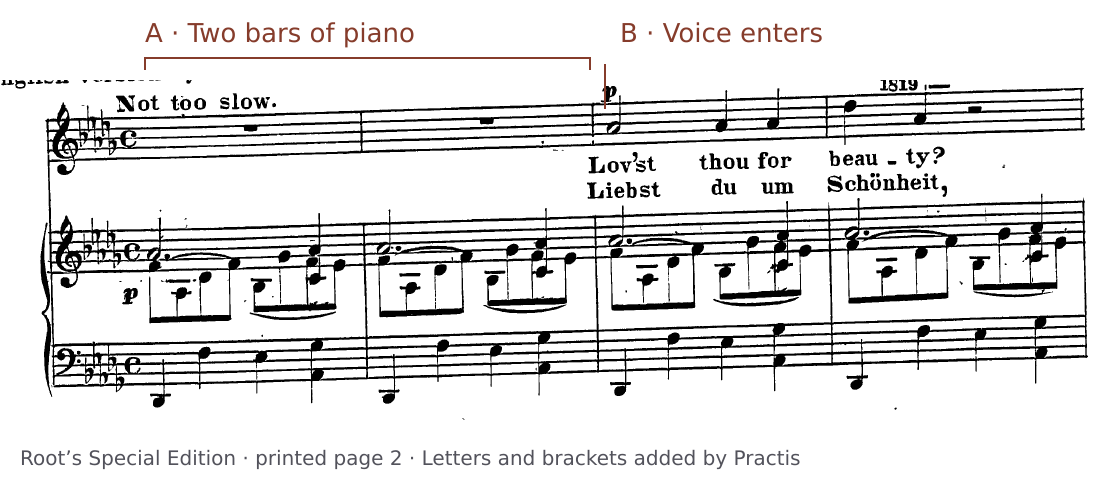
A: agree how the song begins. The pianist has two complete bars before the voice enters. The singer should follow those bars in the full score and know how the piano’s moving figures lead into the vocal phrase. Before playing, discuss the pace and the signal that starts the introduction. A pianist’s familiarity with a recording cannot establish the pace this singer intends.
B: prepare the entrance during the introduction. The first sung note arrives at the start of bar 3 while the piano texture continues. Practise from the beginning of the introduction, so the singer prepares the entry within the existing pulse. Starting every attempt directly on the vocal note would leave the coordination leading up to it untested.
The later change on printed page 3 is a different problem. After a ritardando, Root’s edition prints Faster above the vocal line. That makes a useful second starting place for rehearsal.
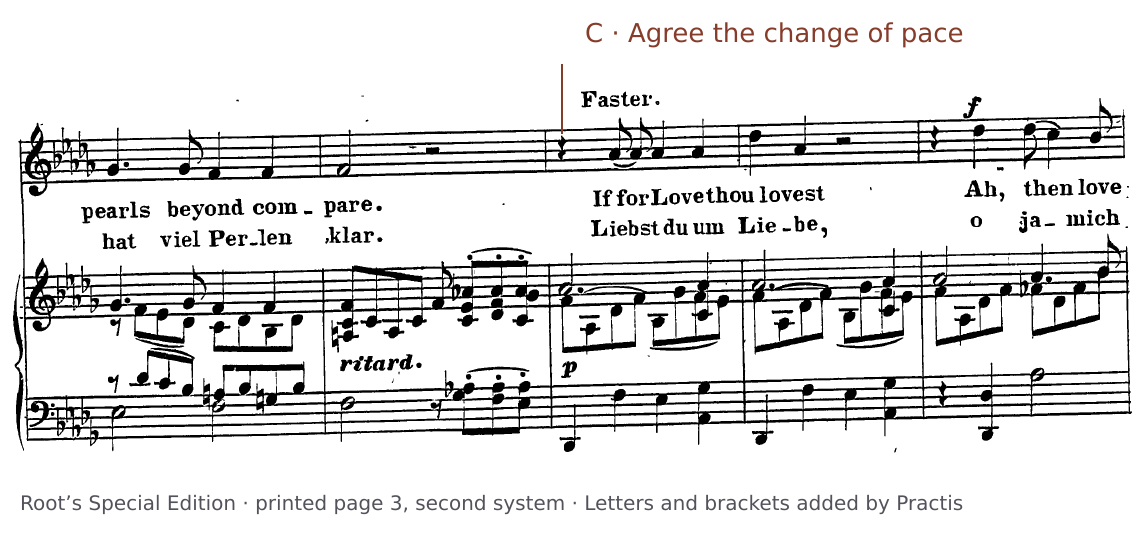
C: agree the new pace before the voice resumes. At the start of the bar labelled Faster, the vocal line has a quarter-note rest. The piano has already begun that bar before the singer’s entry. Discuss how the new pulse will be communicated, then rehearse from the preceding bar so the slowing, the change and the vocal rest remain part of the attempt. Simply asking the pianist to follow the first new sung note would leave the beginning of that bar unresolved.
These are specific enough to prepare separately and open enough to decide together. The full score also continues after the last vocal phrase: allow time to hear the piano postlude and agree the ending as a pair. For the pianist’s side of that relationship, our post on accompanying a singer addresses the wider musical role.
How early is early?
Ask the pianist when they need the music, and check any institutional deadline before arranging the first rehearsal. Preparation depends on the score, workload and event. A short song is not permission to assume someone can take a last-minute commitment.
Ohio State’s collaborative piano guidance asks for the score well in advance and tells students to study the piano part and how the parts align before scheduling rehearsal. It also requires a new submission for any repertoire change. Those responsibilities are part of its own request process; sending a score does not by itself secure an available pianist.
The University of Toronto gives a more specific example in its PMU105/405 contract-pianist policy: instrumentalists provide scores at least three weeks ahead and confirm the rehearsal room with the pianist 24 hours in advance. That is a rule for those classes, not a universal three-week standard. These policy examples were checked in November 2026.
For your own rehearsal, settle the time, room, piano and access arrangements, as well as any fee and what it covers. If school support has a limited allocation, ask which activities use it. A lesson, hearing, recording and public recital can create different commitments even when they involve the same music.
When the programme changes, ask again
A pianist having the whole sonata on the shelf does not mean they agreed to prepare every movement. In this fictional school example, the teacher wants to add the second movement of Beethoven’s Spring Sonata. The existing request covers only the first. The coordinator sends a specific proposal, leaving the expanded programme pending until the people affected have replied.
Subject: Programme change proposed: Jonah Reed, violin, studio recital 11 December
From / to: From the instrumental coordinator to Jonah, teacher Tomas Varga and pianist Daniel Chen. Issued 10 November 2026.
Current programme: Beethoven: Sonata for Violin and Piano in F major, Op. 24, Spring, movement I only. G. Henle Verlag, HN 162.
Requested change: Add movement II after movement I. Complete movements in that order, with no cuts or transposition. The work and edition stay the same; the pianist would have another movement to prepare.
Score and rehearsal: Pianist has the HN 162 piano score; student has the corresponding violin part. Teacher will confirm the working copies together. First rehearsal is 17 November; do not assume the added movement fits the existing allocation.
Confirmation needed: Daniel: can you prepare the added movement and accommodate the necessary rehearsal? Please identify any extra time or fee to agree. Teacher: confirm the expanded programme is appropriate. Coordinator: check the event allowance and any required revised request.
Reply and decision: Replies requested by 12 November. Status: awaiting the pianist’s reply and school approval. Movement I remains the confirmed programme until the coordinator issues the decision to everyone affected.
The HN 162 edition identifies the piano score and associated violin material; the notice does not authorize distributing it. The practical issue here is the expanded commitment. The pianist may need more preparation or rehearsal, the event may have a length limit, and the school may require a revised request. The teacher’s wish to add a movement does not settle those questions for everyone else.
Once the change is accepted, issue the decision to the student, teacher, pianist and event coordinator. If it also produces a revised rehearsal PDF, use a clear score-version handoff so older markings remain identifiable. If it cannot be accommodated, confirm the programme that will actually be rehearsed.
What school staff should keep visible
A shared programme record helps faculty see the pieces attached to an event and the teacher’s current readiness judgment. In Practis, our institution workspace provides that student and programme context. Staff can use it alongside the agreed brief, particularly when several teachers or performances are involved.
The pianist’s booking, fee, available hours and authorized score access still need separate agreement. Practis does not book pianists, manage their hours or automatically send licensed scores or grant an outside pianist access. Schools looking for the faculty preparation side can see the institution workspace.
Before the first joint run, open the same edition, name the exact music being rehearsed and revisit the brief’s unresolved questions. For the Schumann example, that means an agreed opening, the entry after two piano bars and the later change at Faster. Those are useful musical decisions to bring to a first rehearsal.
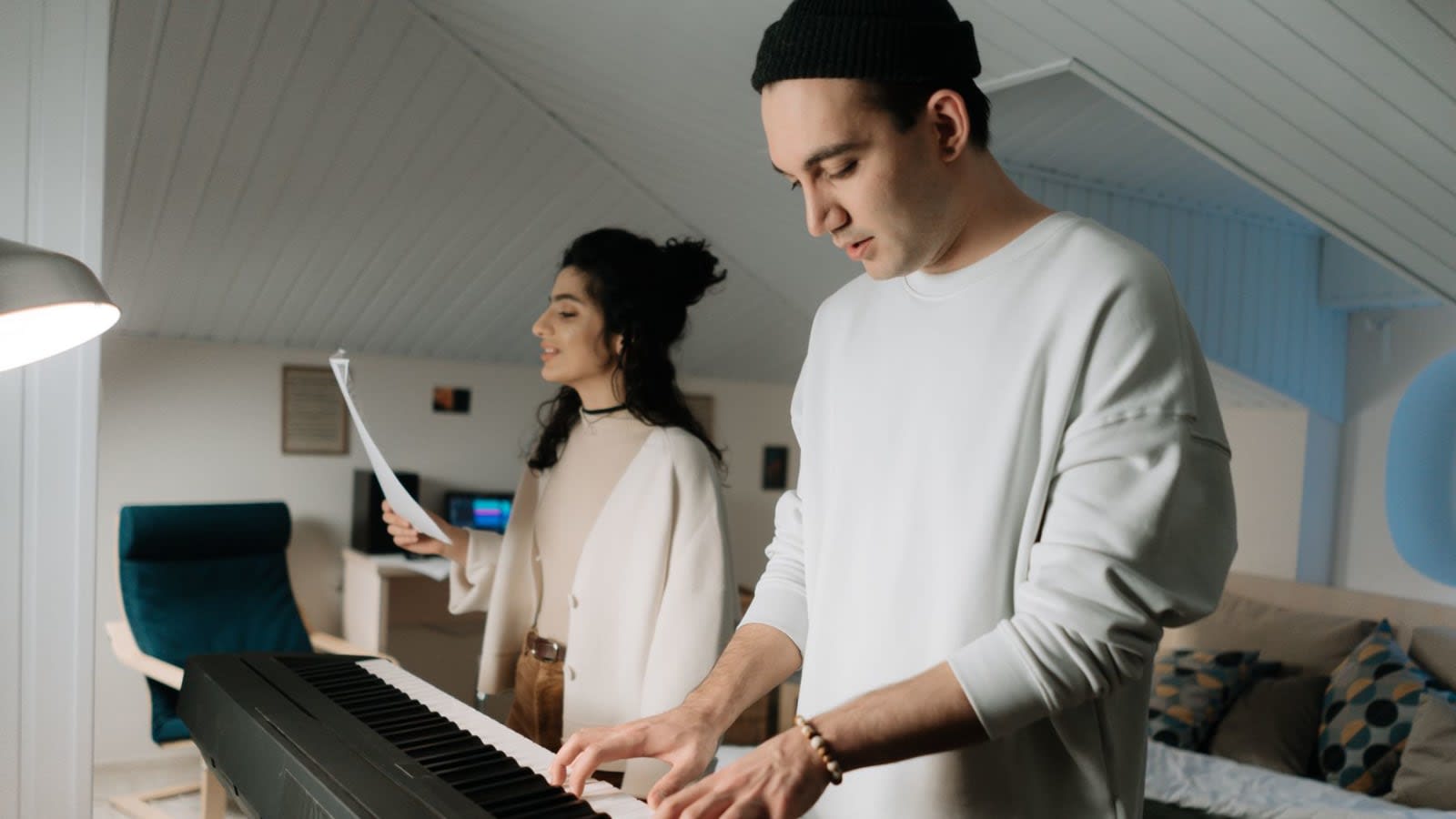
Score details: Clara Schumann, Liebst du um Schönheit, Root’s Special Edition, adapted by Frederic W. Root, John Church & Co., 1885, plate 4502-2. Library of Congress scan via Wikimedia Commons / Internet Archive; Public Domain Mark. Excerpts cropped from the scan; letters, brackets and captions added by Practis. Featured photo: cottonbro studio / Pexels, illustrating a singer and pianist rehearsing.