One teacher hears a convincing phrase with a small interruption. Another hears a performance that never quite keeps moving. Their marks differ by three points, and both can explain why. The useful meeting begins when they stop defending the totals and return to the same passage.
Compare the criterion, the musical evidence and the reason for the mark. A compromise halfway between two totals can conceal a disagreement that will recur with the next student. The aim is a result staff can explain, and a shared standard they can apply beyond this one performance.
Photo: Yan Krukau / Pexels. The people pictured are unrelated to the fictional assessment below.
Agree what this meeting is deciding
For an internal school assessment, the question might be whether the department has applied its own performance rubric consistently. For an examined qualification, use that board’s current criteria and administration rules. A school’s useful four-point scale cannot be substituted for an awarding body’s mark scheme.
Staff often call this a moderation meeting. In the GCSE guidance discussed here, comparing teachers’ marking within the centre is internal standardisation; the board’s later check is external moderation. Those are related stages with different responsibilities.
For AQA GCSE Music, section 5.5 of the specification requires consistent marking across students and one person to manage internal standardisation and sign the Centre declaration sheet. It suggests common sample marking, discussion and reference material. Cambridge OCR’s GCSE Music specification, printed page 41 likewise describes shared sample marking before the main marking begins, followed by comparison or re-marking where several teachers are involved.
Choose a manageable sample that exposes different questions: a strong performance, one near a descriptor boundary, and one where the teachers disagree about a specific musical feature. A sample made entirely of easy agreements will give a comfortable meeting without revealing much.
Each teacher needs the same complete performance, score where relevant, task instructions and version of the criteria. Mark independently before seeing colleagues’ numbers. Keep brief references to passages so the discussion can return to something audible. Our guide to music assessment rubrics covers the separate task of choosing and defining the criteria.
A three-point disagreement in a small department
The following is an invented paper example for discussing how a meeting works. It describes a fictional solo performance; we have not assessed a student recording. The miniature scale is ours, not AQA’s or OCR’s.
Imagine a school assessment of a 32-bar piece: an opening section in bars 1–12, a contrasting middle in bars 13–20 and a return in bars 21–32. Staff have three areas, each worth up to four marks: pulse and continuity, pitch accuracy, and phrase shape. Here are the adjacent descriptors relevant to this disagreement; a real rubric would also define its lower levels and any other required dimensions.
| Area | 2 marks | 3 marks | 4 marks |
|---|---|---|---|
| Pulse and continuity | Repeated unintended interruptions make the beat difficult to follow. | A clear underlying pulse, with an isolated interruption from which the player recovers. | A clear underlying pulse and controlled continuity throughout. |
| Pitch accuracy | Recurring errors obscure parts of the melodic or harmonic line. | Mostly accurate pitches; isolated errors leave the line recognisable. | Accurate pitches throughout. |
| Phrase shape | Some shaping, but much of the performance lacks a clear direction. | Clear shaping in most passages, with a less developed section. | Clear, sustained shaping across all sections. |
The two teachers agree on pitch accuracy. Their disagreement concerns continuity and shaping:
| Area | Teacher A | Teacher B |
|---|---|---|
| Pulse | 3 | 2 |
| Pitch | 3 | 3 |
| Shape | 4 | 2 |
| Total / 12 | 10 | 7 |
The fictional observations
At bars 8 and 32, the player broadens the cadence deliberately. At bar 17, the player stops and restarts once; the beat is then restored. Two isolated pitch errors occur without losing the melodic line.
The opening and returning sections have clear phrase direction. Apart from the restart, the middle section has secure pitches but relatively flat shaping.
These observations are the common ground for the example. In an actual meeting, staff would establish them by listening to the complete performance and the disputed passages, rather than treating a written summary as a replacement for the music.
Find out which disagreement you have
A disagreement about evidence means the teachers heard different things. Teacher B counted the two broad cadences as additional interruptions. Play through the approach to each cadence and the next entry. Is there an intended arrival and a controlled continuation, or does the player lose the thread?
In our example, the cadences are controlled and bar 17 is the sole unintended stop. Both teachers can therefore use the three-mark pulse descriptor. This does not establish that every hesitation is expressive. It explains why these particular moments have been treated differently.
A disagreement about the descriptor remains after staff agree what happened. Teacher A remembers the convincing opening and return; Teacher B gives much greater weight to the flat middle. The wording asks how much of the performance sustains the shaping. With clear shaping across the 24 bars of the outer sections and a weaker eight-bar middle, three marks fits the stated description better than either four or two.
A disagreement about musical preference is different again. One teacher might prefer a faster tempo or less pedal. Ask whether the chosen interpretation fails a criterion, and where. “I would play it differently” does not yet identify a weakness. Equally, calling something an interpretation does not settle whether it works.
The agreed example result becomes 3 + 3 + 3 = 9 out of 12. It is not the average of 10 and 7, which would be 8.5. Staff have changed particular judgments for particular reasons. If a department’s formal procedure requires averaged panel marks, follow that procedure; the point here is that averaging alone does not resolve inconsistent use of descriptors.
Listen again in context after inspecting a short passage. Ten repetitions of a two-second slip can make it dominate the discussion. Conversely, an attractive final phrase can erase the memory of a less convincing middle. The complete performance is what the criterion describes.
Give the discussion a beginning and an end
A suggested 30-minute meeting can work for one already-marked sample. Spend the first five minutes confirming the task, criteria and material. Use the next fifteen to hear the disputed passages and identify the reason for each difference. Leave the final ten for the agreed record, any wider checking and responsibility for completing it. A larger disagreement needs more time, not a forced decision at minute thirty.
Let each marker name the evidence before the senior colleague announces a preferred result. For example: “I put continuity at two because I counted three stops” is something another person can examine. “It just felt like a seven” leaves the judgment unexplained.
Work through the areas separately. In our example, pitch accuracy is already agreed. Spending most of the meeting debating the two wrong notes would avoid the actual difference in judgment. Note the agreement and concentrate on pulse and shaping.
If the sample still cannot be resolved, identify the missing step. It might be another comparison with an authorised reference performance, clarification of an ambiguous school descriptor, or advice from the qualification’s subject support. Name who will obtain it and when staff will return to the decision. Do not describe a disputed provisional mark as agreed.
Cambridge OCR’s guidance makes the wider consequence explicit: where inconsistent standards are found, teachers should adjust or reconsider marks across the learners they assessed, and retain evidence of standardisation. That is why fixing one sampled mark may not finish the job. If a teacher has treated every controlled cadence as a loss of pulse, look for that interpretation in their other marking too. A uniform numerical deduction would not answer that question.
Write down the reason, not the meeting transcript
A useful record should let another colleague understand the decision without attending the discussion. Keep the original marks, identify the performance version and criteria, and explain the changed judgments. For the paper example, a short entry might read:
Illustrative internal standardisation record
Material: fictional 32-bar solo; school performance rubric version 1.2. Initial marks A: 10/12, B: 7/12.
Agreed result: pulse 3, pitch 3, shape 3; total 9/12.
Reason: bars 8 and 32 are controlled cadential broadening. The single restart at bar 17 fits the isolated-interruption descriptor. Shaping is clear in the outer sections but less developed in the middle, supporting 3 rather than 4 or 2.
Follow-up: both teachers check whether the same interpretation affected their other marks. The assessment lead checks the revised records before release.
Add the real meeting date, staff names and secure location of the assessed material. Preserve the original and agreed entries so a later correction does not erase why the mark changed. Keep access within the school’s authorised assessment arrangements.
For AQA GCSE Music, the NEA administration instructions require comments on the Candidate Record Form that show precisely how the assessment criteria have been met, with correct marks and totals. A department’s meeting note supports its work; it does not replace that required form.
For qualifications covered by the current JCQ NEA instructions, candidates must receive centre-assessed marks with enough time to request a review before submission to the awarding body. Staff must also explain that external moderation can change those marks. Build the school’s timetable around that process, rather than holding the first standardisation discussion on submission day.
Keep preparation context separate from the result
A student may have worked steadily for weeks and still give an unsettled assessed performance. Another may prepare irregularly and play convincingly on the day. Where the criterion assesses the performance, practice minutes cannot be substituted for what was played. Effort, progress and preparation can still deserve a separate teaching conversation.
That is where an organised practice record helps. A teacher can find the assigned music, see which passages have been discussed and decide what the student should work on after assessment. The record should make that conversation more specific, without adding invisible marks for persistence.

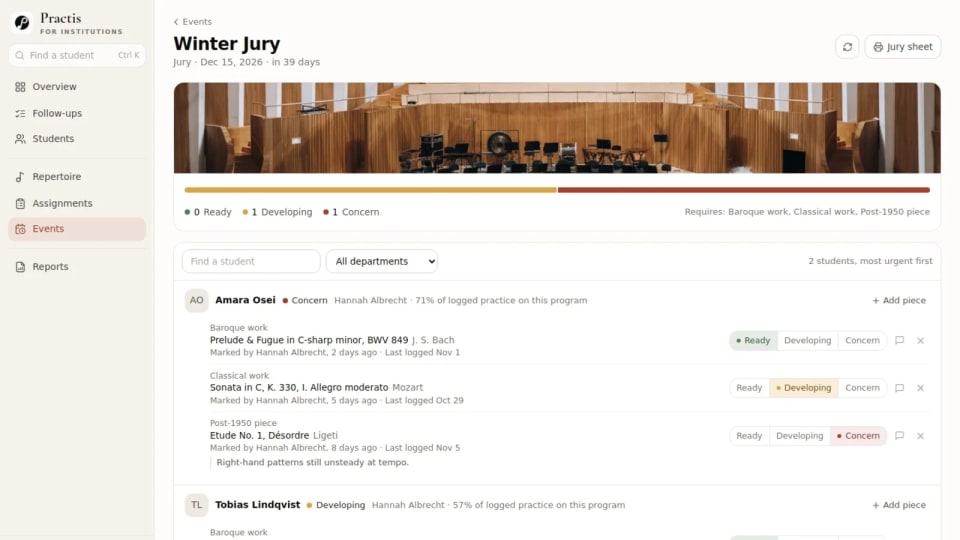
Practis for institutions can put repertoire, practice history, assignments and teacher follow-up in one place for authorised staff. Keep the official assessment, standardisation decision and any review in the school’s chosen assessment system. Our music jury software comparison explains the distinction between preparing a programme and administering its assessment.
Once the result is settled, turn the feedback into a manageable musical task. For the fictional player, “keep the middle section moving towards its high point” needs a passage and an audible aim; it should not become five unrelated teachers’ assignments. The guide to coordinating music homework shows how staff can agree that next week together.
If your department needs a clearer view of preparation before assessments and follow-up afterwards, bring that teaching process to a Practis demonstration. The useful question is what teachers can find and act on. Agreeing the mark remains a musical judgment for the people listening.