
The first movement of Beethoven’s Moonlight Sonata is a good intermediate project, rather than a first piano piece. Its opening pattern is easy to recognise and tempting to copy, but the work soon asks you to bring out a melody within one hand, keep the accompaniment quiet and carry a long phrase without losing the pulse. Learning its notes and making the whole movement speak are different stages of the same job.
What “intermediate” means here
Pianist and teacher Janet Newman calls this movement intermediate in her teaching guide for Pianist. That is a useful broad description, not a promise that every intermediate player will find the same bars difficult. A pianist comfortable with fast scales may still be new to playing a melody and accompaniment at different volumes in the right hand.
You should already be able to read both staves, follow accidentals in C-sharp minor’s four-sharp key signature and play broken chords without stopping to find each note. The bass includes octaves, and the hands need to move between positions comfortably. If an octave makes you strain, ask a teacher about a workable redistribution or a different piece before trying to hold the stretch through repeated practice.
Be careful with a difficulty number attached to the title alone. Henle lists the complete sonata at level 7, “difficult”; that includes the much more demanding finale. It does not make the opening Adagio sostenuto a level-7 movement, and learning the Adagio does not mean you are ready to play all three movements.
Try the three passages below before choosing it as your next main piece. They reveal more than repeatedly playing the familiar first four bars. If several kinds of difficulty arrive at once, our post on choosing a piece that helps you improve can help you find a more manageable step towards it.
Bars 4–6: let the melody arrive
At first, the triplets occupy nearly all your attention. In bar 5 a separate melody enters above them, with a dotted rhythm leading into the next bar. The two parts share the right hand, but they have different jobs: the triplets keep moving while the longer top notes form a phrase.
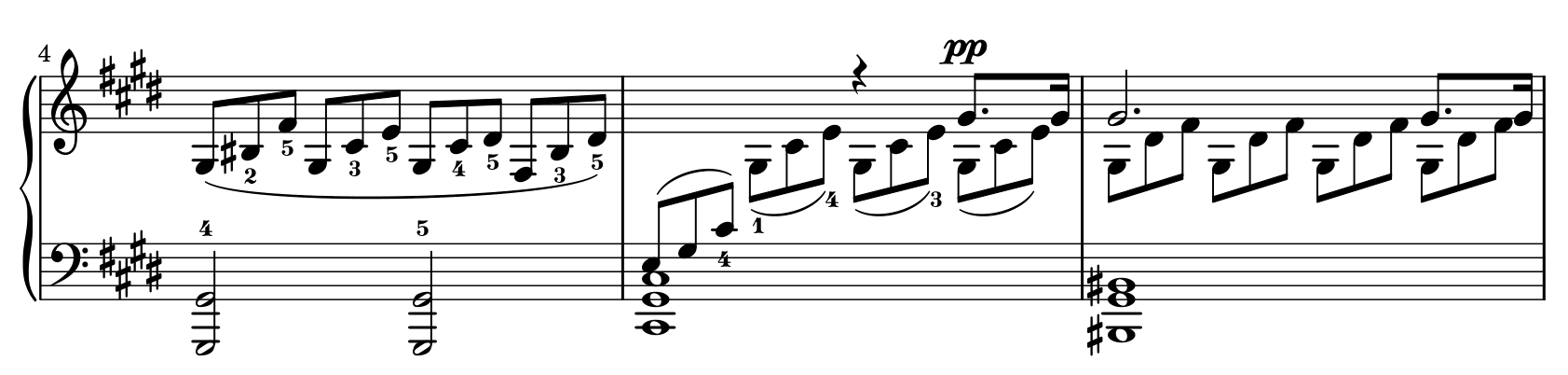
Start at the melody’s entrance in bar 5 and play only the top line into bar 6. Notice where it is going and how long each note lasts. Then try the triplets alone, quietly enough that you could imagine a melody above them. Putting those two parts together is the real test: can you still follow the tune, or does every triplet demand equal attention?
Newman recommends practising combinations of the movement’s three layers: bass, triplets and melody. Here, melody with bass is particularly useful because it lets you hear the phrase without the continuous middle notes. When you restore those notes, preserve that sense of direction. You do not need to make the melody loud; making the accompaniment less insistent can give it room.
Bars 31–33: keep moving through the change of register
The middle of the movement makes a better readiness check than the opening. In this passage a low G-sharp octave underpins figures that move upwards through the keyboard. On the page, part of the moving figure appears on the lower stave before continuing on the upper one. Read the pattern across both staves before assuming that a change of stave means a change of hand.
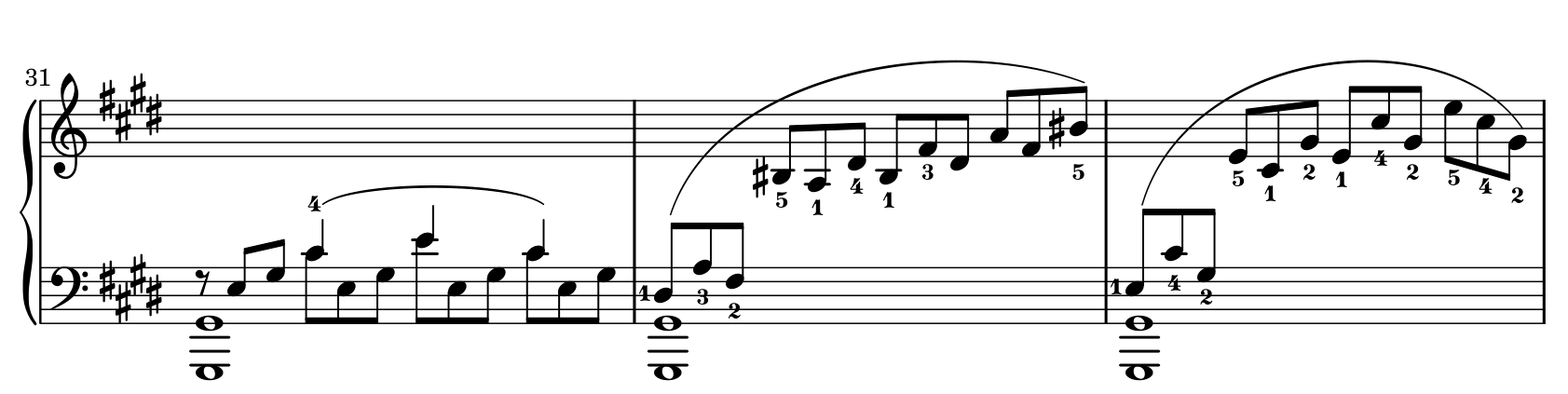
Take bar 32 slowly and work out its route, including the arrival in bar 33. Choose the fingering before repeating it. Then practise the last group of bar 32 together with the first group of bar 33, so the barline does not become an excuse to stop and reset.
Listen for an accidental surge as the figure rises, or a hesitation when the hand changes position. Aim for continuity before adding expressive freedom. The bass also needs a deliberate beginning: an unnecessarily heavy octave can dominate several quiet notes after it. If the printed fingering makes the route awkward, compare alternatives using the principles in our post on choosing fingerings.
Bars 61–63: follow the tune into the left hand
Near the end, the familiar dotted figure belongs to the left hand, above the bass. The right hand continues its arpeggios and begins to range more widely. It is easy to watch that movement and let the quieter melodic part disappear.
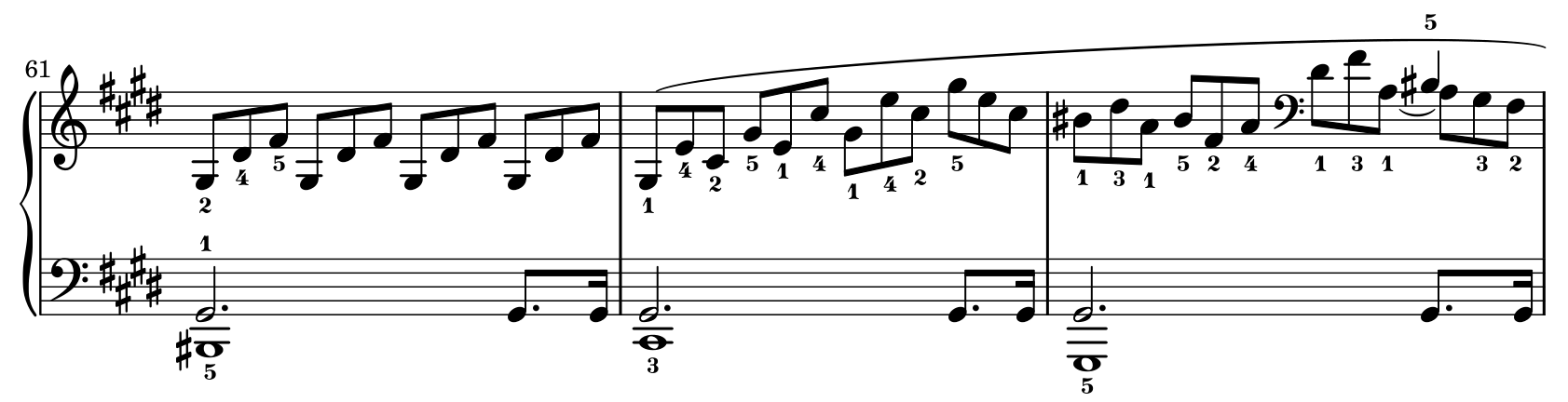
Play the left hand alone and follow its upper notes through all three bars. Then add the right hand at a deliberately restrained volume. Record the passage and listen once without looking at the score. Can you follow the left-hand phrase through the right hand’s change of register?
This is also a reason to learn the later pages early. The ending asks for a different balance from the opening, even though the accompaniment remains recognisable. Playing from the beginning every time can leave you very familiar with one problem and barely acquainted with the other.
How much pedal, and how slowly?
Beethoven’s opening instruction asks for a very delicate sound senza sordino, with the dampers lifted. On a modern piano, simply holding the sustain pedal down throughout can bury the changing harmonies. The decision is how to keep the resonance while allowing the music to remain clear.
In his interpretation notes for Henle, on pages X–XI, Murray Perahia allows harmonies to blend but argues that their meaning must remain audible. He singles out the major-to-minor contrast in bars 9–10: the change should survive the colour of the pedal. Try those bars on your own piano and listen for that contrast while adjusting when and how far you release the pedal.
The pace needs the same attention to the phrase. The score is in cut time, with two broad beats to the bar. Counting smaller divisions can help while learning, but making each triplet a separate event can leave the melody struggling to connect. Perahia suggests letting the outer voices guide the tempo. Try singing the melody over a quiet, steady accompaniment; choose a pace at which you can sustain that line without rushing a difficult change.
This Deutsche Grammophon excerpt shows Perahia playing the movement. Follow the melody’s entry and the continuing motion beneath it. For the complete first movement, there is also the 2018 recording on Spotify.
A score and a useful first session
The free Mutopia score contains the complete sonata; its first five pages cover the first movement. The examples above come from that engraving, based on a historical edition edited by A. Winterberger. Its fingerings are suggestions from an edition, not a requirement to fit your hand to a particular shape. Henle’s modern edition adds source commentary and Perahia’s interpretation notes if you want to investigate the editorial choices further.
For a first session, work on bars 4–6 and make a short recording. Listen specifically for the melody entering above the triplets. If the notes feel manageable but the balance needs work, you have found a useful reason to study the piece. If reading, reaching and keeping time are all difficult at once, bring these same bars to a lesson and choose the next step from what actually happens at the keyboard.
Score excerpts: Beethoven, Sonata op. 27 no. 2, engraved by Stewart Holmes / Mutopia Project. Cropped and rendered as images; the notation is unchanged. The excerpts and these adaptations are licensed CC BY-SA 2.5. Featured photograph: Nicat Teymurov / Pexels.


