
How to Download the Right Piano Edition from IMSLP
Download a usable piano score from IMSLP: compare editions, check territory notices and inspect every page, with a worked Für Elise example.
Mia
Community & Content. Writer and lifelong pianist. Writes about gear, production, and the business side of making music.

A search for Für Elise can produce an early edition, a modern typesetting, a simplified arrangement and several scans of the same publication. They can all have a similar title. Before adding fingerings or sending a PDF to a student, it is worth identifying exactly which file you have.
The practical route: find the work, compare the edition records, check the file’s copyright notice for your country, then inspect the downloaded PDF. For this example, the three-page Breitkopf scan is a useful starting point for checking an older printed edition.
Before you start: you need a browser, an internet connection and somewhere to save and open a PDF. No IMSLP account or paid membership is required for the free score used here. We followed the public download route on desktop Chromium 131 on Linux on 20 September 2026; mobile browser save controls differ. A printer or score-reader app is optional. You should already be able to recognize your piece’s opening and use a PDF viewer.
Find the composition before choosing a file
Search for the composer and a catalogue number when you have one: Beethoven Für Elise WoO 59 is more specific than “easy Elise piano PDF.” Open the IMSLP work page and check the title and composer. Its opening music example gives you another way to confirm that you have reached the right piece.
Go to Sheet Music → Scores. On this page, arrangements have their own section. For the original solo-piano work, stay with the score entries; a version for another instrument or a simplified piano arrangement is a different choice. For a sonata or suite, also check whether the download contains the whole work or only the movement you need.
When a teacher has named an editor or publisher, keep that information beside you. “The same piece” is not enough to guarantee matching page turns, bar numbers or markings at a lesson.
Read the small print under “Complete Score”
Several links carry the same download label. The details underneath distinguish them. Here is how to read the record for the file used in this walkthrough:
Edition record · Für Elise
- File identity
- #318757 · Complete ScoreThe file number distinguishes this scan from another upload.
- Extent
- 3 PDF pagesCompare this with the document after downloading.
- Publication
- Breitkopf & Härtel · [1888] · plate B.298The publication date is separate from the upload date.
- Printed pagination
- 354–356 in the collected editionThe PDF viewer will call these pages 1–3.
- Rights field
- Public DomainRead any attached territory qualifications before proceeding.
Three records on the same work page illustrate the choices. These are different sources, rather than a quality ranking:
A clean re-engraving may be easier for you to read, but its appearance alone cannot establish the accuracy of its notes. Likewise, an older scan can be perfectly usable even when the paper is uneven. If your concern is what to do with the printed finger numbers, that is a separate decision covered in our post on choosing and changing fingerings.
Check the territory notice, then follow the download
Read the copyright field on your chosen file, including any qualifications. IMSLP hosts files under different territorial rules; its presence on the site does not establish permission everywhere. A label such as “Non-PD US” matters to a reader in the United States, even when the composer died centuries ago. Editors, arrangers and other added material can affect the position. Use IMSLP’s copyright guidance and the relevant local rules; if the status remains unclear, use an authorized edition instead.
- Select the Complete Score link beside #318757. Check the number first so you follow the intended scan.
- Read the disclaimer. Continue through “I understand” only after checking that the file is available for your intended use where you are. The disclaimer explains the territorial limits.
- Wait for the score-download link. Our free download displayed the membership page and a waiting period, then “Click here to continue your download.” A membership purchase was not necessary. IMSLP’s FAQ explains its free-access and waiting-period arrangements.
- Save the PDF from the resulting document. Depending on your browser, it may open in a viewer or download immediately. Save it to a folder you can find again, rather than leaving it only in an open tab.
If you land on an advertisement, membership checkout or a document for another instrument, return to the work page and recheck the file record. Do not install a “download manager” to obtain this PDF.
Inspect the first page, middle and ending
We opened all three pages of #318757. The first is headed Clavierstück in A moll, with the Für Elise inscription at upper right; the familiar opening appears below “Poco moto.” That is useful confirmation when the downloaded filename is long and unhelpful.
The first page also shows why both kinds of page number belong in your notes: the printed number includes 354, while the viewer starts at 1.
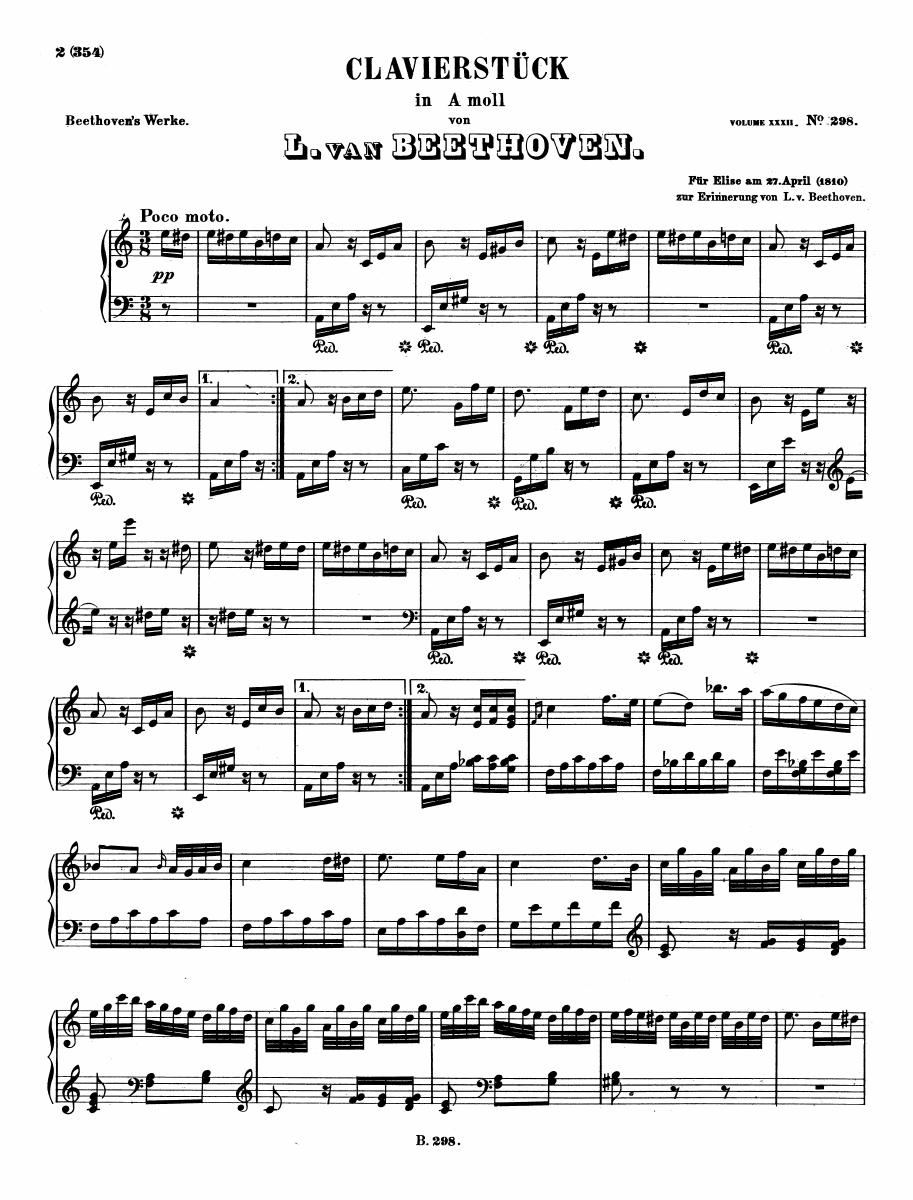
In this file, the next two pages show printed numbers 355 and 356, and the final page reaches a closing double barline. Page count and continuity agree. This checks the document’s extent; it is not a note-by-note critical review of the edition.
Before committing to a copy, look closely at an accidental, a small rest and the top and bottom staves on every page. Missing edges, pale noteheads and a blurred inner margin are easier to catch now. If printing, try one page at your intended paper size first. Check the result on the music stand at your normal sitting distance; a readable screen enlargement can become a cramped print.
On a tablet, open the saved file in your reader and turn through it once. Check that the beginning, page transitions and ending are all present. If you still need a reader, our free sheet-music app comparison explains the practical restrictions to check before importing a library.
Keep enough information to find the edition again
Use a filename that makes sense outside the Downloads folder, and keep the work-page link with it. For this example, a short library record could look like this:
Beethoven-Fur-Elise-WoO59-Breitkopf-1888-IMSLP318757.pdf
Source: IMSLP #318757 · plate B.298
Extent: 3 PDF pages · printed pp. 354–356
Copy: original download, saved 20 September 2026
Keep the untouched download alongside your annotated copy. Send the edition number with any page-specific question to a teacher, and agree on bar numbering if your copies differ. You can then start reading through the score away from the piano without wondering whether you are both looking at the same document.
Further reading
 Apps & Tools
Free Sheet Music Reader Apps in 2026: What You Give Up Versus Paid
Practis is our best free sheet music starting point in 2026, tying score reading to real practice. See when Piascore, GoScore, or paid apps fit.
17 min read Practice Methods
Reading Scores Away From the Piano: A Practical Method
Reading a score without an instrument is a trainable skill, not a gift. A four-stage method that builds from easy keyboard works to chamber and orchestral scores — and accelerates memorization and structural understanding along the way.
13 min read Technique
How to Choose Fingerings (and When to Override the Edition's)
Editions are inherited and not always made for your hand. A practical framework for choosing fingerings — anatomical efficiency, musical phrasing, predictability under stress — and the discipline of testing alternatives before committing.
13 min read