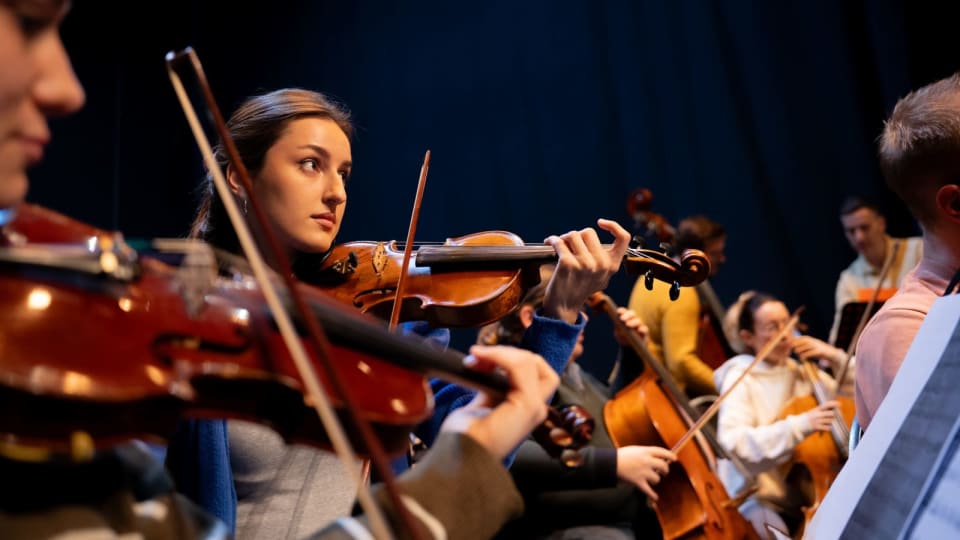
Jess Gillam’s Shine puts a medieval antiphon, a Bach concerto movement and songs by Joni Mitchell and David Bowie in the same saxophonist’s programme. That range becomes more interesting when you follow where the music has already been. Some of these pieces were changing shape long before they reached this album.
Released on 9 October 2026, the record places Gillam alongside strings, piano, bass and percussion. The track credits are a useful guide: the composers identify the source material, while the arrangers help explain the route into this particular ensemble.
Saxophone photograph: Caique Araujo / Pexels.
“Shine You No More” has an older idea inside it
The opening selection is Rune Tonsgaard Sørensen’s “Shine You No More,” arranged here by Parkin. It is a contemporary tune with a historical connection: ECM’s account of the Danish String Quartet’s Last Leaf describes Sørensen building a reel from the harmonic progression of John Dowland’s “Flow My Tears.”
That gives the title more context than simply treating it as an upbeat album opener. A borrowed sequence of harmonies can support a different melody, movement and purpose. The relationship between the pieces does not require the newer tune to reproduce the older song’s mood.
Start with Gillam’s official video:
Then compare the Danish String Quartet’s earlier version, published by ECM for Last Leaf in 2017. Sørensen is one of the quartet’s violinists; the ensemble identifies the tune as his composition for that album.
A question for the comparison
Follow one recognisable phrase. In each version, where does its energy seem to come from: the melody’s attack, an accompanying rhythm, a change of register, or several players together? Then listen to the accompanying parts while letting the tune recede into the background.
The point is to discover how the tune is carried. A melody you recognise immediately can still depend on different relationships within an ensemble. These videos offer a way to investigate that directly without needing to read a score first.
The Bach concerto was already travelling between instruments
Gillam’s programme includes the first movement of C.P.E. Bach’s Flute Concerto in A minor, H.431, in an arrangement credited to Parkin. The flute title might suggest a simple journey from an original wind work to a new wind instrument. Its history is more complicated.
The critical edition’s introduction places this flute concerto, also numbered Wq 166, beside related versions for cello, Wq 170, and keyboard, Wq 26. Those are different settings of closely related material in Bach’s own output. The editorial discussion considers how the solo writing changes between them.
That history gives you another way to approach Gillam’s arrangement. Instead of asking only whether a saxophone resembles a flute, consider the job of the solo line. When does it lead, when does it answer, and how does it interact with the surrounding players? You can follow those relationships before deciding what you think about the particular instrumental colour.
It also helps when searching for another recording or score. “Bach concerto in A minor” is far too broad. Use the composer’s full name, instrument and catalogue number. Here the album contains an arranged movement, not a promise to present every movement of the original concerto.
Mitchell and Bowie bring words into the listening, even when no one sings them
“A Case of You” comes from Joni Mitchell’s Blue, released in 1971, as her own discography records. “Life on Mars?” also appeared on a 1971 album, David Bowie’s Hunky Dory, before becoming a UK single in 1973, according to Bowie’s official archive. Shine credits their arrangements to Newell and Vennart respectively.
A song’s melody arrives with more than its pitches. If you know the original, you may remember a particular word, the weight of a syllable or the point where the singer seems to hesitate. An instrumental version gives you the melody without automatically supplying those verbal associations to every listener.
Try hearing one of the songs first in its vocal version, then on Shine. Choose a single phrase and notice where you expect it to breathe or gather momentum. Ask what the instrumental performance makes prominent when the words are no longer being delivered.
You do not need to decide which version wins. The comparison can reveal what you had been hearing as melody, what belonged to a singer’s delivery and what your memory of the text contributes. For players approaching an arrangement themselves, that is a more useful starting point than copying a line of notes without knowing where it came from.
The final selection began as a sacred text
Hildegard of Bingen’s “Spiritus sanctus vivificans” is an antiphon for the Holy Spirit. The International Society of Hildegard von Bingen Studies provides the text, translation and musical commentary. Its account connects the words’ images of life, cleansing and renewal with the shaping of the melodic phrases.
That matters when approaching a modern instrumental setting. This is music with a particular verbal and devotional purpose, rather than an anonymous piece of medieval atmosphere. Reading the text gives the melodic line a context even if the Latin is unfamiliar.
On Shine, a “Prelude to Hildegard,” credited to Gillam, Sam Becker and Leif Kaner-Lidström, precedes the antiphon in Lawson’s arrangement. The release announcement identifies the prelude as an improvisation connected to the final piece.
Listen to that transition as a pair. What expectations does the prelude create, and what happens when the named composition arrives? It is a different relationship from a modern song being arranged for the same ensemble: here new material sits directly beside the historical work it introduces.
Follow one connection beyond the album
The full programme also includes Strozzi, Corelli, Kate Bush, Sidney Bechet and Barbara Thompson. You do not need a history lesson on every selection before pressing play. Pick the connection that catches your ear and give it a second listen:
- For musical borrowing: start with “Shine You No More,” then explore the Danish String Quartet and the Dowland connection.
- For instrumental roles: compare the C.P.E. Bach selection with a flute or cello version of the related concerto, keeping the work numbers beside you.
- For phrasing: return to a vocal original of the Mitchell or Bowie song and follow one phrase into the arrangement.
- For text and setting: read Hildegard’s antiphon, then hear the prelude and final track together.
Music changing form is also central to our post on Max Richter’s While the Flood Rages, where novels, ballet and album create different settings for related ideas. If a recording makes you want to find music to play, our guide to Hisaishi’s soundtrack, concert suite and piano scores shows why identifying the version matters.
With Shine, the arrangement credits are an invitation to follow those paths. A familiar song can lead to a new instrument, and an unfamiliar title can lead back several centuries. The album is a place where those journeys meet.