
A violin, a saxophone and a recorder arrived at the BBC Young Musician 2026 final with three very different ideas of what a concerto can be. Violinist Sofia Demetriades won, playing Tchaikovsky, alongside finalists Kezia Colton and Alma Nunez Debretzeni. The result offers a good excuse to explore all three works: one places a singing violin against an orchestra, another builds a trio within it, and the third makes a soloist's breath central to the music.
The final took place at Bristol Beacon on 15 October, with the BBC National Orchestra of Wales conducted by Alpesh Chauhan; the winner was announced on 1 November 2026. Here is the repertoire from the BBC programme listing.
| Finalist | Instrument | Concerto |
|---|---|---|
| Sofia Demetriades | Violin | Tchaikovsky: Violin Concerto in D major, Op. 35 |
| Kezia Colton | Saxophone | Yoshimatsu: Cyber-Bird, Op. 59 |
| Alma Nunez Debretzeni | Recorder | Graham Fitkin: Recorder Concerto |
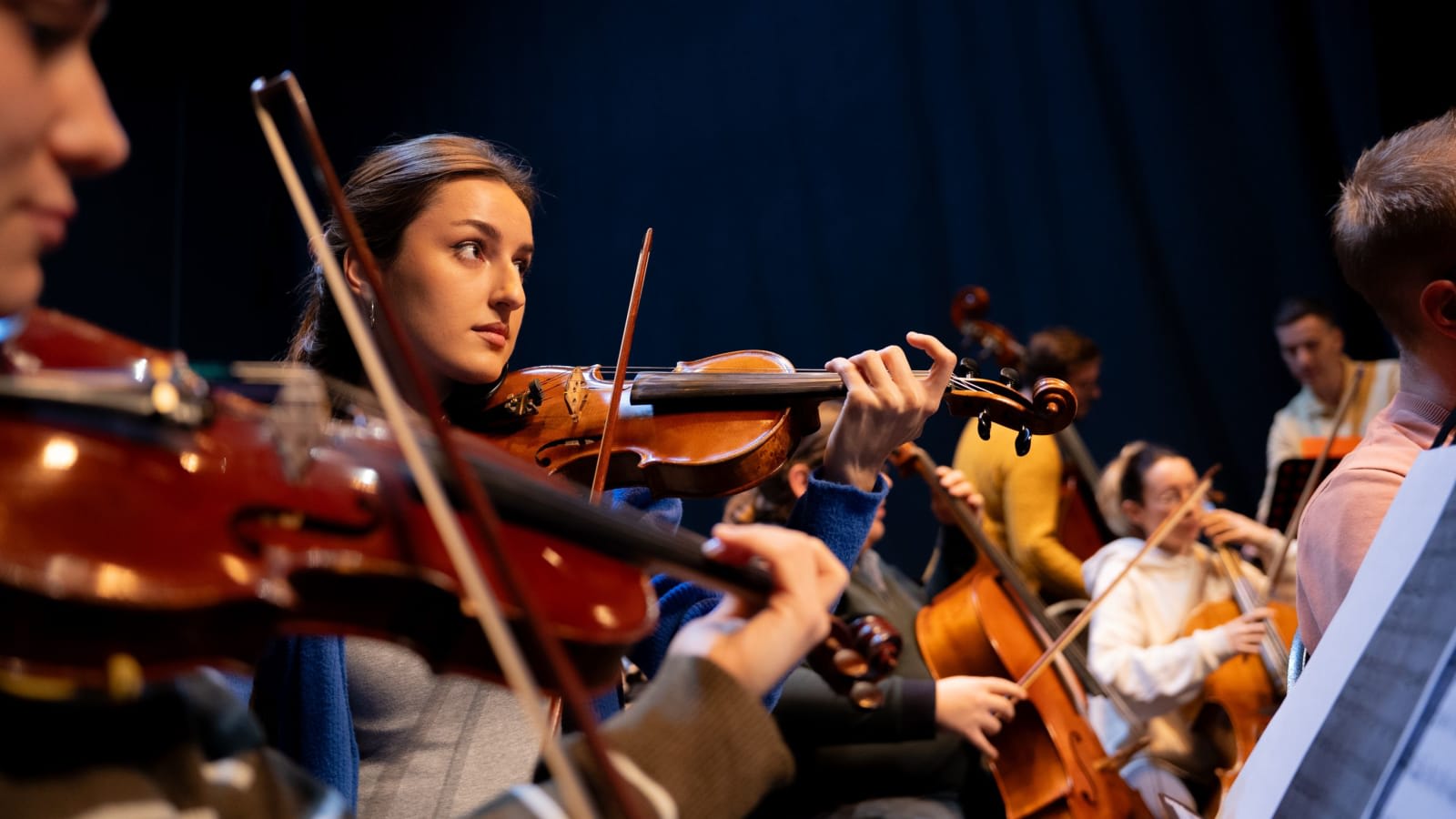
Featured photograph: Božo Gunjajević / Pexels. An illustrative orchestra photograph, not a picture of the BBC final.
Tchaikovsky: follow the tune past the difficult notes
Tchaikovsky's 1878 concerto is easy to approach as a display of violin technique. A more revealing first listen is to follow a melody and notice what happens around it. In the opening movement, two principal themes unfold against changing accompaniment. The LA Phil’s programme note points to that combination of lyrical solo writing and an active orchestral setting.
The middle movement is a Canzonetta, a little song. Woodwind introduce it before the violin enters, and it leads straight into the final movement without a pause. The finale is a rondo: a main idea returns between contrasting episodes. That returning idea gives a listener something to recognise amid the fast passagework and dance-like energy.
Try listening once with your attention deliberately away from the soloist. When the violin holds a note or finishes a phrase, who keeps the music moving? Then return to the same passage and follow the violin again. You need not name every chord to notice that a tune feels different when the sounds supporting it change.
For a performer's perspective, Ray Chen has published an annotated first movement with commentary on screen. The video below features Chen with the Royal Liverpool Philharmonic and Vasily Petrenko, as identified by George Mason University’s introduction. It is a companion recording, separate from Demetriades's competition performance.
Commentary can point you towards a decision you had not noticed. It is also worth hearing the passage once without reading anything. Our post on learning from recordings without simply copying them develops that distinction: a performance can give you questions to investigate in your own playing.
Yoshimatsu: there is a trio inside this concerto
The most useful clue to Cyber-Bird comes from Yoshimatsu himself. His notes for the Chandos recording describe a saxophone, piano and percussion trio at the centre of the work, with a free-jazz character. The piece was written in 1993–94 for Nobuya Sugawa, pianist Minako Koyagi and percussionist Takako Yamaguchi. Knowing that changes where to direct your attention: piano and percussion belong in the foreground of the listening.
The title imagines a bird moving through cyberspace and across musical styles. The three movements offer a simple route through that imagined flight:
- Bird in Colors: a fast opening, marked Allegro.
- Bird in Grief: the slower central Andante.
- Bird in the Wind: a Presto finale.
Rather than trying to identify every stylistic reference, follow the three players. Ask when the saxophone seems to initiate an exchange, when piano or percussion changes its direction, and when the wider orchestra draws your attention. Those are listening questions, not a requirement to hear one correct story.
A useful second listen: choose a short section you enjoyed and follow only the piano. On the next pass, follow the saxophone. Does the passage still seem to have the same leader?
The recording below features Nobuya Sugawa, the BBC Philharmonic and Sachio Fujioka. The concerto occupies the first three tracks; Yoshimatsu's Third Symphony follows. Chandos identifies the performers and track list. This is another performance to explore, not Colton's final with the BBC National Orchestra of Wales.
Fitkin: the recorder concerto begins with breath
Graham Fitkin's 2017 concerto asks its soloist to use six amplified recorders. That means several instruments for one player, not six recorder soloists. If your mental picture of a recorder is still the instrument you played at school, the scoring alone is a reason to investigate further.
In Fitkin’s own account of the piece, the practical questions came early: the available instruments and ranges, their dynamics, amplification, and how they would relate to an orchestra. He then made breath central to the composition, thinking about anticipation, effort, recovery and calm. The work was composed for Sophie Westbrooke and the BBC National Orchestra of Wales for the 2017 Vale of Glamorgan Festival.
That gives a listener a more interesting starting point than wondering whether a recorder can be loud enough. Try following the music as a succession of different kinds of breath. Where do you sense preparation or release? Where does a pause feel restful, and where does it leave something unresolved? You can ask those questions without playing a wind instrument.
Amplification also belongs to the design of this particular concerto. There is little value in treating the performance as a contest between one unassisted recorder and an orchestra. The composer's choices establish the conditions in which the instrument can speak.
For Nunez Debretzeni's performance of the concerto, use the final linked below. The BBC also offers a separate clip of her semifinal appearance; that is different repertoire and should not be mistaken for an extract from the Fitkin final.
Watch the final, then keep following the music
The BBC Young Musician 2026 final is listed on iPlayer, subject to BBC availability and UK viewing restrictions. The supporting recordings above provide another way into the repertoire; they do not reproduce the competition programme or its performances.
You do not need to turn an evening's listening into homework. If one passage stays with you, save the recording and a short note about why: the point where the accompaniment changes the melody's character, a piano entry you missed on the first listen, or a pause you want to hear again. Include the performer and the recording's time so you can find the same moment later.
For musicians, that observation can become a question about your own interpretation. What is happening under a sustained note in your piece? Whose entry needs room? When you prepare to perform with other people, those questions are worth bringing into rehearsal. Start with whichever of these concertos made you curious enough to press play again.


