

Free piano learning can carry a beginner much farther than most subscription pages imply. It works when each free resource has one job: a course supplies order, an app drills one skill, music supplies something worth playing, and a recording creates a basic reality check. The shortage is not content; it is diagnosis.
This guide builds a usable zero-cost plan first, then draws an honest line around what apps and YouTube cannot reliably do; product access and free-tier limits were checked on July 18, 2026.
The $0 piano plan that can actually work
A free piano plan needs five roles, but it does not need five competing courses. Choose one lesson sequence as the spine. Everything else should solve a smaller problem without deciding what comes next.
For a younger learner or a family learning together, Hoffman Academy is the clearer spine. Its current library lays out more than 350 lessons in 18 ordered units, with technique, rhythm, notation, ear work, improvisation, and repertoire woven together. The presentation is child-friendly, but an adult who does not mind that tone can still follow the sequence.
For an adult who prefers a calm, long-form explanation, Bill Hilton's free beginner course is the better fit. His lessons feel more like sitting through a thoughtful class than completing app levels. Whichever route you choose, stay with it for at least four weeks before declaring that you need a better course. Constantly restarting is one of the hidden costs of free learning.

Free app, free tier, and free trial are not the same
The word free covers three very different offers. A genuinely free resource lets you keep learning without a clock. A free tier gives permanent access to a limited slice. A trial briefly opens a paid product, then closes it or charges you. None is automatically bad, but the distinction matters when you are trying to build a plan that will still work next month.
| Resource | What free means now | Best use | The catch |
|---|---|---|---|
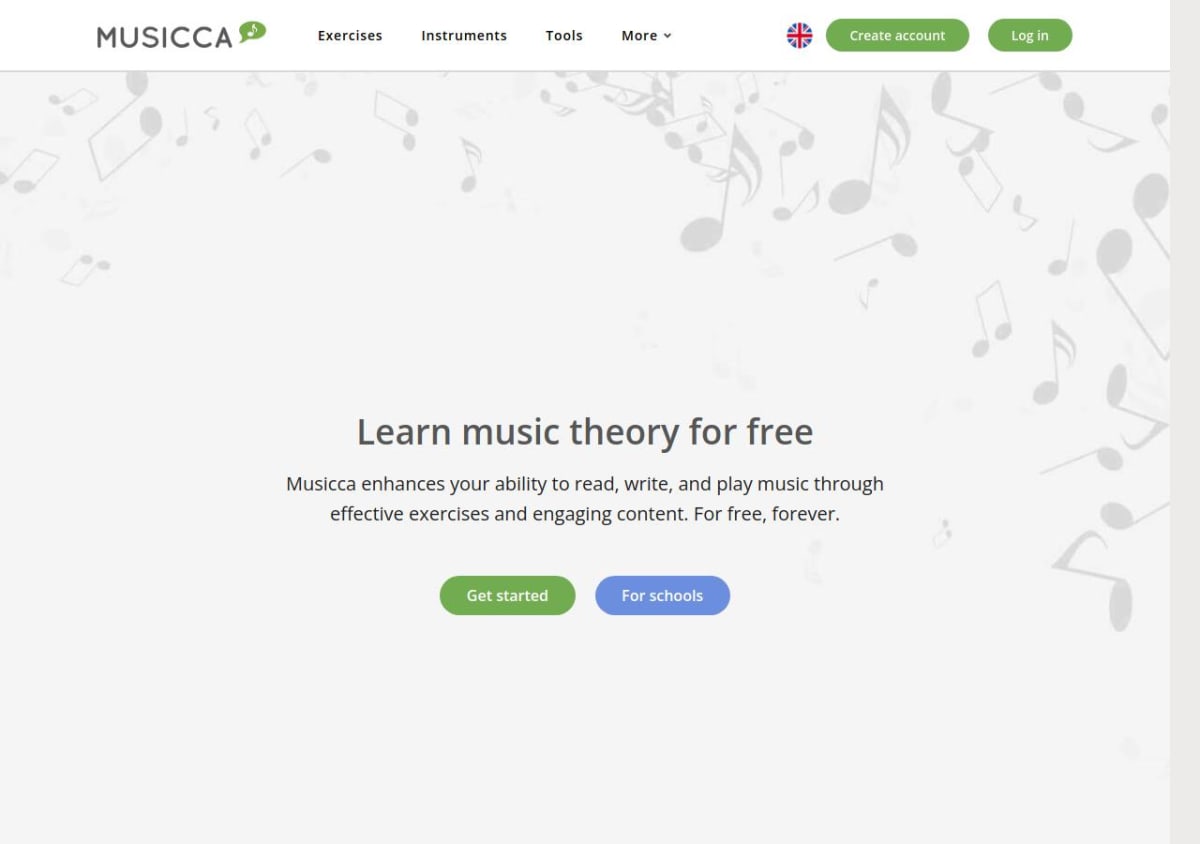
| Musicca / musictheory.net | Genuinely free lessons and exercises | Theory, reading, rhythm, ear work | Not a complete piano method |
| Hoffman Academy | Large free video lesson sequence | A structured beginner spine | Some supporting tools sit in paid plans |
| Piano Marvel | Permanent $0 account with 200+ exercises, 150+ songs, 25 video lessons, and limited sight-reading tests | Early reading with immediate scoring | Most of the curriculum remains premium |
| flowkey | Eight songs and selected course exercises, with learning modes | Testing its song-led interface | A sample, not a long curriculum |
| Simply Piano | Two free courses for all users | Checking whether guided app lessons click | Continued progression requires a subscription |
A free tier is most useful as a test bench. Ask whether you like the feedback, whether your instrument connects reliably, and whether you willingly return the next day. Do not build a twelve-month curriculum around eight unlocked songs. If you want a closer look at genuinely useful drills, our comparison of free piano apps that teach a specific skill separates the durable tools from thin subscription previews.
Use YouTube as a course, not a search bar
YouTube becomes chaotic when every difficulty triggers a new search and a new teacher. One person says to curve every finger; another demonstrates a flat-finger sound; a third gives you an exercise far beyond your current level. All three may be sensible in context, but the beginner has no context yet.
Subscribe to one ordered beginner playlist and move through it in sequence. Keep at most one additional channel as a reference library for a specific technique or musical question. If Bill Hilton is the course, for example, a technique explainer can clarify wrist rotation or voicing without becoming a second curriculum.
A 2018 review of 100 beginner instrumental videos on YouTube found that the sample had average-to-good teaching value as supplementary material, but weaker musical modeling and uneven presenter quality. The study covered flute, clarinet, trumpet, trombone, and snare drum rather than piano, so it is not a verdict on every piano channel. It does support a sensible rule: YouTube is useful, but the first confident presenter in search results should not automatically become your teacher.
Free works best when every resource has one job. It fails when five resources all pretend to be the teacher.
The PianoTechSupport video below works well as a reference map: it demonstrates 100 named techniques in one place, so you can identify the idea a course has introduced and then return to your actual assignment. It is broad by design, not a first-lesson sequence.
A technique index from PianoTechSupport. Use it to name a problem, not to replace an ordered beginner course.
A zero-cost week needs assignments, not inspiration
The easiest way to waste free resources is to decide what to do only after sitting at the piano. Make the decision once per week instead. A realistic beginner target is four sessions of 25 to 30 minutes, plus one short listen-back. More time is welcome; it should not be required for the plan to survive.
Inside a 30-minute session, try five minutes of fundamentals, five minutes reviewing something secure, fifteen minutes on the week's small target, and five minutes playing for continuity. This is not a sacred ratio. It simply stops one stubborn bar, one app game, or one enjoyable old piece from consuming the whole session.
Our guide to the first six months of adult piano gives that weekly rhythm a longer progression. The important part is that the course chooses the next skill while your weekly note chooses the next action.
A small study of five advanced piano students found that the strongest self-regulated practicer regularly paused, studied and marked the score, and listened to recordings rather than simply playing through. Five advanced students cannot tell us the perfect beginner routine. They can remind us that productive practice includes moments when no key is moving.
Where free learning genuinely stops
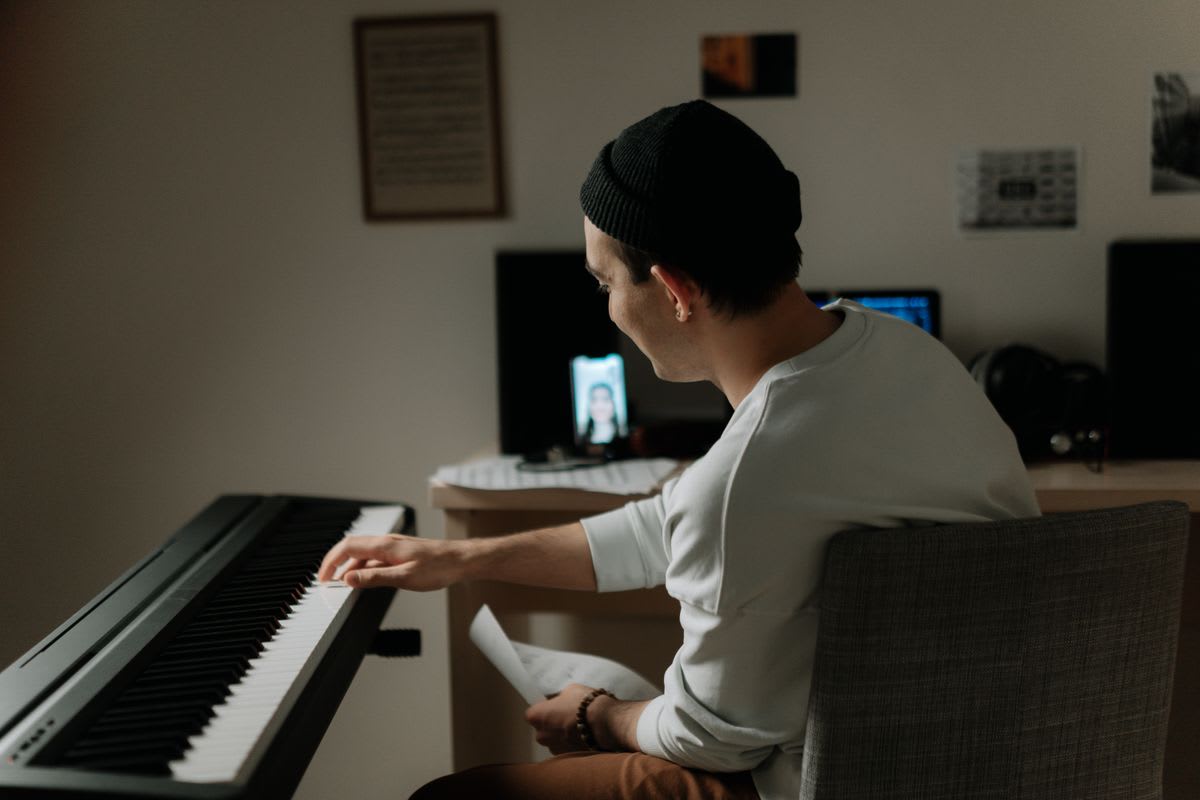
Free learning stops being efficient when the missing job is judgment. A microphone can report that you struck E instead of F. It cannot reliably explain whether the miss came from an awkward fingering, a late glance, a collapsed hand, a rhythm you never understood, or a piece that is simply too difficult right now.
Look for five practical warning signs:
- Discomfort or tension keeps returning. Stop forcing repetitions. A qualified teacher can inspect the movement; persistent pain deserves appropriate clinical advice rather than another tutorial.
- The same passage fails for weeks and you cannot say why. More content is unlikely to identify the cause.
- You can follow the screen but cannot begin from the printed score alone. The interface may be carrying a skill you thought you owned.
- Your pieces are either boring or impossible. Choosing the next level is itself a teaching skill.
- An exam, audition, or performance has a date. Feedback delivered after the event is not useful feedback.
Recording helps, especially if you decide what to listen for before pressing play. It is not a tiny teacher living in your phone. In a 2025 study of 25 advanced pianists, hearing playback changed how students rated themselves, but it did not significantly change external ratings of their performances. A recording can redirect attention. It cannot guarantee the right diagnosis.
That is also why the most useful feedback is specific, improvement-focused, and two-way. “Wrong note” is a signal. “Your hand arrives late because your eyes leave the bass too soon; try this fingering and look earlier” is guidance.
The first thing worth paying for is not more content. It is a correction you could not generate alone.
Our post on the biggest mistake self-taught musicians make goes deeper into this gap: repeating a plausible solution before checking the actual cause.
The cheapest upgrade is usually a checkpoint
Reaching the limit of free learning does not mean committing immediately to weekly lessons forever. Buy the smallest intervention that solves the current bottleneck.
For a concrete pay-as-you-go option, PianoTechSupport currently lists trial lessons and online Zoom teaching at $45 for 60 minutes or $60 for 90 minutes. That makes a focused checkpoint possible without pretending free resources have failed. Bring a short video, one stubborn passage, and three questions; leave with a corrected priority list.
If you want to compare that route with other formats and teachers, our guide to the best online piano teachers in 2026 explains who each option suits and what it costs. A good teacher should reduce confusion, not add another endless content library.
The honest answer is that free piano learning works. It can teach first notes, basic rhythm, reading, chords, scales, full beginner pieces, and the habit of listening back. Give one course four steady weeks, keep the supporting stack small, and let evidence from your own playing decide the next step. Pay only when you can name the job that money needs to do.


