
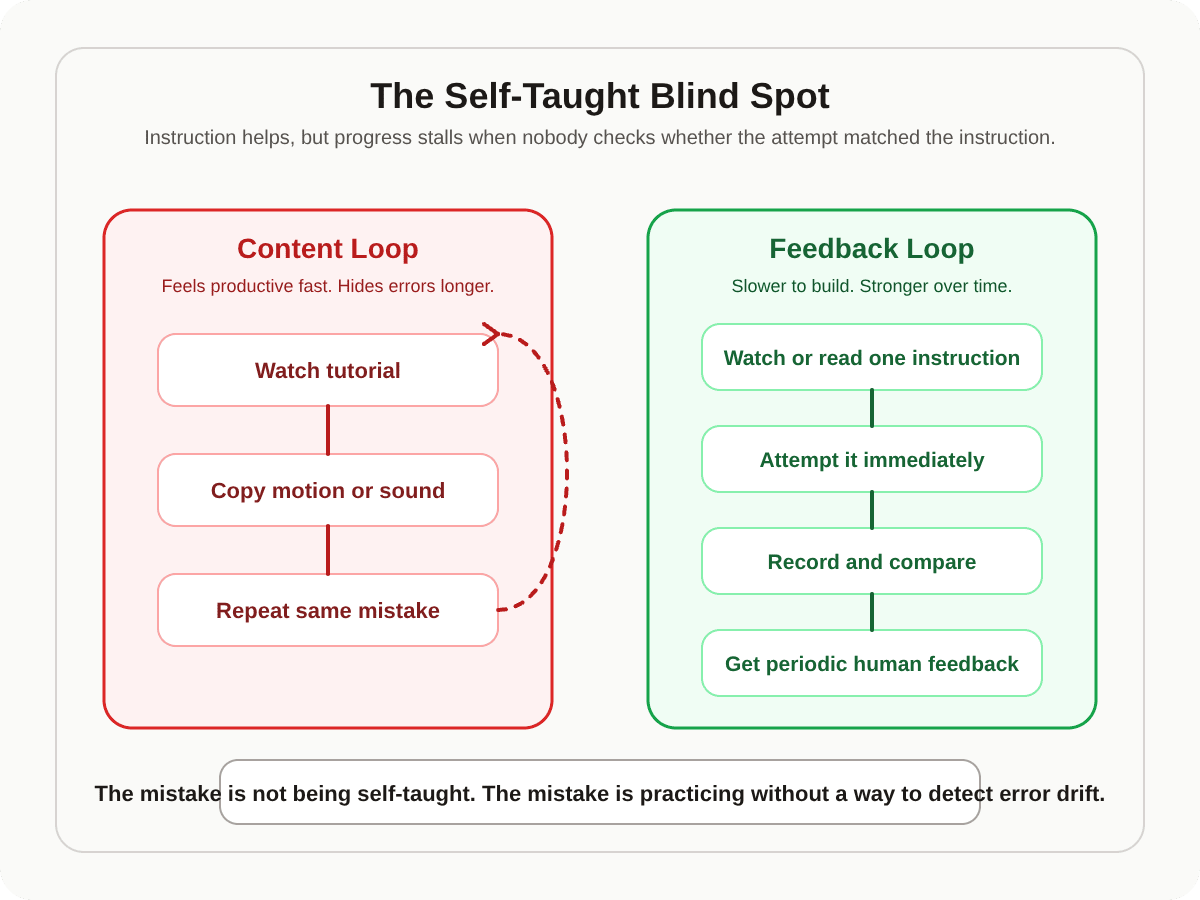
The biggest mistake self-taught musicians make is not being self-taught. It is building skill without a reliable feedback loop. That sounds like a small distinction. It is not. One is a learning path. The other is a structural error that turns innocent technique problems into habits.
This is why a lot of self-taught players feel like they improve fast at first and then hit a weird wall. The first stage of learning responds well to information. You learn where the notes are. You learn the rough shape of a chord. You learn the outline of a bow stroke, breath, or groove. Videos are very good at that. But once the problem shifts from “what do I do?” to “did I actually do it correctly?”, information stops being enough.
That is the part almost no YouTube teacher can solve for you inside the video itself. They can explain. They can demonstrate. They can even explain beautifully. What they cannot do is notice that your wrist is collapsing, your thumb is locking, your rhythm is drifting early, your intonation is flattening when you shift, or your breath setup is undoing the phrase before the sound starts. If nobody catches those things, your reps become evidence only that you repeated something, not that you learned the right thing.
Josef Hanson’s 2018 study Assessing the Educational Value of YouTube Videos for Beginning Instrumental Music is still one of the clearest research snapshots here. Reviewing 100 beginner tutorial videos across several instruments, Hanson found that the videos were of average to good pedagogical value as a supplement to traditional instruction. That phrase matters. He also found that the videos rated very low in musicality and that videos by nonprofessional presenters offered questionable educational value. Catherine Schmidt-Jones reached a similar conclusion in Instrument-based music theory on YouTube: Entries and barriers to lifelong learning: many independent learners clearly do use YouTube successfully, but novice barriers remain real.
The problem is not that YouTube is useless. The problem is that self-taught musicians often use explanation as a substitute for diagnosis.
The real mistake is confusing instruction with feedback
Instruction tells you what to aim for. Feedback tells you what actually happened. Those are not the same thing. Self-taught musicians often have plenty of instruction. They know the fingering pattern, the warm-up sequence, the picking motion, the scale formula, the “correct” posture, the phrasing concept. What they do not have is a live mechanism that checks whether their attempt matched the instruction.
This is why “I watched a lot of tutorials” and “I practiced a lot” can both be true while progress still stays shallow. Aaron Williamon and Elizabeth Valentine’s classic study on quantity and quality of musical practice found that the amount of practice time was not significantly related to performance quality. What mattered more was the content and organization of the practice. That should matter to self-taught musicians because it means raw effort is not a defense. If the practice content is built on undetected error, more minutes can strengthen the wrong pattern just as efficiently as the right one.
| What videos and apps do well | What they usually cannot do alone | What to add |
|---|---|---|
| Show the task clearly | Confirm whether your version matches the model | Record yourself and compare one target at a time |
| Explain concepts and vocabulary | Catch hidden tension or inefficient setup | Use occasional teacher or coach feedback |
| Give structure for beginners | Adapt instantly to your specific sticking point | Keep a short practice log with one diagnosis line |
| Provide motivation and examples | Decide whether the issue is rhythm, hearing, memory, or mechanics | Run a repeatable weekly review |
Greg McPherson, Jennifer Blackwell, and John Hattie make the same point from the teacher side in Feedback in Music Performance Teaching. Strong feedback is specific, improvement-oriented, and dialogic. A prerecorded tutorial, by definition, cannot be dialogic with your particular attempt. It cannot ask what you were aiming for, where the motion changed, or what you heard. So the self-taught player has to build that dialogue manually.
Why invisible errors compound so quickly
Technique problems are dangerous precisely because they often feel normal after enough repetition. Your body adapts to what it repeats. Your ear adapts to what it expects. A self-taught player can spend weeks polishing a movement that feels smoother each day while still being fundamentally inefficient. That is why the trap is so easy to miss: internal comfort rises even when external quality stalls.
Guadalupe López-Íñiguez and Gary McPherson’s 2024 study on music microanalysis is useful because it centers the monitoring process itself. Strong practice is not just doing a lot. It is observing thoughts, actions, and outcomes closely enough to adapt the next attempt. Self-taught musicians often skip that middle layer. They either consume more input or grind more output. What is missing is the loop that asks, “What exactly changed on the last rep, and what does that tell me?”
That monitoring gap is one reason technique errors become expensive later. A thumb position that feels harmless at beginner tempo turns into a speed ceiling. A hand shape that sort of works for open chords becomes a tension problem when stretches get wider. A fuzzy sense of pulse seems manageable until ensemble playing exposes it instantly. By the time the problem is finally obvious, it has already been rehearsed enough to feel like identity.
Hidden error
The problem only appears at higher tempo, longer phrases, wider shifts, or harder repertoire.
False progress
You feel smoother because the motion is familiar, not because it is efficient or accurate.
Plateau
Progress stops looking linear, and you start blaming talent, age, or motivation instead of diagnosis.
Repair cost
Fixing the issue later takes longer because you are replacing a habit, not learning from zero.
Photo: Being_Rv via Pexels
Five signs your self-teaching loop is missing real feedback
You do not need a conservatory to notice whether your current system is weak. The symptoms are usually obvious once you know what to look for.
1. You keep restarting from the top
You know something is wrong, but you are not isolating where the mismatch begins.
2. Every fix is another tutorial
You keep collecting explanations instead of testing whether the last explanation changed your attempt.
3. You almost never record yourself
If you do not create playback, you are trusting the least reliable witness in the room: your own in-the-moment impression.
4. You cannot name the exact problem
“It feels off” is honest, but it is not yet diagnosis. Good practice needs narrower language than that.
5. You only seek help after frustration is high
That usually means the habit is already deeper and the repair job is bigger than it needed to be.
This is also why purely self-directed structure aids have limits. In Adult Beginner Instrumentalists’ Practice, Self-Regulation, and Self-Efficacy, Laura Ritchie and Phil Kearney found that worksheets promoted self-regulatory behaviors, but the worksheet itself was not recognized by participants as directly influencing learning. That is a useful warning. Tools help. Logs help. Templates help. But none of them automatically replace diagnosis. They only work when the player uses them to observe and adjust something real.
The model that works better is hybrid, not pure self-teaching
The practical answer is not “quit YouTube and pay for weekly lessons forever.” That is too blunt and often unrealistic. The better model for many adults is hybrid learning: keep the low-friction advantages of videos, apps, and self-study, but add recurring checkpoints that can catch drift before it hardens.
This is why the real alternative to bad self-teaching is not dependency. It is smarter autonomy. Learn material independently. Try it. Record it. Compare it against a clear target. Log one sentence about what changed. Then use a teacher, coach, or even a single diagnostic session to review the things you cannot see yourself. That can be far more cost-effective than waiting six months and then paying someone to unwind a whole cluster of habits.
There is also evidence that self-listening changes how musicians evaluate their own playing. In the 2025 study Effects of audio feedback interventions with the Disklavier on the performance of piano students, pianists who listened to playbacks of their own performances rated their second performances more positively on several musical parameters than the control group. External ratings did not show significant effects, which is important: recording yourself is not magic. But it is still a useful diagnostic bridge between pure self-teaching and live expert feedback. It gives you something concrete to compare instead of relying on memory and wishful thinking.
| If you are mostly self-taught... | Best upgrade | Why it works |
|---|---|---|
| You use mostly YouTube and apps | Add weekly self-recording review | Creates a basic external view of your playing |
| You keep getting stuck on the same passages | Book one diagnostic lesson every few weeks | Catches hidden mechanical or hearing errors early |
| You are short on time | Use a short log after each session | Preserves what changed so the next session starts sharper |
| You feel overwhelmed by conflicting advice | Pick one teacher or method as your baseline | Reduces random switching and helps you compare attempts honestly |
Session 1
Learn from one trusted source only. Do not stack five tutorials on the same problem.
Session 2
Attempt immediately and record a short excerpt rather than a full performance.
Session 3
Compare against one target: rhythm, intonation, motion, tone, or relaxation.
Checkpoint
Bring the unresolved issue to a real teacher before it becomes your default technique.
Review
Write one line: what changed, what stayed wrong, and what the next session should test.
Repeat
Keep the system. Change the exercise. This is how independent learning stops being random.
If you want practical extensions of this model, the strongest companions are app versus teacher, what makes a good music teacher for adult beginners, how to use a practice log without turning it into homework, and how to get more out of each music lesson. They all point to the same principle from different angles: independence works better when it has checkpoints.
Keep YouTube. Keep the apps. Keep the convenience. Just stop asking one-way content to do the job of two-way feedback.
The biggest mistake self-taught musicians make is not self-teaching. It is letting repetition outrun diagnosis. Once you fix that, self-teaching becomes much more powerful because it stops being isolated. It becomes a real system.


