In Mozart’s K.414, the orchestra establishes a pulse and a character before your first solo entrance. For an advancing pianist, the first movements of Haydn’s D-major Concerto, Hob. XVIII:11, and Mozart’s A-major Concerto, K.414, are two worthwhile starting points to explore with a teacher. Choose the movement and the people you can rehearse with together; a manageable solo part is only part of the decision.
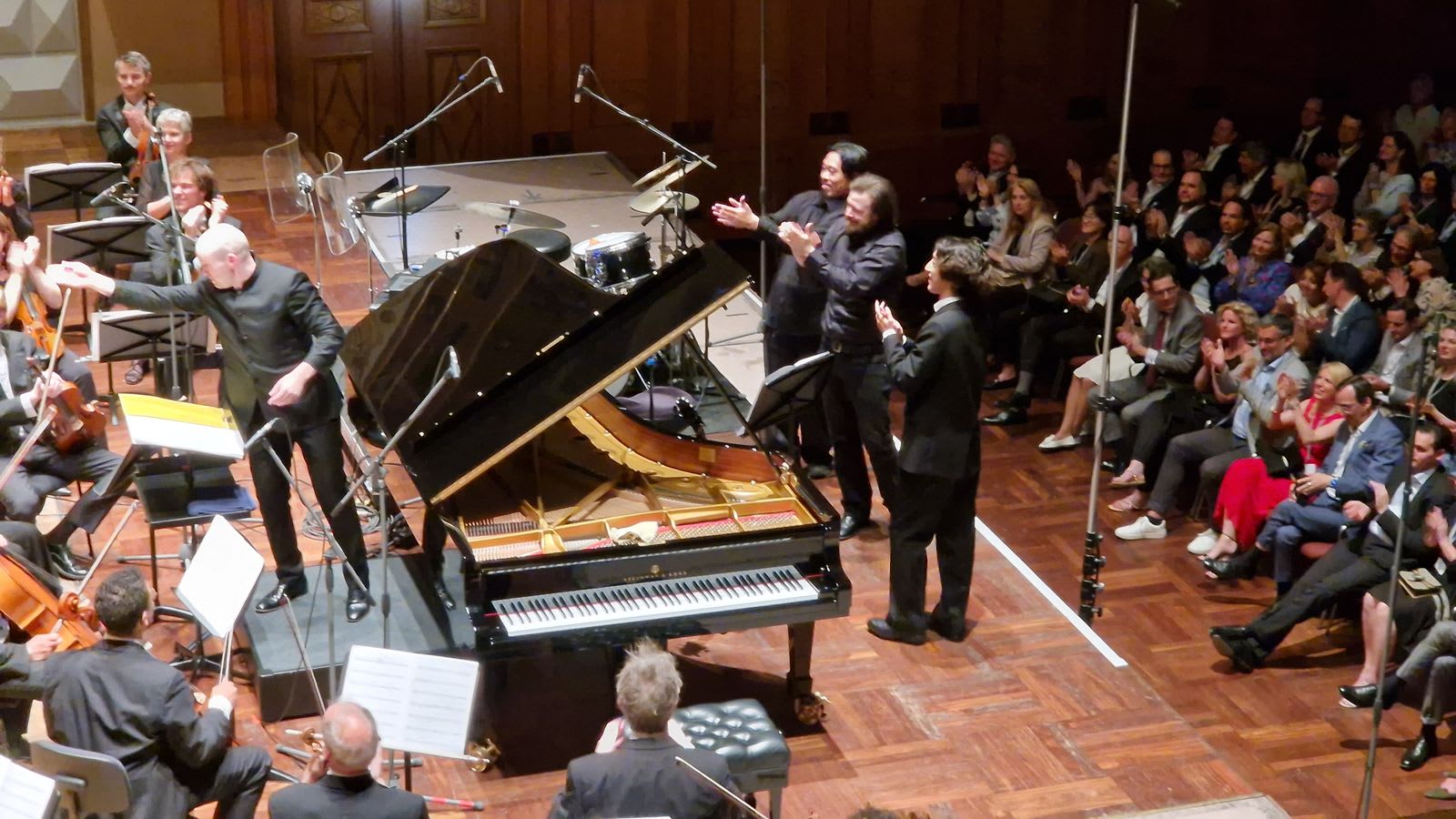
Featured photograph: a performance of Gulda’s Concerto for Myself at Kurhaus Wiesbaden. Gerda Arendt / Wikimedia Commons, CC0; cropped. It shows the shared stage a concerto requires.
Two candidates, two different challenges
“Easier piano concerto” usually means easier than the large virtuoso works that dominate recordings. It does not mean beginner piano music. Both movements below ask for fluent passagework, controlled articulation and enough spare attention to hear another musician while playing.
On a phone, swipe the comparison sideways to see all three columns.
| First movement | A reason to explore it | Look beyond the opening |
|---|---|---|
| Haydn: D major, Hob. XVIII:11 Vivace | A focused introduction to Classical solo-and-ensemble exchange, with a choice of cadenza. | Octave writing, changing hand coordination and the demands of your particular cadenza. |
| Mozart: A major, K.414 Allegro | A project in phrase shaping and conversation; it also has a string-quartet accompaniment option. | Long orchestral passages, exposed solo phrasing and moments when the piano accompanies another player. |
Piano teacher Janna Williamson’s account of teaching beginning concertos is a useful starting point for this shortlist: she favours Haydn’s D-major work as an introduction to the historical repertoire and considers K.414 for students already shaping phrases well. That is a teacher’s experience with particular students, rather than a universal ranking.
Bring a recently learned Classical sonata movement to the discussion. Can you keep its pulse through a less secure bar, make melody and accompaniment distinct, and start convincingly from several places? Those are more useful observations than asking for a single exam grade. A concerto can develop ensemble skills, but the solo notes should leave you some attention to develop them.
Learning one movement is a legitimate first project. It does not establish readiness for all three movements, and a competition or concert may require a different programme. Confirm the actual requirement before choosing.
Haydn: make the clear writing speak
Haydn’s D-major concerto offers a compact way into the sound and etiquette of a Classical concerto. Its apparent neatness is a reason to inspect the details: a short slur, an octave figure or a displaced accent can require a different physical and musical response from the passage immediately before it.
Williamson’s closer look at the first movement identifies blocked and broken octaves, familiar patterns moving through related keys, and syncopation between the hands in the second theme. Try those kinds of writing before deciding that the opening page settles the difficulty. Being comfortable with D major is useful; it does not settle the coordination of the whole movement.
The first solo entrance arrives at bar 49. In this historical keyboard part, the upper system represents the orchestral lead-in, bars 44–48. The next system begins with the label Solo: the keyboard takes up the theme over repeated left-hand notes.
Follow the orchestral lead-in across the upper system, then the solo entrance below. On a phone, swipe the score sideways or open it full size.
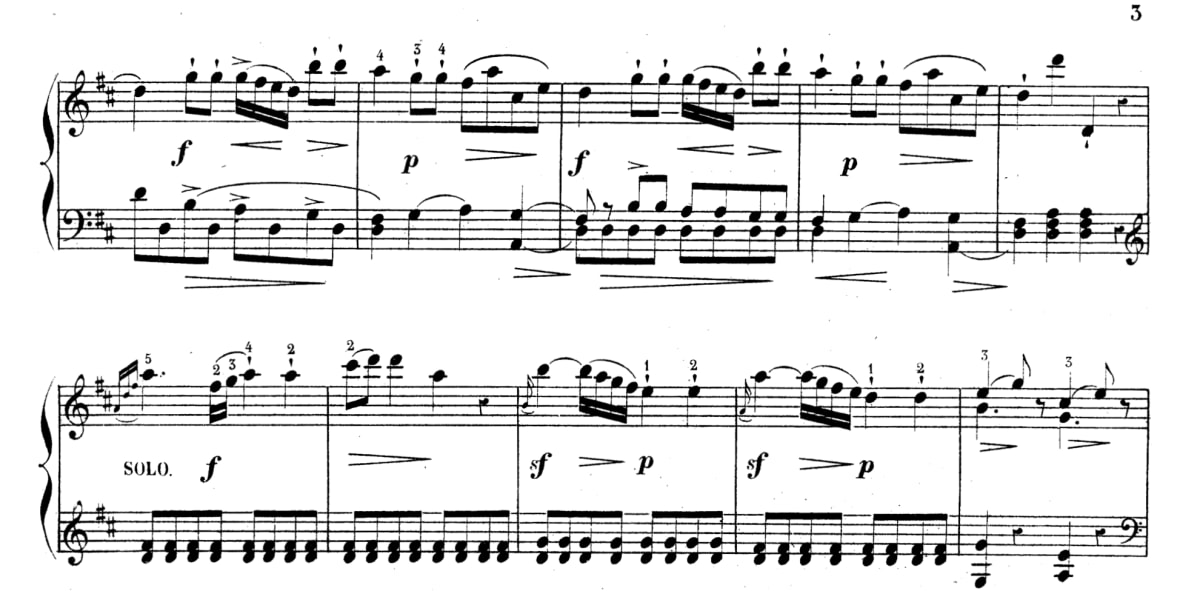
For a first rehearsal, ask the second pianist to play the lead-in from the reduction while you prepare the solo entrance. Keep the pulse through the end of their phrase and join at the marked Solo. Starting directly at bar 49 practises your opening notes; adding the preceding bars practises entering the concerto. Use your agreed rehearsal edition for the notes and markings.
In the performance below, follow the opening orchestral statement before concentrating on the soloist. Keep track of a recognisable musical idea as it returns, and notice when the pianist is leading, waiting or joining a texture already in progress. The film contains the whole concerto; the player starts at the opening Vivace, 0:25.
One score-reading trap deserves attention. Some editions print bass notes and figures in the keyboard part during orchestral tuttis, the passages where the ensemble plays together. Henle’s editorial preface connects these with the soloist’s historical continuo role. A note in the keyboard staff is therefore not automatically the beginning of a featured solo. Mark the actual solo and ensemble roles with your teacher in the edition you will use.
Mozart: learn both sides of the conversation
The first piano solo in K.414’s Allegro begins at bar 64. The preceding 63 bars are already part of your performance: you need to recognise how the opening develops and arrive at your entry with its pulse and character in mind. Learning from the first solo page onward leaves a substantial part of the job untouched.
A later exchange shows why counting rests is only the beginning. In bars 172–173, the piano plays a short articulated motif. The first violin answers in bars 174–175 while the piano’s left hand continues its accompaniment. Your right hand becomes less busy, but your listening becomes more important.
The first two staves are the piano; the next is first violin. This excerpt begins at bar 171. On a phone, swipe the score sideways or open it full size.
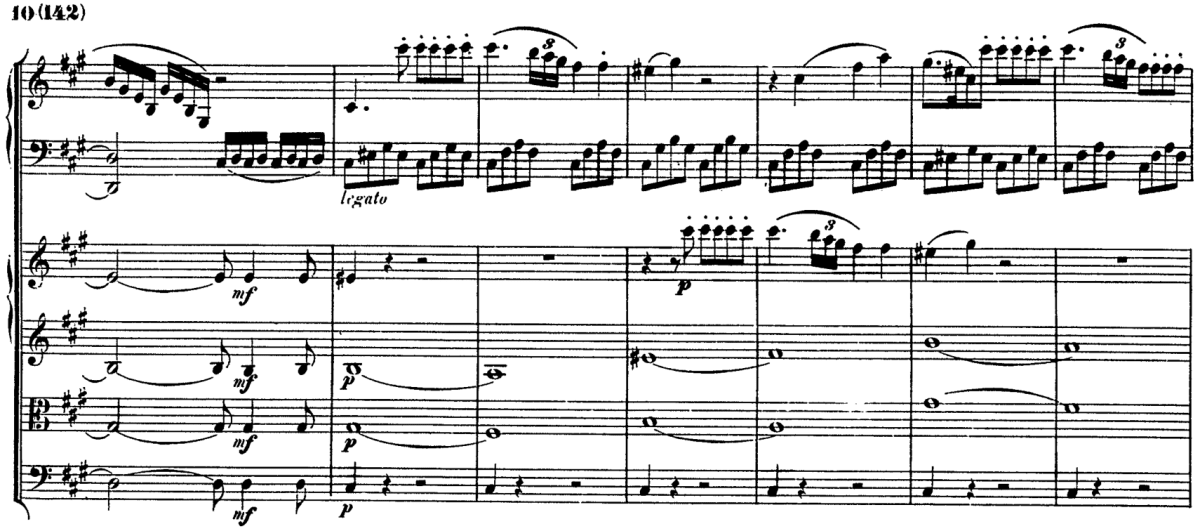
Try the exchange with a partner before aiming for concert tempo. Have them bring out the violin’s reply in the reduction while you keep the left-hand accompaniment even and leave room for that reply. Then begin a few bars earlier: can you change roles while keeping the pulse steady and leaving the violin’s reply audible? This is a more revealing trial than playing the right-hand motif in isolation.
The recording below contains the first movement, played by Vladimir Ashkenazy with the Philharmonia Orchestra. Follow the orchestral introduction in your score, then listen for how the solo part joins it. On another pass, follow an orchestral line during a passage where the piano is also active: keeping that second part in your attention is part of preparing the concerto.
K.414 has another practical attraction. As the Boston Symphony Orchestra’s programme note explains, Mozart allowed accompaniment by string quartet as well as orchestra. That makes a real chamber performance possible with two violins, viola and cello. You still need suitable parts, capable partners and rehearsal time; a smaller ensemble does not remove the need to listen and agree how the music moves.
Choose the cadenza before committing
A cadenza is the solo passage near a structural stopping point where the ensemble waits and the pianist has greater freedom. Its length and technical demands can change the scale of your project. Do not learn the movement first and discover at the end that the cadenza in your recording is a much harder piece of music.
For Haydn, establish who wrote the cadenza in your edition. Henle HN 640 supplies cadenzas by Sonja Gerlach; they are not Haydn compositions. Other editions offer other choices. For Mozart, the New Mozart Edition’s preface discusses different Mozart cadenza versions. Choose a specific version with your teacher and identify it in both players’ copies.
In K.414’s first movement the cadenza falls at bar 290, and the ensemble resumes at bar 291. Those adjacent numbers can conceal a substantial solo passage. The useful rehearsal unit is the approach, the cadenza and the return together.
- 1. Arrive togetherPlay from before the held harmony so that the ensemble knows where your freedom begins.
- 2. Agree the endingIdentify the final gesture in your chosen cadenza and how you will signal the return.
- 3. Resume togetherContinue into the closing orchestral passage at the agreed tempo.
Ask the accompanying pianist what they need to hear or see at the return. A successful solo ending and a successful ensemble restart are related skills; rehearse the connection explicitly.
Get the score for the rehearsal you can arrange
A two-piano reduction places the solo part beside an orchestral part arranged for a second pianist. It lets you work with someone who can respond to your phrasing and help repair an uncertain entry. A full orchestral score helps you understand who is playing, but it is a different format and does not replace a usable reduction on the second pianist’s stand.
Haydn: Henle HN 640
Piano Concerto in D major, Hob. XVIII:11, HN 640 is a two-piano reduction edited by Bettina Wackernagel and Horst Walter, with the reduction and supplied cadenzas by Sonja Gerlach. The publisher specifies two copies for performance. Check that both pianists have the same cadenza and markings.
Mozart: Bärenreiter BA4876-90
Piano Concerto in A major, K.414, BA4876-90, edited by Christoph Wolff, is the piano-reduction format. The solo and reduced orchestral parts share a system; the publisher specifies two copies for performance. The similarly named study score is not the same purchase.
Before ordering, agree the edition with your partner, check the cadenza and find a room with two suitable keyboards. If hiring a pianist or studio, ask for the preparation and rehearsal fee as well as the session length. Two books and access to the instruments belong in the project budget; owning the solo score alone does not provide a rehearsal setup.
An existing readable edition may serve well if both players can reconcile its text and bar numbers. Our guide to Urtext and edited piano scores explains what the editorial information can add. For archive copies, see choosing an IMSLP edition; the historical excerpts above illustrate the music rather than prescribe a particular practice edition.
Build a project that includes the other player
You do not need to polish every solo note before a first rehearsal. You do need enough preparation to make the meeting useful. These three sessions can be separated by as much individual work as the music needs; they are checkpoints, not a promise to learn a concerto in three lessons.
First: try the difficult decisions
With your teacher, sample a demanding solo passage, one ensemble exchange and the proposed cadenza. For Mozart, the exchange above gives you a concrete place to start. For Haydn, include the octave writing and the second-theme coordination, rather than judging from the opening alone.
Choose a working tempo at which articulation, rhythm and hand coordination remain clear. If a passage needs further technical preparation, decide whether that is a useful part of this project or a reason to choose something else. Settle recurring fingerings early; our guide to choosing and testing fingerings offers a way to compare options.
Then: connect the entrances
Mark a few recognisable orchestral cues in your score: a theme returning, a bass change or a phrase leading into your entry. Keep bar counts as support. Ask your partner to begin at several agreed points before an entrance, so that you learn to recognise the approach rather than rely on always starting at bar 1.
Work through each handover and the cadenza return. Agree a few places where either player can restart during practice, using bar numbers from the same edition. A recording can help you follow the larger movement, but it cannot wait, change a rehearsal tempo or tell you that your cue was unclear.
Finally: keep the whole movement going
Play through without stopping for every missed note. Continue following the ensemble during its tuttis, and notice whether later entries are as secure as the first. This tests concentration across the movement as well as the stamina of the active passages.
Afterwards, separate the problems: an unreliable fingering, a lost place and an unclear return need different work. Agree with your partner how to recover from a missed entry, then practise from the surrounding music. Extend the spans you can play reliably before pushing the tempo; the last page should retain the control and attention you had at the start.
What being ready for an orchestra adds
Learning the solo part privately can be rewarding. Performing with a second pianist adds the shared pulse, balance and responsiveness that make it a concerto. An orchestral performance adds another set of people, sounds and practical decisions.
Before accepting a date, confirm the movement, cuts if any, cadenza, editions and parts with the organiser and conductor. Establish how much rehearsal time is available, who will prepare the parts, and whether the venue and piano arrangements are settled. For K.414 with string quartet, make the equivalent agreements directly with the players. Neither project should depend on an assumed orchestra appearing after the notes are learned.
The immediate next step is smaller: take both first movements to your teacher, try the passages that might decide between them, and arrange a read-through with a collaborative pianist. Choose the concerto whose musical problems you want to work on and whose rehearsal life you can actually give it.