
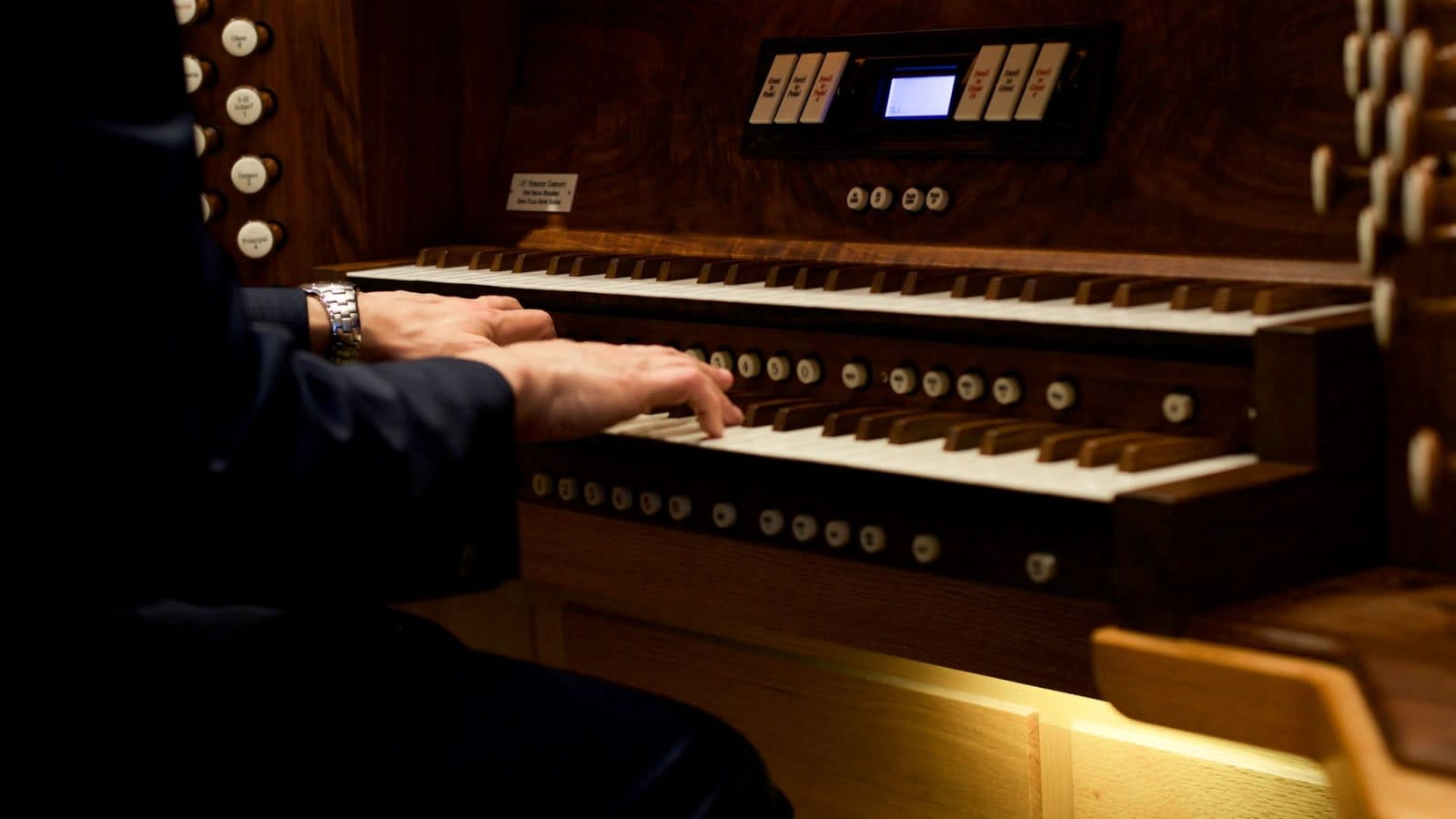
A first organ service asks more of a pianist than a new keyboard technique. You need to know when the music begins, how the congregation joins it and what happens after the final chord. Start with the service order and the actual instrument, then rehearse that sequence with the person who will lead it.
Find out exactly what you have agreed to play
Ask the music director or service leader for the running order, the hymnbook or scores being used, and the selected stanzas. Confirm who cues each entry and whether any spoken announcement comes before the introduction. A hymn title alone leaves room for a different tune, key, harmonization or set of words.
The Church of England's guidance on choosing music starts with the shape of the service, the congregation and the available musicians. That is a useful order of decisions for a first assignment: establish what the service needs before adding music you happen to enjoy playing.
Keep one agreed copy of the order beside the scores. If the leader changes the stanza selection, update that copy and the music director's copy together. The same version-agreement problem arises in a church as in an ensemble rehearsal.
Visit the console before the service day
Arrange access with the regular organist. Have them show you the power controls, manuals, pedals, expression controls and the stops you will use. Find a comfortable bench position and check the sightline to the leader. Bring the actual scores so that the visit includes playing, turning pages and looking up for cues.
A registration is the combination of stops selected for a sound. A piston may recall a stored combination, while a setter is used when storing one. These are different operations. BYU's OrganTutor explanation makes that distinction; its memory-level lesson also shows why the same piston number can mean different things on different memory levels.
Ask which memory level and controls you may use. Some instruments need stop changes by hand; BYU discusses that manual method too. Write down the selected stops, couplers and expression position alongside any piston reference, so the instruction is more useful than “press 3.”
Local permission matters. Chichester Cathedral's visiting-organist pack, for example, reserves particular memory channels for visitors. Its allocation belongs to that instrument. Ask for the equivalent instruction at yours, and practise the agreed changes without overwriting someone else's settings.
For your first assignment, work out the hand and pedal allocation with an organist who knows your playing. A four-part hymn page does not specify which notes your feet should play. Choose an approach you can sustain through all the verses while also following the service.
Prepare the introduction and the next entry
An introduction gives singers a recognizable tune and a sense of the pace. In his guidance on hymn introductions, Paul J. Grime explains why an unfamiliar tune may benefit from being played in full, and why musical phrases matter more than printed line breaks when choosing a shorter introduction. Agree the introduction with the local organist and practise the congregation's entry immediately after it.
The following complete Winchester New setting is credited to W. H. Monk. It offers a concrete preparation example: four phrases in B-flat major, beginning with an F pickup in the upper voice. The double barlines mark phrase boundaries; they do not each mark the end of a complete four-beat bar.

For our hypothetical service, the proposed introduction is the complete tune, followed by three selected stanzas. Each stanza uses the whole setting. The score contains no words or stanza count, so the text and the three stanzas must be marked in the church's agreed hymnbook.
Practise the final B-flat chord followed by the next F pickup. That join leads into the first sung stanza and returns between stanzas. Agree the release and breathing space with the organist or singers, then practise it repeatedly. The last stanza needs a final ending; keep that distinction visible rather than relying on remembering how many times you have played the tune.
Put the music into a complete service order
This fictional short morning service assigns two hymns and a brief closing voluntary to the organist. The other items are unaccompanied. It illustrates a preparation sheet; the actual order, texts, keys and musical choices belong to the local church.
| Service item | Music and plan | Entry and finish to rehearse |
|---|---|---|
| Welcome | Listen; opening hymn is ready on the stand. | Wait until the announcement has finished and the leader gives the agreed cue. |
| Opening hymn | Winchester New: whole-tune introduction, then three selected stanzas. | Lead the pickup into each stanza. Finish after the third; keep the next spoken item clear. |
| Reading and reflection | No organ music assigned. | Remain able to follow the order; prepare the next score during an agreed opportunity. |
| Prayers | No organ music assigned. | Wait for the closing-hymn announcement and cue. |
| Closing hymn | St. Anne: whole-tune introduction, then four selected stanzas. | Begin on the beat, rather than borrowing Winchester New's pickup. End after the fourth stanza. |
| Blessing and dismissal | Silence; prepare the agreed voluntary registration. | Wait for the dismissal and the leader's cue. |
| Closing voluntary | Winchester New setting, once through, without sung stanzas. | Play to the written final chord and finish. This planned reuse keeps the first assignment manageable. |
The second hymn has a different beginning. This St. Anne engraving, credited to William Croft, contains eight complete bars in C major with no pickup. The upper voice starts on G and finishes on C. Practising its entry immediately after Winchester New helps you check that the right beginning is ready for each hymn.

Download the illustrative service order (CSV) if you want to adapt it. Replace its musical choices and stanza counts with the agreed assignment. Both supplied scores are four-part hymn settings, without an organ registration or pedal part; they are starting materials to prepare with the local organist.
Rehearse the joins on the actual instrument
Ask someone to read the spoken cues while you follow the order. Start with the welcome and carry on through the dismissal and voluntary, including the waits. This exposes practical work that disappears when every attempt begins with your hands already in position and the right stops selected.
Give the run-through three listening questions: was the first sung entry clear, did the pace remain usable across the stanzas, and did the ending leave the next speaker space? The Royal Canadian College of Organists' service-playing syllabus likewise treats introductions, stanzas, rhythmic control, text and registration as parts of the playing task. Its examination requirements are separate from your church's assignment.
Let the local organist or music director listen from the congregation's position as well as at the console. If a change is awkward, rehearse the exact moment: release the previous chord, make the agreed change, find the next opening and respond to the cue. Simplify the plan together if it asks more than you can reliably manage.
With permission, record a rehearsal so you can revisit those joins. Label the recording with the hymn, date and question being checked; our post on organising practice recordings gives a useful way to keep successive attempts distinct. A recording of your practice does not establish permission to record or publish the congregation's service.
Leave yourself a useful note for the next visit
Record what actually happened and what you will try next. A hypothetical note might read:
Winchester New: the final chord into the next pickup needs another check with the singer. Next visit: repeat that join, then play the introduction and all three selected stanzas without stopping.
Keep the instrument's agreed registration sheet with the service order. Keep the musical task with the piece, using a notebook or a practice diary. In our app, Practis, a manual practice entry can include a selected piece and a note. The principle is the same as in our guide to useful practice notes: preserve the specific next action, so you can begin there when you return.
On the day, allow time to check the instrument and any changes to the order. Put the final stanza choices, cues and agreed registrations where you can find them while playing. The aim is to arrive with enough attention left for the people you are accompanying.
Featured photograph: Andrew Patrick Photo / Pexels.


