
When a pianist conducts from the keyboard, the orchestra does not wait for a spare hand before knowing what to do. Some information comes from a gesture, some from the piano’s sound, and much of it has already been settled in rehearsal. The difficult moments are the joins: an orchestral answer after a solo phrase, a return after a cadenza, or a change of pace while both hands are occupied.
Three things make those joins possible: the musicians know the same score, they can see or hear the person preparing the next event, and they agree what that preparation means. Looking at particular musical situations makes the job much easier to understand than counting how often the soloist waves an arm.
The playing itself can lead
A pianist can communicate the character of an orchestral answer through the phrase that precedes it. A light, short release suggests something different from a full, sustained sound. The group still needs agreement about the tempo and the entry, but the piano can supply an audible example of how the music should speak.
That is central to the Saint Paul Chamber Orchestra’s experience with Christian Zacharias. In his account of their collaboration, violinist Kyu-Young Kim describes the influence of Zacharias’s playing, including his treatment of inner voices, pacing and sound. Zacharias, in a separate orchestra interview, explains how years together made his musical intentions easier to convey with a small gesture.
Those accounts help explain why two superficially similar nods can produce different results. With a familiar ensemble, a small movement may recall a phrase shape rehearsed many times. With a new group, the same movement may be ambiguous. The useful question is what the musicians understand from it.
Three entrances that need different kinds of help
1. Beethoven’s Fourth: the orchestra answers a quiet piano
Beethoven’s Fourth Piano Concerto opens with the pianist alone. After a five-bar phrase in G major, the strings answer softly in B major. The Basel Chamber Orchestra programme notes describe this unusual opening and its subdued dynamics. It is a particularly clear example of a soloist establishing a musical world before the orchestra enters it.
For a pianist-director, the task is more specific than “bring in the strings.” The answer needs a shared starting point, but it also needs to belong to the piano’s phrase. An emphatic cue could give everyone an unmistakable beat while suggesting far too much weight for the sound.
A useful rehearsal would first decide how the final part of the solo phrase leads into the response. Does the ensemble hear the approach clearly? Who prepares the string entry? Can the pianist finish the phrase without making a last-second movement that disrupts its sound? These are rehearsal questions raised by the score, not a claim that there is one correct gesture for this passage.
2. Chopin’s Second: support a line that feels like speech
In the middle of the slow movement of Chopin’s Second Concerto, the piano’s writing becomes more agitated over trembling strings. The Los Angeles Philharmonic’s notes identify this striking contrast. Here the coordination problem differs from Beethoven’s opening: the orchestra is already sounding while the piano delivers the foreground line.
Tremolo is a rapid repetition of a note or chord. It can sustain an unsettled background, but it does not make the players’ timing irrelevant. The string players still have to know when the harmony changes, where the phrase moves and how the passage ends. The pianist’s many notes are not all equally useful as signals.
One way to rehearse such a texture is to identify its shared arrival points first. The solo line can then be flexible between those points without leaving the accompaniment to guess where the next change belongs. For a listener, following the bass and the string changes can reveal the partnership more clearly than following only the piano’s decoration.
3. After a cadenza: the return has to be prepared
A cadenza is a solo passage during which the orchestra falls silent. In a concerto that allows the pianist to choose or improvise a cadenza, the ensemble may not have a bar-by-bar copy of what the soloist is about to play. The ending therefore deserves its own rehearsal.
The WQXR broadcast of Mitsuko Uchida with the Mahler Chamber Orchestra discusses her own cadenza for Mozart’s K. 503. That choice highlights a practical need: the players must recognise the approach to their return, even when the solo material is specific to that pianist.
Where a cadenza ends with a trill, its mere presence does not tell the orchestra exactly when to enter. The players need to know how the trill will finish, whether there is a release or breath, and who supplies the preparation. Rehearsing the final stretch of the cadenza and the first orchestral phrase together is more useful than repeatedly testing the entrance in isolation.
| Situation | What the ensemble needs | A useful rehearsal focus |
|---|---|---|
| A soft orchestral answer | A starting point and the right sound | The end of the piano phrase and the beginning of the answer |
| Flexible solo playing over accompaniment | Shared changes and arrivals | The places where the parts must meet, then the freedom between them |
| A return after a cadenza | Recognition of the ending and a clear preparation | The approach to the return, including the exact cadenza ending |
Watch Zacharias and the Saint Paul Chamber Orchestra
This complete Chopin Second Concerto is the orchestra’s May 2016 performance with Zacharias, also linked from his website. It gives you the slow-movement example above in its musical context.
Begin by finding the piano’s first entry in the opening movement. Look at the preceding orchestral phrase as well as the soloist. A transition is a relationship between two events; watching only the moment the pianist starts hides half of it.
In the slow movement, listen for the change from the lyrical material to the more urgent piano writing over tremolo strings. Follow the orchestra through that change. Which musical landmarks would help the players remain together while the foreground line moves freely?
Finally, watch an orchestral passage while the pianist is silent. This is where a pianist-director has more freedom to gesture, but it also shows something easy to overlook: the soloist’s work continues through the rests. Knowing what the other instruments are doing is part of preparing the next piano entry.
The camera cannot reveal every exchange or what was said in rehearsal. These are specific places to investigate in the performance, rather than a claim that a visible movement alone caused an entrance.
Why the piano’s position and the concertmaster matter
A piano is a large physical obstacle as well as an instrument. In the same Carnegie Hall broadcast, WQXR’s presenters describe Uchida facing the orchestra with her back towards the audience and the piano lid removed. That arrangement lets players see her across the instrument and changes what she can hear coming back from the ensemble.
It is a concrete reminder that “give a clearer cue” may be the wrong answer to an unclear entry. A musician hidden behind the lid cannot use a beautifully shaped gesture. Moving a music stand or adjusting a seat may solve a problem that another run-through would leave untouched.
The concertmaster, the leader of the first violins, also remains an active musical presence. A string section can coordinate a bow stroke through its leader while listening to the piano. This does not require a new decision about leadership on every beat. The players need a shared understanding of who prepares a particular event and how it reaches the rest of the group.
The Mahler Chamber Orchestra’s account of its Uchida partnership illustrates how naturally these responsibilities can coexist. Its first tour paired piano concertos led from the keyboard with Mozart’s K. 137 Divertimento led by the concertmaster. Direction can come from different places within the same programme.
None of that removes rehearsal. In a 2016 tour diary, MCO musician Paulien Holthuis describes long balance rehearsals before concerts, including playing through both concertos and returning to particular passages. The ease an audience sees is supported by continued work on familiar music.
Try the coordination problem with a small ensemble
You do not need an orchestra to experience the same difficulty. Imagine a pianist and two string players preparing a return after a solo passage. The pianist slows down towards the end; one string player follows the last piano note, while the other waits for a nod. Both are trying to be attentive, yet they enter at different times.
First, describe the disagreement precisely. “The return is untidy” names the result. “We are using two different signals” identifies something the group can change. Agree who prepares the entry and make sure both players can see that person.
Next, start several beats before the return. The pianist plays the actual ending, including the intended slowing, while the others practise recognising the approach. Stopping immediately before the entry and then counting it in would remove the very problem you need to solve.
Once that works, add the first full phrase after the return. An entrance can be together while the following tempo remains uncertain. The test is whether the group continues naturally, without another emergency adjustment two beats later.
Example rehearsal note: After the solo, the violin prepares our return. Keep a clear sightline. Rehearse from the last piano phrase through the first ensemble phrase; agree the tempo after the entry.
That note records a decision somebody can use at the next rehearsal. “Watch each other more” would leave the original disagreement unresolved. A part-specific preparation pack can keep such decisions alongside the relevant music when players work separately between meetings.
What to prepare away from the ensemble
Choose three places in your own part: an entrance after a rest, a change in tempo or character, and a handover to another instrument. For each, find the line immediately before yours and the line that follows it. Sing them, or play a simple reduction, so that your entry belongs to a sentence rather than a bar count.
Then practise looking up before the moment you need contact. If every glance happens on the note that should already be together, there is little time for anyone else to respond. The aim is to make enough of the approach familiar that you can attend to another person while still playing.
Our guide to how ensemble playing changes solo practice develops this habit. The same preparation helps a concerto soloist working with a separate conductor: knowing the surrounding music makes collaboration easier regardless of who holds the baton.
There is a timely opportunity to see these questions explored in rehearsal. The Géza Anda Foundation’s November 2026 Conducting from the Piano project brings Christian Zacharias together with Daumants Liepiņš, Illia Ovcharenko, Julian Trevelyan and the Orchestre de Chambre de Genève. The foundation announces streamed rehearsals on 18–19 November, with selected sessions open to an audience in Geneva. The repertoire includes Mozart’s K. 488 and K. 491 and Beethoven’s Second Concerto; the project page carries viewing and attendance details.
When watching, pay attention to what changes after a discussion. The interesting discovery may be a new sightline, a different release or an agreed point of arrival. A successful pianist-director makes those decisions audible even when both hands stay on the keys.
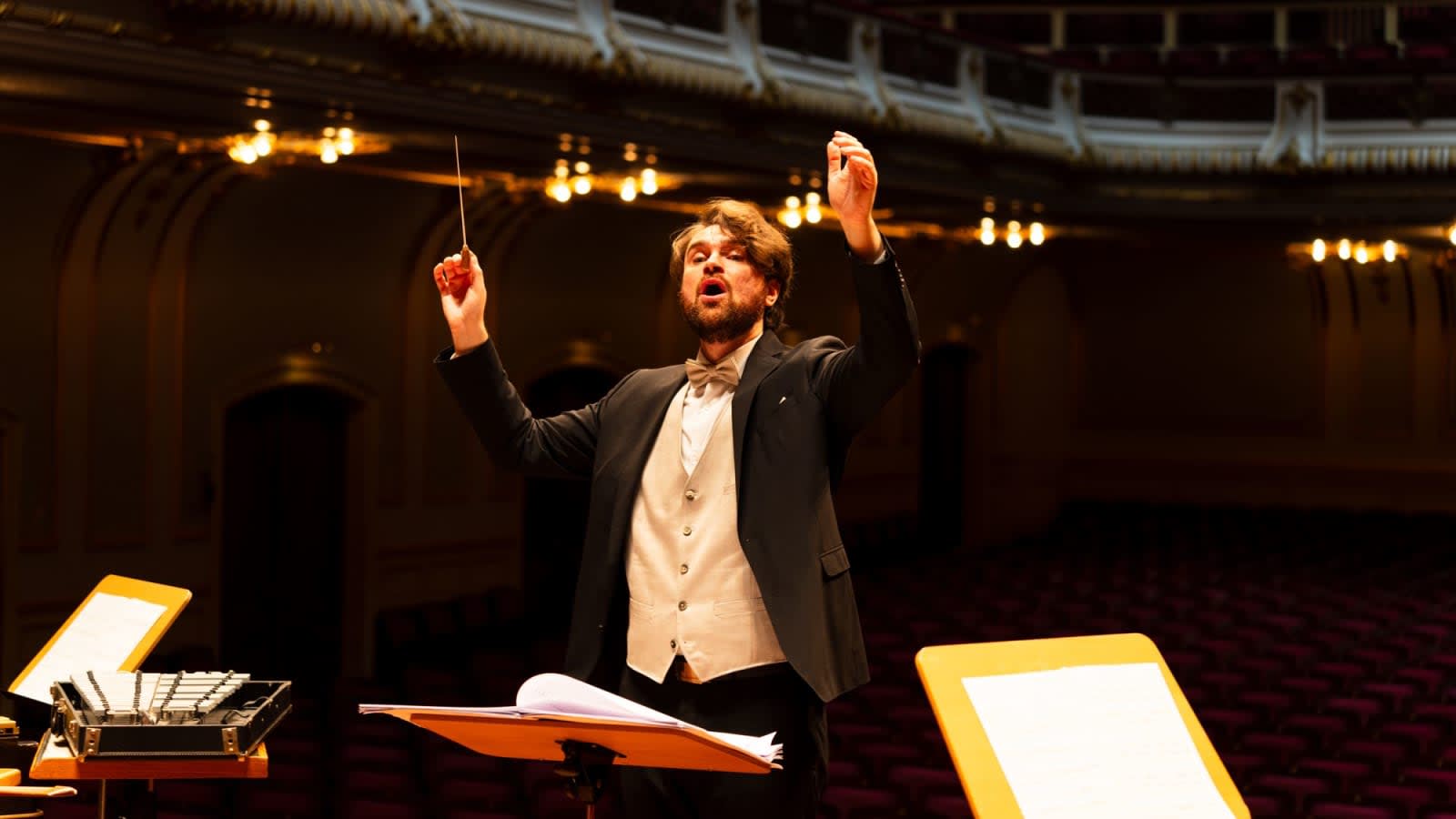
Featured photo: a conductor at work, by Jonas Baumann / Pexels. Illustrative photograph; the conductor pictured is not Christian Zacharias.


