

A beginner piano bundle can arrive with six accessories and still leave you needing a usable seat. For Black Friday 2026, we would start with a complete-setup budget, shortlist three instruments, and compare the extras by what you will actually keep. That makes a modest discount on a suitable piano easier to judge against a much louder bundle offer.
Advance buying guide · 8 September 2026. Black Friday falls on 27 November. The US-dollar limits below are our planning targets, not current prices or announced Black Friday offers.
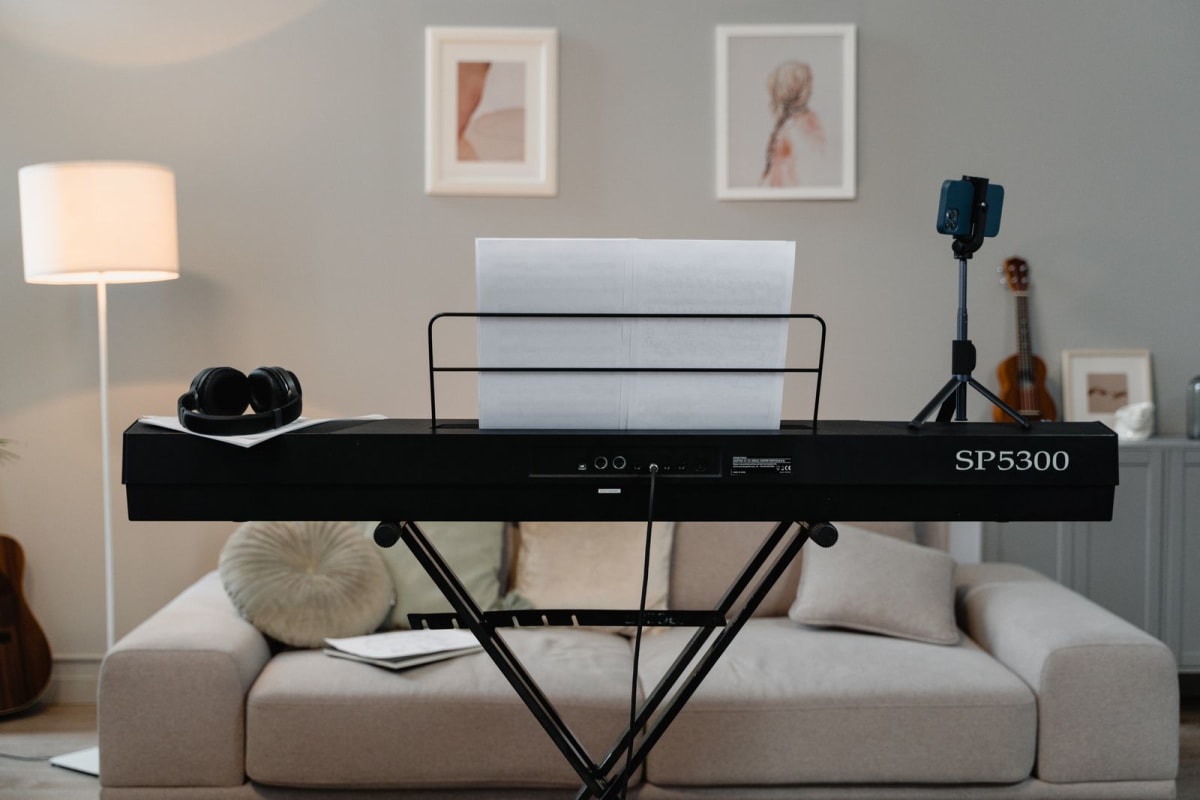
Photo: Monica Escalera / Pexels.
Start with the amount you can spend on everything
For a new beginner setup with 88 weighted keys, built-in speakers and wired headphone listening, a $750 planning budget gives us a useful starting point. It is an example, not a minimum entry fee. An existing suitable stand, seat or pair of headphones can reduce what you need to buy.
We would initially reserve $220 for the stand, bench and headphones, plus a provisional $80 for tax and delivery. That leaves a $450 ceiling for the instrument. Here is how that budget divides:
music rest and starter pedal.
The hardware allowances total $670. If delivery and tax exceed the buffer, the plan needs adjusting before you order. Lessons, books and any paid learning subscription are separate; this is a hardware budget, not the cost of your first year learning piano.
There is nothing special about $450 as a universal piano valuation. It is the amount left in this particular plan. Someone who already owns the accessories has a different calculation, and a beginner who needs a taller bench may need to reserve more for seating.
Three digital pianos for the watchlist
These are specific models to compare when offers appear. All three have 88 hammer-action keys, speakers and a headphone output. Our targets assume a new US-market instrument with its normal included accessories. They are spending limits we would use for this setup, not a forecast that these prices will appear.
Affiliate notice: Some links are paid links. As an Amazon Associate, we earn from qualifying purchases.
Yamaha P-145BT
With ten built-in sounds and Yamaha’s GHC weighted action, the P-145BT keeps the shortlist focused on basic piano playing. Yamaha includes the music rest, AC adapter and sustain footswitch. Those three items should already be in your basic instrument purchase.
Its Bluetooth feature receives audio from a phone, useful for playing a backing track through the piano speakers. It does not transmit the piano’s sound to wireless headphones. Check the exact suffix in a listing: P-145BT and P-145 are different model names, and a bundle title can obscure which one is supplied.
Roland FP-10
The FP-10 has Roland’s PHA-4 Standard hammer action, with graded weighting and escapement. It is worth trying alongside the Yamaha before the sale period if a local shop has both. Key resistance and the sound through your own headphones can settle a choice that specifications leave open.
Roland lists a music rest, power supply and pedal switch as included. Its Bluetooth connection is MIDI, for compatible software, rather than the Yamaha’s Bluetooth-audio feature. The matching KSCFP10 furniture stand is optional; it is not included simply because a listing photograph shows it.
Casio CDP-S160
The CDP-S160 offers a small built-in MIDI recorder alongside its scaled hammer action. Being able to play a phrase back without opening a recording app is a useful beginner convenience. Casio includes the power supply, sustain pedal and music rest.
We would put this on the watchlist at a lower ceiling, leaving another $50 in the setup budget. That is a reason to compare an offer if one appears, not a claim that the Casio will be discounted to $400. The CDP-S110, CDP-S160 and stand bundles need separate comparisons; a similar-looking listing is easy to mistake for the one you saved.
If none reaches the target, there is no requirement to force the purchase into this basket. You can wait, revise the budget or compare a different instrument. Our digital pianos under $1,000 post covers a wider range when you have more room to spend.
Make the accessories earn their place
A bundle’s stand and bench need to fit the player together. The stand’s quoted minimum height is not the height of the piano keys once the instrument sits on it. Leave room for knees, the pedal and its cable, then check that the seat can reach a comfortable playing position.
Measure the actual space before shopping, including the bench pulled out for playing. A piano that fits against the wall can still block a passage when someone sits down.
These three accessories make useful references when a bundle just says “stand, bench and headphones.” The earlier dollar figures are allowances; compare the actual delivered prices when you shop.
Stand: Liquid Stands MS1078
This adjustable Z-style stand has a published height range of 22 to 33.5 inches and width range of 22 to 35 inches. Its layout is worth considering when an X-style stand’s central crossing gets in the way of seated playing. Check the piano’s underside and support placement as well as the stand’s weight rating. Our keyboard stand comparison explains the fit differences between X, Z and table designs.
Bench: On-Stage KT7800
The KT7800 is a folding bench with three height positions, spanning 18.75 to 20.5 inches. That limited adjustment is the important qualification to its budget appeal. A child, or two players sharing a piano, may need something else. Measure before allocating $75 to it; “adjustable” does not guarantee that one of the stops will suit the player.
Headphones: Audio-Technica ATH-M20x
The wired ATH-M20x has a closed-back design, a three-metre cable and an included quarter-inch adapter. The cable gives you room to move the seat, though you will need to keep the surplus away from your feet. This is the wired M20x, not the M20xBT. Already own comfortable wired headphones with the right connection? Try those first; our digital-piano headphone picks are there if you need a replacement.
We have not added a second sustain pedal to the starter basket because these pianos include one. A more substantial pedal can come later if the supplied switch moves around or your playing needs a supported half-pedal option. A dust cover, carry bag or subscription trial is similarly optional. Count a bundle extra as a saving only when it replaces something you intended to buy.
Compare two complete baskets
Suppose you find the same piano in a $549 bundle and as a $449 instrument-only purchase. The bundle includes a suitable stand, but its bench is the wrong height and you would replace its headphones. This hypothetical comparison uses the accessory allowances above:
- Advertised bundle
- $549
- Suitable bench
- + $75
- Wired headphones
- + $60
- Same piano
- $449
- Stand
- + $85
- Bench + headphones
- + $135
If the bundle’s original bench and headphones actually work for you, its $549 price would be $120 below the separate basket. The accessory quality and fit change the result. There is no blanket rule that bundles are poor value.
For your own comparison, write down the exact instrument, included items, replacements, shipping and tax. The FTC’s online-shopping guidance recommends comparing total cost and checking refund terms, including return shipping and restocking fees. A crossed-out reference price cannot tell you the cost of the setup you will use.
Check the seller and the calendar before paying
The seller’s name matters, especially on a marketplace where several businesses can offer the same model. Confirm who handles a problem and which return policy applies to that seller and item. The FTC’s marketplace advice specifically highlights those differences and the need to keep track of deadlines.
For a gift, find the actual last return date and decide when someone can test the piano. Do not assume a holiday extension applies to a particular listing. Keep the packaging until the piano, pedal, headphones and assembled supports have all been checked, especially if the recipient will not open the gift for several weeks.
Three common situations are worth settling before the sale week:
Should we buy before Black Friday?
If lessons start sooner and the complete setup already fits your budget, buying earlier can be reasonable. Waiting has a practical cost when the player has no instrument to use. Future savings are unknown, so compare an available offer with your spending limit and start date.
What about an open-box piano?
Compare it separately from new stock. Ask what is missing, what condition has been documented, which warranty applies and what a return would cost. A missing power supply or stand hardware can turn a small discount into another shopping job. For a first piano, straightforward returns may be worth paying a little more for.
Is a lesson-app trial a valuable extra?
Only if you want that service. Check activation deadlines, renewal charges and whether payment details are required. Give the trial a value of zero in your hardware comparison until you have decided to use it. A teacher or an existing course may already give you enough to begin.
Before ordering, save the final item list and checkout total. Once it arrives, play every key through the speakers and headphones, check the pedal, and make sure the assembled setup stays steady at the height you need. Allow time to resolve a problem before the first lesson or gift date.
For now, the useful preparation is small: measure the room, save two or three exact model names, and write down your complete-setup limit. You can assess November’s offers against that list when they exist.


