In Beethoven’s Triple Concerto, the cello gets the first solo entrance in every movement. That gives the listener a useful guide through a work whose three soloists are continually changing jobs. Follow what happens after each entrance, and the concerto becomes a conversation you can trace: one musician introduces an idea, another takes it up, and a third changes what surrounds it.
The Triple Concerto in C major, Op. 56 is for piano, violin and cello with orchestra. You do not need to play any of those instruments to follow it. A few recognisable entrances and two short score excerpts are enough to start hearing beyond whoever happens to be playing the most notes.
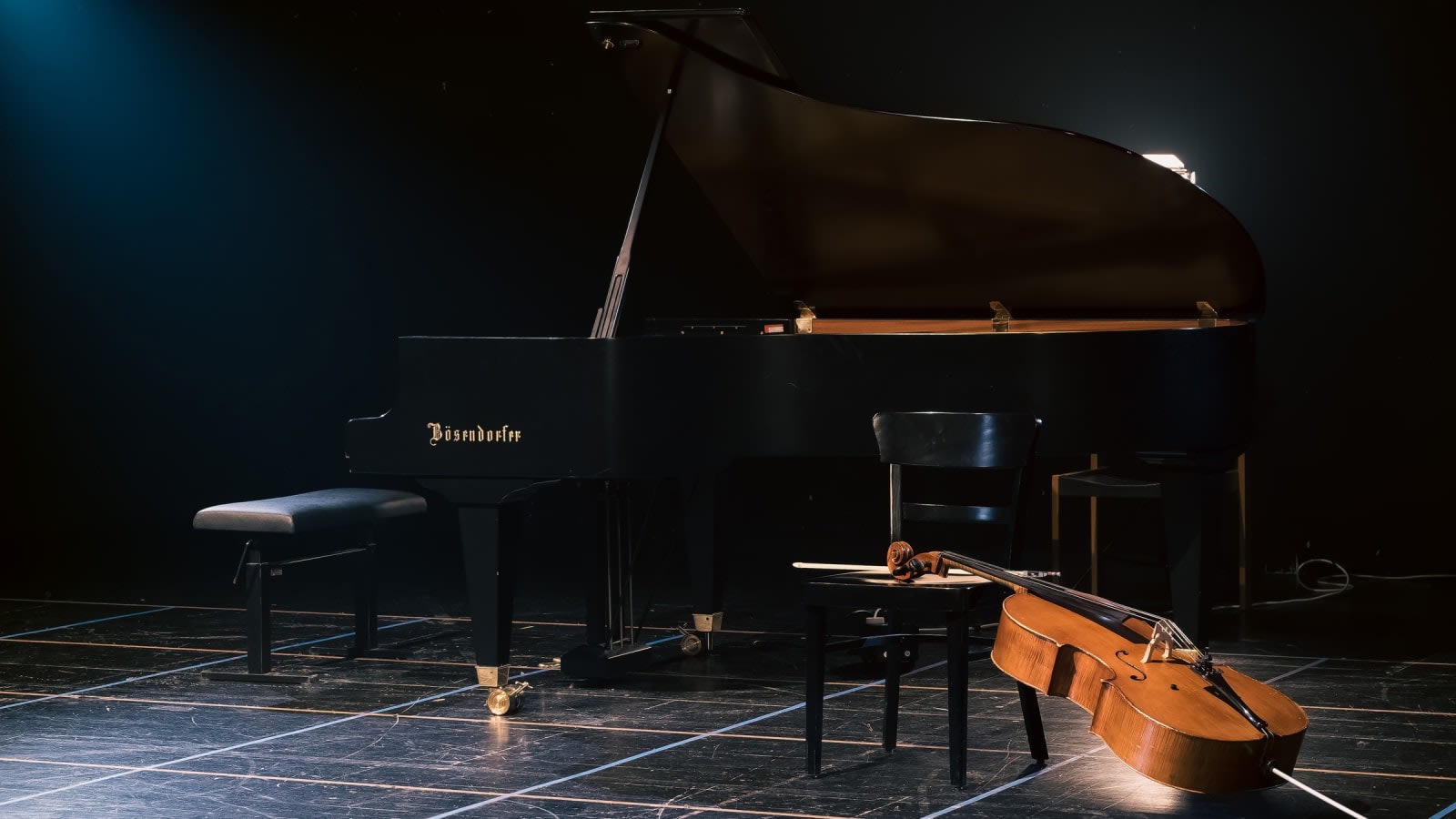
Featured photograph: piano and cello on a concert stage, by Ivan Chumak / Pexels.
A piano trio inside an orchestral work
The solo instruments form the familiar combination called a piano trio: one piano, one violin and one cello. Here they also have an orchestra to respond to. The interest lies in both relationships, between the three individuals and between their small group and the larger ensemble.
Those relationships are easier to follow if you separate an instrument’s identity from its current task. The cello can carry the melody high in its range. The piano can provide the busiest surface while the strings carry the longer phrase. The violin can join the cello’s line rather than introduce a rival tune. “Soloist” describes a player’s place in the concerto; it does not mean that every note in their part must be in the foreground.
The orchestra matters before any soloist has entered. At the beginning of the Allegro, Beethoven starts with the orchestral cellos and basses, then builds out the texture. The solo cello’s later appearance is therefore a new event, not the first time a cello has sounded. On a first listen, distinguish the opening orchestral statement from the entrance of the individual player.
Our examples come from the historical Breitkopf & Härtel full score. In it, Violino concertante and Violoncello concertante identify the solo strings. Violino I, Violino II and the cello-and-bass staff lower down belong to the orchestra. Learning those labels prevents a surprisingly easy mistake: following an orchestral section while thinking you are watching the soloist’s line.
A performance to follow
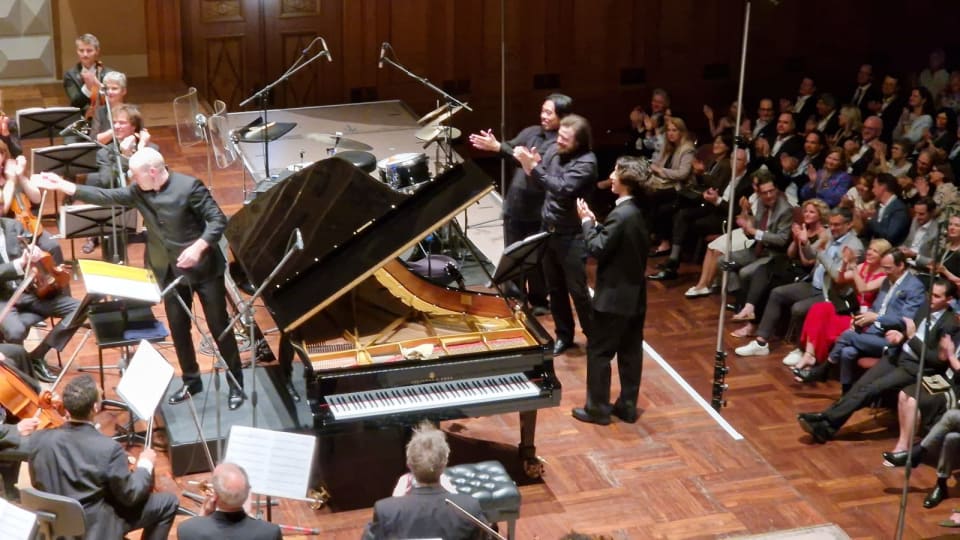
This complete concert film comes from the hr-Sinfonieorchester’s official channel. The soloists are Nicholas Angelich, piano; Gil Shaham, violin; and Anne Gastinel, cello, with Paavo Järvi conducting the Frankfurt Radio Symphony. It was recorded at the Alte Oper Frankfurt on 6 March 2015.
Begin with the whole first movement if you have time. For a shorter visit, start with the Largo, then stay for its transition into the finale. The landmarks below describe the score’s sequence, so they also work with other complete recordings.
Allegro: an entrance becomes a handover
After the orchestral introduction, listen for the solo cello’s first sustained, singing idea. Beethoven marks its opening dolce, or sweetly, while the orchestral violins supply quiet repeated notes. The cello’s phrase combines longer notes with small moving figures. Try remembering its shape rather than naming every pitch.
When the solo violin enters, it takes up that material at a higher pitch level. The cello continues underneath on longer notes; it has changed from introducing the idea to supporting its continuation. That is the first exchange to catch. Listening only for a player to stop and another to begin would miss the overlap.
Swipe the score sideways on a phone, or open it full size.
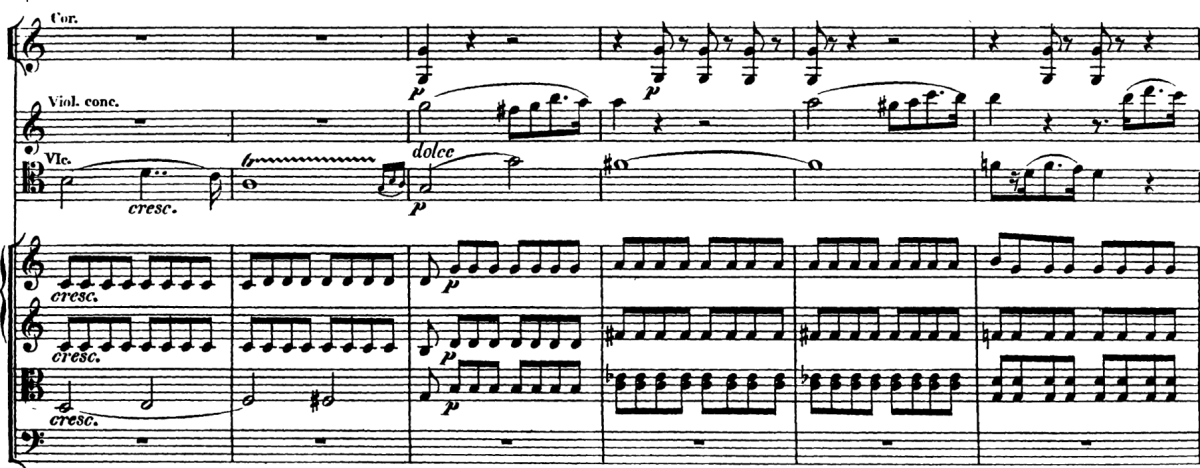
In the excerpt, the solo violin rests for two bars, then enters at dolce. Beneath it, the cello’s trill gives way to sustained notes. The repeated orchestral notes continue through the exchange. The newcomer does not have to establish a new pulse; it joins motion that is already there.
Later in this opening solo passage, the piano enters at dolce too. Its arrival adds a different kind of attack and resonance to the same small group. Follow the phrase into the keyboard, then turn your attention back to the strings. Which line now carries the recognisable idea, and which keeps the music moving around it?
This gives you a useful way to explore the rest of the movement. Each time a short figure reappears, notice whether it belongs to the same instrument, a new soloist, two players together or the orchestra. Sometimes the important change is the identity of the speaker; sometimes it is what the other players do while that speaker continues.
Do not try to maintain a running count of every exchange. Choose one idea you can recognise and follow it until you lose it. Then listen to the larger phrase until another clear entrance gives you a way back in. A concerto can remain intelligible even when you cannot account for every bar.
Largo: the busiest part can be the accompaniment
The slow movement starts in A-flat major and 3/8. After a short orchestral opening, the cello enters with a melody marked molto cantabile, asking for a strongly singing manner. The orchestral violins are marked to use mutes. The solo violin and piano initially wait, leaving the cello time to establish the line.
The piano’s first entry brings flowing, closely spaced notes. Then the solo violin joins the cello’s melodic world, and the two strings move together above the keyboard’s changing figures. This is a good place to test the habit of treating the fastest part as the main subject.
In the passage below, the violin and cello share the same rhythmic outline an octave apart. The piano has many more attacks, with figures reaching between lower and upper registers. You can follow that activity as a layer of its own while still keeping the strings’ longer phrase in mind.
Swipe sideways on a phone, or open the score full size.
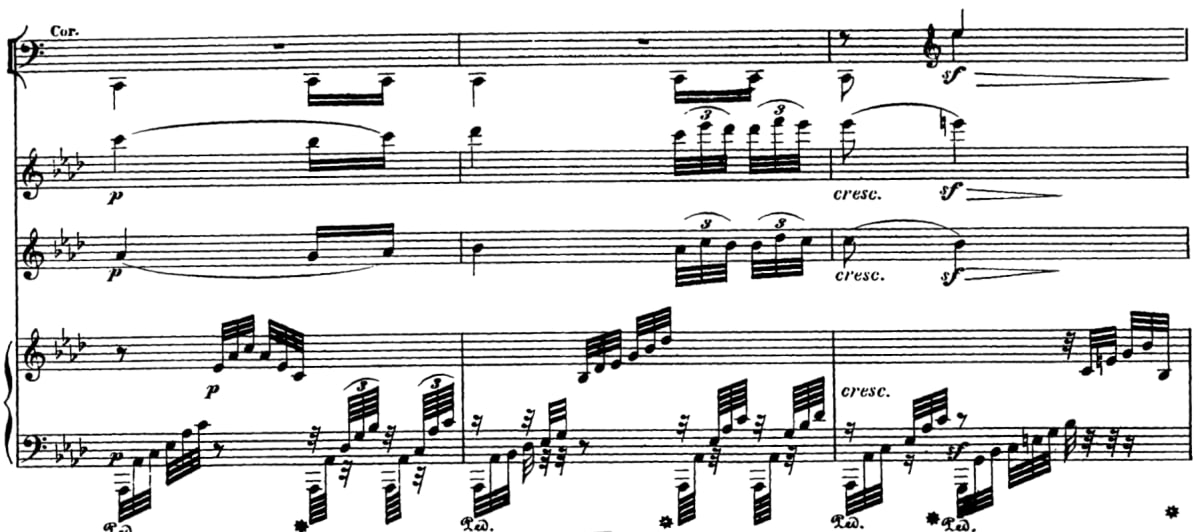
The string parts do more than sustain a static background: they have their own small moving notes, triplets and a shared swell towards the next arrival. At the same time, the keyboard’s figures are shaped into groups. Calling one layer “melody” and another “accompaniment” helps locate your attention; it does not make the second layer musically disposable.
Listen through this passage once with the strings as your reference. On another pass, follow the piano while keeping track of where the strings’ phrase is heading. Notice whether you can shift your attention without losing the larger line. That small change of focus is one of the pleasures of chamber music, even with an orchestra present.
Try one short passage three ways
Use the Largo from its opening through the point where violin and cello are playing together over the piano. The full score places the movement’s beginning on printed page 50, the piano’s first entry on page 51 and the combined texture on pages 52–53. Those page numbers belong to the linked historical edition.
- Find the tune without the score. Follow the cello’s opening line. When another instrument attracts your attention, decide whether the tune has moved or whether a new layer has appeared around it.
- Follow only the solo staves. Replay the passage with the score. Notice the rests before each entrance, then the places where two parts have matching rhythms. You can see those relationships without reading every pitch.
- Choose a supporting part. Listen again to the piano during the string duet. Keep the strings’ phrase in mind while attending to the keyboard’s figures. Write one sentence about how the layers fit together.
A score-based starting note could be: “On page 53, violin and cello move together while the piano fills the space with quicker figures.” Your listening note can then be more specific: identify which layer you found easiest to follow and where your attention changed. The first sentence describes the notation; the second should come from what you actually hear.
If you lose your place, restart before the piano’s first entry rather than trying to locate one isolated chord in the middle. A recognisable entrance gives the surrounding music a shape. Our guide to learning from recordings develops this approach to listening in separate passes.
Rondo alla Polacca: listen across the join
Stay with the end of the Largo. The score marks attacca: continue directly into the next movement. Near that join, the cello’s repeated moving figures prepare an ongoing thread, and the finale begins with the cello leading again. Treating the movements as unrelated tracks would hide that connection.
The heading Rondo alla Polacca announces a rondo in the manner of a polonaise. Its opening is in 3/4, with the cello marked p sotto voce, quietly and in a restrained voice, over very soft orchestral strings. The solo violin takes up the material while the cello moves to longer supporting notes. Later, a short orchestral passage leads to a piano entrance, followed by replies from the strings.
Use the three-beat metre to locate the dance, then listen to how the melody travels across it. The notes include quick turns and longer spans; giving every beat the same musical weight would flatten those differences. You can lightly count three while following the opening, then stop counting and see whether the phrase still retains its direction.
A rondo’s recurring material gives you something to recognise after contrasting episodes. Each time you recognise a return, ask who introduces it and who joins. The same tune can change its role when its companions change, just as it did in the first movement. Leave room for the orchestra to become the centre of attention as well.
A reason to revisit it in Beethoven’s anniversary year
The announced Beethovenfest programme for 20 March 2027 pairs the Triple Concerto with the Sixth Symphony at Bonn’s Beethovenhalle, Großer Saal, at 19:30. It lists Daniel Hope on violin and directing, Maximilian Hornung on cello, Marie Sophie Hauzel on piano, and the Zürcher Kammerorchester. The concert belongs to the celebrations of the 200th anniversary of Beethoven’s death; consult the organiser’s page for current concert details.
Whether you attend that performance or return to a recording, take one observation with you: the instant a player changes role can be as interesting as their entrance. Try following a favourite soloist through the bars where they support someone else. You may find that the phrase makes more sense when you hear what keeps it together.
For a playing project alongside this listening, our shorter Beethoven piano selections offer much smaller pieces to explore. If playing with an ensemble is the attraction, choosing a first piano concerto considers the partners, preparation and rehearsal decisions involved. The listening habit transfers to either scale: know when you are carrying the phrase, and keep listening when someone else takes it.