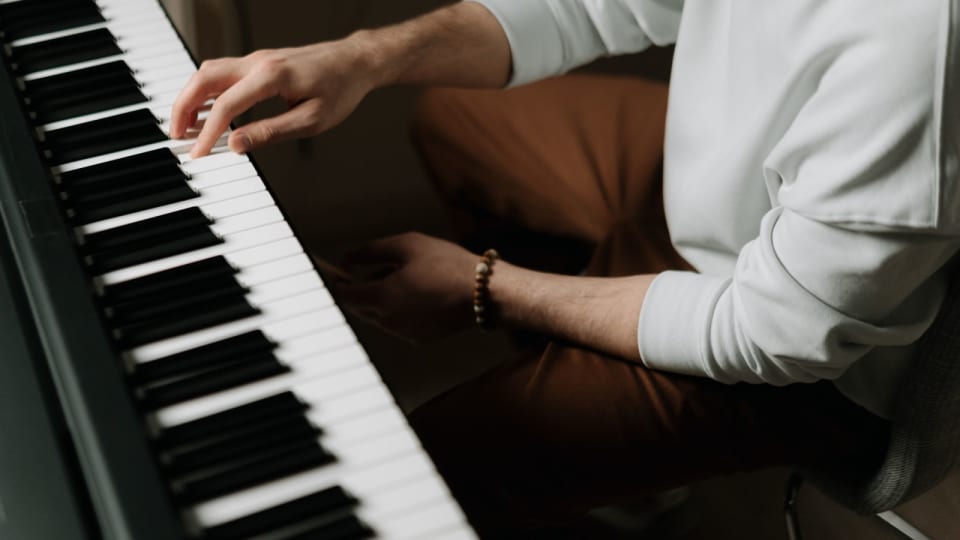
Bach’s Goldberg Variations were written for a harpsichord with two keyboards. On a modern grand piano, the music brings different possibilities for shaping a phrase, balancing its voices and getting the hands past each other.
The piano lets a player vary the strength of individual notes through touch. The harpsichord puts particular weight on the timing and length of notes, their relationship to one another, and the choice of stops. Both instruments reward expressive playing. The interesting part is discovering how they achieve it.
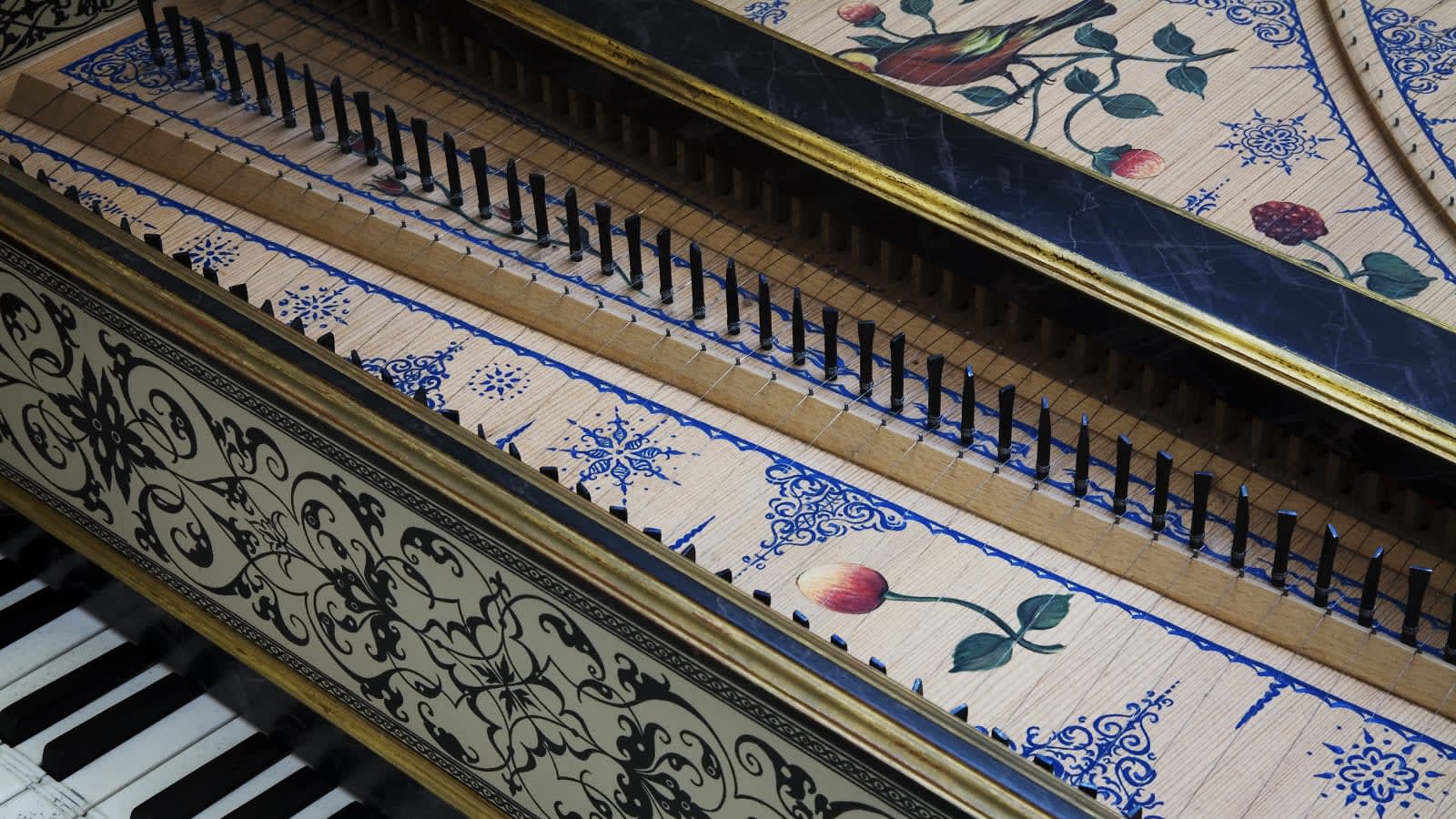
Featured photograph: harpsichord detail in Berlin, Jorge Royan / Wikimedia Commons. Cropped; the photograph and this crop are licensed CC BY-SA 3.0.
Start with the same music: the Goldberg Aria
Play the opening of these recordings one at a time. Begin by following the upper melody; then return to the beginning and follow the bass instead. Keeping the musical passage constant makes it easier to hear what changes when the instrument and player change.
Jean Rondeau on harpsichord
The Netherlands Bach Society’s performance was filmed in Bruges in 2017. Rondeau plays a harpsichord built by Jonte Knif and Arno Pelto in 2004. The player below opens at the Aria, ten seconds into the full film; the variations continue afterwards.
Angela Hewitt on piano
This is the opening Aria from Hewitt’s 2015 recording for Hyperion. Her published performance notes are especially helpful when considering how the music translates to piano, including its ornamentation and the practical problems of crossing parts.
These are two interpretations, recorded in different places. The room, microphones, instrument setup and performer’s choices all contribute. A difference between these recordings cannot automatically be assigned to every piano or every harpsichord. If the melody is already familiar from another pianist, such as the performance discussed in our Yunchan Lim Goldberg post, keep that version in mind as a third interpretation rather than a neutral reference.
What changes between your finger and the string?
On a harpsichord, pressing a key raises a jack carrying a small plectrum that plucks a string. On a piano, an action sends a hammer towards the string. The Bate Collection at Oxford explains the distinction: a standard harpsichord does not offer the pianist’s control of individual note volume through the strength of the touch. Stops bring different sets of strings into use, changing the available sound.
The piano’s hammer action makes a different kind of shaping possible. A pianist can make one note more prominent than its neighbours, or give the melody a different dynamic weight from the accompaniment within the same hand. Wendy Powers’s Metropolitan Museum essay on the piano’s invention explains how control of soft and loud became central to the instrument.
That does not make a harpsichord phrase an unvarying row of sounds. Articulation concerns how notes join or separate; attack is the beginning of a sound, and decay is its fading afterwards. A little space before a note can give it significance without making the note itself louder.
Harpsichordist and teacher Gavin Black’s explanation of the action and dampers makes the release important, too. Once a string has been plucked, the sound fades unless the player ends it earlier. Releasing the key brings its damper back to the string. Black also describes how, on many instruments, the manner of release can shape the ending of a note.
A pianist can benefit from listening for that ending. It is easy to concentrate on how firmly a note begins and overlook how it gives way to the next one. The space between two notes can be part of the phrase.
The Aria: a melody, a bass and the notes between them
The opening gives us more to follow than a tune over chords. In this historical score, the long bass notes sit beneath other notes that arrive later in the bar. Above them, the melody is decorated with ornaments and short flourishes.
On a phone, swipe the notation sideways or open the score full size.

In the first bar, for example, the lowest note lasts while two higher notes enter above it. That means the left hand is already doing more than marking the start of a chord. The right hand has a melody whose smaller notes belong to its character: Hewitt’s notes describe the ornaments as integral to the line.
Listen once for the beginning, once for the space
On the first pass, follow the upper melody across its long notes and ornaments. On the second, pay attention to the lower notes arriving underneath it. Can you keep the inner part in mind while the tune continues?
Then choose one join between melody notes. Does it feel connected, lightly separated or delayed? Try describing that event before describing the whole instrument as warm, bright or dry.
On piano, changing the relative strength of the notes is one way to make these layers intelligible. On harpsichord, the pattern of entries and releases becomes particularly revealing. Neither instrument relieves the player of deciding which line needs attention at a given moment.
The long bass note also makes a useful question audible: what happens while a note is being held? Holding a key does not continuously feed energy into the string. Listen for the other parts carrying the phrase forward as the original sound fades. A sense of sustained melody can come from the relationship between successive notes, rather than from any one note remaining equally loud.
Two keyboards change more than the colour
A manual is a keyboard played with the hands. A double-manual harpsichord has two, one above the other. This can let the hands occupy overlapping pitch ranges while remaining physically separate.
Manuals and stops are different things. In his guide to harpsichord keyboards and stops, Black points out that an instrument with one manual can still have several sounds. Two manuals make it possible to change between sounds by changing keyboards, or to use contrasting sounds in the two hands at once, depending on the instrument’s arrangement.
Variation 8 makes the physical issue vivid. Its heading specifies a 2 Clav., for two keyboards. Look at bars 9–12 below: both staves begin in treble clef, and the two lines move through overlapping regions. A lower staff is not a promise that its notes will stay safely below those in the upper one.
On a phone, swipe the notation sideways or open the score full size.

Hewitt discusses this exact variation in her notes. She identifies the overlapping hands as a particular challenge on piano and explains that transferring some notes between hands can help, provided the individual lines remain clear. That is a useful distinction: the practical division of notes between the hands can change while the musical conversation remains intact.
To see the problem in motion, open Rondeau’s Variation 8 at 17:31. Follow one hand for a few bars, then follow the other. You can also hear Hewitt’s 2015 recording of Variation 8 on Spotify, which may require sign-in. The musical question is whether you can follow the two parts as independent lines when they approach and pass one another.
For a pianist learning similar writing, this is a reason to choose a fingering around the voice you want to preserve. A convenient hand position is useful only if it allows the intended rhythm, articulation and continuity. Our post on choosing fingerings and testing alternatives develops that practical decision.
What about the piano’s sustain pedal?
The sustain pedal introduces another choice. It allows dampers to remain lifted after the fingers release the keys, so notes can continue sounding together. Black’s account of damping helps explain why a pianist’s finger releases and the audible ends of notes need not coincide.
For this comparison, listen for what remains sounding as a new bass note or harmony arrives. Are the lines distinct? Does a release create a clear boundary? A resonant recording alone will not tell you exactly which pedal movements a pianist made, because the room contributes its own lingering sound.
If you play the passage, try a short section without pedal first, simply to hear the connections your fingers make. Then consider what adding pedal contributes. The useful result is a phrase whose voices and harmonic changes you can follow; a rule that every Bach passage must use exactly the same amount of pedal will not make those decisions for you. The interaction between a held melody and moving accompaniment also appears in our illustrated post on Satie’s Gymnopédie No. 1, in a very different musical setting.
Bach did encounter pianos
It is tempting to settle the argument by saying that Bach never knew the piano. That is historically wrong. The Netherlands Bach Society’s account of the Ricercar from The Musical Offering describes Bach playing a Silbermann fortepiano for Frederick the Great in 1747.
That early piano was different from a modern concert grand. The Met’s account describes the considerable differences between early pianos and the later instrument. Bach’s encounter does not establish a preference for a modern grand he could never have tried; the Goldberg title’s specification of a two-manual harpsichord is much more direct evidence about this particular work.
Nor should that specification be extended to every piece Bach wrote for a keyboard. His keyboard world also included the organ and clavichord. The instrument question belongs with the particular music, its sources and the choices in front of the performer.
Give each instrument a fair second hearing
Return to the Aria with one smaller question. Follow the bass through the first phrase, or choose an ornament and listen to how it joins the surrounding melody. Keep the playback level comfortable and broadly comparable, and allow each performance to establish its own pace.
You may prefer one approach. Try to name the musical event that persuaded you: a clear arrival, the independence of a lower voice, a space that makes the next note matter. Those observations give you something to hear in the next performance, whichever keyboard it uses.