For piano study, 88 weighted keys are the dependable default. For portable keyboard playing, songwriting, and synth work, 61 keys are often enough. A 76-key board earns its place when 61 feels cramped but an 88-key instrument would be awkward to carry or house.
The number alone does not settle the purchase. It tells you how many pitches are available at once. Key action, key width, speakers, pedals, and the music you plan to play are separate questions, and a good decision accounts for all of them.
61 vs 76 vs 88 keys: the decision table
This table gives the broad pattern across current keyboards. Individual models vary, especially in their action. There are light 88-key controllers and weighted boards with fewer than 88 keys, so the specification page still matters.
| Question | 61 keys | 76 keys | 88 keys |
|---|---|---|---|
| Pitch span | 5 octaves | 6¼ octaves | 7¼ octaves |
| Action commonly found | Light synth or organ-style action | Light or semi-weighted action; weighted models exist | Hammer action on digital pianos; light action on some controllers and workstations |
| Natural fit | Songwriting, synth parts, chords, general learning, small rooms | Two-hand pop, arranger playing, live splits, left-hand bass | Piano lessons, classical repertoire, exams, acoustic-piano transfer |
| Compromise you notice | The hands reach the ends sooner; splits can feel crowded | More range without automatically gaining piano-like resistance | More width, weight, and usually a larger case and stand |
What 15 or 27 extra keys change
A 61-key keyboard contains 60 semitone intervals, which makes a five-octave span. Moving to 76 adds 15 playable notes. Moving from 61 to 88 adds 27, and the standard piano range reaches seven and a quarter octaves. Yamaha dates the modern 88-key compass to the 1890s in its history of the piano keyboard.
Simultaneous playing range
What the extra keys add
The bars are proportional to key count. They do not represent chassis width, which also depends on speakers, controls, and case design.
The practical difference appears when both hands need distant registers at the same time. A pop arrangement may put octaves or a bass line in the left hand while the right hand plays chords above middle C. Layered orchestral parts and keyboard splits also consume range quickly. On 61 keys, the notes may all exist somewhere after pressing an octave button, but they are not all physically available together.
Octave shift works well for a synth lead, a bass patch, or a MIDI part recorded one hand at a time. It is less helpful in a continuous piano piece because shifting moves the whole active range while you are playing. A 76-key board reduces that interruption without taking on the full length of an 88.
Early method-book pieces, scales, chord practice, and a large amount of pop material fit on 61 keys. The restriction arrives by piece and arrangement rather than at a particular month of learning. Checking the lowest and highest written notes in music you genuinely want to play is more revealing than assigning a skill level to each keyboard size.
Range and action answer different questions
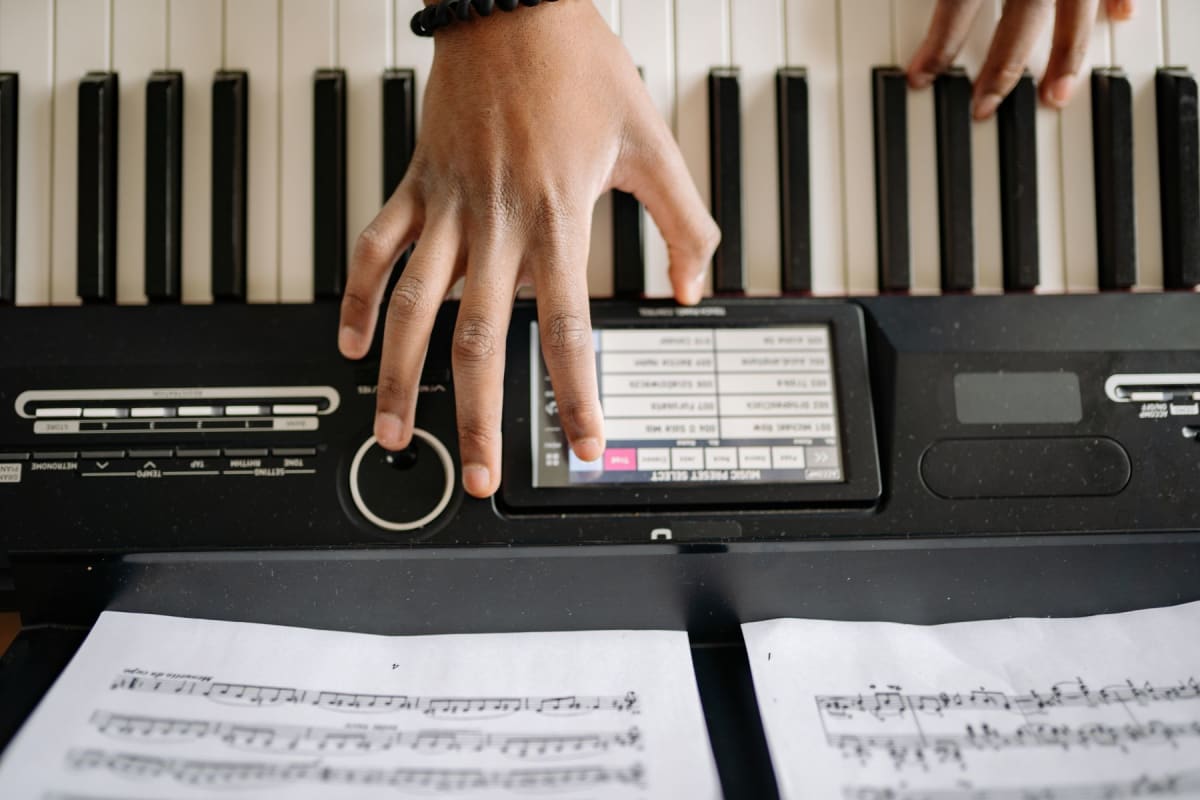
Key count is about range. Action is about physical response. Touch sensitivity means the instrument can produce a different volume or tone when a key is struck more firmly. It does not mean the key has the mass and resistance of an acoustic-piano action. Terms such as organ-style, synth action, semi-weighted, hammer action, and graded hammer action describe different mechanisms and should be checked separately from the key total.
The contrast is easy to see within Yamaha's current entry-level range. Its 76-key PSR-EW320 uses the same organ-style, touch-sensitive action as the 61-key PSR-E383. The 88-key P-145BT uses Yamaha's Graded Hammer Compact action. The lower keys on a graded action are designed to feel heavier than the upper keys, closer to the changing resistance across an acoustic piano.
This matters most when the goal is piano technique. Dynamic control, balance between voices, repeated notes, and the way the hand releases a key all feel different on a light spring action. A responsive light keyboard can still be an excellent instrument for organ, synth, arranger, and production work. It simply trains a different physical relationship with the keys.
Exam rules show why “76 keys is enough” needs context. The Royal Conservatory permits a weighted, touch-sensitive keyboard with at least 76 keys for remote Preparatory through Level 8 piano exams, while preferring 88. Its current guidance does not make an unweighted 76-key arranger equivalent to a digital piano. Trinity's February 2026 requirements for digital piano exams likewise require enough range for the selected pieces and a touch-sensitive weighted action; within those piano grades, electronic keyboards are allowed only through Grade 3 and must meet the music's demands.
Someone preparing classical repertoire or expecting regular lessons on an acoustic piano will usually benefit from 88 weighted keys from the beginning. For a songwriter building tracks, a church keyboardist using splits, or a player who mainly wants organs and synths, the quicker response and lower weight of a 61- or 76-key action may be preferable.
How the three sizes fit real playing
Classical piano and graded study. An 88-key weighted digital piano gives the music its intended compass and removes an avoidable change when moving to an acoustic instrument. Beginners may spend months playing pieces that fit comfortably inside five octaves, yet their touch develops during those months. This is the strongest case for buying the larger format before the repertoire visibly demands every note.
Pop, worship, and two-hand arranging. Seventy-six keys can be unusually practical here. There is room for a low bass register, a chordal center, and an upper sound without an 88-key chassis. A performer who uses split points can give the left-hand zone more than an octave and still leave a broad right-hand area. The trade is selection: there are fewer 76-key models, and many have a light action.
Songwriting, MIDI, and synth parts. Sixty-one keys cover a great deal of real work. Chords, melodies, pads, bass recording, drum programming, and one-hand overdubs rarely require a full piano compass in a single take. A smaller instrument also leaves desk space for a computer, interface, monitors, and control surfaces. Players who write dense two-hand piano parts may still run out of room, but that is a specific workflow rather than a universal problem.
Shared rooms and frequent transport. The difference is not confined to the instrument. A longer board needs a wider stand, a longer bag, and enough clear wall or floor space to approach it comfortably. Hammer mechanisms add weight. Someone carrying a keyboard up stairs every week may reasonably accept octave shifts in exchange for a setup that is easier to move.
Teacher-and-student duo practice. Some digital pianos can divide the keyboard into two equivalent pitch zones. Yamaha's P-145BT has a Duo mode, for example. Two players on an 88-key instrument receive much more useful physical room than they do when a 61-key board is divided in half.

Measure the whole setup before buying
Keyboard dimensions are model-specific, so key count cannot be converted into one universal width. These three Yamaha examples show the scale of the change while keeping the manufacturer consistent. Measurements and weights come from Yamaha's US specifications.
12 1/2 in deep
9 lb 11 oz
12 1/2 in deep
11 lb 7 oz
10 9/16 in deep
24 lb 8 oz
The 76-key model adds 8 1/8 inches and 1 pound 12 ounces to the 61-key chassis. The weighted 88-key model is another 7 inches wider and more than twice the weight of the 76-key board.
Measure the clear width at playing height, including a few inches for cables and access to the power socket. Then check the stand's supported width and weight, the bench position, pedal reach, music-rest height, and the bag's external dimensions. A board that technically fits a wall recess may still be unpleasant to use if the player has to twist around furniture or remove it after every session.
Depth can be surprising. The weighted P-145BT is shallower than the two arranger keyboards above, even though it is much heavier. Front-panel controls and speakers affect the case just as much as the keybed. Our post on digital-piano buying mistakes covers stand stability, pedal placement, speakers, and connections in more detail.
Three current examples, one at each size
The models below make the differences tangible rather than serving as a universal ranking. Specifications and US product listings were checked on August 30, 2026. The non-Amazon prices are snapshots from that date; prices and package contents can change.
Affiliate notice: Some links are paid links. As an Amazon Associate, we earn from qualifying purchases.
Yamaha PSR-E383
View on AmazonThis is a practical first keyboard for general learning, songwriting, and arranger features. It has 61 organ-style touch-sensitive keys, speakers, headphone and sustain connections, battery power, and USB audio and MIDI. The 650 voices and 260 accompaniment styles make it more flexible than a piano-focused instrument. Its five-octave limit and light action remain the important boundaries. A hands-on review from PianoDreamers found the action firm and responsive for its category, while still distinguishing it clearly from weighted piano practice. Sweetwater listed the keyboard-and-adapter package at $199.99 on August 30, 2026. See Yamaha's full specifications.
Yamaha PSR-EW320
View on AmazonThe EW320 keeps the E383's sounds, rhythms, speakers, connectivity, and organ-style touch response, then adds 15 keys. That makes the comparison unusually clean: the extra money and width buy simultaneous range, not hammer weighting or a more powerful sound system. It suits two-hand pop arrangements, accompaniment splits, and players who already know that five octaves interrupt their music. Sweetwater listed it at $299.99 on August 30, 2026. See Yamaha's full specifications.
Yamaha P-145BT
View on AmazonThe P-145BT changes category as well as size. Its 88-key Graded Hammer Compact action, sustain footswitch, 64-note polyphony, USB audio and MIDI, and optional three-pedal unit are aimed at piano practice. It has ten voices rather than hundreds of arranger sounds, and it does not run on batteries. Bluetooth handles incoming audio, which is useful for playing along, but it does not make this a wireless MIDI controller. Yamaha's US store listed it at $469.99 on August 30, 2026; the same page has the full current specifications.
For more options within each category, compare our portable beginner keyboards under $400 and our weighted digital pianos for beginners. Those lists address sound, connections, pedals, and value after the size decision is settled.
A five-minute test before you commit
Bring or open the music you expect to play during the next year. Find its lowest and highest notes, then play the passages that use them. Try any split or layer you expect to use. This reveals whether 61 keys create a real interruption and whether 76 removes it.
Next, ignore the sound for a moment and feel the action. Play a slow scale as quietly as possible, then repeat it loudly without the keys becoming hard to control. Test repeated notes, chords with one deliberately softer note, and a phrase near the back of the keys. If acoustic-piano transfer matters, compare the candidate directly with a weighted digital or acoustic piano rather than relying on the word “touch-sensitive.”
Finally, simulate ownership. Lift the instrument safely, place it on the intended stand, connect headphones and a sustain pedal, and sit at the correct height. Check whether the music rest blocks a screen or shelf and whether cables protrude into a wall. For a board that will travel, the case and accessories belong in the weight calculation.
That short test usually makes the trade-off clearer. A player who needs piano technique has a strong reason to accept the size and weight of 88 weighted keys. A player whose music fits five octaves can keep the smaller footprint without treating it as a temporary or lesser instrument. Seventy-six remains the useful middle when simultaneous range is the part that actually feels constrained.
If the uncertainty is less about size and more about commitment, our broader post on whether a first keyboard needs 88 keys looks at the beginner purchase from that angle.