
Why You Keep Making the Same Mistakes in Music Practice
Repeated mistakes usually do not mean you are lazy or untalented. More often, they mean you are stuck in a repetition loop that never gets interrupted, diagnosed, or rebuilt with a better cue.
Pract.is
Research-based practice guidance from the Pract.is team.

The brain gets better at what it repeats. That is useful when the repetition is clean. It is a problem when the repetition is flawed.
Many musicians keep making the same mistake not because they do not care, but because the mistake is living inside a loop: same passage, same cue, same automatic attempt, same outcome. More effort poured into that loop often just stabilizes it.
The way out is not mystical. First identify the loop. Then interrupt it. Then rebuild the passage with a better cue or constraint.
Why the same mistake keeps surviving
Repetition feels productive. That is exactly why it can fool musicians.
Christine Carter and Jessica Grahn make this point clearly in their 2016 music-learning study on blocked versus interleaved practice. Blocked repetition tends to feel fluent in the moment, but that feeling is not a reliable indicator of long-term learning. In their study with 10 advanced clarinetists, the interleaved schedule often produced better ratings than the blocked schedule, and players also reported better focus, goal setting, and mistake identification.
That fits a broader motor-learning pattern. A review in Neuroscience and Biobehavioral Reviews concluded that random or varied practice often produces better learning than constant or blocked practice, even though the blocked version feels easier while you are doing it. Marc Bangert and colleagues also found in a piano study that practice variability improved transfer compared with fixed repetition.
So if you keep making the same mistake, the first correction is conceptual: stop assuming repetition and learning are automatically the same thing.
What a practice loop actually looks like
Most bad loops have three parts:
| Loop part | What it sounds or feels like | Why it keeps the mistake alive |
|---|---|---|
| Automatic attempt | You launch the passage the same way every time | No new information enters the system |
| Weak interruption | You notice the error but keep going anyway | The failed pattern gets another full run |
| Unchanged input | You try again with the same fingering, cue, tempo, or motion plan | The brain is asked to reproduce the same outcome again |
This is why “I practiced it many times” is not always meaningful. If the setup is unchanged, many times may just mean many reinforcements of the same route.
Practice warning: if your last five reps all started from the same place, with the same cue, at the same speed, and failed in the same bar, you are not exploring the problem. You are rehearsing the loop.
Step 1: identify the loop, not just the error
Most musicians identify the visible mistake but not the loop feeding it. Wrong note in bar 18. Rhythm wobble at the shift. Cracked entrance after the breath. That is the symptom. The loop is the repeatable setup that keeps generating it.
A better diagnostic question is: what stays the same every time right before this goes wrong?
Sometimes the answer is mechanical. The hand tightens before the leap. The bow speed collapses before the string crossing. The tongue releases late after a breath. Sometimes it is attentional. You stop subdividing. You stop hearing the inner line. You think about the hard bar instead of the pulse. Sometimes it is structural. You only ever practice from the top, so the mistake is always approached with the same momentum and panic.
This is exactly where practice diagnosis matters. If the category is rhythm, coordination, sound, memory, reading, tension, or attention, the interruption has to match that category. Otherwise you just replace one loop with another.
Step 2: interrupt the loop hard enough to matter
A weak interruption is just another version of the same attempt. A real interruption changes the conditions enough that the old mistake cannot run on autopilot.
Good interruptions include:
- starting from the error bar instead of always approaching from earlier
- changing the rhythm or grouping of a fast passage
- removing pedal, vibrato, or sustaining habits that blur the fault
- stopping after one beat and rebuilding the connection into the next beat
- recording one short take and replaying it before the next rep
- alternating two excerpts instead of hammering one in a block
That last point has strong support. In the Carter and Grahn study, interleaving did not just change retention; players also reported benefits to focus and mistake identification. In other words, the varied schedule did not merely make them work harder. It changed what they noticed.
If the repeated mistake is rhythmic, use a rhythm-specific interruption. That may mean subdivision, displaced accents, or regrouping, which is the more specific fix described in the sloppy-rhythm piece. If the repeated mistake is broader than rhythm, do not hide behind the metronome and call it solved.
Step 3: rebuild with a better cue
Interrupting the bad loop is only half the job. You still need a better instruction for the next attempt.
That instruction should be small and testable. Not “play better.” More like:
- land the thumb under earlier
- hear beat three before moving
- keep the melody above the left hand
- release the shoulder before the leap
- arrive on the new string with faster bow and lighter pressure

Photo: Houssam benamara via Pexels
This is where short written labels help. A 2024 Frontiers paper by Guadalupe López-Íñiguez and Gary McPherson on music microanalysis frames practice as a cycle of defining the task, monitoring what happened, evaluating it, and planning the next move. That planning step is where many loops survive. Musicians hear the mistake, but they do not convert it into a usable next cue.
If you want that cue to stay honest, pair it with the method in self-correction without a teacher in the room. A ten-second replay is often enough to expose whether the “new” attempt was actually new.
Three escape routes from the most common loops
Different loops need different exits. Here are three common ones.
Loop 1: the speed loop. You keep testing the passage near performance tempo, fail, slow down briefly, then drift back up before the organization is stable. Escape route: hold the tempo down, but also change the grouping or rhythm so you are not just replaying a slower version of the same failure.
Loop 2: the top-to-bottom loop. You always begin from the same earlier point, so the same stress buildup arrives at the same place. Escape route: start from the error, then start one beat before it, then two beats before it, then reconnect it into a longer span.
Loop 3: the mood loop. You judge each rep by a feeling like tense, off, bad, or not together. Escape route: replace mood language with one observable target: pitch center, pulse stability, hand release, balance, articulation.
The exit question is simple: what did I change that makes the old mistake less likely to happen on this rep?
Why effort alone does not solve it
This matters because many musicians respond to repeated mistakes by increasing emotional force. More determination. More hours. More frustration. That can raise intensity without changing design.
Williamon and Valentine showed this years ago in their study of pianists: better performance quality was associated with better strategies, not just more time. Roberta Antonini Philippe and colleagues reached a similar conclusion in their 2020 study of conservatory exam preparation. Strong preparation depended heavily on self-regulation, planning, and temporal organization, not mere accumulation of hours.
So yes, effort matters. But effort that never interrupts the loop is just energy trapped in a circle.
A five-rep rule for escaping mistake loops
If you want one rule to use immediately, use this:
- Rep 1 identifies the mistake.
- Rep 2 confirms whether it repeats in the same way.
- Rep 3 must introduce a real interruption.
- Rep 4 tests one new cue.
- Rep 5 checks whether the cue held.
If by rep 5 nothing meaningful has changed, do not keep grinding. Change the setup again.
The goal of practice is not to prove you can suffer through repetition. It is to make the next attempt different enough, and better enough, that the old mistake stops feeling inevitable.
Further reading
 Practice Methods
How to Diagnose What's Actually Going Wrong in Your Practice
Many practice problems persist because musicians apply the wrong fix to the wrong category of problem. This guide gives you a simple framework for identifying whether the issue is rhythm, coordination, sound, memory, reading, tension, or attention before you try to solve it.
10 min read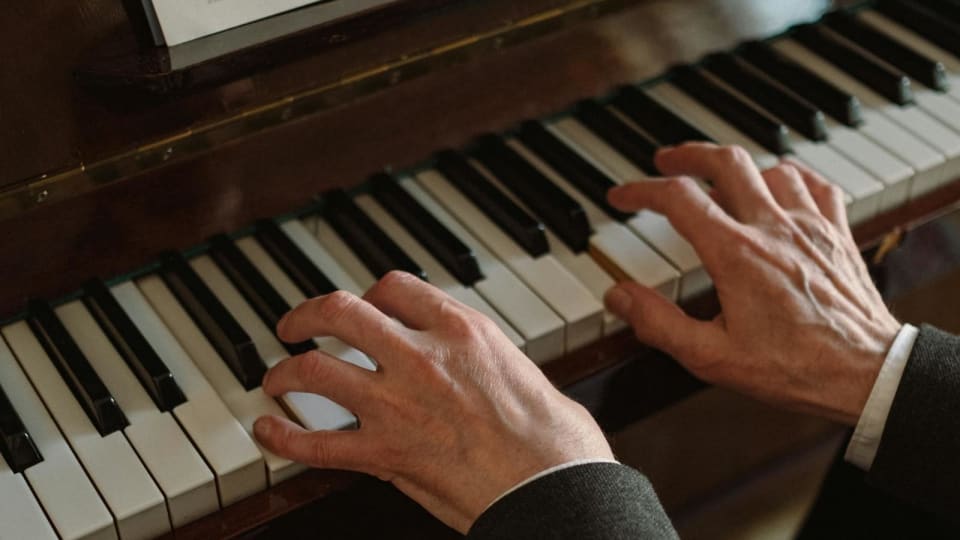 Technique
How to Fix Sloppy Rhythm at the Piano Without Just "Practicing Slower"
Slowing down helps, but sloppy rhythm usually comes from something more specific: weak subdivision, unstable chunk boundaries, hand-coordination problems, or a missing feedback loop. Here is how to fix the cause instead of just reducing the tempo.
10 min read Practice Methods
How to Self-Correct in Practice Without a Teacher in the Room
Self-correction is not a talent. It is a trainable practice skill built from short recordings, immediate replay, clear problem labels, and testing one change at a time.
10 min read