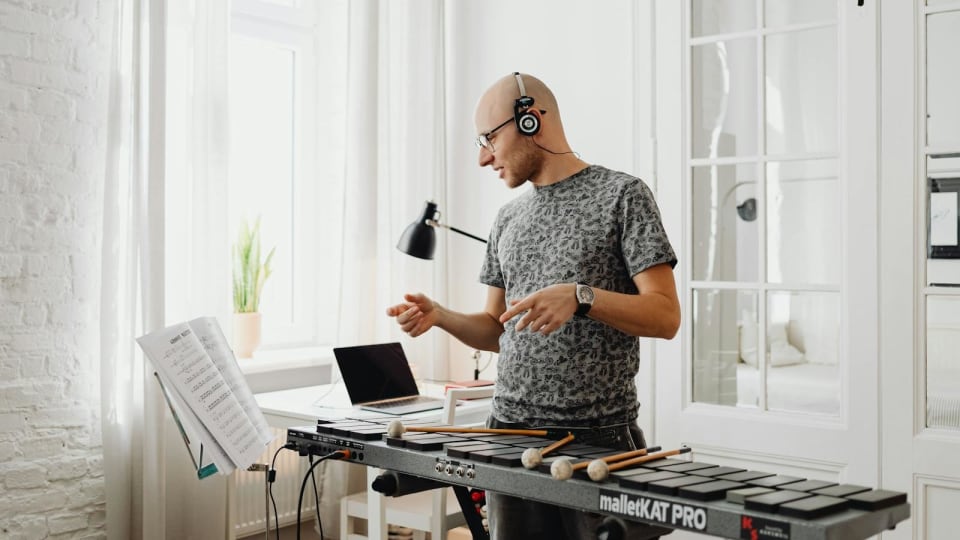
Self-taught musicians usually notice pitch problems before they notice rhythm problems. That is not because rhythm matters less. It is because rhythm is harder to audit alone. A wrong note is obvious. A dragged entrance, weak subdivision, or unstable internal pulse can sit inside otherwise convincing playing for a long time before the player names it correctly.
That makes rhythm one of the easiest skills to neglect without realizing it. The notes keep getting attention, the hands stay busy, and the passage may even sound close enough that the real limit never gets addressed directly. Then progress starts flattening out, and the player thinks the issue is technique in general, when a lot of the damage is actually happening in time.
Self-taught players often check notes harder than they check time
This is the quiet structural problem in self-taught learning. Notes are easier to verify than rhythm. You can compare pitches to the score, to a tutorial, to an app, or to a recording and usually tell fairly quickly whether something is right. Rhythm is murkier. A passage can be approximately in time and still be unstable, rushed between beats, or dependent on the previous bar to stay upright. That kind of inaccuracy is harder to spot without a teacher, ensemble, or recording habit that keeps exposing it.
There is a second problem underneath that one: a lot of rhythm trouble does not sound dramatic until the texture gets harder. A self-taught player may survive basic material with a vague pulse and then suddenly fall apart when syncopation, rests, longer phrases, or left-right coordination start asking for a stronger time grid. In The Impact of Instrument-Specific Musical Training on Rhythm Perception and Production, Matthews and colleagues found that meter, complexity, tempo, and beat phase all affected rhythmic accuracy. That matters because it shows rhythm is not one fixed background skill that stays equally strong as pieces get harder. The task changes. Weaknesses that were tolerable in simple material become much more visible later.
This is one reason self-taught players can make real progress and still hit an invisible ceiling. The pitch side keeps improving enough to feel productive, but the timing side keeps quietly limiting how clean, musical, or stable the result can become. That is also why more repetition without diagnosis so often fails to solve the problem. If the timing layer is the thing actually breaking, more note repetitions mostly make the masking better.
| What self-taught players often check first | What rhythm issue hides underneath | Better first test |
|---|---|---|
| Wrong notes | The beat compresses when the notes get faster | Clap and count the same bar away from the instrument |
| Fingerings | Subdivision disappears between attacks | Say the smallest count value aloud while tapping one pitch |
| Whether the piece sounds recognizable | The groove or pulse is inconsistent | Record one phrase and listen only for steadiness, not notes |
| Whether it matches the tutorial | The time is borrowed from imitation, not generated internally | Play the phrase after the model stops and see if it stays steady |
Following a beat is not the same as generating one
This is the biggest rhythm misunderstanding in self-taught practice. Many players become reasonably good at following a beat before they become good at generating one. Those are related skills, but they are not the same skill. Following means reacting to an external time source. Generating means maintaining a stable internal pulse when the help gets thinner, delayed, or removed.
The distinction shows up clearly in the timing literature. In the 2026 Scientific Reports study on sensorimotor timing across age and music experience, musicians showed better synchronization and better continuation timing than less experienced participants. That matters because the continuation segment is exactly the part where the external cue disappears and the internal model has to keep carrying the beat. A similar distinction appears in a 2025 synchronization-continuation study, where early tapping performance in both synchronization and continuation conditions reflected rapid refinement of internal timing models. In plain language: reacting to the click and continuing without it are connected, but they are not identical demands.
For self-taught musicians, this gap often goes unnoticed because a dense metronome or backing track can cover it up for a long time. The playing seems “in time” while the support is present, but the moment the cue thins out, the beat starts drifting toward comfort, tension, or guesswork. That is not a small issue. It affects phrasing, ensemble readiness, transitions, and how stable the piece feels when no external support is holding it together.
Rhythm stack
Hear beat
Recognize the pulse
Hold beat
Keep it when cues thin
Split beat
Subdivision stays active
Place notes
Attacks land cleanly
Many self-taught players train the top layer and skip the middle two.
Subdivision is the layer most people skip
Subdivision is what stops rhythm from becoming guesswork between beats. If you only know where beat one and beat two are, everything inside that span is vulnerable to tension, rushing, dragging, and uneven spacing. A lot of musicians think they have a pulse problem when the real problem is that the inner grid between beats is too vague to guide the movement accurately.
This is also why movement-based rhythm work is often more effective than expected. Jessica Grahn and James Rowe showed in Feeling the Beat that beat perception engages motor-related systems even when listeners are not overtly moving. Hannah Creviston makes the practical version of that point in Yamaha's Use Movement to Fix Rhythmic Issues: stepping, clapping, or conducting can reveal and stabilize timing in ways that instrument-only work often does not. If the body does not clearly feel the subdivision, the hands, voice, or embouchure are being asked to build on a weak floor.
Robert Miller's Percussive Arts Society article on subdivision gets at the same issue from a pedagogy angle. His basic point is that subdivision is what turns rhythm from counting symbols into measurable time. That matters far beyond percussion. For a pianist, guitarist, singer, or string player, weak subdivision is one of the main reasons a passage sounds approximately correct while still feeling unstable. It is also why rhythm-specific repair work often succeeds where general practice does not.

Photo: cottonbro studio via Pexels
Weak subdivision sounds like
Even simple syncopations feel rushed, rests collapse, and fast notes smear toward the next beat.
Better drill
Say the smallest count value aloud while stepping the beat or tapping one neutral pitch.
The metronome does not fix what you never made explicit
A metronome is useful, but it is not a rhythm education by itself. If the player has never made pulse, subdivision, and placement explicit away from the notes, the click often becomes a crutch rather than a teacher. The passage stays alive only while the cue is loud and frequent. The player learns to react to the next click instead of carrying a living time grid through the bar.
That is why good metronome work gradually removes help instead of permanently adding it. Yamaha's creative metronome practice guide and Josh Gottry's Don't Play With the Metronome make the same practical argument from different angles: use the click to expose whether your internal pulse survives with less support. Once the pattern is clear, thinner clicks are more revealing than denser ones.
Self-taught players often stop too early in that process. They prove the passage can line up with quarter-note clicks, then move on. What they have not yet checked is whether the pulse still exists when the click moves to half notes, to beats two and four, or to one click per bar. If it falls apart there, the issue is not “I need more metronome.” The issue is that the time source is still external.
This is also why metronome work alone rarely solves the whole problem. It needs to be paired with speaking, moving, clapping, and simplified pitch versions. Otherwise the note layer keeps hiding what the timing layer still cannot do on its own. That is the same transfer problem behind using the metronome without becoming robotic: the click should reveal the weakness, not permanently replace the missing skill.
A short daily rhythm routine does more than occasional panic-fixing
If rhythm is the neglected layer, it improves most when it becomes a standing part of practice rather than a rescue tool pulled out only when something falls apart. The good news is that it does not need to take long. Ten focused minutes a day will do more than forty-minute emergency sessions once the piece is already a mess. The key is that the routine should train rhythm as rhythm: pulse, subdivision, continuation, and placement, not just notes with a click attached.
A simple routine works well because it forces the skills into the right order. Start without the instrument. Add the smallest useful amount of pitch. Then thin out support. This also keeps the work honest. If the rhythm only exists once the full notes are back, you know the timing layer is still too weak.
Step and count
Step the beat or tap it with the hand while counting subdivisions aloud. No instrument yet.
Clap or tap one line
Reduce the target passage to one rhythm line or one neutral pitch so the time grid stays visible.
Use a sparse click
Confirm the pattern with the metronome, then immediately thin the cue so you have to hold time between clicks.
Return to the real passage
Bring the full notes back only after the rhythm has stayed stable in simpler forms.
Check continuity
Run a small phrase without stopping and listen for whether the time still belongs to you once the exercise ends.
Bottom line
Self-taught musicians often neglect rhythm because pitch is easier to self-correct. That does not make rhythm secondary. It makes rhythm the hidden limit on everything else.
If rhythm has been the quiet weak point in your playing, that is not a reason for drama. It is a reason to stop treating time as a background assumption and start training it as its own skill.