
Twenty minutes at the piano, fifteen on guitar, then a little ear training: a perfectly ordinary evening can become surprisingly hard to read in a practice log. The total is clear, but “worked on the chorus” could belong to either instrument. You can keep everything in one diary by identifying the instrument in each entry, giving different versions of a piece their own histories, and counting shared work once. Here is a practical way to do that in our practice diary, Practis.
Give the same tune two separate histories
A piece title tells you what music you played. It does not always tell you what you were learning. You might accompany a song confidently on piano while still finding its melody on the guitar fretboard. Put both sessions under one undifferentiated title and a note such as “ready to play through” becomes ambiguous.
The useful unit is instrument plus piece or exercise. For a tune you play on two instruments, create two entries. The composition stays the same; the fingering, arrangement, problem spots and readiness can develop separately.
Imagine you have written a short tune and are learning to play it both ways. Its entries might look like this:
My eight-bar tune
Melody with left-hand chords.
Latest note: the accompaniment covers the melody in bars 5–6.
Single-note melody.
Latest note: the shift into bar 5 interrupts the phrase.
In Practis, open My Pieces and use Add piece to create a custom entry. Put the instrument at the beginning of the title, as above, and enter the composer in the composer field. For your own composition, that would be your name. For an exercise from a book, retain the exercise name and its author so you can find it again.
This prefix is a naming convention you supply. Practis does not currently give custom pieces a dedicated instrument field or provide an instrument dashboard. The title makes the distinction visible when you select a piece and searchable later. Separate versions also count toward your plan's collection limit.
Use the same spelling each time: Piano |, Guitar |, Violin |. Add a more specific label, such as Tenor sax |, when that distinction matters to your practice. There is no need to invent categories for every technique within an instrument.
Save the session before changing instruments
The easiest logging mistake happens during the switch. You finish piano, pick up the guitar and keep the timer running against the piano piece. Later, the duration looks plausible, so the misplaced minutes are easy to miss.
With the Practis timer, pause and use Save Session while the first piece is still selected. After the save succeeds and the timer resets, select the other instrument's entry and start again. Merely changing the selected piece does not divide the elapsed time between instruments.
Manual logging works too. Choose the entry, enter its duration and date, and add your note. There is no advantage to running a second timer if you already saved that same session from the first one. If you forget the switch, a reasonable estimate is more useful than pretending you remember the exact minute.
Here is one possible evening, with short notes that distinguish what happened at each instrument. The listening exercise at the end has its own entry:
One evening's log
Worked example · 45 minutesBars 5–6: melody audible with quieter left-hand chords. Try the same balance from bar 3 next time.
Bar 5 shift still leaves a gap. Practise the last two notes of bar 4 into the first note of bar 5.
Listening quiz: major and minor triads, 8 of 10 correct. Both misses were minor chords.
Those notes can be rough. A few recognisable words about the passage are enough; our guide to keeping a practice log short covers the general habit. The extra detail needed here is which instrument the observation belongs to.
Where shared ear training and theory belong
Listening to chord qualities, analysing a score away from the instrument and clapping a rhythm may support several parts of your musical life. A shared entry lets you record that work without arbitrarily crediting it all to the instrument you happened to practise first.
In Practis, you can make a custom entry with Shared | at the front of its title. Use an accurate source or description in the required composer field, such as the author of the exercise or “Self-directed exercise” for a drill you devised. This is a way to organise general musicianship work within the existing collection.
The distinction follows what you actually did. Ten minutes identifying recorded chords belongs comfortably under shared ear training. Ten minutes finding those chords on guitar includes fretboard work and can go under guitar, even though it also exercises your ear. The entry does not need to represent every benefit of the activity.
A backing track creates a similar temptation to double-count. If you recorded a piano accompaniment and then played guitar over it, log the time spent on each activity. Playing along with the recording is guitar time; the piano track playing in the background is not another simultaneous piano session.
For rapid switching, split the total approximately if separate instrument totals matter to you. Otherwise, keep a clearly labelled mixed session with a note describing the instruments involved. Leave it out of claims about exact piano or guitar minutes. You can always make future entries more specific without reconstructing an evening from memory.
Let each instrument have its own starting point
Being experienced on one instrument can make the beginner work on another feel disproportionately small. A clean chord change on guitar may deserve attention even when your piano entry concerns the voicing of a complete piece.
Woodwind specialist Bret Pimentel makes the underlying point in his guide to becoming a multi-instrumentalist: approach a new instrument with a beginner's commitment to its fundamentals. His context is professional woodwind doubling. For a practice diary, we would apply that by judging each instrument against its own earlier playing.
That means keeping a small, repeatable observation alongside the minutes. On piano, it could be whether the melody remains audible through a particular phrase. On guitar, whether a named chord change happens without a pause. A clarinettist might record which register change interrupts an otherwise connected line. These observations have different meanings; they do not need a common numerical score.
Ed Joffe's advice for woodwind multi-instrumentalists similarly includes separate tone, articulation and scale work for each instrument. Your log can preserve that specificity without recording every warm-up repetition.
When you use a tempo as evidence, include enough context to repeat the test: the passage, rhythm, fingering or articulation, and whether you played alone or with accompaniment. “At 80” tells you little if last week's version was hands separately and today's was hands together. A short recording of the same task is useful when the change is easier to hear than to describe.
Total minutes still help you notice an imbalance. A busy week of piano can conceal the fact that the guitar has not left its case. But equal time is not an automatic goal. An upcoming rehearsal may reasonably change the balance; the log helps you see that choice and revisit it afterward.
Find the right history before you review it
In Practis History, search for your instrument prefix, such as Guitar |, and check the date window. The view offers 30, 90 and 365 days, plus All time. Leave the session-type selector on All session types unless you deliberately want a narrower selection.
Search also reads composer names and session notes, so this is text search rather than a strict instrument filter. The separator makes your naming pattern easier to distinguish, but a note containing the same prefix can still match. Glance through the returned piece titles before treating the results as one instrument's complete history.
The History view below shows where the search, date controls and exports sit:
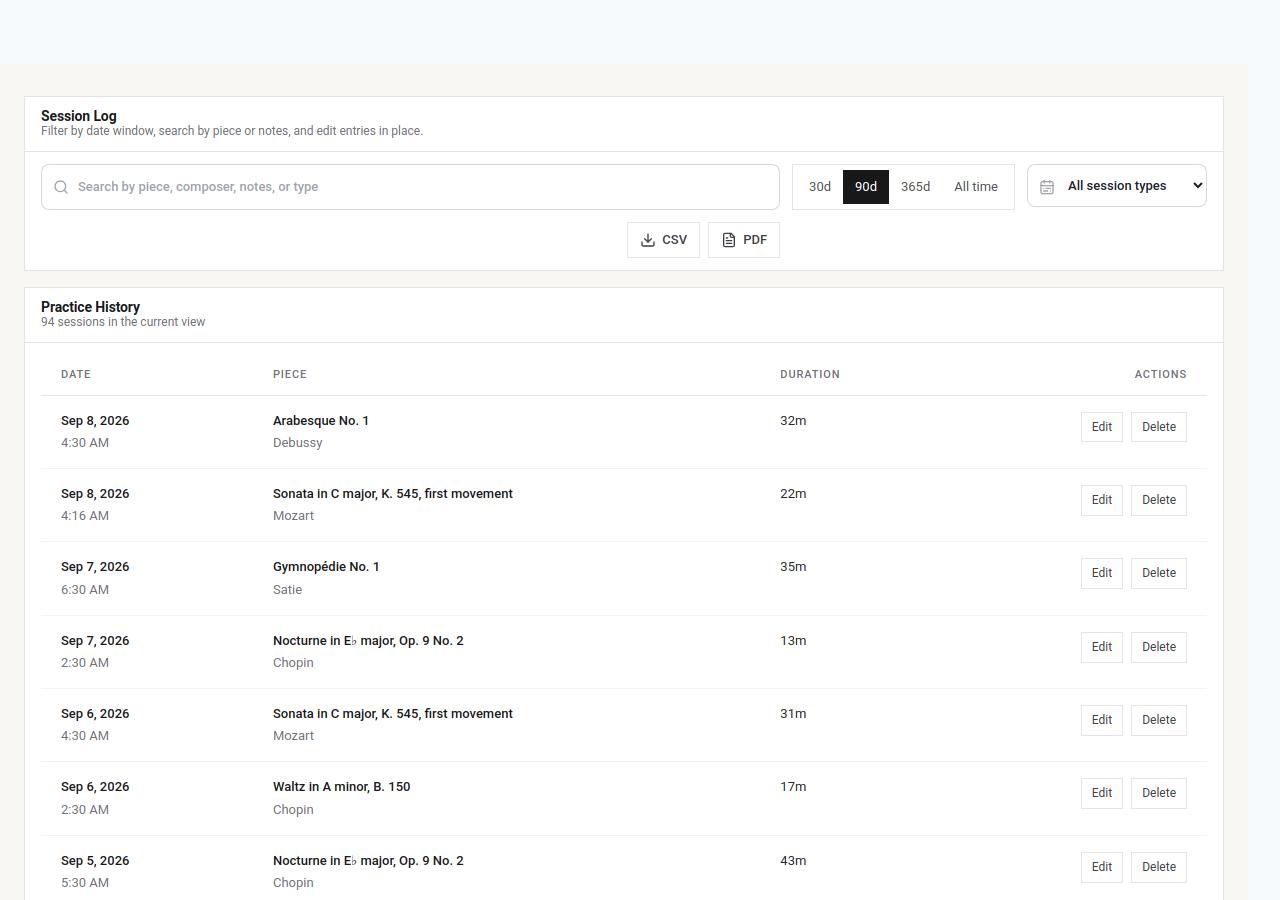
The CSV and PDF buttons export the currently filtered results across all pages. They do not export just the rows visible on screen. This makes a focused history useful for a lesson: find the relevant instrument or piece, check the dates, then export.
CSV includes the piece title, date, duration and notes, among other fields. There is no separate instrument column. Your prefix remains in the Piece column, where you can filter it in a spreadsheet if you want instrument-by-instrument totals. For an exact calendar week or month, export a wide enough date window and narrow the dates there.
Before a review, look for the latest specific observation on each instrument and whether you tried the next task it suggested. If the difficulty is actually keeping several pieces moving within one instrument, our separate guide to tracking multiple pieces covers that part of the job.
Add another instrument without rebuilding your diary
An established piano log does not need to be emptied when you start violin or guitar. Keep its existing history. Add clearly named entries for the new instrument and adopt the prefix convention for new repertoire from here onward.
If an older title contains sessions from both instruments, keep that ambiguity in mind when reviewing it. You can start separate entries now without copying the old minutes into both of them. For an older piece that has always belonged to one instrument, searching its full title remains useful even if it has no prefix.
Start with the material you are actually playing this week. After a few sessions, check whether you can find the latest note for either instrument without opening the other one's entries. That is a practical test of whether the organisation is helping. You should be able to sit down, read what happened last time and get on with the next attempt.


