A lot of musicians now have two jobs. One is the old one: practice, write, rehearse, record, perform, get better. The other is newer and much harder to see when people talk about "just posting more": film the clip, cut it, caption it, publish it, reply to people, watch what happened, and then do it again before the platforms cool off.
This is not vanity. It is a rational response to how music is discovered now. On February 13, 2025, TikTok and Luminate said U.S. TikTok users were 74% more likely to discover and share new music on social and short-form video platforms than the average short-form video user, and that 84% of songs entering the Billboard Global 200 in 2024 had gone viral on TikTok first. If discovery is happening there, musicians will go there.
The problem is what the work does to the practice room. The hours do not just split neatly in half. Content work leaks into music work. It changes what feels worth practicing, what feels urgent, and what still seems worth doing when the camera is off. That is the real rise of the content musician: not a musician who posts, but a musician whose growth now has to compete with the demands of staying visible.
Why becoming a content musician is a rational move
If you want to be found, the incentives are obvious. Social platforms are no longer a side channel for music. They are part of the main route people use to discover artists, songs, and personalities. That was already visible when we wrote about why music schools are losing students to YouTube, and the numbers have only made the point harder to ignore.
Pew Research Center's February 2025 analysis of TikTok creators shows what visibility looks like from the creator side. Creator accounts made up 52% of the accounts followed by the U.S. adult TikTok users in Pew's sample. The most popular creators posted multiple times per week on average, and the median creator with 1 million or more followers had produced 777 posts over the life of the account, compared with 154 for creators under 10,000 followers. That does not tell you how to build a music career. It does tell you what the platforms appear to reward: volume, regularity, and ongoing self-presentation.
There is also a deeper cultural shift here. Nancy Baym has spent years describing artist-audience interaction online as relational labor: the work of staying present, reachable, legible, and emotionally available enough to keep a fan relationship alive. That matters because "post more" is not just a marketing instruction. It is an instruction to turn yourself into part musician, part editor, part on-camera personality, part customer-service desk.
74% more likely
TikTok said U.S. users on the platform were more likely to discover and share new music on social video platforms.
84% of chart entries
TikTok and Luminate said most songs entering the Billboard Global 200 in 2024 had gone viral there first.
777 posts
Pew found the median creator with 1M+ followers had produced 777 lifetime posts and posted multiple times per week.
30% low wellbeing
Help Musicians found 30% of surveyed UK musicians reported poor mental wellbeing, with low earnings and portfolio pressure in the background.
Seen from that angle, the content musician is not an ego problem. It is a labor-market adaptation. If attention increasingly arrives through clips, feeds, short-form personality, and platform-native storytelling, musicians will keep reallocating energy toward those forms even when they know it comes at a cost.
What posting competes with is not just time
The obvious cost is hours. But the more damaging cost is mental shape. Good practice usually needs monotony in the best sense: repetition, narrow focus, tolerance for boring fixes, and enough privacy to sound rough while you are working something out. Content work tends to demand the opposite. It pulls you toward presentation, immediacy, clean takes, and a constant low-level awareness of how the thing will look once it leaves the room.
YouTube's own creator guidance now states bluntly that being a creator is "not like a typical job" and describes it as an around-the-clock effort. The same guidance assumes creators juggle multiple tasks, recommends batching shoots and edits, and treats burnout as a normal enough risk that creators should actively build boundaries against it. That is revealing. Even the platform knows the job is sprawling.
Musgrave and colleagues make the music-specific version even clearer in their 2025 paper "Working in the content factory". Interviewing working UK musicians, they found that social media could help with networking, inspiration, and career building, but also produced harmful comparison, abuse, algorithm uncertainty, and a felt need to share more and more, to the point that it risked displacing valued offline activities. That last phrase matters. For musicians, one of the most valuable offline activities is obvious: practice that is not being performed for a feed.
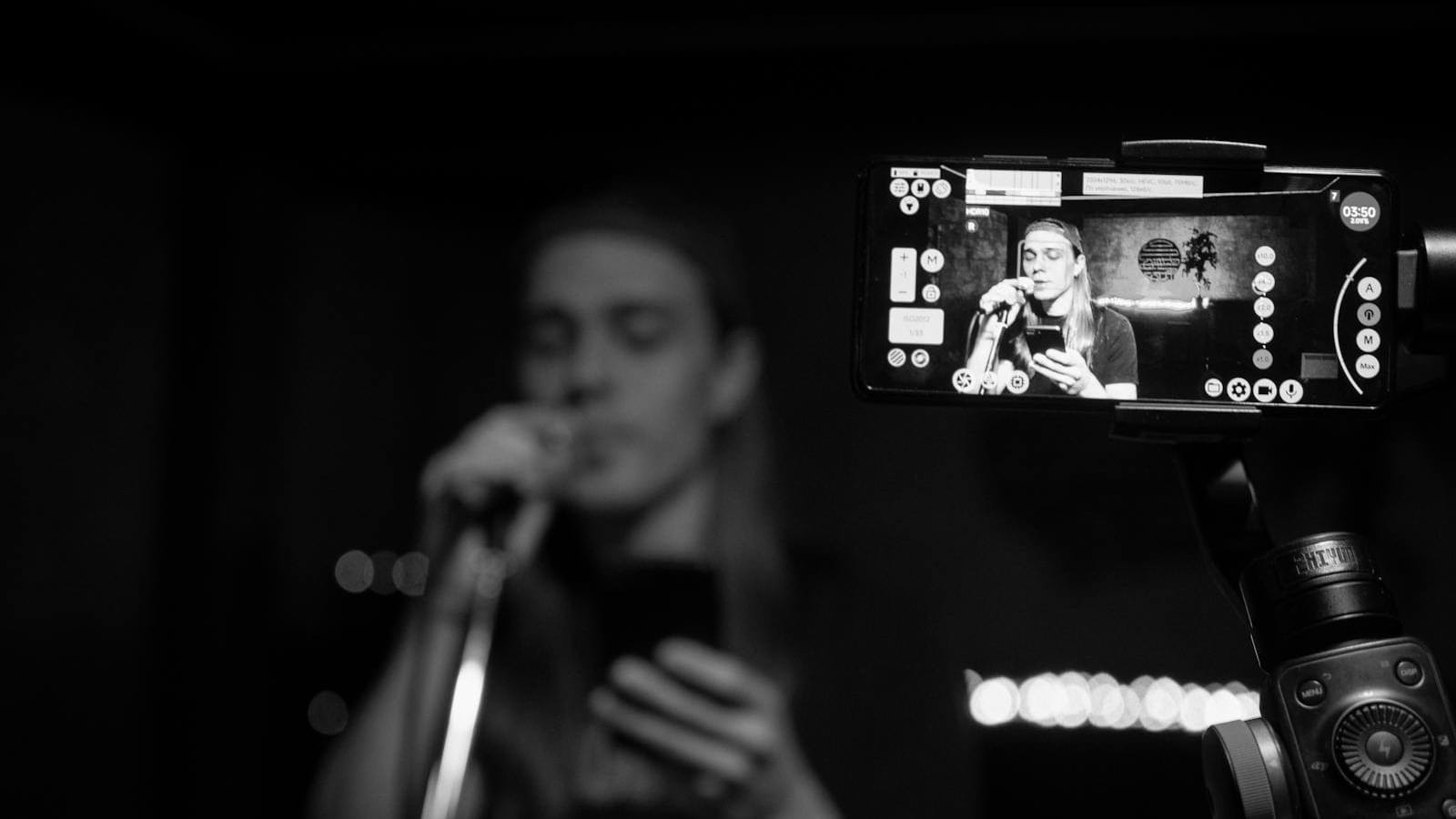
That is why the damage often arrives before burnout becomes dramatic enough to name. A practice session gets interrupted by setup. A take gets repeated because it was musically fine but visually dead. The edit happens right after the session, so the brain never actually leaves production mode. Then comments and metrics pull attention back later. By the end of the week, the musician has not merely spent time posting. They have spent the week organizing their music around postability.
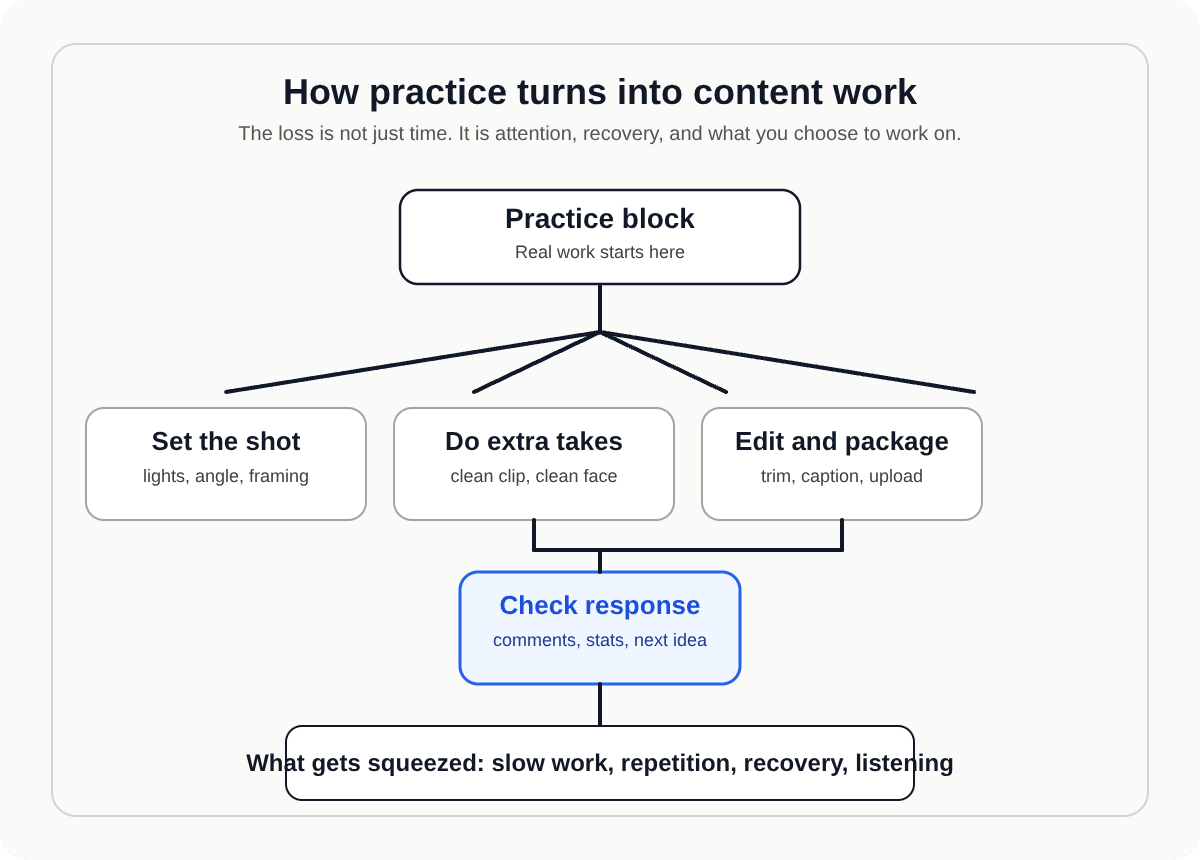
The clearest warning sign is not "I spend a lot of time online." It is "my best practice energy now goes to packaging, not improvement."
This is also why public complaints from artists have felt so familiar. In May 2022, Halsey told Entertainment Weekly that their label wanted a fake viral TikTok moment before releasing a song. The details of any one artist-label conflict will vary, but the underlying pressure is recognizable. The system keeps telling musicians that visibility is part of the work now. For many people, it is. The problem is that the work expands until it starts eating the craft it was supposed to support.
Once the camera enters the practice room, the practice room changes
Not all musical work survives the camera equally well. Slow correction does not. Ugly first attempts do not. Ten minutes on one transition does not. Rebuilding a fingering, sitting with intonation against a drone, or repeating one rhythmic cell until it stops wobbling all make sense to musicians, but they are weak content unless you already know how to narrate them. A flashy excerpt, a polished chorus, a satisfying before-and-after clip, or a neat overhead shot of fast hands translates much better.
That matters because what gets rewarded starts steering what gets practiced. The musician does not have to become cynical for this to happen. It is enough that the feed gives immediate proof of life while slow technical work does not. The exact same dynamic sits behind why full-piece run-throughs feel productive even when they are weaker practice than isolated repair work, which is why our piece on why isolation practice works better than full run-throughs keeps landing with readers. The camera makes the performance-looking version even more tempting.
It can also flatten repertoire choices. You start favoring material with instant payoff, visible motion, or recognizable hooks. You spend less time on harder-to-show work that actually changes the instrument under your hands. That is one reason the aesthetics in our piece on piano ASMR on YouTube matter: once a format proves it can convert clean mood clips into attention, the music itself starts bending toward what the format can easily digest.
| If the week is music-first | If the week is content-first | What quietly gets lost |
|---|---|---|
| Material is chosen because it exposes a real weakness or develops a real skill | Material is chosen because it clips well, reads fast, or flatters the performer on camera | Long-term technical growth |
| Bad takes are useful evidence | Bad takes are waste unless they can be turned into a post | Freedom to experiment |
| Stopping on one bar for ten minutes feels normal | Stopping on one bar for ten minutes feels visually dead | Deep correction |
| Success is better control, better listening, better recovery under pressure | Success is reach, retention, saves, comments, or a clean-looking clip | A stable definition of progress |
That does not mean musicians should hide from the internet. It means they need to notice when practice stops being designed for growth and starts being designed for proof. Those are different activities. They can overlap. They should not be confused.
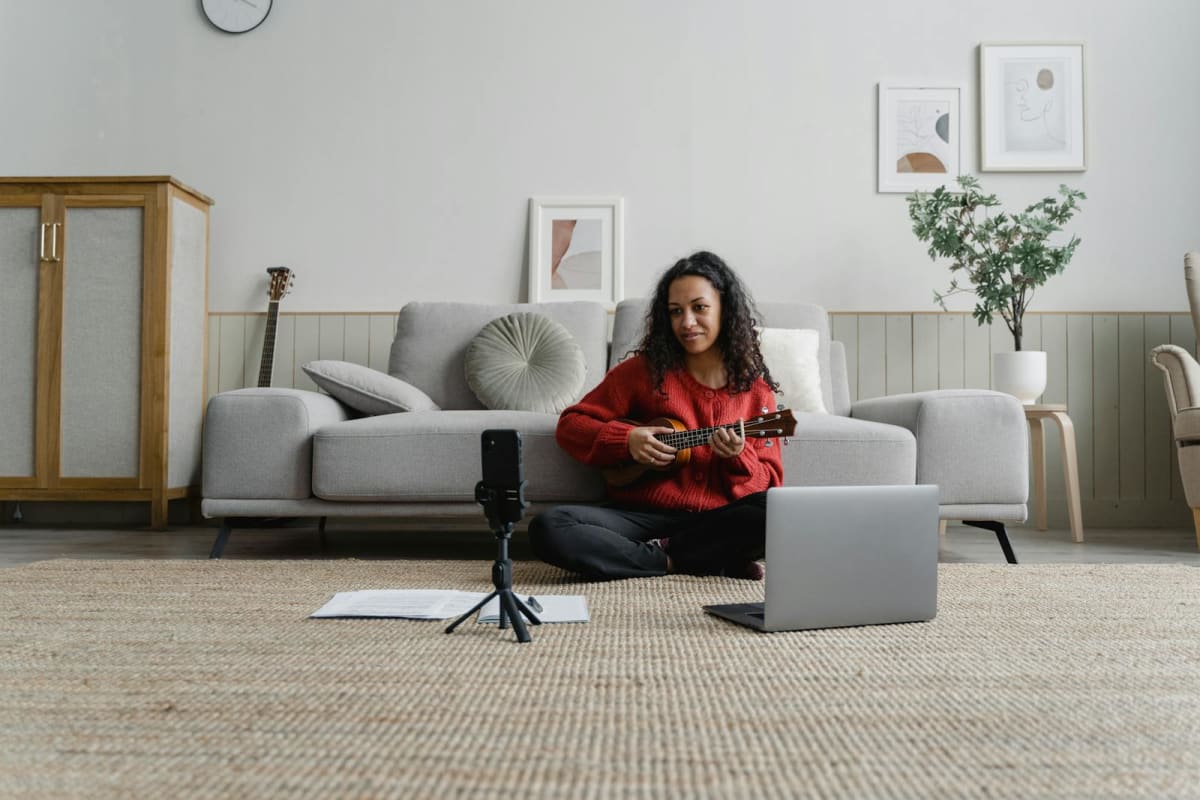
Photo: Tima Miroshnichenko via Pexels
The fix is not to quit posting. It is to separate music work from creator work
The sanest answer is not purity. Most working musicians cannot afford that, and many should not want it. Posting can absolutely help people find the music, trust the musician, and stay connected over time. The fix is structural: stop pretending the two jobs are the same job. Music work and creator work should inform each other, but they should not share one undifferentiated pile of time and attention.
That usually means batching and limiting. YouTube's own burnout guidance recommends planning shoots to allow bulk filming and editing, setting reasonable task limits, and deciding how much time you will spend on comments before the work expands on its own. Those are creator tactics, but they help musicians precisely because they fence the creator role off from the practice role. The point is to keep posting from taking the best hours by default.
1. Make
Protect camera-off sessions
Keep most practice blocks offline. Let them be ugly, repetitive, and unshareable if that is what the work requires.
2. Capture
Film after real work
Use the camera to document a session that already happened, not to turn the whole session into a performance.
3. Publish
Batch the admin
Edit, caption, schedule, and reply in contained windows so the platform does not keep reopening the workday.
If you have a full-time job, this separation matters even more. We already argued in how to learn an instrument when you have a full-time job that adults improve by reducing friction, not by pretending they have infinite energy. Content work is friction. Useful sometimes, necessary sometimes, but still friction. Treating it as free is how it quietly wipes out the little bit of focused capacity you actually had for practice.
One simple rule helps: never let content be the reason you skip the slow work. If you still have time to post but no time to listen back, isolate a weak passage, rebuild a fingering, or sit with a tone problem, the balance is already off. That same imbalance also feeds the cycle described in our pieces on musician burnout and why musicians struggle to take breaks. The work starts to feel endless because it is no longer bounded by the actual act of making music.
The rise of the content musician is real. But the best musicians online are not the ones who confuse posting with progress. They are the ones who build enough structure that the post still serves the practice, instead of replacing it.