From 1 January 2027, under current US law, the identified 1931 words and music of As Time Goes By and All of Me will be in the US public domain. Musicians can use that original material for their own arrangements, performances and recordings in the US without permission from the expired song copyright. A recent arrangement or somebody else’s recorded performance is a separate matter.
That distinction determines what you can actually make. A duo recording its own version, a teacher distributing a new student arrangement and a creator putting an existing jazz recording under a video may all be using the same song title, but they are using different material. This guide follows those projects through the decisions that matter.
What the change lets you make
Public domain is useful because it allows new musical decisions. You can devise an introduction, change the instrumentation, write an accompaniment, transpose the original material and make your own recording. You can also distribute your own edition of the public-domain material in the US, including commercially. The original song does not become yours exclusively; your own copyright, if any, covers the new protectable contribution.
Here are four examples for after the January rollover. They assume US use of the identified original material, with no unlicensed later arrangement or recording included.
| Your project | What you can build from the old song | What remains separate |
|---|---|---|
| A voice-and-piano recording | Your own accompaniment, interpretation and newly recorded performance | Any later arrangement you copy, plus the performers’ and producer’s agreements for the new recording |
| A student ensemble score | Your own parts for the instruments and players you have | Photocopying a current publisher’s arrangement or redistributing its downloaded PDF |
| An arrangement you sell | Your independently created edition and any original added writing | Later authorship borrowed from another edition, and rights in countries outside the US |
| Music for a video | Your own performance of the public-domain song, recorded for the project | An existing recording, backing track, film clip or other third-party material |
The Copyright Office’s guide for musicians explains why a musical work and a sound recording are separate works. The old song can become available while a particular performance of it remains protected. A public-domain composition also does not guarantee that a distributor will accept every proposed release; its submission terms and the territories you select still matter.
Why these two songs qualify in 2027
The US term for the material identified here runs for 95 years from the year copyright was originally secured, ending with the calendar year under sections 304(b) and 305. For these 1931 registrations, that reaches the end of 2026. Both songs also have matching renewal entries in the Copyright Office’s 1958 catalogue.
| Song | Original record | Renewal evidence |
|---|---|---|
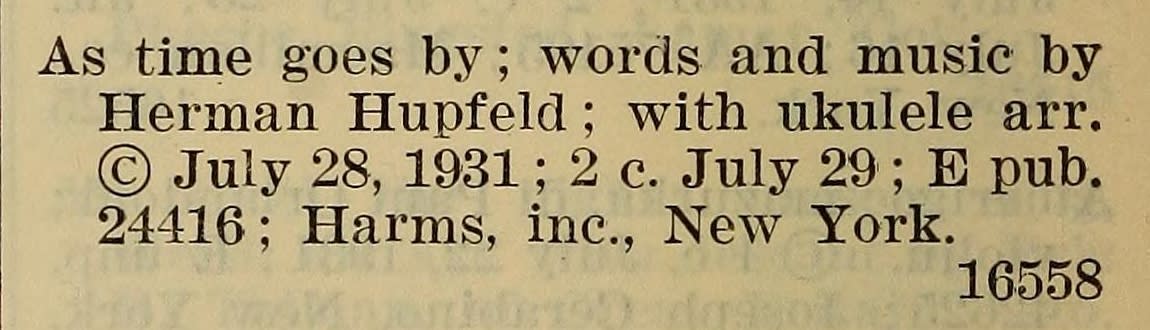
| As Time Goes By Herman Hupfeld | Published entry dated 28 July 1931, Harms, including a ukulele arrangement. 1931 catalogue, page 852. | Two entries refer to that original registration. 1958 catalogue, page 1717. |
| All of Me Seymour Simons and Gerald Marks | Unpublished registration on 30 September; published entry on 27 November, Irving Berlin, Inc. Page 1092 and page 1339. | Four entries cover the unpublished and published registrations. 1958 catalogue, page 1715. |
The As Time Goes By entry names the words and music, Hupfeld, the publisher and the July 1931 date. A later film appearance, album release or digital reissue is not the date that determines the term of this original song.
This is a US conclusion about the identified material. Different countries can apply different terms and rules. A worldwide upload or score sale needs a territory check; the US date alone does not establish that the same material is public domain everywhere.
Example: build your own All of Me duet
Imagine a singer and pianist planning a short January recording. They want a version they can shape themselves, rather than a recreation of a favourite artist’s track. A lead sheet is a useful working format because it gives the melody and chord symbols without prescribing every note of the accompaniment. The source still needs checking for later additions before it becomes the basis of a distributed arrangement.
Start by choosing the singer’s key. Sing through the full melody before arranging an elaborate introduction; a comfortable opening does not guarantee a comfortable high point later. Then agree on the form of this particular performance. The following is an original project plan, not a transcription of an existing recording:
- A short piano introduction. Create a two- or four-bar introduction that establishes the tempo and gives the singer a dependable entry. Write down its ending so the pickup is not a different guess on each take.
- The first statement of the song. Keep the accompaniment sparse enough for the melody and words to remain clear. Decide whether the piano fills spaces between phrases or leaves them open.
- An instrumental passage. Let the piano take a complete pass through the agreed form, or choose a shorter passage and mark exactly where the singer returns. Either can work; both players need the same plan.
- A shared ending. Agree whether to keep the pulse, slow down, repeat a final phrase or stop after a written tag. Rehearse the last phrase with that ending attached.
The first rehearsal recording may reveal that the introduction is too long, the piano fills obscure the singer’s breath, or the return after the instrumental passage is uncertain. Each is a concrete arranging problem. Fixing one of them produces a more useful second take than asking both performers to “make it more jazzy.”
For the eventual release, keep a copy of the source you used and the arrangement you created. Record all the sounds yourselves, and agree how the two performers’ contribution and the resulting recording may be used. If you bring in a commercial backing track instead, its licence becomes another part of the project.
A new arrangement does not make the old song private again
Suppose another pianist publishes an As Time Goes By arrangement with a newly composed introduction, an elaborate accompaniment and an original ending. The song’s US expiry does not give everyone permission to lift those additions into their own editions.
At the same time, the arranger cannot claim ownership of Hupfeld’s public-domain words and music merely by printing a new copyright date. Under section 103(b), protection in a derivative work covers the new author’s contribution and does not extend the underlying material’s term.
The distinction is practical when two versions sound similar. Following the original melody is different from copying a later arranger’s distinctive added passage. If your aim is an independent arrangement, begin with a source for the original material and make your own decisions about texture, introduction and ending.
Nor does a fresh typesetting automatically make every old note newly protected. The Copyright Office’s guidance on derivative works requires new copyrightable authorship. A recent edition may contain that authorship, but the date on its cover is not enough to tell you exactly what it protects.
Example: a music-school ensemble with uneven experience
Consider a school with a confident singer, a developing pianist, a melody instrument and a bass player. A published arrangement for a different ensemble may be too dense or put an essential line in the least confident player’s part. The public-domain song offers a basis for writing parts that fit this actual group.
For an original As Time Goes By arrangement, the singer could carry the first statement while the pianist supplies a simple accompaniment. The melody instrument could join later, take a separate statement or add a short answering figure you compose. The bass part could begin with a deliberately limited role, then become more active where the player is secure.
Make the musical decisions visible in the parts. Label the introduction, mark the singer’s entry, give the resting players a useful cue before they return, and write a common ending. If the pianist’s part changes after rehearsal, update the other copies wherever their cues depend on it. Our guide to sharing annotated ensemble scores addresses that version problem.
The copying question remains separate. Buying one contemporary arrangement does not automatically allow a school to scan it for every student. Teaching is not, by itself, blanket permission to reproduce a publisher’s file. An independently created set of parts from the public-domain source, with the school’s own added writing, is a different proposition from distributing somebody else’s arrangement.
If the school records or films the concert, settle the performers’ permissions and the intended use as well. The song’s status does not replace consent for featuring students or an agreement about the school’s new recording.
Choose a working score without confusing it with the historical source
For As Time Goes By, Alfred sells a digital piano/vocal/chords score. That format is worth considering when you want a written accompaniment alongside a vocal line. For All of Me, Sheet Music Direct sells a one-page Marks–Simons lead sheet, published by Hal Leonard, with interactive and PDF versions advertised.
The lead-sheet preview shows a melody staff, lyrics and chord symbols rather than a fully written piano part. That leaves the pianist to choose voicings, rhythm and spacing. A player who needs both hands written out should choose an appropriate piano arrangement instead. Our lead-sheet versus piano-arrangement guide explains the difference.
Prices checked 16 November 2026: Alfred lists US$2.95; Sheet Music Direct displayed €4.49. These are individual digital purchases. Currency and applicable tax depend on your location; check the checkout total.
These are legitimate ways to obtain rehearsal music, not verified facsimiles of unchanged 1931 editions. Inspect the key, contents and preview before buying. A familiar song title does not tell you whether a score includes an introductory verse, a particular accompaniment or later additions. Buying the download does not itself grant permission to redistribute that file.
For historical editions, the Mississippi State records for Hupfeld’s song and Simons and Marks’s song provide bibliographic references. They currently display copyright restrictions; they are not being offered here as free score downloads. The Library of Congress’s guidance on using collection material likewise distinguishes access to an item from permission for a particular reuse.
Example: your own video versus somebody else’s recording
A pianist records an original arrangement of the public-domain song and uses that new performance in a US teaching video. The music and recorded sounds come from the pianist’s project. A second creator takes a commercial jazz recording of the same song and places it underneath a montage. The second creator is using someone else’s recording, even though the underlying song has the same public-domain status.
That difference remains if the borrowed recording is slowed down, has its vocal removed, or appears for only a few seconds. The Copyright Office cautions that there is no fixed minimum amount of music that is automatically free to use. A permitted use needs its own basis; the song’s expiry does not supply one for every recording of it.
Even a recording first published in 1931 has a different timetable. For recordings first published from 1923 through 1946, section 1401 provides 95 years followed by five more years. A recording actually first published in 1931 therefore follows a term calculation through the end of 2031, rather than the end of 2026.
The Copyright Office’s pre-1972 guidance explains those separate periods. Do not assume that a track labelled “1931” establishes its first-publication history. A reissue date, performance date and recording’s original publication date can describe different things.
Why a “1931 songs” list can still get the date wrong
Dream a Little Dream of Me supplies a useful counterexample. The 1931 catalogue’s page 25 lists an unpublished registration dated 29 December 1930, followed by a published entry dated 8 January 1931. The latter also identifies a ukulele arrangement by Roy Smeck.
Those entries do not justify calling the entire underlying song newly public domain in 2027. Under the earlier system, an unpublished work could secure federal copyright through registration before publication. A subsequent edition does not simply restart the term of material already protected.
That is why it is absent from the two-song selection here. If you find another attractive title on a 1931 list, establish the history of the material you plan to use rather than relying on the date beside its name. Then distinguish that material from any later arrangement and recording.
Keep enough information to identify your version
For a small project, a short note can hold the essential decisions: the song and original writers, the source edition, what you added, who performed, who recorded it and where you intend to release it. That note is also useful when a collaborator returns a month later and asks which introduction the group finally chose.
Example project record: As Time Goes By, words and music by Herman Hupfeld. New voice-and-piano arrangement with our own introduction and ending. Source edition retained with the project. Both performers recorded for this release; no third-party audio. US release planned after 1 January 2027. Other territories to be checked separately.
This is a practical record, not a permission document. It makes the remaining questions visible and helps the credits match what the group actually made. A suitable credit can name the original songwriter and identify your arrangement and performers without claiming ownership of the underlying public-domain song.
Once the version is settled, make a complete rehearsal take. Listen for the agreed musical details: whether the introduction prepares the entry, whether the accompaniment leaves room for the melody, and whether the ending is shared. Our guide to listening back to your own recording can help keep that review specific. The point of the new freedom is to make a version worth hearing.
Featured photo: historic sheet-music pages by Buchkiste / Pexels. Illustrative photograph; the pages do not depict the two songs discussed here.