A thirty-song list arrives, and you recognise most of the titles. That is encouraging until the band starts one in a different key, waits another two bars before the lead enters and finishes with a stop you have never practised. Preparing the gig begins with finding those differences while there is still time to agree on them.
Ask for the band's actual versions, then prepare your part in each arrangement. Give early attention to missing decisions and changes that affect several players. A difficult fill may need more individual practice, but an undecided ending needs an answer from the band.
Find out what the thirty-song list actually means
Before dividing your practice time into thirty equal portions, ask how the list will be used. Are all thirty songs scheduled, or are some reserves? Is the order settled? Are you replacing a regular player whose part should stay recognisable, or helping the group build new arrangements? The answers change both what you prepare and what you need from the bandleader.
Ask for a reference that identifies the performance, not just the song title. A rehearsal recording can be more useful than a polished studio release if it contains the group's actual intro and ending. If the reference is a commercial recording, confirm which differences the band has agreed. A live version, radio edit and album track can leave different routes through an otherwise familiar song.
Patrice Williamson's Berklee setlist lesson recommends keeping key, metre, tempo and style with the repertoire, then discussing entrances, solos, returns and endings. Those details turn a playlist into something the group can prepare. For a substitute player, Guido Spannocchi's gig-etiquette advice likewise starts with asking for parts or a setlist and becoming familiar with the material beforehand.
Keep the information close to the chart or notes you will actually use. A key change buried in yesterday's conversation can be missed by the player who downloaded their part earlier. If the answer is still unknown, write a precise question: “Does the lead enter after two bars or four?” is something the bandleader can settle.
Five songs that deserve different kinds of work
Consider a fictional assignment of two 45-minute sets: twelve scheduled songs in each, with six more listed as possible reserves. The downloadable register has all thirty positions filled with invented working titles and planning values. It is a model to replace with your band's real material, not a recommended repertoire list or evidence of a band we tested.
| Song in the example | What is unresolved | Useful next action |
|---|---|---|
| P01 · Station Lights | The individual part is familiar; the group entry and release have not been tried. | Check the drummer's count-in and the final release together. |
| P03 · Paper Satellites | The player prepared C, but the singer and band have agreed D. | Prepare the D part and confirm its starting pitches. |
| P04 · Borrowed Sun | The singer is unavailable for this number. | Propose reserve P27, Side Door, and get the whole band's agreement. |
| P07 · Short Walk | The old chart gives two intro bars; the current arrangement gives four. | Correct the chart and rehearse the actual entry. |
| P10 · City Glass | The reference fades; nobody has settled the live ending. | Agree an ending before practising an imagined one. |
Download the fictional thirty-song register · Download thirty blank positions. CSV files open in spreadsheet software. Durations are planning assumptions, not measured performances.
These are different problems. Playing City Glass five more times alone will not resolve the band's ending. Repeating Paper Satellites in C makes the wrong version more comfortable. Meanwhile, Station Lights may only need a short check with the drummer before the group can move on.
Make your first pass through the list an investigation. For each number, identify the version, your job and the most likely point of confusion. Then separate work you can do alone from an answer or cue somebody else must provide. The result should be a short set of specific tasks, not thirty identical reminders to “practise more.”
Try the difference between two arrangements
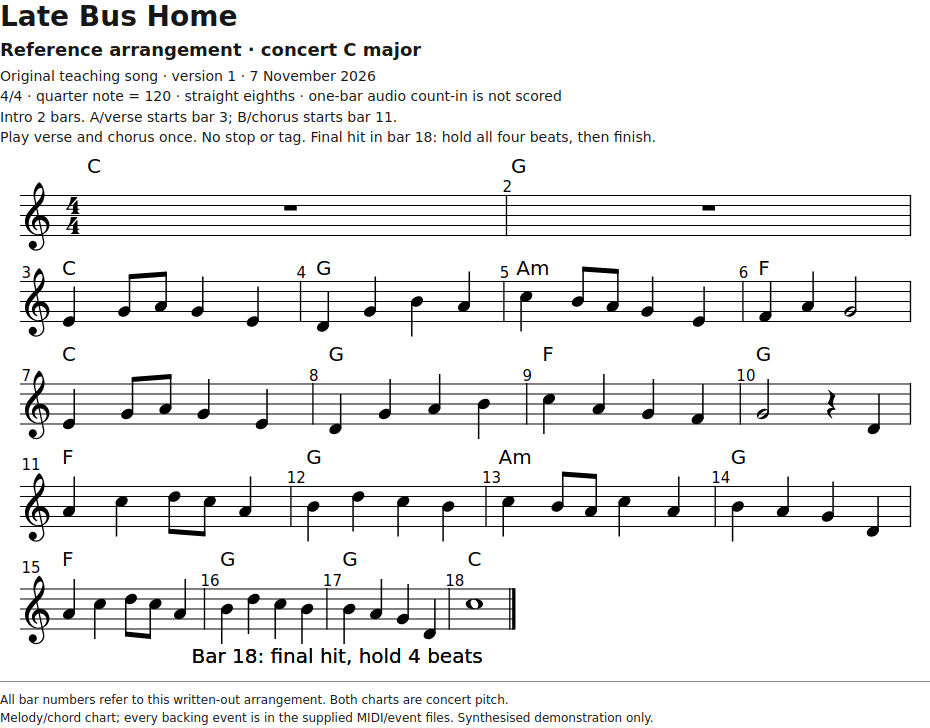
Late Bus Home is a short original teaching tune with two arrangements. It is separate from the thirty fictional working titles above. The recordings use synthetic melody, chords, bass and percussion at quarter note = 120 in 4/4, with straight eighth notes. Each starts with a one-bar count-in; that count-in is not included in the score's bar numbers.
The C reference has a two-bar instrumental intro, an eight-bar verse and an eight-bar chorus. The lead enters at arrangement bar 3. The final chord is held for four beats. Follow that version once with its score, paying particular attention to the first lead entry and the end.
The fictional band's agreed D arrangement adds two intro bars, transposes the tune up a whole tone and changes two places later on. In the chorus's fourth bar, the band plays beat 1 for one beat and rests for beats 2–4. After the chorus, it repeats the last two bars once; the final chord of that tag lasts two beats, followed by two beats of rest.
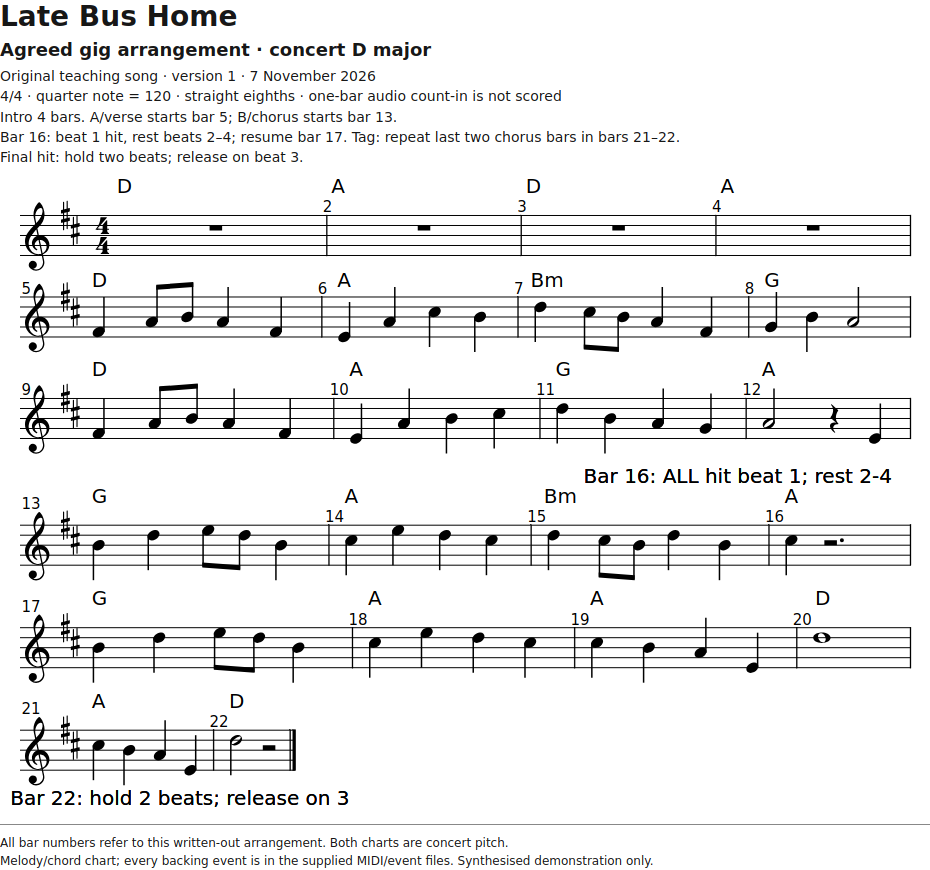
In the D file, the lead begins at 0:10, after the count-in and four intro bars. The chorus starts at 0:26. The short hit is at 0:32, the rest starts at 0:32.5 and the next bar resumes at 0:34. The final tag chord starts at 0:44 and releases at 0:45. These are positions in the generated files, calculated from the programmed tempo.
A player following the C reference's two-bar intro would attempt the D lead entry at 0:06, two bars before the agreed entrance. One who remembers only the original ending could finish before the tag. Both mistakes can happen even when the player knows the underlying sixteen-bar tune.
Compare the two versions with the score first. Then use the D file to check the entry, chorus stop and final release separately before trying the whole arrangement. Count through the rest rather than treating it as an extra pause. The file keeps a fixed pulse; deciding how a real group communicates the return belongs in rehearsal.
The synthetic examples make the written differences explicit. They do not demonstrate live timing, interaction or how any particular instrument should fill the texture. A drummer, singer and chordal player need different information in their own parts. Prepare the part you will actually supply, and agree any cue with the people who must follow it.
Write the arrangement the other players need
A useful arrangement sheet answers the questions that could otherwise stop the rehearsal. For the D version of Late Bus Home, a compact note can be quite precise:
Late Bus Home · D concert · quarter = 120 · straight eighths. One-bar count-in, then four intro bars. Lead starts at bar 5. Verse 8 bars, chorus 8 bars. In chorus bar 4, hit beat 1 for one beat and rest beats 2–4; resume on the next downbeat. Repeat the last two chorus bars once. Final tag chord: hold beats 1–2, release on beat 3. Finish after that bar; no further repeat.
Download both arrangement specifications · Download a blank arrangement sheet. The supplied scores and their bar numbers govern the demonstration.
That note identifies a sounding key. If someone uses a transposing instrument, their written part must also be correct; a concert-key label alone does not prepare it. Both supplied scores are in concert pitch.
Include whatever your part genuinely needs. A melody player may need the melody and a few cue notes. A rhythm player may need chord symbols, rhythm figures and clear section lengths. Someone covering a distinctive instrumental hook needs that actual line. A page that gives only chord names cannot communicate every one of those jobs; our comparison of lead sheets and arrangements explains the difference.
Keep the instructions consistent between the chart and any separate note. “Four-bar intro” beside a score containing two intro bars makes the player decide which document to believe. When the band agrees a change, update the issued part and say what changed. Our post on sharing annotated ensemble parts covers that handoff.
For commercial songs, use parts and recordings you are entitled to access and share. A link to a reference recording is not permission to redistribute its audio or somebody else's chart. The original study here supplies the comparison without borrowing a commercial melody or recording.
Give rehearsal a job that individual practice cannot finish
Arrive with the notes you can prepare alone, and with the remaining questions visible. In the fictional register, that means the keyboard player brings the D part for Paper Satellites, while the bandleader brings an ending proposal for City Glass. The group can then spend its time trying the arrangement rather than discovering that everyone prepared a different one.
The ISM rehearsal guidance contributed by MusicTeacher.com recommends a shared purpose, individual preparation, attention to troublesome sections and work on transitions. Apply that to the actual decisions in front of the group. If two songs both need a stop checked, run the relevant lead-in and return for each, then put the repaired passage back into its song.
Agree who starts and who gives any cue before relying on an unspoken nod. Try the lead-in as well as the isolated difficult bar. A final chord can be easy to play on request and still arrive at the wrong time when the singer adds a phrase or the preceding section is repeated.
A complete run has a different purpose. It exposes a lost place late in the set, a sound change that takes longer than expected, a chart that is awkward to find or an ending that leaves the next player unready. Decide beforehand whether the run should continue through a recoverable mistake. Afterwards, record the song and exact place that needs another attempt, rather than assigning every song the same broad verdict.
Backing tracks can help prepare your part, but the group still needs to try it together. Leo Blanco's Berklee repertoire lesson makes that distinction while discussing work on melody, harmony and form. The stop in our D example is a good place to hear the limit: a fixed file cannot respond to the drummer or show whether everybody saw the same cue.
A forty-five-minute playlist may not fit a forty-five-minute set
The fictional register's first twelve songs add up to 42:30 of planned music. That leaves 2:30 within a 45-minute set for every transition and spoken link. The second set's music totals 42:50, leaving 2:10. Neither number is a measured rehearsal result.
For the first set, suppose each of the eleven gaps between songs takes twenty seconds. Those gaps add 3:40, bringing the set to 46:10 before any opening introduction. You are already 1:10 over. A commercial playlist duration could look comfortable while the band's actual sequence runs long.
Time a complete rehearsal in the intended order, including the things the group actually does between numbers. If a guitar change or keyboard setup interrupts the sequence, decide whether the order, the change itself or the musical plan should change. Do not fix the arithmetic by entering a shorter duration for music that nobody has actually shortened.
The six reserves serve a practical purpose only if the musicians know which ones can substitute for which situations. A slower song, a number with a different lead singer and a familiar opener are not interchangeable simply because each lasts about four minutes. Keep the choices with the bandleader and the actual engagement's requirements.
In the example, replacing the 4:00 Borrowed Sun with the 3:40 Side Door saves twenty seconds of planned music. It does not solve the first set's assumed 1:10 overrun by itself. More importantly, the replacement remains a proposal until every player has the agreed A version, its start and its ending. A song being in the reserve column is not proof that the band can perform it tonight.
Leave the next rehearsal with a usable list
Keep one current song order and make each musician's next action specific. “Learn Side Door in A from the agreed reference; check the lead entry and final release” gives a player something to complete. “New set attached” leaves them to discover what changed.
Our Practis web app can hold your repertoire and practice-session notes, and Programs lets signed-in Free users order pieces with entered durations, headings and breaks. For newer Free accounts, the collection limit is five pieces in total; Pro removes that limit. Older Free accounts can be exempt. A larger working collection is the relevant distinction for a thirty-song project; Programs itself is already available on Free.
Keep the band's arrangement agreement in the shared chart or separate sheet. The current planned-programme editor is not a place to save arrangement notes, and a personal practice record does not tell you that the other musicians accepted a change. Use the diary for what you attempted and what needs another session, then confirm the band's decision through the channel the group actually uses.
Before the next rehearsal, resolve the questions that would make people prepare incompatible versions. Then practise the entry, stop, transition or passage that is yours to fix. When the set is ready for a continuous run, play it in order and measure what actually happens.
Featured photograph: RDNE Stock project / Pexels.