

Equal time for every piece is usually the wrong answer. It feels fair, organized, and responsible, which is exactly why so many musicians default to it. But when every piece gets the same amount of attention, every piece also tends to get the same shallow kind of attention. You touch everything, feel busy, and still finish the session with the nagging sense that nothing really moved.
That is not because learning multiple pieces is a bad idea. It is because multi-piece practice needs a system. One piece should get the hardest thinking. One may only need to keep moving. Another may only need a short maintenance check. Once those roles are clear, the session stops feeling chaotic and starts feeling strategic.
Research on practice scheduling points in the same direction. In a 2016 study, Christine Carter and Jessica Grahn had 10 clarinetists practice repertoire in either blocked chunks or an interleaved schedule. The interleaved condition alternated pieces in 3-minute rotations rather than 12-minute uninterrupted blocks, and the players later showed better retention trends and reported benefits for focus, goal setting, and mistake identification. That does not mean you should switch pieces every sixty seconds. It does mean the “finish one piece completely, then maybe glance at the others” model is not always the smartest one.
Stop giving every piece the same status
The first fix is conceptual. Pieces are not interchangeable units of moral obligation. Each one is in a different phase, asking for a different kind of work. If you treat a brand-new piece, a nearly polished piece, and a maintenance piece as if they all deserve the same practice block, your schedule will feel tidy and your results will feel muddy.
Eleonora Concina’s review of metacognition in music performance describes effective practice as requiring musicians to plan, monitor, and regulate learning activity toward specific goals. That sounds abstract until you apply it here. The goal of a new piece is not the goal of a recital piece. The goal of a maintenance piece is definitely not the goal of either of those. Once you accept that, equal-time scheduling starts looking less fair and more lazy.
What works better is piece categorization. Give each item a role before the session begins. A primary piece gets the deepest work. A secondary piece still moves, but under a narrower goal. A maintenance piece gets checked and preserved, not rebuilt from scratch. This is closely related to the triage logic in how to keep a piece alive after you’ve learned it, but here the point is broader: multi-piece practice only becomes manageable once roles replace guilt.
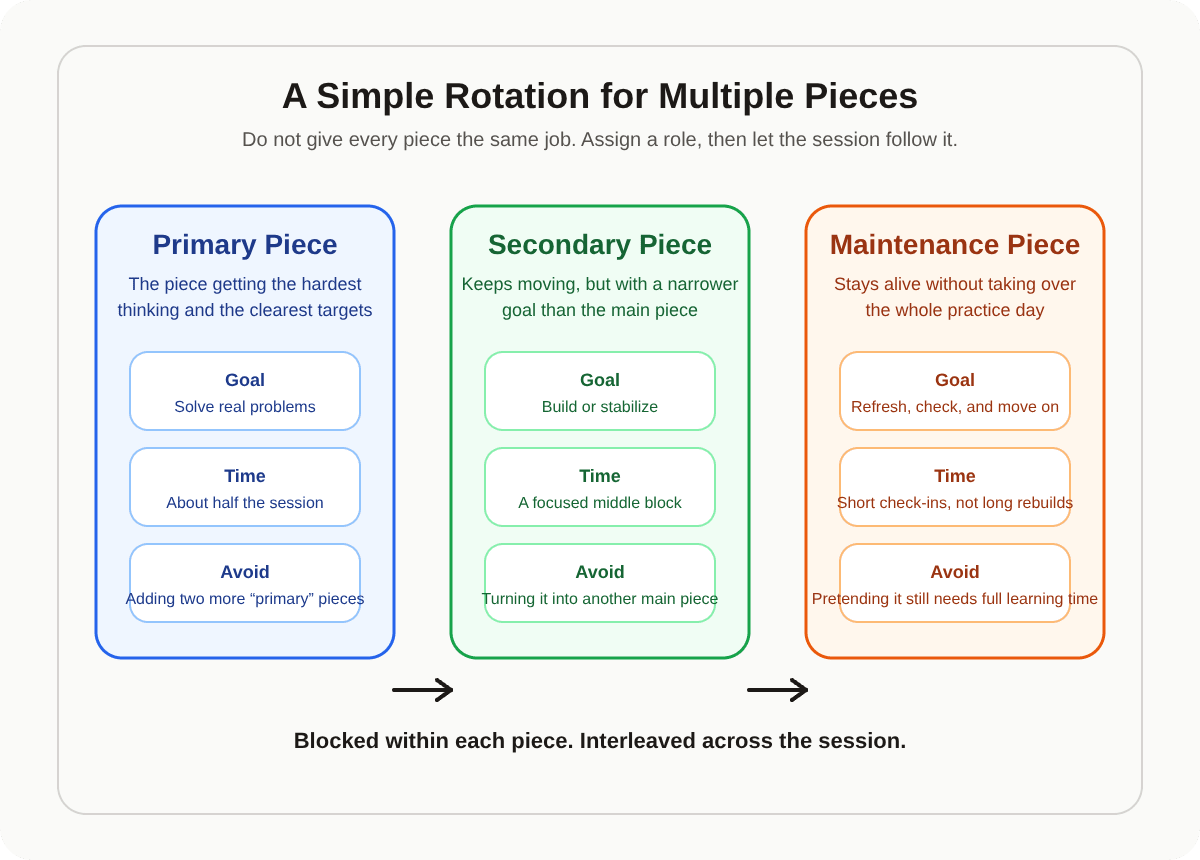
The moment every piece becomes “equally important,” none of them is being practiced with enough clarity.
Use blocked practice inside the piece, and interleaving across the session
This is the part people often muddle. They hear that interleaving helps and assume they should constantly hop between tasks. That is not the useful takeaway. You still need focused, blocked work inside each piece. If a passage is failing, you usually need a coherent block of time to diagnose it, test a strategy, and get several meaningful repetitions. What changes is the shape of the larger session.
Carter and Grahn’s clarinet study is valuable because it models a realistic version of interleaving in music. Participants did not alternate every few seconds. They worked in 3-minute rotations, which is long enough to achieve something inside a piece and short enough to keep the whole session from hardening into tunnel vision. The interleaved schedule did not merely shuffle attention randomly. It created productive returns.
That fits two broader learning ideas. The first is contextual interference: changing tasks can feel worse during practice while still improving later retention. The second is that returning to a piece forces you to reload the plan instead of riding a single warm groove for too long. That is often why a passage feels “great” at minute twelve and surprisingly fragile the next day. You learned the run, not the return.
| Bad version of multi-piece practice | Better version | Why the better version works |
|---|---|---|
| Twenty minutes on Piece A, twenty on Piece B, twenty on Piece C with no role difference | Primary piece, secondary piece, maintenance piece | The session reflects what each piece actually needs |
| Play-throughs from the top every time you return | Blocked problem-solving inside each piece before switching away | You still solve real issues instead of skimming them |
| Touch all pieces every day because you feel guilty not to | Rotate some pieces across days or the week | Attention stays deep enough to matter |
This is also why multi-piece work sits naturally beside what good practice looks like across different instruments. The instrument changes, but the repetition still needs a job. Rotation is not permission to be vague. It is a way of preserving intensity without pretending every piece needs the same thing.
Give each piece a different job
One reason multi-piece sessions become messy is that musicians assign the same goal to every piece: improve it. That sounds fine until you try to do it for four things in forty-five minutes. Improvement is too broad. Better practice happens when each piece has a narrower job for the day.
A new piece might be about mapping sections, fingering decisions, or rhythmic decoding. A middle-stage piece might be about cleaning one technical bottleneck. A late-stage piece might be about continuity, endurance, and musical shape. A maintenance piece might only need restart points and one fast stability check. Those are four different tasks, and they should not look like four identical blocks of “work on it.”
This is exactly why posts like how to start a new piece without wasting the first week and how to keep a piece alive after you’ve learned it exist as separate posts in the first place. The practice behavior that builds a piece is not the same behavior that maintains one. Multi-piece practice becomes much easier once you stop forcing all repertoire into one phase model.
New piece
Goal: decode, organize, and choose. You are building a map, not chasing polish.
Developing piece
Goal: solve one or two true bottlenecks. This is usually where the deepest work goes.
Performance piece
Goal: continuity, consistency, and recovery. Fewer fragments, more usable runs.
Maintenance piece
Goal: refresh and verify. If it needs a rebuild, it probably no longer belongs in maintenance.

Photo: Pavel Danilyuk via Pexels
A realistic session should feel narrower than your ambition
This is where adults, especially, get into trouble. They try to practice multiple pieces in a way that reflects how much they care about them rather than how much time and attention actually exist. The result is a session that feels generous at the planning stage and frantic in the room. By the end, everything has been touched and almost nothing has been advanced clearly.
The fix is not a heroic spreadsheet. It is smaller boundaries. A 45-minute session might look like 20 minutes on the primary piece, 15 on the secondary piece, and 10 on maintenance. A 30-minute session might be 15, 10, and 5. A longer 75-minute session may support two true work blocks and one lighter one, but it still usually does not support five “important” pieces unless some are getting only maintenance-level attention.
This matters because attention is a resource, not just time. Concina’s metacognition review emphasizes organizing time and personal resources, not simply allocating minutes. That distinction is crucial. By minute forty, a tired brain does not give the fifth piece the same quality of thought it gave the first. Your schedule should admit that reality rather than pretending all late-session minutes are equal.
| Session length | Primary | Secondary | Maintenance | Best use |
|---|---|---|---|---|
| 30 minutes | 15 min | 10 min | 5 min | One real work block, one lighter block, one quick check |
| 45 minutes | 20 min | 15 min | 10 min | Good default for two active pieces plus maintenance |
| 60 minutes | 25 min | 20 min | 15 min | Enough space for deeper problem-solving and a real refresh block |
This is also why a sustainable practice routine matters so much here. Multi-piece practice collapses fast when the plan only works on ideal days. A smaller rotation that survives ordinary weeks will produce more real progress than an ambitious repertoire plan that keeps breaking under its own weight.
If every piece still feels stalled, your rotation is too crowded
There is one more hard truth here. Sometimes the problem is not strategy inside the session. It is the number of active pieces itself. If you keep rotating honestly and still feel that nothing is advancing, the answer may be that you are carrying too many active priorities at once.
The warning signs are predictable. You keep re-diagnosing the same passages. Maintenance pieces start needing rebuild work. The primary piece never gets enough uninterrupted thought to move. Every session begins with the question “what even deserves attention today?” instead of with a known opening task. Those are not signs that you need a more complicated planner. They are signs that something needs to be parked.
This is where a practice log or tracker can help in a very direct way. If you repeatedly record the same bottleneck on three different pieces, that is useful information. It tells you the queue is outrunning the available attention. A log like the one described in how to use a practice log without turning it into homework can make that visible without turning scheduling into admin theater.
Multi-piece practice works best when the session looks a little ruthless on paper. Fewer active priorities. Clearer roles. Shorter maintenance. More honest rotation. That may feel less generous at first. It is usually much more effective.


