

Forty-five minutes at the piano can contain four completely different kinds of work, and a piano practice diary that records only “45 minutes” erases the difference. The useful record is not proof that you sat at the keys; it is a handover note to your next session. Done well, it shows whether a plateau needs a new strategy, where a memorized piece can restart, and whether sight-reading has quietly vanished from the week.
A piano hour is not one kind of work
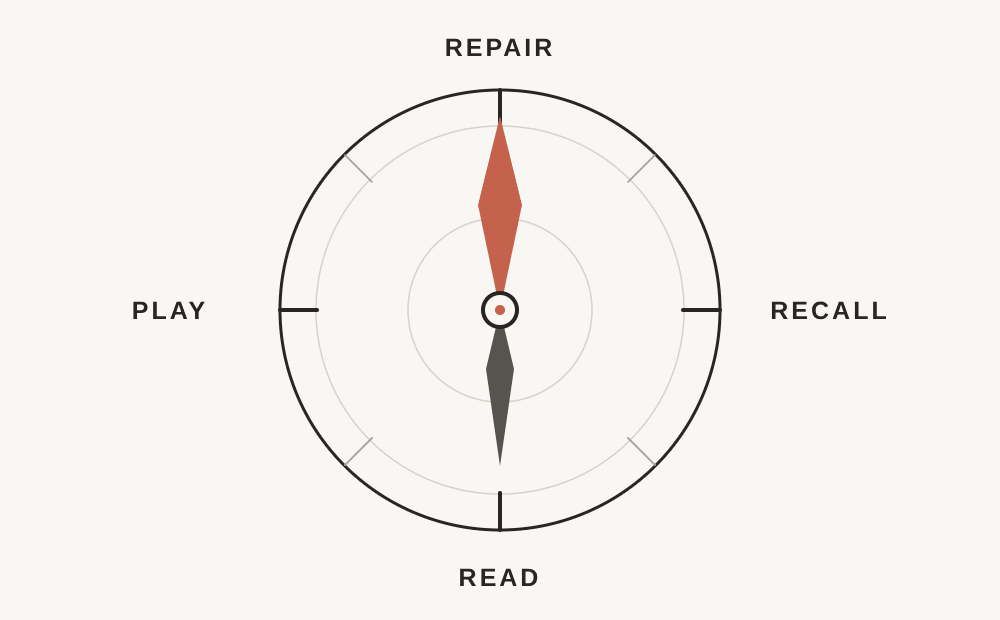
A pianist can spend a session repairing a left-hand turn, building reliable memory, reading unfamiliar music, or shaping a complete performance. All four may involve the same keyboard and the same piece, but they produce different evidence. A clean third repetition of two bars says something about repair. A cold start from the development says something about recall. Keeping the pulse through a new page says something about reading. One uninterrupted take says something about performance.
This is the first job of a piano practice log: name what the time was for. Without that label, a week of serious work can look balanced when every session was actually spent running repertoire from the beginning. The total rises while the weakest ability remains untouched.
A 2025 case study gives this distinction some practical weight. Researchers compared 83 early-intermediate group-piano students: 41 received two class sessions with directed practice worksheets, while 42 rehearsed without them, followed by a week of individual practice. The intervention group played the assigned music more accurately and used practice strategies more efficiently. Only 40 students completed logs, and the worksheets, teaching, and logging were bundled together, so the study does not show that writing alone improves piano playing. It does show that a record works best when it directs a specific way of working, not when it merely collects minutes.
THE PIANO PRACTICE COMPASS
Write the change, not the activity
“Practiced Chopin for 30 minutes” is easy to write and almost useless to retrieve. Tomorrow it does not tell you which passage resisted, which fingering you chose, whether the metronome exposed a problem, or where to place your hands first. Replace the activity report with one line containing four parts: location, musical job, result, and next move.
The result needs a condition. “Better” could mean better after ten warm repetitions, better with separate hands, or better once at half speed. Those are not interchangeable. Record the tempo, starting point, score/no-score condition, or number of clean attempts only when it makes the observation reproducible. You are leaving yourself a tiny experiment that tomorrow can repeat.
Researchers tested a much more detailed version with seven first-year classical piano majors over nine weeks. Each student completed nine entries in a diary organized around planning before practice, monitoring during it, and reflection afterward. The full protocol took about ten minutes per entry. The study found that the pianists could use the structure to make their practice processes visible, but its sample was too small for inferential statistics and the authors explicitly called for larger, longer-term work. For an everyday pianist, the useful lesson from that piano-diary study is the before-during-after link, not the five-page form. One next move can preserve that link in a sentence.
“A piano diary is useful when it tells tomorrow’s hands what today’s hands discovered.”
Turn plateaus into named experiments
A plateau usually arrives as a vague feeling: the piece has sounded roughly the same for two weeks. The diary should make that feeling smaller. Name the place where the impression comes from, the condition under which it fails, and the strategy already tried. Once those are visible, repetition stops being the only available answer.
Do not keep adding fields to cover every possible piano problem. Add detail only around the current bottleneck. If bar 41 is stable, it does not need a daily rating. If bar 42 has failed in the same way across four entries, that pattern deserves attention. Our post on passages that keep plateauing gives the repair strategies; the diary's job is to show when the current one has stopped earning more repetitions.
Give memory more than one front door
Memory can feel secure because the hands know how to continue from the opening. That is serial familiarity, and it can conceal a fragile map. A better diary records independent starts: the second theme, the beginning of a development, the return, the coda, or any place where harmony, texture, or fingering changes clearly enough to act as a cue.
One influential study followed concert pianist Gabriela Imreh as she learned the Presto from Bach's Italian Concerto. Her practice, decisions, starts, stops, and repetitions were documented, then related to early memory hesitations and recall two years later. Formal structure and deliberately chosen performance cues acted as a retrieval scheme. This was an intensive case study of one expert, not a formula tested across ordinary learners, but it gives a strong reason to write down the places that organize recall.
A useful memory entry might read: “Start B: left-hand A-flat octave + return of opening rhythm; successful twice cold, failed once after distraction.” That line records more than success. It names the cue that is supposed to retrieve the passage and the condition that challenged it. On the next day, start there before playing from the beginning.
Keep four to eight entry points for a substantial piece and rotate them. If one never works without a long lead-in, mark it for repair. If every entry works but the full run still breaks, the issue may be transition, attention, or performance pressure rather than memory storage. Our guide to building less fragile musical memory develops those tests further.
Protect sight-reading from your repertoire
Sight-reading disappears from diaries because it often feels too small to record. Five minutes on an unfamiliar page gets absorbed into the main piece total, or a familiar piece played with the score is mislabeled as reading. The fix is to give sight-reading its own line and keep the criteria brutally simple: new material, approximate level, pulse policy, and one continuity observation.
For example: “Kabalevsky, two fresh pages, easier than current repertoire; 60 bpm, no stops; pulse held, bass clef lagged at chord changes.” There is no accuracy percentage to maintain and no need to catalog every wrong note. The line tells you whether the material was truly new, whether it was easy enough for reading practice, and what visual pattern needs more exposure.
Memory and sight-reading also deserve separate rows because they are not the same ability in disguise. In a study of 11 professional pianists, participants sight-read unfamiliar music, practiced it for 20 minutes, then were unexpectedly asked to perform from memory. Sight-reading errors did not correlate with memory-test errors; some pianists played accurately before the memory test yet retained little of the score. It is a small, specialized sample, but the result supports the practical decision to track reading and recall as distinct jobs.
Review the sight-reading row weekly, not daily. The useful questions are whether fresh material appeared often enough, whether the level allowed continuity, and whether the same reading problem keeps returning. If every attempt stops in dense textures, reduce the level before increasing the time. Our post on practicing sight-reading as its own skill gives a fuller routine.
Put the handover where you can retrieve it
Paper works well when the notebook stays on the piano and you can find the last relevant entry quickly. A digital diary earns its place when it removes the search: the note stays attached to the piece, the session time is recorded automatically, and the weekly history can show which work disappeared.
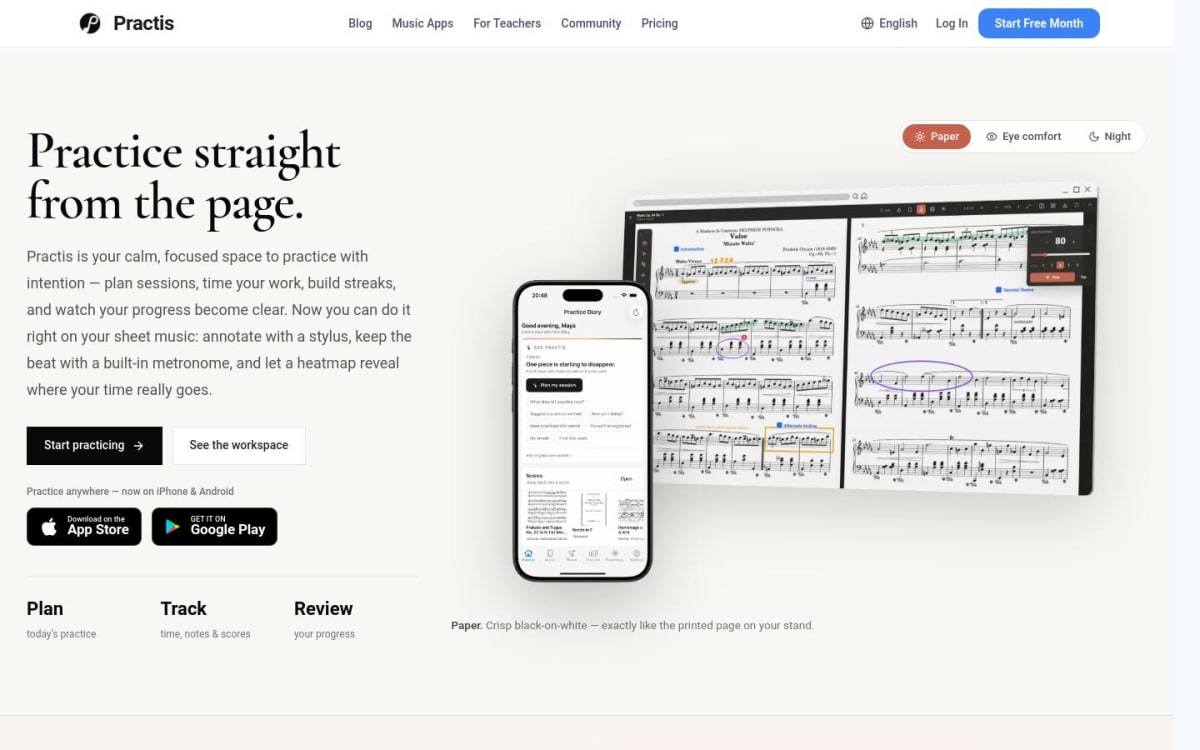
Practis is our product, so this is an owned-product example rather than a neutral recommendation. For this particular workflow, create entries for the pieces you are actually playing, start a session against the relevant piece, and finish with the four-part handover line. The diary and history then preserve the sequence without asking you to total a spreadsheet.
The free plan is enough to test the method: it includes up to five active pieces, a practice diary, full history, a streak, daily and weekly goals, and limited Ask Practis access. Practice sessions are not capped. The web version works in a browser, and the iPhone and Android apps are optional companions. Five active pieces is a real boundary, but it is also a useful constraint for a pianist trying to keep the working list focused.
Do not turn every field into a target. Duration can remain context; the note carries the diagnosis. A weekly goal can protect three sight-reading sessions or two cold memory tests instead of demanding a larger total. If any logging system begins to take longer than the observation it preserves, our lighter practice-log method is the reset.
Use the week to choose tomorrow's direction
A daily entry catches details. A weekly review catches imbalance. Give it eight minutes, and do not grade the week. Read it as a set of directions for the next one.
The diary does not need to prove that every week was productive. Its value appears when a disappointing week becomes legible: too many run-throughs, no fresh reading, one memory entry point still unreliable, or a plateau receiving the same treatment. That is enough information to change the next session.
Tonight, leave one line before closing the lid: the exact place, the job, the result under a named condition, and the first move for tomorrow. After seven sessions, the pattern will tell you more than the hour total ever could.
SEE THE WORKFLOW
Open the Practis demo and see how scores, sessions, notes, and progress stay together.


