You can take piano lessons without ever sitting a graded exam. The useful question is what will give those lessons direction: the music you want to play, the skills that will help you learn it, and a teacher who can connect the two. For an adult studying without exams, we would agree a modest course of work and a time to review it, with room for both careful repertoire study and music that keeps you exploring.
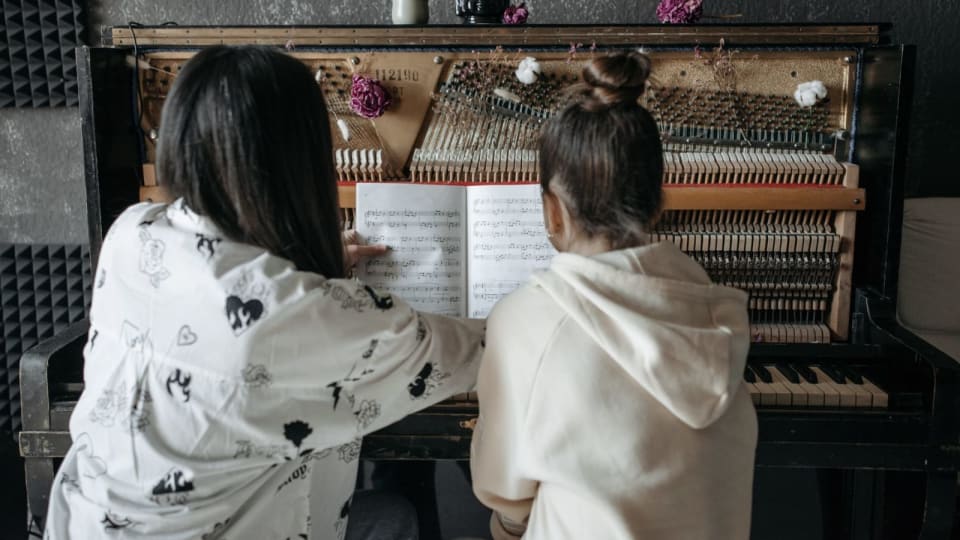
Featured photograph: Brett Sayles / Pexels. An illustrative piano photograph.
Classical lessons do not have to lead to grades
It is possible to want demanding, detailed teaching and have no interest in a certificate. You may want to understand the score more deeply, keep a few favourite pieces in your hands, or open new music with less hesitation. Those are substantial reasons to pay for lessons.
For that kind of classical study, we would start with Vienna Piano School, which we also run. Its approach to adult goals begins with a musical question and connects repertoire, reading, listening and sharing a performance around it. That gives you a useful basis for discussing lessons without a grade syllabus: name what you want to hear or do differently, then agree how a teacher would help you work towards it.

Nor is an exam-free approach an unusual exception that a school must invent for you. For example, London Piano Institute’s adult classical course explicitly makes ABRSM and Trinity exams optional. Other teachers organise their work differently, so state your preference at the beginning rather than assuming that “classical lessons” means preparation for the next grade.
A useful opening is: “I would like to study seriously, but I do not want to take exams. How would we choose the music and review my progress?” That gives a prospective teacher something to discuss. “I just want to play for pleasure” can mean anything from exploring songs casually to spending months on the details of a sonata. Explain what pleasure at the piano looks like to you.
You can also change your mind later. Studying without exams now does not commit you to avoiding every future assessment. Equally, having taken exams as a child does not oblige you to continue that sequence as an adult.
Be clear about what you are choosing instead
An exam gives a course of study some ready-made decisions: a defined standard, requirements to prepare, an occasion to present the work and an external assessment. If those features motivate you, they can be valuable. Some adults enjoy the bounded project and the satisfaction of finishing it.
The preparation can also be musically broad. ABRSM’s Practical piano specification (PDF) includes pieces, scales and arpeggios, sight-reading and aural work. Trinity’s supporting-test options include improvisation. It would be unfair to reduce all exams to memorising three pieces or assume that creativity only happens outside them.
Without an exam, you gain freedom over repertoire and timing. You also take on, with your teacher, the job of deciding what the study should cover. A favourite piece can occupy months while reading, listening or unfamiliar styles receive very little attention. The solution is to make those choices visible, so that the course reflects your interests without becoming accidental.
The trade-off is different if you need a particular qualification for an application. Check the actual requirement before deciding whether to pursue it. For the distinctions between exam routes and what a result establishes, our explanation of piano grades goes into more detail. Here, the aim is a course of lessons whose purpose is musical development in its own right.
Agree what the lessons will cover
You do not need to arrive with a curriculum. Bring a description of what you can currently play and a few examples of music that interests you. The teacher can then hear you, discuss the demands of that music and suggest an appropriate starting point.
There are two decisions worth separating. One is what you want to play: perhaps lyrical Romantic pieces, a collection of short Baroque works or a modest programme for friends. The other is what you want to become more able to do: read unfamiliar textures, hear the relationship between melody and accompaniment, or learn a piece with less dependence on a recording. Your repertoire gives those abilities a musical setting, but a single difficult piece may not give them enough room to develop.
A teacher should be able to explain why a proposed piece belongs in the course. “You like this music, and it gives us a manageable way to work on the sound of a singing line” is a useful rationale. So is “This is easier than your main piece, which will let us look at how you approach unfamiliar notation.” Neither needs to be dressed up as an unofficial grade.
Technique, listening and musical understanding still belong in the conversation. You might agree to connect technical work to current repertoire while also revisiting gaps that appear across several pieces. You might want some lesson time spent identifying harmonies, reading with the teacher or trying an accompaniment. The exact balance depends on your aims; it should be possible to explain where those activities fit.
Keep the initial agreement small enough to remember. A sentence about your direction, a short list of current material and a date for discussion are usually more useful than a detailed year-long syllabus made before the teacher knows your playing. The work can become more specific as the lessons reveal what you need.
Give each piece a purpose, including permission to finish
One source of frustration in exam-free lessons is uncertainty about when a piece is finished. There is always another detail to improve. If every work remains on the stand until nothing more can be said about it, the repertoire can become a queue that never moves.
Agree the purpose before investing heavily. One piece might be prepared to play through for someone. Another might be explored for its texture or form, then put aside. Easier music can serve as regular reading material without becoming a polished performance project. A familiar piece can remain in use simply because you enjoy playing it.
These purposes create different stopping points. For a piece you intend to share, the teacher might help you decide whether the whole performance is coherent enough to let another person hear it. For reading material, the important discussion may be what you noticed and how independently you began. Returning every short reading piece the following week perfectly polished would change the activity into something else.
A decision to move on is not a declaration that the music is exhausted. You can return later with more experience. Our post on building a repertoire explores how learned music can stay available instead of disappearing as soon as the next piece arrives.
What an exam-free term of lessons could look like
Imagine an adult who can already learn short pieces but would like both more convincing performances and greater confidence with unfamiliar scores. This person wants continuing lessons, with no exam or public recital planned. A useful term could address those two aims together while leaving the teacher free to adjust the amount of material.
An illustrative term: depth and breadth
A course outline to discuss with a teacher. The stages describe decisions, not a promise to learn a set number of pieces.
- Opening lessonsChoose the work
Bring a familiar piece and try some new music with the teacher. Choose a suitable main project, shorter contrasting music and reading material that leaves room to keep going.
Agree what each is for, and which technical or listening questions deserve attention alongside it.
- Middle of the termDevelop and adjust
Work in detail on the main piece. Introduce fresh, easier reading material rather than polishing every page. Revisit the contrasting piece enough to decide whether it should continue or make way for something else.
If one project consumes the whole lesson repeatedly, discuss whether its size or the balance of work needs to change.
- Review lessonListen and choose again
Hear some prepared music as a whole, then look at a new short extract together. Discuss what the player now hears, understands and begins more independently.
Decide what to keep, what to put aside and what the next period of lessons should develop.
Notice that the reading work has its own place. It does not have to match the main piece in difficulty or style every week. The point is to give the student repeated encounters with new music while there is still time for depth elsewhere.
The plan also gives listening a practical use. In a lesson, the teacher could play two versions of a phrase and invite the student to describe the difference, then relate that observation to the music being studied. A discussion of harmony could help the student recognise where a passage settles or moves away. These are possible activities to agree, rather than a list every teacher must fit into every appointment.
Attendance and available practice time will affect the size of the course. If the main piece is progressing slowly, the answer may be to reduce its scope, choose different music or keep it for longer. A review date gives you a chance to make that decision. It need not become a deadline by which everything must be complete.
Review what you can do, without inventing your own exam
A productive review can start at the piano. Play a piece through, revisit an earlier passage and try something unfamiliar. Then discuss the evidence in relation to the work you agreed, rather than attempting to calculate a single level for the whole person.
For example, playing a familiar piece with fewer interruptions may show that the work has become more secure. Beginning a new page without the teacher supplying every note tells you something different about reading. Recognising where an accompaniment has become too prominent tells you something about listening, even if changing it still takes time. Those observations can lead to different next steps.
Ask the teacher to distinguish what has improved in the current piece from what seems available in other music. If a particular fingering is secure only in one memorised passage, it may be a useful local achievement. If you can recognise a related pattern in a new score and discuss how to approach it, the learning is beginning to travel. Both matter, but they are not interchangeable.
A brief recording or a few lesson notes can help you remember earlier work. They do not need to become a portfolio of evidence unless you find that enjoyable. Some adults prefer to hear the comparison in the lesson and leave with a clearer sense of what to do next.
If you want more structure between meetings, setting practice goals as an adult hobbyist deals with turning a musical direction into manageable weekly work. The review of your lessons serves a larger purpose: deciding whether the course is developing the abilities you came to learn.
Make room for feedback as well as enjoyment
Choosing lessons without exams does not mean asking a teacher to avoid criticism. You can want patient, respectful teaching and still welcome a precise account of what needs work. Tell the teacher how much challenge you are seeking, particularly if earlier lessons left you equating correction with failure.
At the same time, the teacher needs to know where your ambitions stop. An adult who enjoys detailed work but has little interest in public performance should be able to say so. Playing for a friend, recording for yourself or simply keeping music ready at home may fit your life better. A concert can be an opportunity; it does not have to replace the exam you chose to avoid.
There is room for a less demanding period too. During a busy month, you might spend more time maintaining familiar music and less on new repertoire. Discuss that adjustment openly. Otherwise, a teacher may interpret a smaller amount of preparation as a sign that the assignment was unclear, while the student assumes the teacher understands the pressure elsewhere.
Pay attention to the conversation after a few lessons. Can you explain why you are studying the current music? Is there a way to discuss something that is not working? Does the next assignment have a sensible relationship to your time and interests? Those answers tell you more about the fit than whether the teacher describes their approach as relaxed or rigorous.
Ask about the kind of classical study you want
A useful enquiry can be simple: “I would like classical piano lessons without exams. I can currently play a few short pieces, and I want to improve my reading while learning music I can keep playing for pleasure. How would you organise that kind of study?” Add a little about your previous experience, your instrument and the time you expect to have for practice.
If that direction appeals to you, ask Vienna Piano School about an exam-free path through online piano lessons. Describe the music and abilities you would like to develop, then discuss fit, current availability, fees and scheduling before deciding on an arrangement.