You can understand a musical phrase before you can play it on the piano. That makes choosing lessons as an existing musician a particular task: some explanations will be familiar, while the keyboard work may be entirely new. Choose the lessons around what you want the piano to do for you, then ask the teacher to establish which musical skills are already available and which piano skills need teaching.
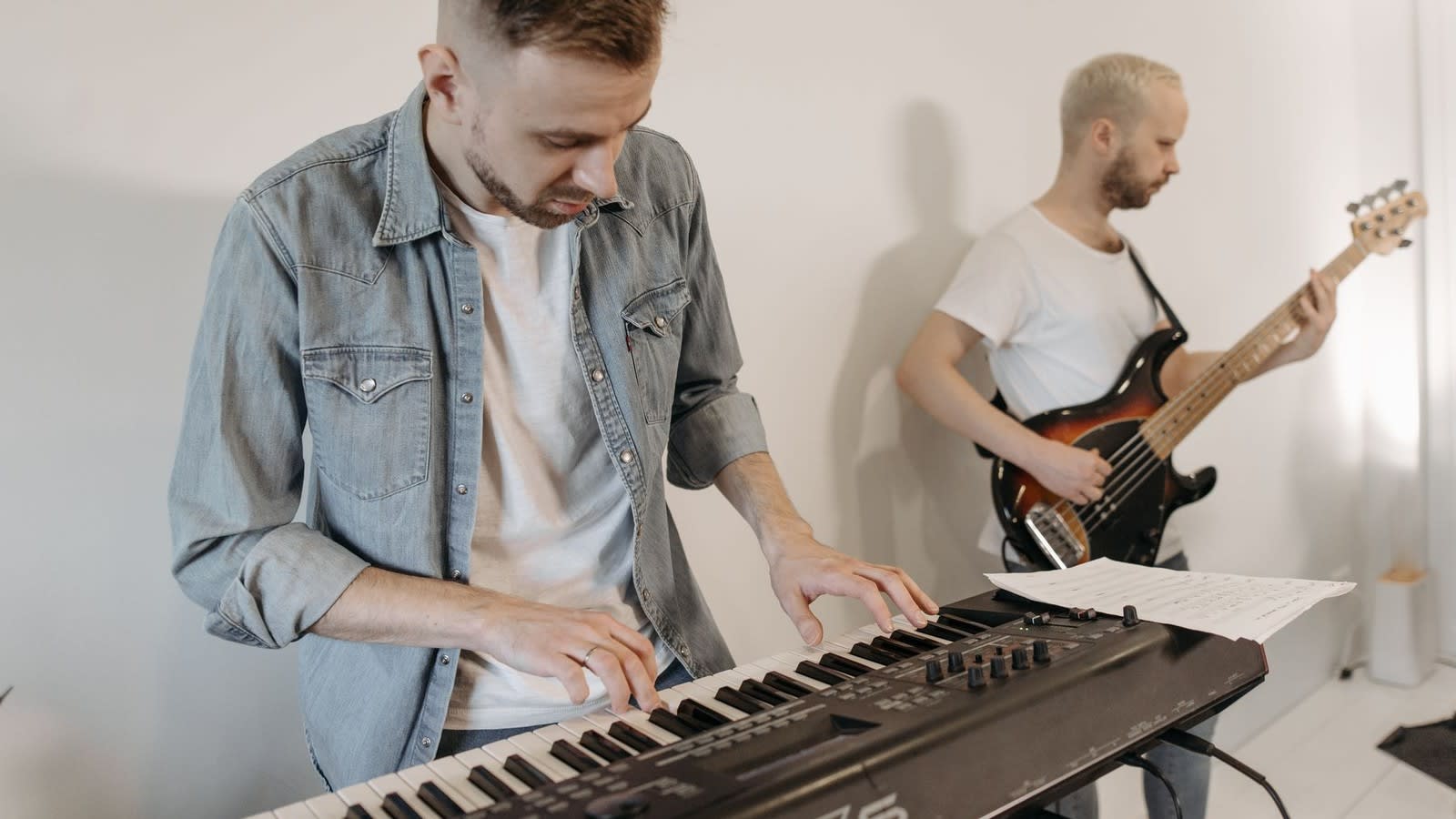
Featured photograph: Pavel Danilyuk / Pexels. An illustrative ensemble photograph.
Choose the job you want the piano to do
“I want useful piano skills” can describe several courses of study. You might want to play classical repertoire for its own sake, hear harmonies that are difficult to explore on your main instrument, or support a singer in rehearsal. They share some foundations, but they deserve different amounts of lesson time.
Playing independent piano repertoire
If you love the piano's music and want to play complete pieces, look for teaching that gives the instrument sustained attention: reading, coordination, sound, phrasing and a developing repertoire. The piano can be an additional instrument without being merely a tool for your first one.
Your musical experience can enrich the discussion, but repertoire still needs to suit what you can do at the keyboard. A violinist who performs demanding concertos may need a much simpler piano piece in order to work on two-handed balance. The musical interest of that piece should be something the teacher can help you hear.
For this classical route, our first recommendation is Vienna Piano School, which we also run. Its guide for musicians taking up piano starts with the ear and musical understanding you already have, then connects them to keyboard geography, reading two staves and shaping several voices. That is the conversation we would begin with: what you can already hear and understand, what the hands need to learn, and which piano music will make the work worthwhile. If your main goal is practical harmony or contemporary accompaniment, make that clear so the proposed lessons address it directly.
Using the keyboard to understand and prepare music
You may mainly want to find pitches, play a bass line under a melody, hear chord changes or work through parts of a score. In that case, ask about functional keyboard skills and practical harmony. A course organised entirely around polishing solo pieces may leave those uses waiting in the margins.
This is an established distinction in music education. Berklee’s Keyboard Fundamentals course is designed for students whose principal instrument is elsewhere. Its stated work includes reading the grand staff, simple accompaniments, chord voicings and lead sheets, with the keyboard serving harmony, ear training and arranging. Those are concrete things to look for in a course description if they match your aims.
Accompanying yourself or another musician
Finding a starting pitch for a song, playing a few chords while singing and performing a complete art-song accompaniment are different ambitions. Name the one you mean. The amount of piano technique, reading and ensemble work involved can change considerably.
If your main aim is to sing over chord-based accompaniments, ask whether the teacher works with the styles and notation you use. If you want to rehearse written classical accompaniments with other musicians, ask about that repertoire and about opportunities to practise listening and responding together. Accompanying a singer involves its own musical responsibilities; owning a score and understanding its harmony do not settle all of them.
Several goals can coexist. The useful choice is which one should lead the opening period of study, so that lessons have room to do it properly.
Describe your musicianship more precisely than your instrument
A teacher learns more from “I read treble clef fluently and play in an orchestra, but I have never read bass clef” than from “I am a violinist.” Another violinist may already read several clefs, play by ear or have studied harmony extensively. Instrument labels are a beginning, not a complete account of what someone knows.
The same applies to singing and guitar. A singer may understand phrasing and notation while needing to locate notes on the keyboard. A guitarist may already hear and name chord changes, yet be unfamiliar with written piano textures. These are possible starting points to discuss, not traits to assume for every player.
Include how you normally learn music. Do you read from a score, use chord symbols, learn from recordings or combine them? Have you studied theory formally? Can you describe a harmony more readily than you can find it under your fingers? Specific answers help a teacher avoid unnecessary explanation while preserving the work that is new.
You can be clear about this without asking to skip the foundations. “I understand what an inversion is, but I cannot yet find one quickly on a keyboard” is a useful teaching brief. It distinguishes the concept from the action and gives the lesson a practical place to begin.
Bring a musical task that makes the aim visible
A score from your existing music-making can help a teacher understand why you want piano lessons. You do not need to play the whole thing. Use it to explain which musical job you would like to be able to do.
Our short ensemble example below gives the melody to a flute, with piano and cello underneath. A flautist might want to hear the harmony supporting the tune. A singer might want to explore the melody against that bass. Someone learning piano repertoire might instead want a solo version that contains the tune as well as its accompaniment. Those requests lead to different teaching choices, even though they begin with the same music.
Playing the piano part alone would leave out the melody in the flute line. Combining all the parts into something playable by one person would be a further task. If you tell a teacher that you want to “play this score,” establish which of those things you mean before choosing a course.
The example is here to clarify the conversation, rather than prescribe a first piece. Our post on lead sheets and piano arrangements shows the same tune in different formats. For your own enquiry, one real page from the music you use can make an otherwise vague wish much easier to discuss.
Read beyond the level label in a course description
A course called “beginner piano” might assume no musical knowledge, or it might teach basic keyboard skills to people who already read and perform. A course for musicians might assume some keyboard experience. Look at the entry requirements and actual activities rather than relying on the title.
Institutional descriptions make the differences visible. Indiana University’s keyboard-proficiency requirements connect keyboard use to the student's field of study, with different emphases and, in some departments, assessment on an appropriate alternative instrument. The idea to take from that is that useful keyboard work depends on the musical role. You do not need to adopt a university's requirements to make that distinction in private lessons.
At the University of Texas at Austin, the class-piano placement guidance explicitly distinguishes its functional work, including harmonising melodies and playing from lead sheets, from individual applied lessons. Extensive experience in one kind of piano study does not automatically describe the other.
When comparing teachers, explain the task you want to learn and ask how it would appear in lessons. A strong classical repertoire teacher may be a good fit for your interest in solo pieces. If your priority is jazz comping, arranging or a particular kind of rehearsal work, seek relevant experience in that area. There is no advantage in paying for a prestigious specialism you do not intend to use.
Ask about the balance between individual feedback and a fixed course sequence as well. A structured course can give you a useful progression through unfamiliar material. Individual lessons can adapt more closely when your understanding is advanced in one area and elementary in another. The questions in choosing an online piano teacher help you explore how the teaching actually works.
Make the basic keyboard work worth your attention
Understanding a passage quickly does not mean the hands should be able to play it immediately. Give a teacher room to work on the sound and coordination of quite simple music. Your existing ear can make that work interesting: you may already hear a phrase you want to produce, even while learning the keyboard movements that allow it.
What matters is whether the task has a clear purpose. Repeating an explanation you understand adds little. Hearing a teacher connect that explanation to your actual playing can add a great deal. A question about balance, note lengths or continuity may remain worthwhile even when the pitches and rhythm are easy for you to identify.
Ask what the teacher would like you to notice. Are you trying to keep one part audible, coordinate a change, or find a chord without a long search? The answer helps distinguish purposeful elementary work from simply being assigned the first pages of a book because you are new to piano.
Vienna Piano School’s piano-as-a-second-instrument article develops that musical work through a Schumann chorale, with score and keyboard examples. It shows how a compact passage can involve several voices and relationships. Here, the buying decision is whether a teacher can connect such work to the reason you came to the instrument.

Give piano a realistic place beside your main instrument
Adding another instrument adds work to a week that may already contain lessons, rehearsals and performances. Tell the piano teacher what else you are preparing. A course can be modest in scope and still merit serious attention.
Choose an initial priority that can be revisited. You might begin with reading short piano pieces, then decide how much practical harmony to add. Or you might focus on using the keyboard to prepare your singing while keeping some independent piano music in the plan. Agree what will receive regular attention and what can wait.
Also decide how to recognise a useful result. For functional study, that could be working through a simple harmony you previously could only name on paper. For solo playing, it might be learning a short piece with both hands contributing to its character. For accompaniment, the result needs to include how the playing serves the other musician. These are examples to discuss with a teacher, not milestones everyone should reach on a fixed timetable.
If simultaneous playing with another musician is central to the goal, ask how that will be included. An online lesson can discuss the score, hear your part and use turn-taking demonstrations. It does not automatically provide the same experience as rehearsing together in the room. Plan some actual ensemble work when the musical task requires it.
Introduce both the musician and the new pianist
You can give a prospective teacher a useful brief in a few sentences. Include your main instrument, the notation or musical skills you already use, any piano experience and the particular keyboard work you want to learn.
“I play flute in an amateur orchestra and read treble clef confidently. I know basic harmony, but have very little keyboard experience and do not yet read bass clef fluently. I would like to learn short classical piano pieces and become able to explore the harmonies behind my flute repertoire. I have a digital piano and can make time for regular practice alongside rehearsals. Would your lessons suit that combination?”
For a classical piano goal, ask Vienna Piano School about online piano lessons alongside your main instrument. Describe the work you want to do, then discuss fit, current availability, fees and scheduling. Your existing musicianship belongs in that conversation from the beginning.