A 35-minute playlist is a promising place to start a piano diploma, but it is not yet a programme you can enter. The exact movements, repeat rules and your own playing determine whether it fits. The two ATCL examples below show how to put those decisions together: one centres on a Beethoven sonata, while the other builds a recital from five independent works.
Both use the current Trinity list. Their durations come from named commercial recordings, so you can see the arithmetic before measuring your own performances. Neither is a candidate's tested recital or a promise that the same pieces will take you the same time.
Featured photograph: cottonbro studio / Pexels. A general practice photograph, not an exam performance.
Choose the diploma before choosing the programme
For Trinity ATCL piano, the recital must last 32–38 minutes, include at least two works and show a range of moods, styles and tempi. Works are complete unless the list specifically permits selected movements. An entirely listed programme needs no separate repertoire approval. Trinity also requires an acoustic piano for a solo piano diploma. These details come from the May 2026 piano repertoire list.
That makes the list's wording worth reading carefully. “Prélude and/or Sarabande” from Debussy's Pour le piano allows those named movements; it does not turn the entire three-movement suite into the same ATCL choice. Likewise, one movement from a sonata listed complete is a different proposal. Write down the work and movement selection before buying music or committing months of practice.
If you are still deciding what follows Grade 8, our post on what piano grades tell you helps put the qualification in context. A diploma programme is a substantial musical project. The useful question is which set of works you can develop into a convincing recital with your teacher, rather than which collection has the most impressive titles.
ARSM has a different calculation. ABRSM specifies 30 minutes, with a two-minute tolerance, measured from the first note to the last including transitions. At least 20 minutes must come from its ARSM list, with up to ten minutes of suitable own-choice music; normally only one work per composer is allowed. The examples here are ATCL examples, and should not be transferred to an ARSM entry without a fresh check.
Programme one: give Beethoven room to develop
Here the complete Op. 90 sonata occupies the centre of the recital. Bach supplies a concentrated opening, Chopin changes the texture afterwards, and Debussy combines momentum with a quiet close. This is a useful direction for a pianist who wants to show how a longer work develops as well as how separate pieces differ.
Recording references, in minutes:seconds. On a phone, swipe sideways to see each cumulative total. The linked performer names lead to the labels' track listings.
| Work and recording | Duration | Music so far |
|---|---|---|
| Bach: Toccata in E minor, BWV 914Complete work Katharine Durran | 7:24 | 7:24 |
| Beethoven: Sonata in E minor, Op. 90Both movements: 5:47 + 7:26 Jean-Efflam Bavouzet | 13:13 | 20:37 |
| Chopin: Nocturne in E major, Op. 62 No. 2Complete work Imogen Cooper | 5:54 | 26:31 |
| Debussy: Prélude and Sarabande from Pour le pianoFirst two movements: 4:06 + 4:12 Jean-Efflam Bavouzet | 8:18 | 34:49 |
| Reference total | 34:49 | |
The Beethoven total uses the displayed movement lengths, 5:47 + 7:26. Chandos's combined heading differs by one second. Treat the overall result as approximately 34 minutes 50 seconds, then replace it with your own timings.
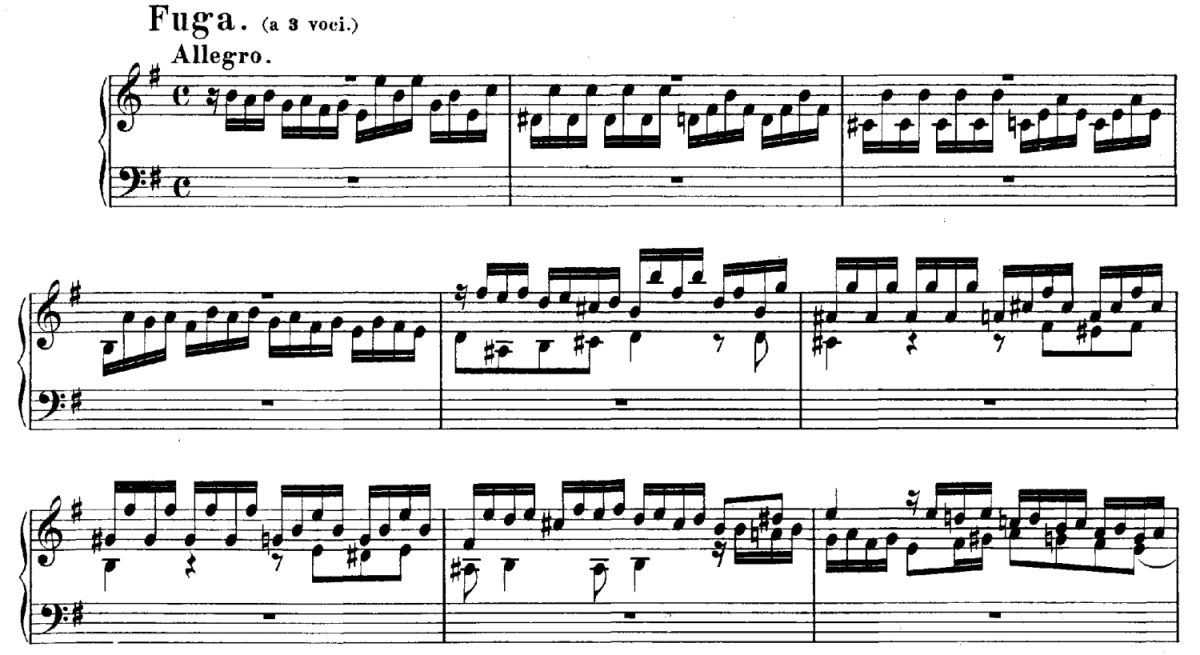
Bach's E-minor Toccata changes character within its own seven or so minutes. Its free opening leads to contrapuntal writing, an Adagio and a final fugue. A pianist who can make those changes feel connected has already shown more than “a Baroque piece” before reaching Beethoven.
The fugue's opening makes one of the demands visible. A single moving line begins alone; another voice joins in the middle system while the first continues. Follow each line separately in the score, then notice what happens to its direction when you put the voices together.
On a phone, swipe the notation sideways or open the score excerpt full size.
Beethoven then asks for a different kind of continuity. The first movement of Op. 90 is compact and dramatic, with a three-beat pulse and sharply changing gestures. The second moves into E major and a broad, singing two-beat flow. Its returns are written into the score: they are part of the movement's design, not optional repeat signs to remove when the programme runs long.
Place the sonata where you can give that second movement enough concentration. Playing the first movement with conviction and then letting the longer second movement drift will be more noticeable than a small difference in speed. In rehearsal, listen for whether each return still has a destination, rather than simply recognising that familiar music has come back.
Chopin's Op. 62 No. 2 continues the E-major sound, but changes the relationship between melody and accompaniment. Its middle becomes agitated and more involved. Check the moving inner lines as well as the opening melody when deciding whether the nocturne fits your current technique; the title does not make it a convenient rest.
The Debussy Prélude restores motion through passagework, glissandi and a cadenza. The Sarabande then closes with deliberate chords and a restrained final sound. A quiet ending can be persuasive if you can sustain its pulse and voicing. It is less convincing when the last piece feels like the remaining four minutes that needed filling.
There is a deliberate tonal connection here: Bach and Beethoven begin in E minor, Beethoven moves to E major, and Chopin remains there. Four composers do not automatically mean four very different sound worlds. The changes of articulation, texture, pace and scale need to be heard in your playing.
Timing position: the recording references total 34:49, leaving 2:49 above ATCL's lower boundary and 3:11 below its upper boundary. That is a useful starting position. It is still necessary to measure complete works with your own phrasing and the correct treatment of repeats.
Programme two: shape five independent works
A recital does not have to revolve around a long sonata. This second direction opens with Bach, puts Chopin's energetic Boléro at the centre, and finishes with Debussy's wide range of register and resonance. It can suit a pianist whose strengths lie in changing character between self-contained works.
The order deliberately separates Ravel and Schubert with the Boléro. That creates a more pronounced change of pulse than placing all the lyrical music together. Each duration below is again a recording reference.
Bach: Fantasia and Fugue in A minor, BWV 904
Both sections: 3:37 + 4:22
Angela Hewitt · cumulative 7:59Schubert: Impromptu in G-flat major, Op. 90 No. 3, D 899
Original G-flat major version
Barry Douglas · cumulative 27:17
Reference total: 33:25. This is only 1:25 above the minimum. It illustrates why checking the lower boundary matters just as much as avoiding an overlong recital. A pianist who takes a more flowing approach to several pieces could need a different selection.
Bach's Fantasia and Fugue is a substantial opening in its own right. The Fantasia's chordal texture and independent lines lead to a fugue with contrasting subject material that combines later. Prepare the complete span: a clean first page does not show whether you can keep the texture and direction clear as it becomes more involved.
Ravel's Pavane offers a more spacious melodic line over layered accompaniment. Its pacing depends on the movement inside the texture, not merely on playing the melody slowly. Practise hearing the line over the inner rhythms and chords without making every layer equally prominent.
Chopin's Boléro changes the physical and rhythmic demands. A quick introduction gives way to a three-beat dance, with contrasting episodes and a brilliant ending. This position lets the piece bring activity back into the recital before Schubert's long, cantabile line. Inspect its complete score, including the later passagework, before treating it as a lighter alternative to the sonata.
Schubert's G-flat Impromptu asks for an accompaniment that remains continuous beneath the melody as the harmony changes. The apparent regularity of the pattern can hide unevenness or a melody that becomes louder simply because the accompaniment has become busier. The exact edition matters here: some older versions transpose the music into G major.
Debussy's La Cathédrale engloutie then expands the register and weight of sound before drawing back into quiet resonance. Its larger chords and quieter echoes give the recital a different ending from programme one's Sarabande. Neither ending needs a final burst of speed to be complete.
The main musical risk is that the Ravel, Schubert and Debussy all acquire the same indistinct “slow and expressive” manner. Ask a listener to describe their different pulses and textures after a trial performance. That tells you more about balance than checking whether the composer dates cover enough historical periods. This programme avoids a long sonata; it does not avoid difficult listening and control.
Measure what you will actually play
Published recordings help you reject an obviously unsuitable first draft. They cannot certify your duration: the artist's tempo and phrasing differ from yours, and track lengths can contain silence or decay. A sum of streamed tracks is especially unreliable if the recording includes repeats that your exam treats differently.
For Trinity, time each complete work separately. Brief gaps between movements count, but pauses between separate works do not. Its current rules omit exposition and recapitulation repeats, repeats longer than two bars and repeats within variations; D.C. and D.S. directions are followed. A qualified exception for some Baroque-suite repeats is not relevant to these examples. See the syllabus timing and repeat rules, pages 14–17 before marking your score.
Once the pieces are ready for full runs, use this small record:
- Fix the version. Write the exact work, movements, edition and repeat plan before starting. Keep the same choices across your trial performances.
- Time complete works. A recording makes it easier to review start and finish points afterwards. Include the normal brief movement gaps within a work; keep gaps between separate works outside the ATCL total.
- Repeat on different days. Record each actual result instead of replacing yesterday's time. Compare the shortest and longest complete totals, and note any interruption that made a run unrepresentative.
- Change the selection while there is still time. If ordinary performances fall below the minimum or approach the maximum, discuss the repertoire with your teacher. Stretching pauses or forcing an unnatural tempo is a poor repair.
An original editable worksheet for your own repertoire and repeated run-throughs. Open it in your usual word processor; no Practis account is required.
Also rehearse the order as a whole. You may discover that a piece which feels secure on its own changes after twenty minutes of playing, or that a page turn repeatedly disturbs the same transition. Our post on practising for performance develops this part of preparation. The timing record is useful alongside those musical observations.
Choose an edition you can identify and use
An exact score reference prevents small ambiguities from becoming months of work on the wrong version. Trinity recommends modern editions, but that does not mean every candidate has to buy a new copy of every work. Check the text, layout and any specified arrangement with your teacher. Our comparison of Urtext and edited piano scores explains what the different editorial choices can offer.
For the first programme, these are readily identifiable editions from the publisher's catalogue:
- Bach: Toccatas, BWV 910–916
- Henle HN 126, edited by Rudolf Steglich. The collection contains the complete BWV 914; check page turns as well as the notes.
- Beethoven: Sonata Op. 90
- Henle HN 1124, edited by Murray Perahia and Norbert Gertsch. This is the complete two-movement sonata used in the example.
- Chopin: Nocturnes
- Henle HN 185, edited by Ewald Zimmermann. The selected piece is Op. 62 No. 2 in E major, not No. 1 in B major.
- Debussy: Pour le piano
- Henle HN 385, edited by Ernst-Günter Heinemann. Use the Sarabande from this suite, rather than its earlier Images version. The example plays only the Prélude and Sarabande.
For programme two, the publisher identifies Ravel’s solo-piano Pavane as HN 1260, Schubert’s original G-flat Impromptu as HN 488, and Debussy’s first book of Préludes as HN 383. These catalogue numbers identify options, not compulsory purchases.
Complete historical references are also available for Bach BWV 904 in Naumann’s 1890 Bach-Gesellschaft edition and Chopin’s Boléro in the 1834 Peters edition, plate 2505. A scan is useful for examining the whole piece; its age does not settle whether the notation, editorial markings or page layout will serve you best in performance.
Keep one current running order
As the repertoire develops, a programme can acquire several competing versions: a list in a message, different durations in a spreadsheet and an old order on the music stand. Keep one current version with the exact titles and your latest measured durations. Preserve earlier timings separately so you can still see the range.
Our web app's Practis Programs & Performances gives signed-in users, including Free accounts, an ordered programme built from their collection. You can enter minutes and seconds beside each work, change the order and see the total. After performing, you can mark the programme performed and add a reflection. It is a place to maintain the project, rather than an exam-board eligibility check.
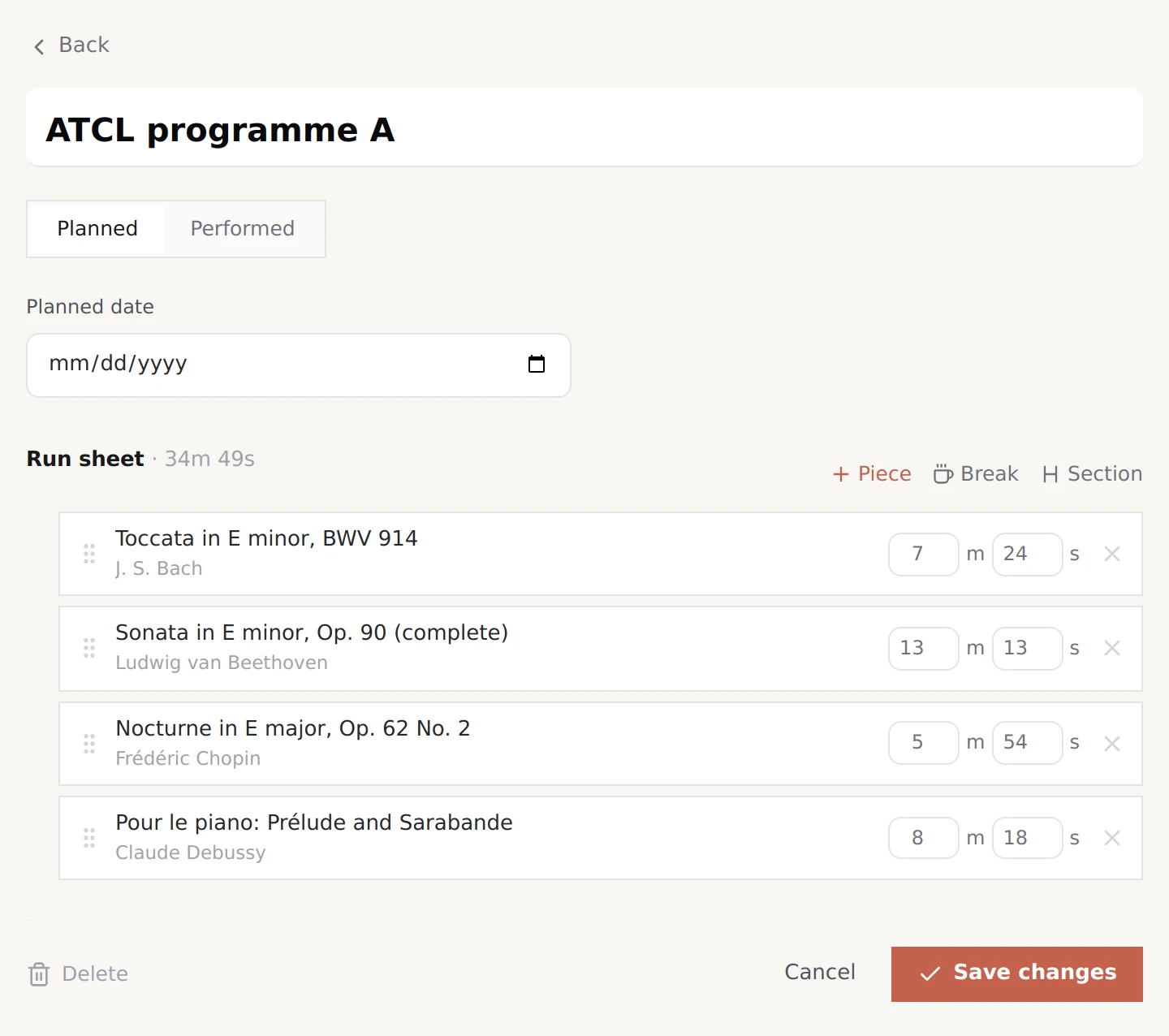
For ATCL, watch the break rows: Practis includes timed breaks in its displayed total. Enter the duration of each complete work, including its brief internal movement gaps, and leave between-work pauses out of that music total. A concert running order may legitimately include those breaks; Trinity's assessed duration uses a different convention.
A paper list or spreadsheet can hold the same essential information. Keep the current syllabus and any approval correspondence alongside whichever record you use. Neither a software total nor a neat programme page confirms that the actual playing meets the rules.
Settle approval before entering
The two examples here stay within Trinity's ATCL list. If you substitute own-choice repertoire or change a complete listed work into an unlisted movement selection, use Trinity’s programme-approval process for the whole proposal. Do not assume that an individually suitable piece makes the revised programme acceptable.
Approval addresses difficulty, not timing or balance. Changes require resubmission, and the current syllabus gives approval letters a three-year validity unless the letter states otherwise. Keep the exact approved version. ABRSM does not offer prior approval of ARSM own-choice repertoire, so the Trinity process should not be applied to an ARSM entry.
Before committing to the exam, bring your teacher the score editions, final order and several complete timing results. Discuss the awkward transitions and the work that feels least dependable late in the recital. That is enough concrete information to decide whether to keep the programme, change one piece or give the project more preparation time.