Begin Philip Glass’s piano music with “Opening” if you want to hear how two rhythmic layers fit together, Metamorphosis Two if you are drawn to a long melody over a moving accompaniment, and the études if you want a collection to explore over time. These are different musical starting points, rather than a ladder from easy to difficult.
Glass turns 90 on 31 January 2027, with an announced season of performances across opera, orchestral music, dance and chamber works. His piano repertoire offers a more intimate way into that world. The notes may look economical on the page; making their relationships clear is a substantial part of the playing.
Opening: two rhythms inside one pulse
“Opening” begins Glassworks, which Glass wrote for the recording studio with a wider audience in mind. The six movements use different instrumental combinations, and his catalogue allows them to be performed separately. This first movement is a complete solo-piano piece, although its title can misleadingly sound like the name of an introductory exercise.
The characteristic coordination is three notes against two. Olivier Lussac’s notes for Jay Gottlieb’s recording, published on Glass’s website, identify that counter-rhythm and the alternating thirds in the left hand. In the opening score, the right hand divides the beat into triplet eighth notes while the left hand divides it into ordinary eighth notes. The hands share a pulse without landing together on every note.
This matters because there are two tempting ways to lose the effect. One is to make the left hand follow the right hand’s three-part division. The other is to squeeze the triplet around the left hand’s second note. Both hands may feel busy, but the spacing between their attacks becomes uneven.
A short coordination exercise before adding the notes
Divide one beat into six evenly spaced counts. Tap the three-part rhythm on counts 1, 3 and 5, and the two-part rhythm on 1 and 4. Both hands start the next cycle together. This is a rhythm exercise, not a reproduction of Glass’s melody or harmony.
| Count | 1 | 2 | 3 | 4 | 5 | 6 |
|---|---|---|---|---|---|---|
| Three | Tap | · | Tap | · | Tap | · |
| Two | Tap | · | · | Tap | · | · |
Start on a tabletop, then try one comfortable key in each hand. Keep both hands quiet enough to hear the spacing. Once the relationship settles, stop saying all six counts and feel the larger beat. If it becomes a sequence of awkward little jolts, return to tapping before trying the passage faster. Our three-against-two practice guide develops the same coordination in more detail.
Now return to the actual score. Add the changing notes without giving every right-hand figure a fresh accent. A rhythmic pattern can be correctly aligned and still sound as though it restarts several times in each bar. Try hearing a complete phrase over the smaller movements.
Hear the harmony beneath the pattern
For a second kind of practice, reduce a short passage to its bass and the harmony above it. Hold that outline long enough to hear where it moves, then restore the written figuration. The reduction is a temporary way to understand the passage; the piece’s motion comes from putting the written rhythms back.
Pedal can help the sound connect, but a wash of resonance can also hide whether a harmony has actually changed. Play a short section without pedal first, then add enough to connect the sound while keeping successive harmonies distinguishable on your instrument. There is no universal pedal depth that will behave identically on a digital piano, an upright and a resonant grand in a hall.
The video above presents the composer’s performance associated with Philip Glass Solo, released in 2024. Use it to hear the piece as a whole after working on a fragment. The separately published piano score is Opening Piece from Glassworks, DU10023; the complete ensemble score of Glassworks serves a different purpose.
Metamorphosis Two: the melody moves more slowly than the hands
Metamorphosis is a set of five solo-piano pieces from 1988. Their family resemblance can make them seem interchangeable at first, but the material is organised differently in each. The publisher’s catalogue identifies the collection; pianist Aleck Karis’s recording notes on Glass’s website explain its individual forms.
The opening page of Chester Music’s authorised score preview makes one practical challenge visible. The left hand keeps moving in eighth notes while the right hand’s melody uses much longer values. The melody arrives high above the accompaniment, marked cantabile, meaning in a singing manner. More activity in the left hand should not automatically mean more prominence.
Try bars 5–6 in the preview
First play just the melody and the bass, leaving out the moving inner notes. Listen to the distance between the melody’s arrivals. It is easy to feel a long note as something that happens once and then stops mattering; in the phrase, it continues to lead towards the next note.
Restore the left-hand figure while keeping that longer melody in your attention. Record those two bars once with the accompaniment deliberately too prominent, then once with it noticeably quieter. On playback, ask whether the upper line remains the thing you naturally follow. The comparison makes balance audible; “play more expressively” does not tell the hands what needs to change.
Then include the approach and the following bar. A successful two-bar balance test is a beginning, but the phrase needs to continue through a change in bass or harmony. Practising only the comfortable pattern can make the join sound like a new start each time.
The form is less square than the surface suggests
Karis describes Metamorphosis Two as a three-part design: the outer material returns after a contrasting middle. He also points out an eighteen-bar phrase, built as 4 + 4 + 4 + 6. The final extension matters. Repeated figuration does not mean that every sentence ends after the same number of bars.
Mark the phrase boundaries in your own score before trying to memorise the whole piece. At an extension, identify what tells you that the phrase is still continuing. If your memory is only “do the pattern again,” two similar passages are easy to confuse. A remembered destination gives the repetition a reason to continue.
For a listener, the same idea changes the experience. Follow the melody’s return after the more active middle rather than counting every small figure. Familiar material can feel different because of what has happened between its appearances.
Where the other four pieces fit
For a fuller sense of the collection, listen to One and Five as a pair. Karis identifies shared material between them, with changes to the opening chords and ending. Then compare the rhythmic emphasis of Three and Four. Lussac’s notes draw attention to their off-beat writing and the added arpeggiation in Four. Those contrasts give the cycle more variety than the recurring accompaniment alone suggests.
Chester Music’s Solo Piano, DU10527, contains all five pieces, plus Mad Rush and Wichita Vortex Sutra. If Metamorphosis is what has caught your attention, that is a more direct purchase than a book of unrelated arrangements with Glass’s name on the cover.
The études: twenty pieces, with more than one purpose
The word étude means study, but the collection is more than a series of drills. In his note for the complete cycle, Glass says Book 1 explored different tempi, textures and techniques while helping him improve his own playing. Book 2 developed towards further questions of harmony and structure. Both books belong to the same project, but their aims are not identical.
The numbering also reflects the history of the collection. The six pieces written for Dennis Russell Davies’s fiftieth birthday became Nos. 2, 3, 4, 5, 9 and 10. No. 5 is therefore part of an early group, not “lesson five” in an ordered course of piano difficulty.
Víkingur Ólafsson’s performance of No. 5, published by Deutsche Grammophon, is a useful first encounter with the études. Give the whole piece one uninterrupted listen. On the second, follow one line through a return of material you recognise. Does it seem to be heading somewhere new, or does the return feel like settling back into a familiar place?
If you later compare another pianist in the same étude, choose one passage rather than judging two whole performances by their opening seconds. Listen separately for the relative weight of the voices, the space at phrase endings and the amount of resonance carried between harmonies. Those are different choices; describing everything as “faster” or “more emotional” can miss them.
Choose a study by the problem you want to work on
Before committing to an étude, inspect the complete score and try a short section from later in the piece as well as the opening. A manageable first page is not a reliable description of the whole work. Look for changes in texture, reach, rhythmic coordination and the length of time a movement has to be sustained.
Write down a specific aim for the passage you choose. “Keep the upper line audible when the texture becomes fuller” gives you something to test. So does “recognise the return without restarting from the beginning.” “Learn Étude No. 5” names a project, but it does not tell you what to listen for in the next ten minutes.
The Complete Piano Etudes, DU10967, contains both books, Nos. 1–20. Check the contents when buying: the complete score, a recording by one pianist and a selection of pieces are three different products.
Which score belongs on your music stand?
| What you want to explore | Edition | What it gives you |
|---|---|---|
| The rhythmic relationship in “Opening” | Opening Piece from Glassworks DU10023 | The separately published solo-piano piece |
| The five-part Metamorphosis collection | Solo Piano DU10527 | Metamorphosis I–V, Mad Rush and Wichita Vortex Sutra |
| A broader study and listening project | The Complete Piano Etudes DU10967 | All twenty études across both books |
The choice is about the music you want to spend time with. These editions are not being ranked by difficulty. If a particular coordination or texture is unfamiliar, a short passage can be useful work without making the whole composition your next performance piece.
A first session with something specific to hear
With “Opening,” you could spend the first few minutes tapping the rhythmic relationship, then try a small passage from the score and finish by listening to the phrase in context. With Metamorphosis Two, compare the melody-and-bass reduction with the full texture. With an étude, identify one return or change of texture that needs separate attention.
Keep a short recording from the beginning of the session and another from the end. Compare the thing you actually worked on: the alignment of the two rhythms, the audibility of the melody, or the continuity through a transition. A slightly steadier passage is useful progress even if you have not added a page.
Our guide to practising voicing goes further into balancing the lines. For another composer whose piano music rewards following the notation while listening, the Fantasy & Reveries score guide offers a different set of musical questions.
Glass’s repeated figures make small changes unusually noticeable. The pleasure of returning to a piece is that the notes can remain familiar while your attention gets more exact.
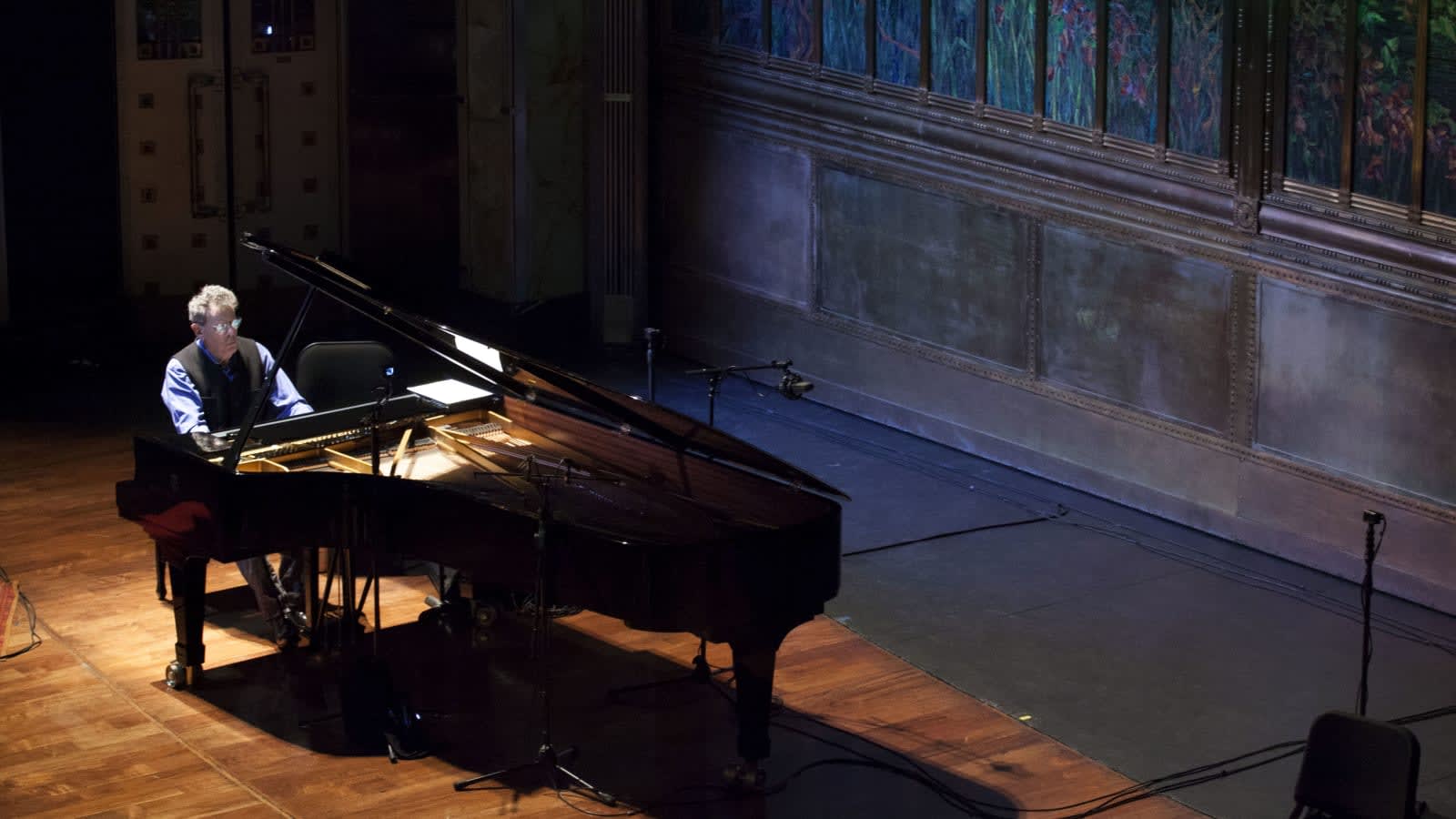
Featured photo: Philip Glass at the Palacio de Bellas Artes, Mexico City, 2018. Photo: Palacio de Bellas Artes / Secretaría de Cultura Ciudad de México, via Wikimedia Commons, CC BY 2.0. Cropped and resized.