
Being able to name a note out of the blue is impressive. It is also a different task from hearing how a melody works. Perfect pitch identifies a note without a reference; relative pitch recognises the relationships between notes. You can learn to play by ear, transpose and make music with other people without having perfect pitch.
One note, with nothing to compare it with
Perfect pitch, also called absolute pitch, lets someone hear an isolated note and identify it as, say, F sharp, without first checking a piano or being given another note. The University of Chicago’s explanation also describes the related ability to produce a named pitch without a reference.
Here is an F sharp above middle C. Its name is printed deliberately: this is an illustration, not a test. Imagine hearing it with no label and no preceding music. Naming it directly would be the absolute-pitch task.
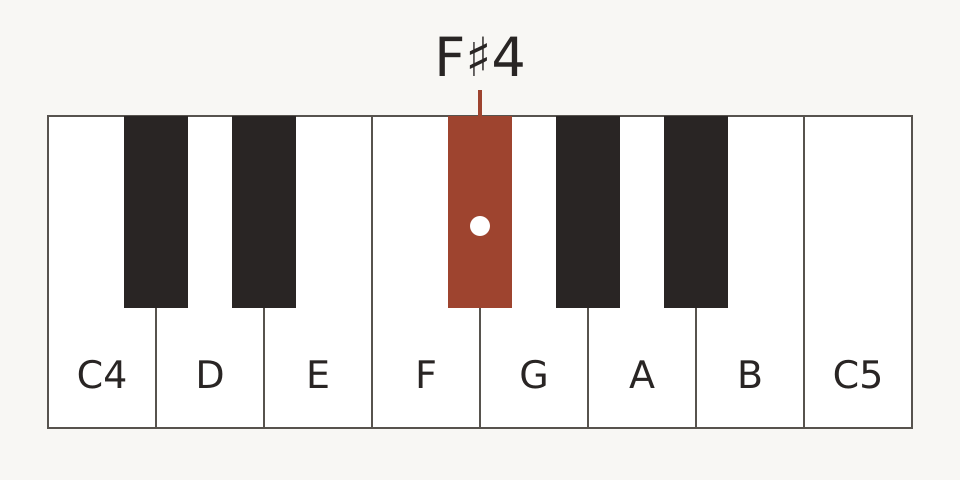
F♯4: a single note
Now suppose someone first tells you that a reference note is D, then plays the F sharp. Hearing a major third above D and working out the name is relative pitch plus note knowledge. The answer can be exactly right even though the route to it is different.
That distinction matters when watching note-naming demonstrations. Knowing the starting note, remembering a reference or using a note heard a moment ago changes the task. A few correct answers on a webpage cannot establish how somebody hears pitch across unfamiliar sounds and registers.
The same melody in two keys
Relative pitch is easier to understand with a tune. This short example plays C–D–E–G–E, pauses, then plays D–E–F♯–A–F♯. Every note in the second version is two semitones higher. The rhythm and the distances between neighbouring notes stay the same.
Listen for the same shape at a different height
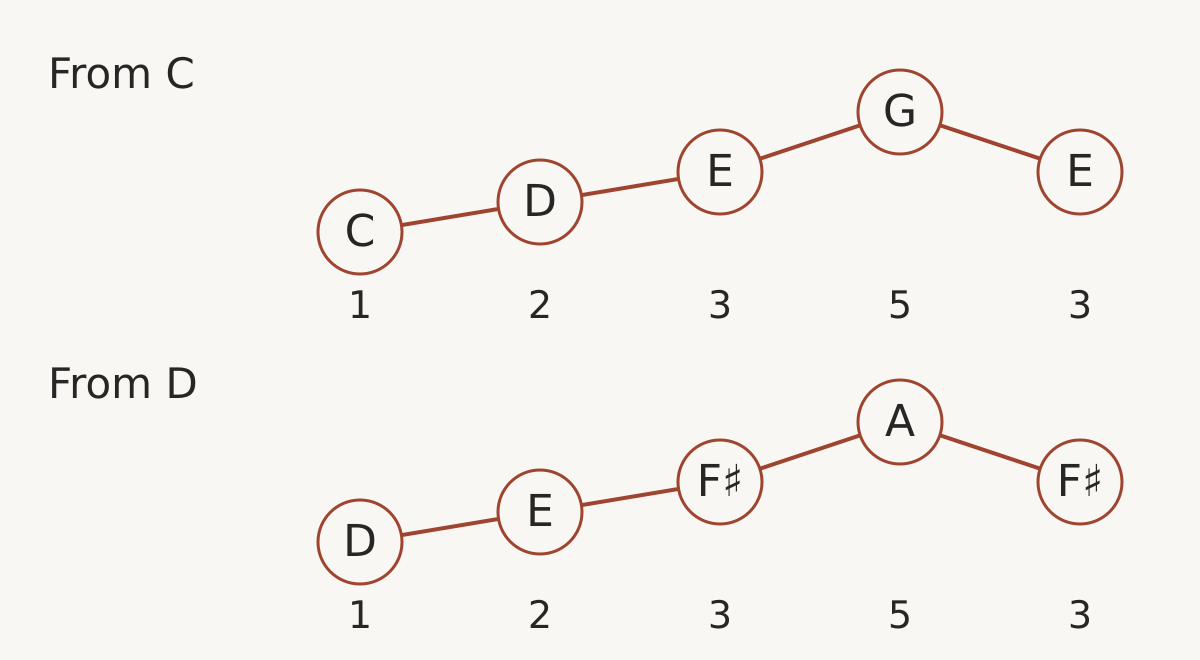
The line rises by a tone, rises by another tone, jumps up a minor third and comes back down that third. Those relationships survive the move from C to D. If you recognise the second version as the same little tune, you are following something that note names alone do not describe.
This becomes useful when a singer asks for a song higher or lower. Keeping the original letter names would keep the original pitches. Understanding where the melody goes lets you rebuild it from a new starting point. In our example, the third note must become F sharp: using F natural would change the distance and the sound of the phrase.
Relative hearing also works within a key. In this major-scale example, you can think of the first note as “home,” then hear the second, third and fifth degrees around it. You do not have to calculate every interval while performing. The aim is to connect a sound you recognise with something you can sing or play.
What happens when you play with someone else?
A choir can begin from a pitch supplied by the piano. From there, each singer has to hear their line in relation to that starting point and to the other voices. A pianist learning an accompaniment by ear has a related job: follow the bass, hear when the harmony changes and find how the melody sits above it.
Absolute pitch can supply useful note names quickly. It does not, by itself, tell you how long to hold a phrase, which voice needs bringing out or whether your rhythm fits the group. These are separate parts of musicianship, and a player can keep developing them regardless of how easily they name an isolated sound.
That broader listening is reflected in Berklee’s ear-training curriculum: its goals include singing from notation with a supplied reference pitch, transcribing melodies and harmonies, and connecting listening with playing. Having a starting note is part of the musical task.
Can adults learn perfect pitch?
There is evidence that some adults can learn much better absolute note identification. The interesting question is how far the improvement goes, and for whom.
A 2025 study by Yetta Kwailing Wong and colleagues analysed 12 experienced adult musicians after eight weeks of training, averaging about 21 hours each. On a broader piano-note test, average accuracy rose from about 14% to 32%. Two participants went much further, reaching 89% and 78% accuracy with responses around a second and a half.
Those results are encouraging, but the group was small and musically experienced. Many recruits did not complete enough training to enter the final analysis. The standout results show what some adults achieved; they do not tell a beginner what eight weeks will deliver.
An earlier study by Stephen Van Hedger and colleagues trained six adults for eight weeks. Its strongest learner met all the study’s absolute-pitch criteria and retained the improvement four months later. Most participants improved more modestly, and this group had been selected for strong auditory working memory. Again, learning was possible, but the outcome varied considerably.
Neither study gives a reason to postpone making music until you can name notes without help. If absolute-pitch training interests you, treat it as a specific skill to explore. A promise that any adult will acquire it on a fixed schedule goes beyond these results.
What is worth working on now?
Start with the musical thing you wish you could do. Learning a melody by ear asks you to retain a phrase, find a starting note and reproduce its movement. Transposing asks you to keep that movement from a different starting point. Playing with others asks you to listen while your own part continues.
For a concrete place to begin, play or sing the five-note example above in C, then find it from D without reading the second line. Check the F sharp afterwards. If you want a regular way to build this kind of hearing, our ten-minute ear-training routine takes it into melodies, intervals and harmony.
You can use a reference note whenever you need one. The useful question is whether you can hear and reproduce what the music does next.
Featured photo: Gustavo Fring / Pexels.