A bar of 6/8 and a bar of 3/4 can both contain six eighth notes. The difference is how those notes belong together: usually two groups of three in 6/8, and three groups of two in 3/4. Set the metronome to support that grouping, then check which note value the tempo number refers to.
For 6/8 marked dotted quarter = 60, the two large beats arrive once per second. If you want a click on every eighth note instead, you need 180 small clicks per minute. An app’s displayed number may differ because some metronomes use a quarter-note reference, as Takt does.
Featured photograph: Agung Pandit Wiguna / Pexels.
Hear the two groupings before changing the settings
In the usual 3/4 grouping, each quarter-note beat divides into two eighth notes. Count “one and, two and, three and.” In 6/8, each dotted-quarter beat divides into three eighth notes: “one la li, two la li.” These syllables are a counting aid; keep another system if it already makes the divisions clear to you.
Music theory calls 3/4 simple triple and 6/8 compound duple: three beats dividing into two, versus two beats dividing into three. Texas A&M Libraries’ comparison of simple and compound meters explains why equal totals of eighth-note values do not make the meters interchangeable.
Six eighth-note positions, two different groupings
6/8: two dotted-quarter beats
3/4: three quarter-note beats
Tap six evenly spaced sounds while speaking the upper row. Keep their spacing and switch to the lower row. Let the spoken numbers show the larger beats; avoid making the intervening sounds shorter or longer. You are changing the grouping without changing the underlying eighth-note rate.
These are the ordinary underlying patterns, not instructions to play every numbered beat loudly. The melody, articulation and accompaniment can draw attention across them. A metronome accent is a useful location marker, while musical emphasis can be much more subtle.
Read the note beside the BPM number
A tempo marking contains a unit as well as a number. Quarter note = 60 means 60 quarter notes per minute. Dotted quarter = 60 means 60 dotted quarters per minute. A dotted quarter lasts as long as three eighth notes, so its three divisions arrive three times as often.
Quarter-note equivalent: 90 per minute
Eighth-note clicks: 180 per minute
The quarter-note equivalent follows from the same relationship: a dotted quarter contains one and a half quarter-note values, so 60 × 1.5 = 90. Conversely, if the score says quarter note = 60 in 6/8, the dotted-quarter pulse is 40, not 60. The signature does not override the printed tempo unit.
This is why “6/8 at 60 BPM” can be ambiguous in a rehearsal message or practice note. Include the note value. The following examples use complete bars and a steady tempo:
| Meter and marking | Eighth notes per minute | One bar lasts |
|---|---|---|
| 6/8, dotted quarter = 60 | 180 | 2 seconds |
| 3/4, quarter = 60 | 120 | 3 seconds |
| 6/8, quarter = 60 | 120 | 3 seconds |
The last two rows have the same eighth-note rate and bar duration, yet their usual grouping differs. The first two have the same printed number but different durations. Separating those two comparisons avoids a common source of confusion.
If a score gives only an Italian tempo word, choose a workable practice pace while keeping the correct unit in your notes. A word such as Andante does not supply the missing numerical conversion by itself. If identifying the written values is the obstacle, a rhythm-first approach to reading sheet music is a useful place to begin.
Choose two large clicks or six small clicks in 6/8
Both can be useful. A click on each eighth note makes it easier to locate a short rest or an entry inside the beat. Two large clicks leave more room to hear the phrase moving across the bar. Roger Dannenberg’s introduction to music concepts describes the familiar distinction between counting slow 6/8 in six and feeling a quicker passage in two.
When counting six, say “ONE two three FOUR five six” and keep the two groups audible. When counting two, say “ONE la li TWO la li.” These can describe exactly the same pace. Removing the small clicks should not accelerate the piece or reduce a dotted-quarter beat to a quarter note.
On a plain metronome with no meter setting, dotted quarter = 60 is straightforward: set 60 and count one large beat per click. For small clicks at the same musical tempo, set 180 and count six per bar. The instrument does not need to label the meter if you supply the grouping yourself.
A metronome app with time signatures may interpret its number differently. Check whether the number measures each click, a quarter note, or a selected beat unit before applying that plain-metronome recipe. Selecting “6/8” alone does not settle the issue.
Set the pattern in Takt for iPhone or iPad
Takt is our metronome app for iPhone and iPad, with free meter, accent and subdivision controls. These instructions describe its iOS version 1.0 controls and assume the standard metronome, with tempo training off. The app requires iOS or iPadOS 16 or later.
Takt’s BPM display uses a quarter-note reference. In 6/8, each numbered meter position is an eighth note, so there are two of those positions per displayed quarter-note interval. For the dotted quarter = 60 example, enter 90 BPM.
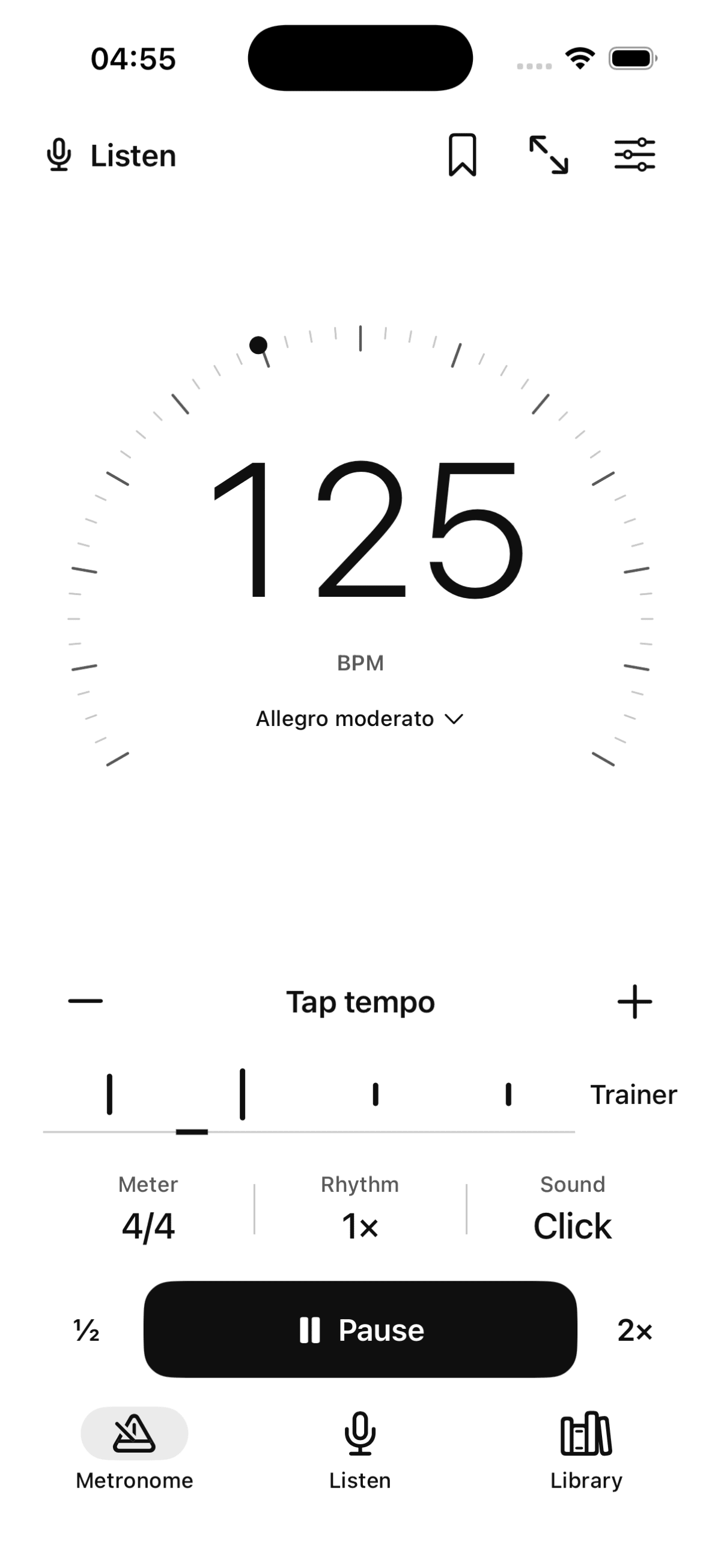
6/8 at dotted quarter = 60
- Tap the tempo number and set 90.
- Open Meter. Set Beats per bar to 6 and Beat unit to 1/8.
- In Group the bar, enter 3 + 3. Select Apply grouping, then Accent group starts. The separate accent action marks positions 1 and 4.
- Open Rhythm and choose Quarter notes, shown as 1× on the main screen. Here that option means one event per numbered meter position, without extra subdivisions.
The result is six eighth-note clicks per bar, with accents at the start of each group of three. Count “ONE two three FOUR five six.” Each group lasts one second, and the complete bar lasts two seconds. The Rhythm option’s label does not change those six positions into quarter notes; their duration comes from the 1/8 meter unit.
To hear only the two larger beats, keep the same tempo and meter. In the Meter accents, set positions 2, 3, 5 and 6 to silent, leaving 1 and 4 audible. Each numbered control cycles through accented, normal and silent states. Count the missing divisions internally while the two surviving clicks keep the dotted-quarter pulse.
3/4 at quarter note = 60
Set the tempo to 60, choose 3 beats per bar and the 1/4 beat unit, then select Quarter notes / 1× in Rhythm. Accent the first position and leave the other two normal. You hear three quarter-note clicks per bar, one second apart.
For all six eighth-note divisions, choose Eighth notes / 2× in Rhythm while retaining 60 BPM and 3/4. Count “one and, two and, three and.” Return to 1× when you want only the quarter-note beats; the musical tempo stays the same.
These metronome tools and saved setups are free in Takt for iPhone and iPad. Save each pattern with its musical tempo unit in the name, such as “6/8, dotted quarter 60,” so the displayed 90 is easy to interpret next time.


Screenshots and controls shown here are from Takt for iPhone and iPad.
When the click still seems too fast or misplaced
First count one complete bar. Six small clicks in 6/8 can sound busy while the larger pulse remains slow. If positions 1 and 4 arrive at the intended large beats, you may simply want fewer audible clicks. If the whole bar passes too quickly, revisit the tempo unit and conversion.
In Takt, entering 180 while retaining 6/8 and 1× produces 360 eighth-note positions per minute, twice the speed of the dotted quarter = 60 example. Likewise, adding a three-way subdivision to an already complete six-position pattern creates additional events inside each eighth note. It does not merely reveal the existing two groups of three.
If the rate is correct but the accents feel wrong, inspect their positions separately from the grouping text. An accent every second eighth note suggests three groups across the bar; accents on the first and fourth eighths support two. Also allow for an incomplete opening bar: a pickup does not suddenly become the downbeat just because it is the first note you play.
When the setting makes sense but the notes still fail to fit, speak the rhythm without the instrument. The next question may be where notes and rests sit inside the pulse, rather than what number belongs on the metronome.
Bring the larger beat back into the phrase
Once the small divisions are clear, try the same passage with only the main beats audible. In 6/8, keep the two dotted-quarter beats moving through the bar. In 3/4, preserve the three quarter-note beats. This is a useful application of moving from dense to sparse metronome support.
Finally, play a complete phrase without the click. Keep the grouping you established, but let articulation, dynamics and phrasing decide how it is expressed. The metronome setting has helped when the bar makes musical sense after the device falls silent.