
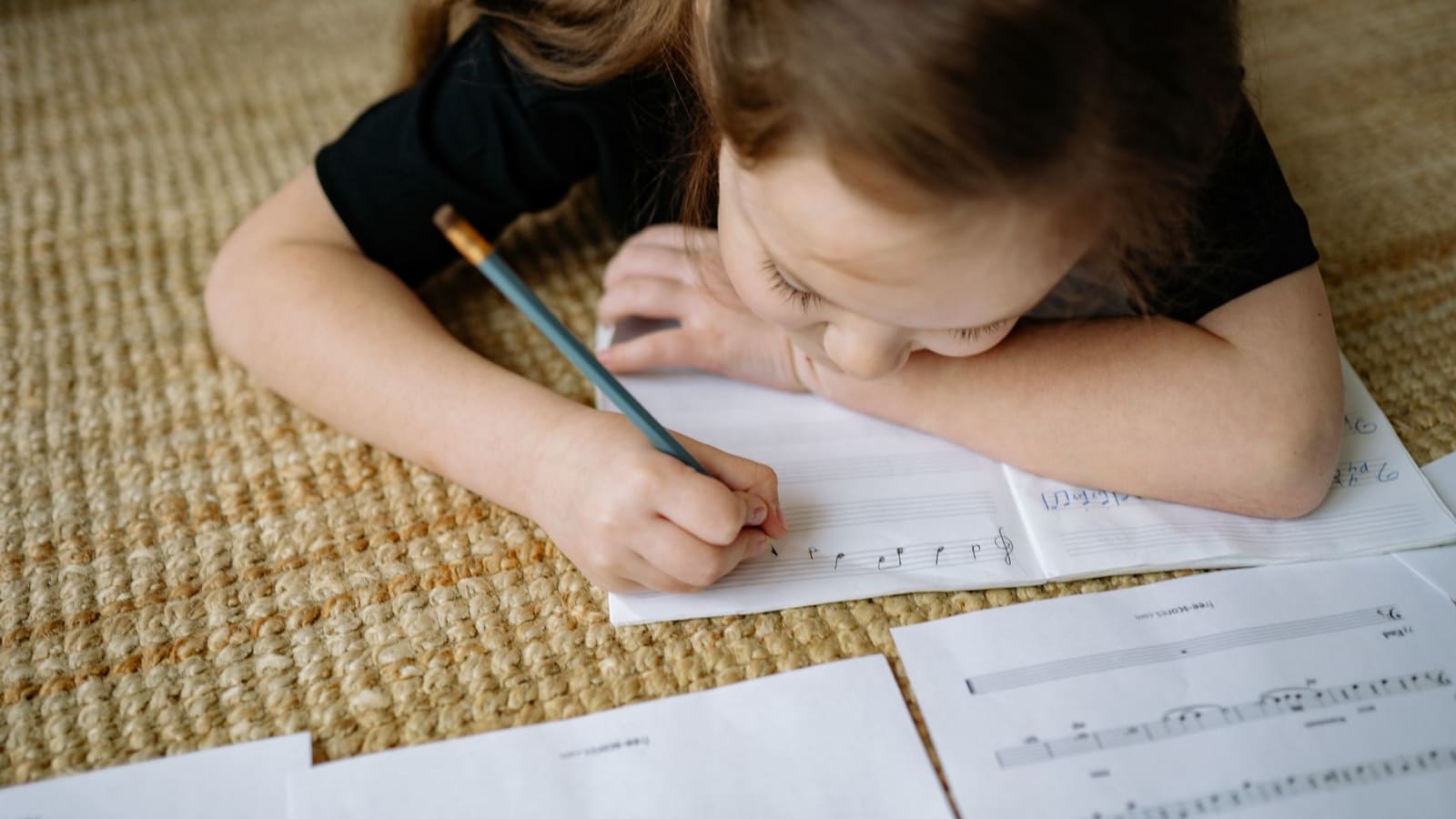
A notebook can have plenty of blank staves and still be awkward for the music you want to write. Small noteheads, a cramped piano part or a page that needs to go into someone else's folder all point toward different formats. The useful comparison starts inside the book.
For a general music notebook, start with the Hal Leonard Green wirebound book. Its 12-stave, Letter-size format gives you room for longer sketches. The Aqua book provides six larger staves, the Blue pad supplies removable pages, and Henle's small Notes booklet is the pocket option.
This is a layout-and-specification comparison, checked on 30 September 2026. We inspected publisher page previews where available; we have not tested these papers with pens, erasers or repeated binding use. Our free printable sampler below lets you try different staff sizes before buying.
What needs to fit on the page?
Take a short example of the work you actually do: a melody with chord symbols, a piano exercise, a harmony answer or a few bars from a lesson. The amount of music is less important than the marks around it. A staff that accommodates bare quarter notes can become crowded once you add fingering, dynamics, lyrics, accidentals and corrections.
Staff height is the distance from the bottom line to the top line of one five-line staff. It is different from the gap between neighbouring staves. A page with fewer staves might use larger notation, leave more space between systems, or simply have larger margins. Check the actual ruling rather than assuming that six staves always means twice the writing size of twelve.
For piano, count pairs. Twelve individual staves can supply six treble-and-bass pairs, but they may be evenly spaced rather than grouped as piano systems. If you want dynamics between the hands, a brace at the left and clear separation before the next system, you must leave room for those elements. Using every printed staff is optional.
The outer dimensions also matter. A US Letter page is 8.5 × 11 inches, approximately 216 × 279 mm. A4 is 210 × 297 mm: slightly narrower and appreciably taller. A cover advertised as “full size” does not tell you which one it uses, and neither size establishes the length of the printed staff inside the margins.
Our original examples use the same two-bar melody to make the spacing question concrete. These are our own layouts, not measurements or reproductions of the four products. The millimetre labels describe the downloadable paper at its intended print size; the figures on your screen scale with your device.
6 mm staff: a compact single line
The melody fits, with room above for a short chord symbol or fingering. Try adding the marks you normally use.
8 mm staff: larger note placement
The same pitches occupy a taller staff. This provides a different writing target without changing the music.
Paired 6 mm staves: a piano system
The lower whole notes align with the starts of the two bars. The space between the hands remains available for dynamics or reminders.
Four products, with different reasons to use them
The following shortlist covers a regular notebook, larger-staff writing, removable pages and a small carry book. It is deliberately a format comparison rather than a paper-quality ranking. Use the identifiers when ordering: similar cover colours and product names can conceal different sizes or page counts.
Affiliate notice: Some links are paid links. As an Amazon Associate, we earn from qualifying purchases.
Hal Leonard Standard Wirebound: the regular working notebook
The Green book is the straightforward choice for someone writing melodies, harmony exercises or longer sketches in one place. A 12-stave page gives a single-line instrument more successive rows before a page turn; a pianist can group the rows into pairs and add clefs and barlines to suit the task.
- Page format
- 8.5 × 11 inches; 12 staves per page
- Book and identifier
- 96 pages; wirebound; HL 210005
ISBN 9780881884999
The publisher listing and sample pages show the ruling and identify the included notation guide. The preview uses evenly repeated individual staves. It is not a pre-bracketed piano exercise book, so leave any additional separation you need between two-hand systems.
The compromise is density. If your handwriting needs substantial room, the larger page does not automatically solve that: the notation still has to fit its ruling. Test a few notes with ledger lines, a correction and a fingering number before committing to this format for a term. A wire binding tells you how the book is assembled, but it does not establish how comfortable it will feel under your writing hand.
Hal Leonard Wide Staff Wirebound: more room for each note
The Aqua book makes sense when the Green page's ruling is too compact. Its publisher preview shows six large, ungrouped staves on a square page. That suits short writing tasks where placing a note clearly matters more than fitting a long piece onto one side.
- Page format
- 8.5 × 8.5 inches; 6 large staves per page
- Book and identifier
- 32 pages; wirebound; HL 210006
ISBN 9781423480969
Hal Leonard documents this exact square format, including a notation guide. “Wide staff” refers to the ruling, not a wider book: its published width is the same as the Green book, while its height is shorter.
The limited number of rows becomes noticeable for piano. Pairing all six staves gives three systems on a page. That can be plenty for a short lesson example, but it is less convenient for drafting a long two-hand arrangement. An adult with larger handwriting may prefer it just as readily as a child; age alone is a poor way to choose ruling.
Hal Leonard Deluxe Pad: pages that can leave the book
A tear-off pad is useful when the finished page belongs with a particular score, pupil's work or project. You can hand over the page without handing over all your other sketches. It also lets you rearrange pages as a piece grows, provided you give each one a title and page number.
- Page format
- 8.5 × 11 inches; 12 staves per side
- Pad and identifier
- 32 sheets / 64 printed pages; tear-off pad
HL 210002; ISBN 9780881884968
The publisher describes a firm-backed, double-sided pad with prepunched paper. Check the hole pattern against your actual binder before buying for that purpose. A broad catalogue claim about ring-binder fit is not a guarantee that US and European ring systems match.
The important counting detail is 32 sheets, not 64 loose sheets. Both sides are printed. If you only want to write on one side, you have 32 writing surfaces available under that choice. The resulting loose pages also need a home: an existing suitable folder may be enough, while buying a new binder adds cost and bulk. We have not tested how neatly a sheet separates or how well its punched edge survives repeated handling.
Henle Notes HN 8000: a genuinely small sketch booklet
Henle's small Notes booklet is a different proposition from the full-size books. Its A6 format is approximately 105 × 148 mm. That is useful for jotting a motif or a short reminder when carrying a large notebook would be inconvenient; it is a poor substitute for a full working page if you need a long piano system.
Henle specifies 32 pages, eight staves per page and saddle stitching for HN 8000, ISMN 9790201880006. The US distributor listing identifies the same publisher code, with approximate inch dimensions. Use Henle's A6 designation when assessing its compactness; do not confuse it with the larger HN 8005 sketchbook or a plain lined Henle notebook.
Eight staves on a pocket page should not be mistaken for large-staff writing. The portable size is the attraction. For someone who normally writes a few notes and a word about the idea, that may be sufficient. For lyrics, detailed corrections or two-handed notation, a larger page offers more working space.
Try the layout with a short writing test
You can learn a lot about ruling from one modest example. Write two bars that include a note below the staff, several ordinary noteheads and a barline. Add a sharp or flat, a dynamic and one short annotation. Then make a correction using the pencil and eraser you normally carry.
Look at the result from your usual reading distance. Can you distinguish notes on lines from notes in spaces? Is the accidental visibly attached to the intended note? Has the annotation collided with the next staff? These questions are more useful than deciding whether a blank page looks elegant.
For a piano example: add a lower staff and a bass note beneath the start of each bar. Align events that happen together vertically. Leave space between the hands for a dynamic, and enough separation before the next pair that the systems remain easy to follow.
Our paired template has a 13 mm gap from the bottom line of the upper staff to the top line of the lower one. That is a starting layout to try, not a universal engraving rule.
Use an actual store sample or a single purchased book to judge paper behaviour. Write on both sides, inspect show-through under the light where you work, and erase a small passage. A product photograph cannot establish opacity. A page-weight number on its own cannot guarantee that your particular pen will not feather or bleed.
Try the binding in the position you use too. A desk, a cramped music rest and writing while standing impose different demands. Check whether the inner margin leaves room for your hand, whether a cover supports the page well enough for the task, and whether turning pages disturbs what you have written. These are buyer checks; our documentation comparison cannot settle them for you.
Free printable staff paper: A4 and US Letter
For occasional exercises, you may not need another notebook. We made a three-page sampler with an eight-stave layout, a larger six-stave layout and four paired piano systems. There is a separate file for each paper size so you do not have to squeeze an A4 design onto Letter paper.
Each file contains three blank layouts, about 16 KB. No account or paid app required. You may print and share them for personal practice, lessons and classroom use.
The single-staff pages use 6 mm and 8 mm staff heights respectively. The piano page uses paired 6 mm staves. These are original templates, not copies of the commercial products. The wider ruling helps you test how a larger writing target feels, but it cannot tell you how a particular purchased paper responds to your pen.
Choose the matching paper size in the print dialog and select Actual size or 100%. A “Fit” setting can change the staff height. Each page has a 50 mm calibration line: measure that after printing if exact size matters. Our files' digital page dimensions were checked; the result from your printer still depends on its settings and printable area.
Print only the page you need first. If you use an existing printer, paper and pencil, there is no notebook purchase, but paper and ink or toner still have a cost. A print shop may be simpler for an occasional sheet. Once the writing is complete, date and title the page before filing it; loose exercises otherwise become difficult to identify surprisingly quickly.
Cost, quantity and what else you need
The figures below are US publisher/distributor catalogue prices checked on 30 September 2026, not Amazon offers. They assume one book or pad, an existing pencil and eraser, and an existing writing surface. Tax and delivery depend on the seller and destination, so these are starting purchase budgets rather than delivered totals.
- Green wirebound book · 96 pagesUS $6.99
- Aqua wide-staff book · 32 pagesUS $5.49
- Blue tear-off pad · 32 double-sided sheetsUS $7.99
- Henle HN 8000 small booklet · 32 pagesUS $1.95
The linked product pages above supply those catalogue figures. The Amazon cards display their own available US offer and timestamp separately. Compare the exact edition and pack quantity at checkout; a multipack and a single book should not be judged by the headline price alone. None of these paper products requires a software subscription.
A useful budget includes only what your task needs. The bound books can remain your storage system. The Blue pad may use a folder or compatible binder you already own; if you need to purchase one, its price is additional and is not included above. A pencil, eraser or printing charge is likewise an extra purchase only if you do not already have that item or service available.
A lower price per page is not necessarily a saving for your use. A notebook that lets you write comfortably on every page can be more useful than a larger one in which you leave alternate staves blank. Conversely, if you already write small, a compact ruling may let you keep an entire sketch together. Compare a page of your own writing before deciding how much paper to stock.
Manuscript paper is also separate from a practice log. It holds the music you write; a log records sessions and next actions. If your actual need is remembering what happened between lessons, our practice-log template addresses that job. For printable, editable finished notation, the notation-software comparison is a more relevant next step than buying several blank books.
For the next lesson or writing session, take the format that passed your short sample test. Buy one before buying a stack. After a few pages, you will know whether you need larger ruling, detachable sheets or simply more of the same book.


